Vermont: Vehicle controls and equipment — Part 4 Practice Test
Questions in this part include: “What is the minimum tread depth tires must have?” · “What is a good rule for how often to have your steering and "the front end" looked over?”
Independent educational site · not affiliated with any government agency or DMV
Ready? Test yourself
- Instant feedback with an explanation
- Every answer cites its source in the manual
- Your best score is saved on this device
- Keyboard: press 1 to 4 to answer and Enter for the next question
Questions are original and based on the official manual "Vermont Driver's Manual" (2025 edition (VN-007 07/2024)), Vermont Department of Motor Vehicles.
All 18 questions in this practice test
Take the test above first, then use this list to study. Tap “Show answer” to see the correct answer and explanation.
Show the questions and answersHide the questions
-
What is the minimum tread depth tires must have?
- 1/32"
- 2/32"
- 4/32"
- 3/32"
Show answer
Correct answer: 2/32"
Tires must have at least 2/32 inch of tread depth.
Source: Vermont Driver's Manual (2025 edition (VN-007 07/2024)), page 60 · Open this page in the manual (Manual page 60)
-
When is it not safe or legal to use a tire?
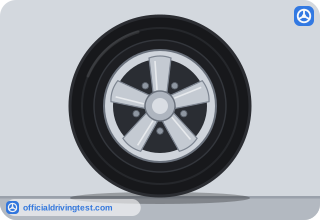
- After the tire has been repaired once
- After the tire has been moved to another wheel
- After the tire has been driven on a dirt road
- After the tread is worn down to the wear bars
Show answer
Correct answer: After the tread is worn down to the wear bars
A tire whose tread is worn off or worn down to the wear bars is neither safe nor legal to use.
Source: Vermont Driver's Manual (2025 edition (VN-007 07/2024)), page 60 · Open this page in the manual (Manual page 60)
-
In the penny test, you place Abraham Lincoln's head first into the deepest-looking groove. If you can see all of his head, what does that mean?
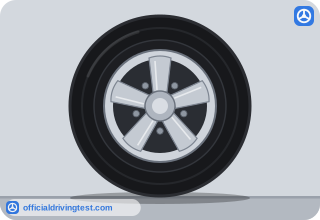
- The tires have the right amount of tread
- The tires are overinflated
- The wheels are out of alignment
- The tires are too worn and should be replaced
Show answer
Correct answer: The tires are too worn and should be replaced
Seeing all of Lincoln's head means the tread is too shallow, so you should not drive on the tires and should replace them.
Source: Vermont Driver's Manual (2025 edition (VN-007 07/2024)), page 60 · Open this page in the manual (Manual page 60)
-
What do both overinflated and underinflated tires do?
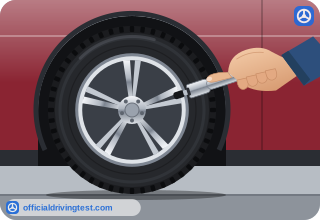
- Improve traction and steering but wear out the brakes sooner
- Reduce traction, cause quicker tire wear, and affect steering
- Only affect steering, with no change to tire wear
- Reduce tire wear but make the wheels go out of alignment
Show answer
Correct answer: Reduce traction, cause quicker tire wear, and affect steering
Too much or too little air reduces traction, wears tires faster and affects steering.
Source: Vermont Driver's Manual (2025 edition (VN-007 07/2024)), page 60 · Open this page in the manual (Manual page 60)
-
What may wavy marks on your front tires mean?
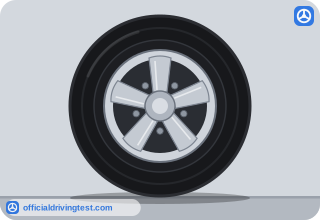
- The tires are overinflated
- The tread is worn to the wear bars
- The wheels may be out of alignment
- The brakes are overheating
Show answer
Correct answer: The wheels may be out of alignment
Wavy marks on the front tires can be a sign that the wheels are out of alignment.
Source: Vermont Driver's Manual (2025 edition (VN-007 07/2024)), page 60 · Open this page in the manual (Manual page 60)
-
If your vehicle pulls to one side or steers hard, what should you do?
- Look at your tires and have your wheels checked
- Look at your headlights and have them re-aimed
- Look at your exhaust and have it replaced
- Look at your brake fluid and have it topped up
Show answer
Correct answer: Look at your tires and have your wheels checked
A vehicle that pulls to one side or steers hard may have a tire or wheel problem, so check the tires and have the wheels checked.
Source: Vermont Driver's Manual (2025 edition (VN-007 07/2024)), page 60 · Open this page in the manual (Manual page 60)
-
What should you do if it becomes difficult to steer, or your steering wheel moves too loosely?
- Drive slowly until the problem goes away
- Have it checked by a qualified mechanic
- Wait for the next annual inspection
- Add air to all four tires
Show answer
Correct answer: Have it checked by a qualified mechanic
Hard steering or a loose steering wheel should be looked at by a qualified mechanic.
Source: Vermont Driver's Manual (2025 edition (VN-007 07/2024)), page 60 · Open this page in the manual (Manual page 60)
-
What is a good rule for how often to have your steering and "the front end" looked over?
- Once a year
- Every two years
- Every three months
- Two times a year
Show answer
Correct answer: Two times a year
The manual suggests having the steering and front end looked over twice a year.
Source: Vermont Driver's Manual (2025 edition (VN-007 07/2024)), page 60 · Open this page in the manual (Manual page 60)
-
What may happen if your headlights are aimed too high or do not go to low beam when a vehicle comes toward you?
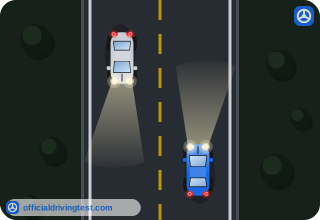
- They may blind the other driver
- Your headlights may burn out sooner
- Your tail lights may stop working
- The other driver may not see your signals
Show answer
Correct answer: They may blind the other driver
Lights aimed too high, or not dimmed for oncoming traffic, can blind the other driver.
Source: Vermont Driver's Manual (2025 edition (VN-007 07/2024)), page 60 · Open this page in the manual (Manual page 60)
-
What happens if your headlights are dim, aimed too low, or dirty?
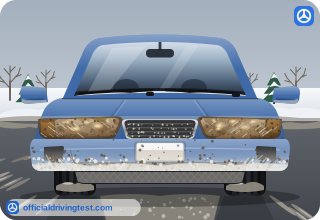
- Your headlights will blind oncoming drivers
- Your tail lights will stop working
- You cannot see as far ahead as you should
- Your high beams will turn on by themselves
Show answer
Correct answer: You cannot see as far ahead as you should
Dim, low-aimed or dirty headlights shorten how far ahead you can see.
Source: Vermont Driver's Manual (2025 edition (VN-007 07/2024)), page 60 · Open this page in the manual (Manual page 60)
-
The back license plate must be lighted so it can be seen and read from at least how far behind the vehicle?
- 50 feet
- 25 feet
- 100 feet
- 200 feet
Show answer
Correct answer: 50 feet
The rear plate light must make the plate readable from at least 50 feet behind the vehicle.
Source: Vermont Driver's Manual (2025 edition (VN-007 07/2024)), page 60 · Open this page in the manual (Manual page 60)
-
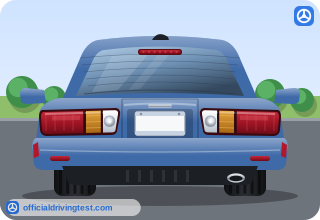
What should you do when a bulb burns out?
- Replace it at the next annual inspection with any similar bulb
- Replace it right away with the brightest bulb you can find
- Replace it right away with the manufacturer's recommended replacement
- Wait until it affects the other bulbs before replacing it
Show answer
Correct answer: Replace it right away with the manufacturer's recommended replacement
Burned-out bulbs should be replaced right away, using the replacements the manufacturer recommends.
Source: Vermont Driver's Manual (2025 edition (VN-007 07/2024)), page 60 · Open this page in the manual (Manual page 60)
-
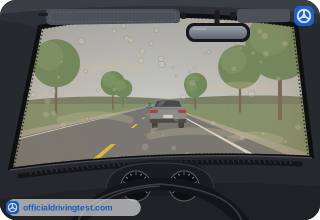
Why should you keep your windshield clean?
- It improves your vision only at night
- It improves your vision both day and night
- It makes the wipers last longer
- It helps the defrosters work faster
Show answer
Correct answer: It improves your vision both day and night
A clean windshield helps you see better in daytime and at night.
Source: Vermont Driver's Manual (2025 edition (VN-007 07/2024)), page 60 · Open this page in the manual (Manual page 60)
-
Which defrosters must be in good working order?
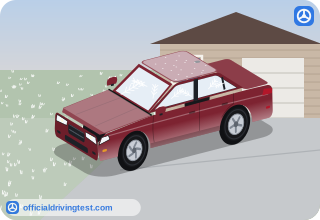
- Only the front defroster
- Only the rear defroster
- Only the defroster for the driver's window
- Both front and rear
Show answer
Correct answer: Both front and rear
The manual says all defrosters, front and rear, must work well.
Source: Vermont Driver's Manual (2025 edition (VN-007 07/2024)), page 60 · Open this page in the manual (Manual page 60)
-
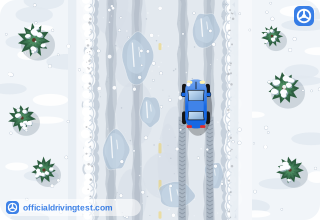
Which condition means you should not try to drive any vehicle?
- The inside of the windows has been cleaned
- The defrosters are turned on and working
- The windshield has just been washed and wiped
- Outside windows are covered with ice and snow
Show answer
Correct answer: Outside windows are covered with ice and snow
You should not drive until the window interiors are free of moisture and the outside windows are clear of ice and snow.
Source: Vermont Driver's Manual (2025 edition (VN-007 07/2024)), page 60 · Open this page in the manual (Manual page 60)
-
Why must the exhaust system not leak?
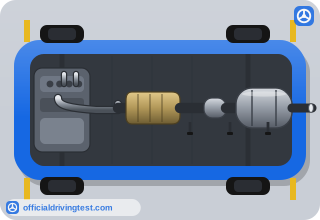
- The engine can overheat and stop running suddenly
- Carbon monoxide gas can enter the passenger area
- The tires can lose air and wear unevenly
- The headlights can go dim and fail to reach low beam
Show answer
Correct answer: Carbon monoxide gas can enter the passenger area
A leaking exhaust can let carbon monoxide into the passenger area, causing poisoning or death.
Source: Vermont Driver's Manual (2025 edition (VN-007 07/2024)), page 60 · Open this page in the manual (Manual page 60)
-
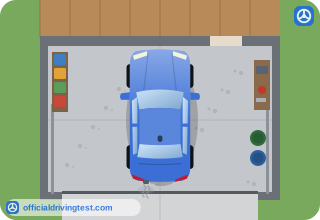
What is true about carbon monoxide gas?
- It has a strong smell of burning oil
- It only forms when the engine is cold
- You cannot smell it
- It has a sweet smell that warns you
Show answer
Correct answer: You cannot smell it
Carbon monoxide has no smell, so you cannot rely on your nose to detect it.
Source: Vermont Driver's Manual (2025 edition (VN-007 07/2024)), page 60 · Open this page in the manual (Manual page 60)
-
According to the manual, if you become drowsy or nauseous, what could it indicate?
- Carbon monoxide poisoning
- A problem with your brake linings
- Worn tires that need replacing
- Headlights that are aimed too low
Show answer
Correct answer: Carbon monoxide poisoning
Drowsiness or nausea can be a sign of carbon monoxide poisoning from a leaking exhaust.
Source: Vermont Driver's Manual (2025 edition (VN-007 07/2024)), page 60 · Open this page in the manual (Manual page 60)