Vermont: Vehicle controls and equipment — Part 2 Practice Test
Questions in this part include: “Which of these tells you whether your vehicle has anti-lock brakes (ABS)?” · “What does the manual call the best practice for headlights during the day?”
Independent educational site · not affiliated with any government agency or DMV
Ready? Test yourself
- Instant feedback with an explanation
- Every answer cites its source in the manual
- Your best score is saved on this device
- Keyboard: press 1 to 4 to answer and Enter for the next question
Questions are original and based on the official manual "Vermont Driver's Manual" (2025 edition (VN-007 07/2024)), Vermont Department of Motor Vehicles.
All 18 questions in this practice test
Take the test above first, then use this list to study. Tap “Show answer” to see the correct answer and explanation.
Show the questions and answersHide the questions
-
What should you expect in the brake pedal when anti-lock brakes are working?
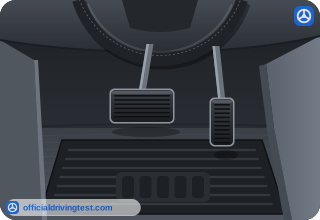
- Noise and vibration
- A sudden loss of braking power
- The pedal locking in place
- No change in the pedal at all
Show answer
Correct answer: Noise and vibration
Noise and vibration in the brake pedal are normal when the anti-lock system works.
Source: Vermont Driver's Manual (2025 edition (VN-007 07/2024)), page 48 · Open this page in the manual (Manual page 48)
-
Why should you not pump the brake or take your foot off the brake pedal in a vehicle with anti-lock brakes?
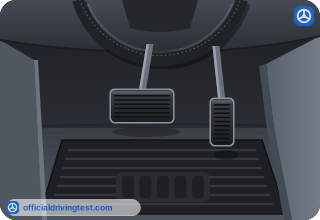
- It will lock all four wheels at once
- It will switch off the stability control
- It will disengage the anti-lock system
- It will turn on the parking brake
Show answer
Correct answer: It will disengage the anti-lock system
Pumping the brake or lifting your foot disengages the anti-lock system.
Source: Vermont Driver's Manual (2025 edition (VN-007 07/2024)), page 49 · Open this page in the manual (Manual page 49)
-
Which of these tells you whether your vehicle has anti-lock brakes (ABS)?
- The registration certificate
- Your owner’s manual
- The inspection sticker
- The tire sidewall markings
Show answer
Correct answer: Your owner’s manual
The manual says your owner's manual tells you if the vehicle has ABS.
Source: Vermont Driver's Manual (2025 edition (VN-007 07/2024)), page 49 · Open this page in the manual (Manual page 49)
-
What should the ABS warning light do when you start your vehicle?
- Stay on until you reach a certain speed
- Flash until the parking brake is released
- Stay off at all times
- Display briefly on the instrument panel
Show answer
Correct answer: Display briefly on the instrument panel
An ABS warning light normally shows briefly on the instrument panel at start-up.
Source: Vermont Driver's Manual (2025 edition (VN-007 07/2024)), page 49 · Open this page in the manual (Manual page 49)
-
Your ABS light stays on after you begin to drive. What does this mean?
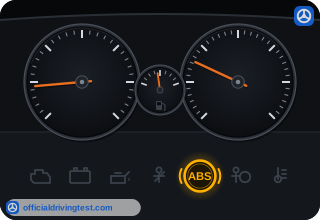
- The vehicle has no brakes at all and must be towed
- The ABS is working and has switched to emergency mode
- The ABS is working normally and the light can be ignored
- The ABS is not working, but you still have brakes
Show answer
Correct answer: The ABS is not working, but you still have brakes
A light that stays on means the ABS is not working, but the vehicle still has regular brakes.
Source: Vermont Driver's Manual (2025 edition (VN-007 07/2024)), page 49 · Open this page in the manual (Manual page 49)
-
When should parking lights be used?
- At night on any road
- Only when your vehicle is parked
- In fog, rain, or snow
- When following another vehicle
Show answer
Correct answer: Only when your vehicle is parked
The manual states that parking lights are to be used only when the vehicle is parked.
Source: Vermont Driver's Manual (2025 edition (VN-007 07/2024)), page 49 · Open this page in the manual (Manual page 49)
-
When snow, rain, and fog limit your visibility, what must you do?
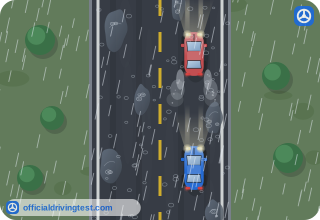
- Turn on only your parking lights
- Rely on your daytime running lights
- Turn your headlights on
- Switch to high beams only
Show answer
Correct answer: Turn your headlights on
Reduced visibility from snow, rain, or fog requires you to turn your headlights on.
Source: Vermont Driver's Manual (2025 edition (VN-007 07/2024)), page 49 · Open this page in the manual (Manual page 49)
-
What does the manual call the best practice for headlights during the day?
- Always drive with at least low beams on
- Turn headlights on only after dark
- Turn headlights on only in rain, snow, or fog
- Use daytime running lights instead of headlights
Show answer
Correct answer: Always drive with at least low beams on
The best practice is to always drive with at least your low beam headlights on, even in the daytime.
Source: Vermont Driver's Manual (2025 edition (VN-007 07/2024)), page 49 · Open this page in the manual (Manual page 49)
-
How do daytime running lights relate to your headlights?
- They come on automatically and should not be confused with headlights
- They are the same lights as the headlights, switched by hand
- They may be used instead of headlights at night
- They come on only when the parking lights are on
Show answer
Correct answer: They come on automatically and should not be confused with headlights
Daytime running lights come on by themselves and are not your headlights.
Source: Vermont Driver's Manual (2025 edition (VN-007 07/2024)), page 49 · Open this page in the manual (Manual page 49)
-
The law requires headlights to be turned on during which period?
- From sunset to sunrise
- From one hour after sunset to one hour before sunrise
- From a half hour after sunset to a half hour before sunrise
- From a half hour before sunset to a half hour after sunrise
Show answer
Correct answer: From a half hour after sunset to a half hour before sunrise
Headlights must be on from half an hour after sunset until half an hour before sunrise.
Source: Vermont Driver's Manual (2025 edition (VN-007 07/2024)), page 49 · Open this page in the manual (Manual page 49)
-
When should you use high beam headlights?
- When approaching other vehicles
- When driving in areas with streetlights
- In open country with few other vehicles
- When following another vehicle
Show answer
Correct answer: In open country with few other vehicles
High beams are for open country with few other vehicles; low beams are used near traffic, streetlights, and fog.
Source: Vermont Driver's Manual (2025 edition (VN-007 07/2024)), page 49 · Open this page in the manual (Manual page 49)
-
Which headlight setting should you always use when approaching other vehicles or pedestrians?
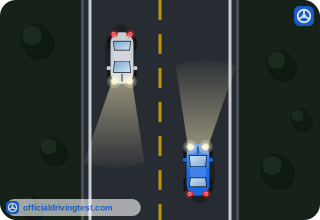
- Low beam
- High beam
- Parking lights
- Daytime running lights only
Show answer
Correct answer: Low beam
Low beam keeps you from blinding the other driver or pedestrian.
Source: Vermont Driver's Manual (2025 edition (VN-007 07/2024)), page 49 · Open this page in the manual (Manual page 49)
-
You are driving in fog. Which headlight setting does the manual say to use?
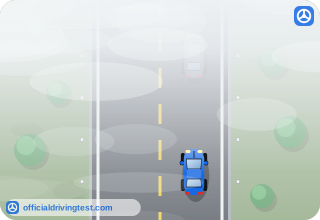
- High beam
- Parking lights
- Low beam
- Daytime running lights only
Show answer
Correct answer: Low beam
The manual says to use low beam in areas with streetlights or fog and when following another vehicle.
Source: Vermont Driver's Manual (2025 edition (VN-007 07/2024)), page 49 · Open this page in the manual (Manual page 49)
-
At night, what should you do with your headlights when meeting or following another vehicle?
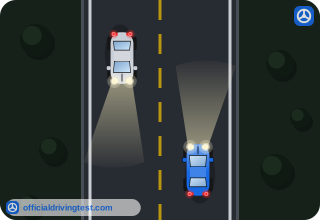
- Leave them on high beam to see better
- Promptly dim them
- Turn them off until the vehicle passes
- Switch to parking lights only
Show answer
Correct answer: Promptly dim them
Courteous drivers promptly dim their headlights when meeting or following another vehicle at night.
Source: Vermont Driver's Manual (2025 edition (VN-007 07/2024)), page 49 · Open this page in the manual (Manual page 49)
-
To avoid being temporarily blinded by oncoming bright lights, where should you look?
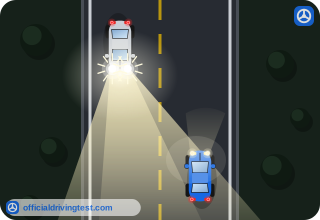
- Directly at the oncoming lights
- Toward the center line of the highway
- At your rearview mirror
- Ahead toward the right edge of the highway
Show answer
Correct answer: Ahead toward the right edge of the highway
Looking toward the right edge of the highway until the bright lights pass helps you keep your vision.
Source: Vermont Driver's Manual (2025 edition (VN-007 07/2024)), page 49 · Open this page in the manual (Manual page 49)
-
If you look directly at oncoming lights, for how long could you be blinded?
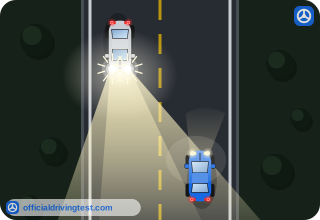
- A fraction of a second
- A few minutes
- About an hour
- Several seconds
Show answer
Correct answer: Several seconds
Looking straight at oncoming lights can blind you for several seconds.
Source: Vermont Driver's Manual (2025 edition (VN-007 07/2024)), page 49 · Open this page in the manual (Manual page 49)
-
Looking toward the right edge of the highway while bright lights go by also helps you do what?
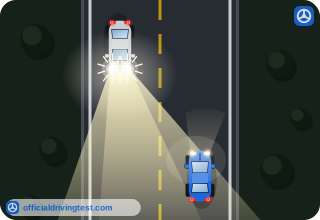
- Judge the speed of an oncoming vehicle accurately
- Detect bicyclists or pedestrians near the edge
- Find the next exit sign on the interstate sooner
- Stay in the center of your lane at night
Show answer
Correct answer: Detect bicyclists or pedestrians near the edge
This practice also helps you notice bicyclists or pedestrians who may be close to the edge of the road.
Source: Vermont Driver's Manual (2025 edition (VN-007 07/2024)), page 50 · Open this page in the manual (Manual page 50)
-
What will the examiner have you do on a hill during the road test?
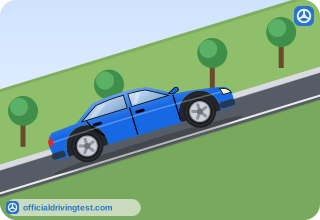
- Pass another vehicle
- Back down to the bottom of the hill
- Park and leave the vehicle
- Stop and start
Show answer
Correct answer: Stop and start
The road test includes stopping and starting on a hill.
Source: Vermont Driver's Manual (2025 edition (VN-007 07/2024)), page 56 · Open this page in the manual (Manual page 56)