Vermont: Pavement markings Practice Test
Yellow and white center lines, solid and broken lines, two-way left-turn lanes, yield lines and lane use markings.
Independent educational site · not affiliated with any government agency or DMV
Ready? Test yourself
- Instant feedback with an explanation
- Every answer cites its source in the manual
- Your best score is saved on this device
- Keyboard: press 1 to 4 to answer and Enter for the next question
Questions are original and based on the official manual "Vermont Driver's Manual" (2025 edition (VN-007 07/2024)), Vermont Department of Motor Vehicles.
All 9 questions in this practice test
Take the test above first, then use this list to study. Tap “Show answer” to see the correct answer and explanation.
Show the questions and answersHide the questions
-
What color are the center lines that mark major highways?
- White
- Red
- Yellow
- Orange
Show answer
Correct answer: Yellow
Major highways are marked with yellow center lines, which divide the highway into travel lanes.
Source: Vermont Driver's Manual (2025 edition (VN-007 07/2024)), page 34 · Open this page in the manual (Manual page 34)
-
What indicates the two opposing lanes of travel on a multi-lane highway without a median?
- A single broken white line
- Double solid lines
- A single solid white line
- A row of white triangles
Show answer
Correct answer: Double solid lines
Multi-lane highways without a median use double solid lines to show the two opposing lanes of travel.
Source: Vermont Driver's Manual (2025 edition (VN-007 07/2024)), page 34 · Open this page in the manual (Manual page 34)
-
What kind of line divides each side of a highway into separate lanes when two or more lanes of travel are permitted in the same direction?
- A double solid yellow line
- A solid red line
- A broken yellow line
- A broken white line
Show answer
Correct answer: A broken white line
A broken white line separates lanes of vehicles traveling in the same direction.
Source: Vermont Driver's Manual (2025 edition (VN-007 07/2024)), page 34 · Open this page in the manual (Manual page 34)
-
What does the manual recommend when the highway has a solid line or two solid lines?
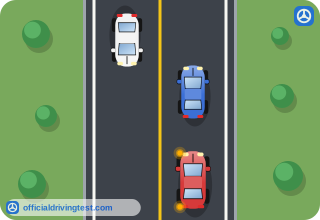
- That you do not pass
- That you pass only after signaling twice
- That you pass only when driving uphill
- That you pass only on the right side
Show answer
Correct answer: That you do not pass
With a solid line or two solid lines, the manual recommends that you do not pass.
Source: Vermont Driver's Manual (2025 edition (VN-007 07/2024)), page 34 · Open this page in the manual (Manual page 34)
-
The highway has a solid line, but the line in your lane is broken. What may you do?
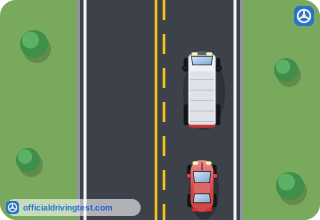
- Pass only if the line in the other lane is also broken
- Never pass, because any solid line forbids passing
- Pass if it is clear ahead
- Pass only after flashing your headlights
Show answer
Correct answer: Pass if it is clear ahead
When the line on your side of the center is broken, you may pass as long as it is clear ahead.
Source: Vermont Driver's Manual (2025 edition (VN-007 07/2024)), page 34 · Open this page in the manual (Manual page 34)
-
There is a solid line in your lane and a broken line in the other lane. What does the manual say?
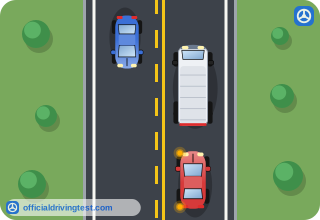
- You may pass if it is clear ahead, and so may the other vehicle
- You should not pass, but the vehicle in the other lane may pass
- Neither you nor the vehicle in the other lane may pass
- You may pass, but the vehicle in the other lane should not
Show answer
Correct answer: You should not pass, but the vehicle in the other lane may pass
A solid line on your side means you should not pass, while the broken line in the other lane lets that vehicle pass.
Source: Vermont Driver's Manual (2025 edition (VN-007 07/2024)), page 34 · Open this page in the manual (Manual page 34)
-
Why are continuous two-way left turn lanes not designed to be used as travel lanes?
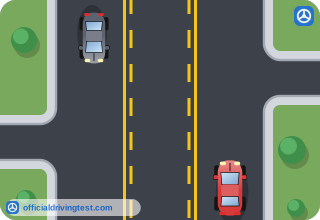
- They are reserved for use by emergency vehicles and buses only
- They are too narrow for most passenger vehicles to enter safely
- They are used only by drivers who are passing slower vehicles ahead
- Traffic moving in both directions may want to use the lane to turn left
Show answer
Correct answer: Traffic moving in both directions may want to use the lane to turn left
Vehicles from both directions use the lane to make left turns, so it should not serve as a travel lane.
Source: Vermont Driver's Manual (2025 edition (VN-007 07/2024)), page 34 · Open this page in the manual (Manual page 34)
-
A series of white triangles pointing toward approaching cars is painted across the lane. What does it show?
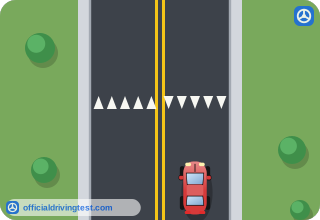
- Where a railroad crossing begins and trains have the right of way
- Where to stop if required to yield to pedestrians or other vehicles
- Where lane changes are prohibited near the intersection
- Where the posted speed limit changes for approaching traffic
Show answer
Correct answer: Where to stop if required to yield to pedestrians or other vehicles
A yield line, a row of white triangles pointing toward approaching cars, shows drivers where to stop when they must yield to pedestrians or other vehicles.
Source: Vermont Driver's Manual (2025 edition (VN-007 07/2024)), page 34 · Open this page in the manual (Manual page 34)
-
While driving on a divided highway, the edge of the highway to your right is painted yellow. What does this indicate?
- You are going the wrong way
- The right lane is for passing only
- The breakdown lane is closed ahead
- The shoulder is reserved for emergency vehicles
Show answer
Correct answer: You are going the wrong way
On a divided highway the line to your right should be white; a yellow line there means you are going the wrong way.
Source: Vermont Driver's Manual (2025 edition (VN-007 07/2024)), page 51 · Open this page in the manual (Manual page 51)