Vermont: 30 Hardest Driving Test Questions
Questions that need a second thought, picked for close numbers, exceptions and easy-to-confuse rules. Take your time.
Independent educational site · not affiliated with any government agency or DMV
Ready? Test yourself
- Instant feedback with an explanation
- Every answer cites its source in the manual
- Your best score is saved on this device
- Keyboard: press 1 to 4 to answer and Enter for the next question
Questions are original and based on the official manual "Vermont Driver's Manual" (2025 edition (VN-007 07/2024)), Vermont Department of Motor Vehicles.
All 30 questions in this practice test
Take the test above first, then use this list to study. Tap “Show answer” to see the correct answer and explanation.
Show the questions and answersHide the questions
-
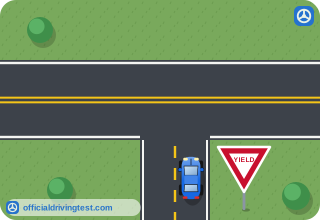
When nearing an intersection marked with a "yield right-of-way" sign, what are you required to do?
- Stop completely every time before you enter the intersection ahead
- Travel slowly enough to stop if necessary and enter only when the way is clear
- Keep your speed the same whenever no other vehicles are in sight ahead
- Enter right away if you reached the intersection before other vehicles
Show answer
Correct answer: Travel slowly enough to stop if necessary and enter only when the way is clear
At a yield sign you must be slow enough to stop if needed and enter only when the way is clear.
Source: Vermont Driver's Manual (2025 edition (VN-007 07/2024)), page 28 · Open this page in the manual (Manual page 28)
-
Which of these does the manual tell drivers NOT to do in a work zone?
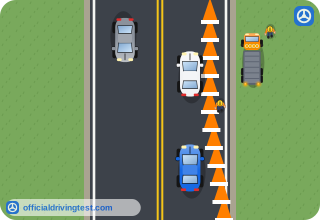
- Change lanes in the work zone
- Follow the signs
- Slow down to the posted speed limit
- Seek an alternate route when delays are expected
Show answer
Correct answer: Change lanes in the work zone
The work zone tips say not to change lanes in the work zone, tailgate, or engage in other aggressive behavior.
Source: Vermont Driver's Manual (2025 edition (VN-007 07/2024)), page 35 · Open this page in the manual (Manual page 35)
-
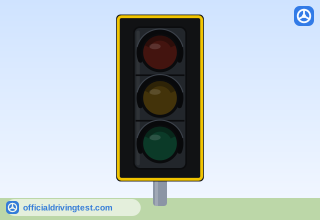
What should you do at a traffic signal that is dark, as in a power failure?
- Proceed if no cross traffic is visible to you
- Stop as if there are stop signs in all directions
- Treat it as a flashing yellow light for all directions
- Yield only to vehicles on your right
Show answer
Correct answer: Stop as if there are stop signs in all directions
A dark signal is treated like stop signs in all directions.
Source: Vermont Driver's Manual (2025 edition (VN-007 07/2024)), page 31 · Open this page in the manual (Manual page 31)
-
A sign in the shape of a triangle with the points cut off is displayed on what kind of vehicles?
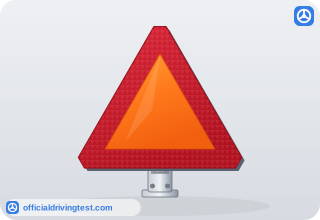
- Vehicles that travel at slow speeds
- Vehicles carrying hazardous materials
- Emergency vehicles
- Vehicles that are stopped on the road
Show answer
Correct answer: Vehicles that travel at slow speeds
A triangle with the points cut off is displayed on vehicles that travel at slow speeds, for example farm vehicles.
Source: Vermont Driver's Manual (2025 edition (VN-007 07/2024)), page 33 · Open this page in the manual (Manual page 33)
-
There is a solid line in your lane and a broken line in the other lane. What does the manual say?
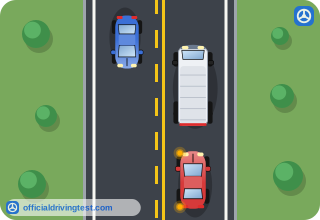
- You may pass if it is clear ahead, and so may the other vehicle
- You should not pass, but the vehicle in the other lane may pass
- Neither you nor the vehicle in the other lane may pass
- You may pass, but the vehicle in the other lane should not
Show answer
Correct answer: You should not pass, but the vehicle in the other lane may pass
A solid line on your side means you should not pass, while the broken line in the other lane lets that vehicle pass.
Source: Vermont Driver's Manual (2025 edition (VN-007 07/2024)), page 34 · Open this page in the manual (Manual page 34)
-
If you look at the steering wheel as the face of a clock, which hand positions does the manual recommend?
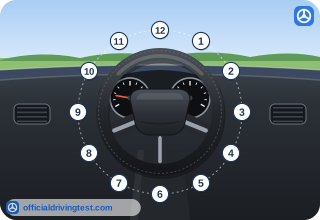
- 10 and 2 or 11 and 1
- 12 and 6 or 1 and 7
- 6 and 12 or 5 and 7
- 9 and 3 or 8 and 4
Show answer
Correct answer: 9 and 3 or 8 and 4
The manual recommends holding the wheel at 9 and 3 or at 8 and 4.
Source: Vermont Driver's Manual (2025 edition (VN-007 07/2024)), page 25 · Open this page in the manual (Manual page 25)
-
What is the minimum following distance when you are behind a horse with a rider, a horse and wagon, or herded animals?
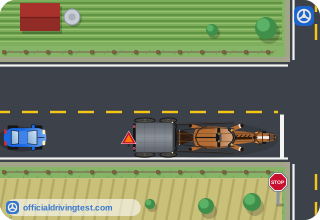
- At least 1 second
- At least 4 seconds
- At least 2 seconds
- At least 3 seconds
Show answer
Correct answer: At least 4 seconds
The manual says to leave at least a 4 second following distance behind horses and herded animals.
Source: Vermont Driver's Manual (2025 edition (VN-007 07/2024)), page 45 · Open this page in the manual (Manual page 45)
-
When do you NOT have to stop for a school bus with its red lights flashing?
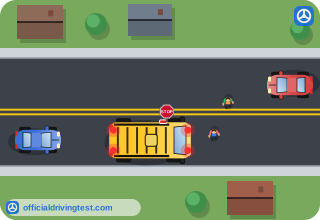
- On any road that has a posted speed limit above 40 mph
- On a divided highway when the bus is traveling in the opposite direction
- On a road with more than two lanes in each direction
- When the bus is stopped at a railroad crossing ahead of you on the road
Show answer
Correct answer: On a divided highway when the bus is traveling in the opposite direction
The manual names the divided highway with the bus going the other way as an exception.
Source: Vermont Driver's Manual (2025 edition (VN-007 07/2024)), page 40 · Open this page in the manual (Manual page 40)
-
A series of white triangles pointing toward approaching cars is painted across the lane. What does it show?
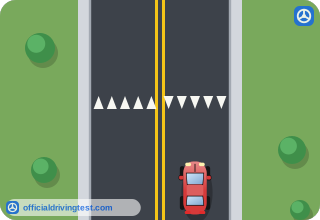
- Where a railroad crossing begins and trains have the right of way
- Where to stop if required to yield to pedestrians or other vehicles
- Where lane changes are prohibited near the intersection
- Where the posted speed limit changes for approaching traffic
Show answer
Correct answer: Where to stop if required to yield to pedestrians or other vehicles
A yield line, a row of white triangles pointing toward approaching cars, shows drivers where to stop when they must yield to pedestrians or other vehicles.
Source: Vermont Driver's Manual (2025 edition (VN-007 07/2024)), page 34 · Open this page in the manual (Manual page 34)
-
A green arrow comes on while the red light is displayed. What may you do?
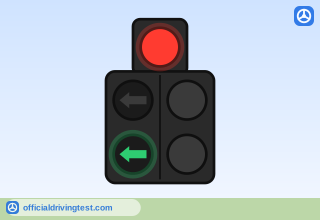
- Wait until the red light turns green
- Proceed in any direction
- Proceed in the direction of the green arrow
- Proceed only after a complete stop of 3 seconds
Show answer
Correct answer: Proceed in the direction of the green arrow
Green arrow signals may come on while the red light is displayed, and you may proceed in the direction of the arrow.
Source: Vermont Driver's Manual (2025 edition (VN-007 07/2024)), page 31 · Open this page in the manual (Manual page 31)
-
At what alcohol concentration can a person under the age of 21 who operates a vehicle receive a civil traffic violation?
- .05 or more
- .02 or more
- .08 or more
- .10 or more
Show answer
Correct answer: .02 or more
People under 21 who drive with an alcohol concentration of .02 or more can receive a civil traffic violation.
Source: Vermont Driver's Manual (2025 edition (VN-007 07/2024)), page 52 · Open this page in the manual (Manual page 52)
-
After a crash, when must you make a written report to the Department of Motor Vehicles if any person has been injured?
- Within 24 hours
- Within 7 days
- Within 30 days
- Within 72 hours
Show answer
Correct answer: Within 72 hours
If anyone is injured or damage is over $3,000, you must send a written report to the DMV within 72 hours.
Source: Vermont Driver's Manual (2025 edition (VN-007 07/2024)), page 58 · Open this page in the manual (Manual page 58)
-
When drivers must stop at a railroad crossing, how close to the nearest rail may they stop?
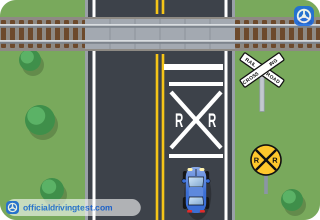
- Not closer than 5 feet
- Not closer than 10 feet
- Not closer than 25 feet
- Not closer than 15 feet
Show answer
Correct answer: Not closer than 15 feet
By law, drivers must stop not less than 15 feet from the nearest rail in the situations the manual lists.
Source: Vermont Driver's Manual (2025 edition (VN-007 07/2024)), page 37 · Open this page in the manual (Manual page 37)
-
How far before making a turn or changing lanes must a driver use a turn signal, according to the law?
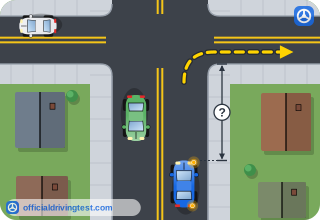
- Not less than 25 feet
- Not less than 50 feet
- Not less than 100 feet
- Not less than 300 feet
Show answer
Correct answer: Not less than 100 feet
The law requires a turn signal at least 100 feet before a turn or lane change.
Source: Vermont Driver's Manual (2025 edition (VN-007 07/2024)), page 26 · Open this page in the manual (Manual page 26)
-
What is the minimum tread depth tires must have?
- 1/32"
- 2/32"
- 4/32"
- 3/32"
Show answer
Correct answer: 2/32"
Tires must have at least 2/32 inch of tread depth.
Source: Vermont Driver's Manual (2025 edition (VN-007 07/2024)), page 60 · Open this page in the manual (Manual page 60)
-
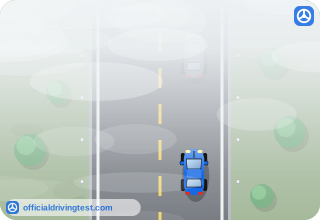
The law requires headlights to be turned on if you cannot clearly see persons or vehicles at what distance ahead?
- 100 feet
- 300 feet
- 500 feet
- 1,000 feet
Show answer
Correct answer: 500 feet
If you cannot clearly see persons or vehicles 500 feet ahead, the law requires headlights to be on.
Source: Vermont Driver's Manual (2025 edition (VN-007 07/2024)), page 46 · Open this page in the manual (Manual page 46)
-
What is the maximum speed for any vehicle on all Vermont roads?
- 45 miles per hour or as posted
- 50 miles per hour or as posted
- 55 miles per hour or as posted
- 65 miles per hour or as posted
Show answer
Correct answer: 50 miles per hour or as posted
The manual gives 50 miles per hour, or the posted limit, as the maximum on Vermont roads.
Source: Vermont Driver's Manual (2025 edition (VN-007 07/2024)), page 28 · Open this page in the manual (Manual page 28)
-
After a crash with no injuries, damage over what amount requires a written report to the Department of Motor Vehicles?
- $3,000
- $500
- $1,000
- $5,000
Show answer
Correct answer: $3,000
A written report to the DMV is required if any person is injured or if the damage is over $3,000.
Source: Vermont Driver's Manual (2025 edition (VN-007 07/2024)), page 58 · Open this page in the manual (Manual page 58)
-
You may not park within how many feet of a flashing red or yellow light, a stop sign or a traffic light?
- 30 feet
- 6 feet
- 20 feet
- 75 feet
Show answer
Correct answer: 30 feet
Parking within 30 feet of a flashing red or yellow light, stop sign or traffic light is not allowed.
Source: Vermont Driver's Manual (2025 edition (VN-007 07/2024)), page 29 · Open this page in the manual (Manual page 29)
-
According to the manual, how far does it take a passenger car to come to a complete stop on dry pavement when traveling at 60 MPH?
- 120 feet
- 180 feet
- 300 feet
- 240 feet
Show answer
Correct answer: 240 feet
On dry pavement a passenger car needs 240 feet to stop completely from 60 MPH.
Source: Vermont Driver's Manual (2025 edition (VN-007 07/2024)), page 35 · Open this page in the manual (Manual page 35)
-
For the 40 hours of driving practice, what period is considered nighttime driving?
- From sunset to sunrise
- From 1 hour after sunset to 1 hour before sunrise
- From 9 p.m. to 5 a.m.
- From 30 minutes after sunset to 30 minutes before sunrise
Show answer
Correct answer: From 30 minutes after sunset to 30 minutes before sunrise
The manual defines nighttime driving as the period starting 30 minutes after sunset and ending 30 minutes before sunrise.
Source: Vermont Driver's Manual (2025 edition (VN-007 07/2024)), page 13 · Open this page in the manual (Manual page 13)
-
Driving at night at what speed with low beam headlights is the manual’s example of “overdriving your headlights”?
- 20 miles an hour
- 40 miles an hour
- 25 miles an hour
- 55 miles an hour
Show answer
Correct answer: 40 miles an hour
The manual gives 40 miles an hour with low beams as an example of overdriving your headlights.
Source: Vermont Driver's Manual (2025 edition (VN-007 07/2024)), page 49 · Open this page in the manual (Manual page 49)
-
What is the fine for a second or subsequent violation of Vermont’s law against using a portable electronic device while driving?
- Not less than $250 and not more than $500
- Not less than $100 and not more than $200
- Not less than $1,000 and not more than $2,000
- Not less than $50 and not more than $150
Show answer
Correct answer: Not less than $250 and not more than $500
A second or later violation carries a fine of at least $250 and at most $500.
Source: Vermont Driver's Manual (2025 edition (VN-007 07/2024)), page 55 · Open this page in the manual (Manual page 55)
-
How many points are put on your driving record for failing to yield the right of way to an ambulance, fire truck or police officer?
- 5 points
- 1 point
- 3 points
- 7 points
Show answer
Correct answer: 5 points
Failure to yield the right of way to an ambulance, fire truck or police officer is a 5-point offense.
Source: Vermont Driver's Manual (2025 edition (VN-007 07/2024)), page 64 · Open this page in the manual (Manual page 64)
-
When a Vermont driver receives a total of how many points is a letter sent saying that the privilege to drive is to be suspended?
- 15 points
- 10 points
- 8 points
- 12 points
Show answer
Correct answer: 10 points
At a total of 10 points the driver is sent a letter that the privilege to drive is to be suspended.
Source: Vermont Driver's Manual (2025 edition (VN-007 07/2024)), page 64 · Open this page in the manual (Manual page 64)
-
You may not park within how many feet of the nearest rail of a railroad crossing?
- 20 feet
- 30 feet
- 50 feet
- 75 feet
Show answer
Correct answer: 50 feet
The manual lists parking on railroad tracks or within 50 feet of the nearest rail of a crossing as not allowed.
Source: Vermont Driver's Manual (2025 edition (VN-007 07/2024)), page 29 · Open this page in the manual (Manual page 29)
-
When there are signs, you may not park across the street from a fire station driveway within how many feet of the driveway?
- 20 feet
- 30 feet
- 50 feet
- 75 feet
Show answer
Correct answer: 75 feet
When signs are posted, parking is not allowed across the street within 75 feet of a fire station driveway.
Source: Vermont Driver's Manual (2025 edition (VN-007 07/2024)), page 29 · Open this page in the manual (Manual page 29)
-
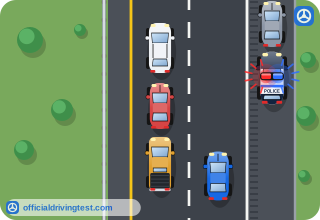
On an interstate, you are unable to change lanes when approaching a stopped law enforcement, emergency, or repair vehicle with a flashing light. How fast may you go by it?
- 10 mph below the speed limit
- 5 mph below the speed limit
- 20 mph below the speed limit
- At the speed limit
Show answer
Correct answer: 20 mph below the speed limit
If you cannot change lanes, you must slow down to 20 mph below the speed limit to go by the stopped vehicles.
Source: Vermont Driver's Manual (2025 edition (VN-007 07/2024)), page 51 · Open this page in the manual (Manual page 51)
-
What triggers the Junior Operator points accumulation recall?
- A single 3-point speeding violation or 6 points in total
- A single 2-point violation of any kind
- Any single 4-point violation or 8 points in total
- Two speeding violations of any number of points
Show answer
Correct answer: A single 3-point speeding violation or 6 points in total
A single 3-point speeding violation or a total of 6 points triggers the recall.
Source: Vermont Driver's Manual (2025 edition (VN-007 07/2024)), page 21 · Open this page in the manual (Manual page 21)
-
A person referred to the judicial bureau and found liable for the minors' alcohol violation is subject to what penalty?
- A $100.00 penalty and a 30-day suspension of the Driver’s License
- A $500.00 penalty and a 180-day suspension of the Driver’s License
- A $300.00 penalty and a 90-day suspension of the Driver’s License
- A $300.00 penalty and a one-year revocation of the Driver’s License
Show answer
Correct answer: A $300.00 penalty and a 90-day suspension of the Driver’s License
The judicial bureau penalty in that case is $300.00 plus a 90-day suspension of the Driver’s License.
Source: Vermont Driver's Manual (2025 edition (VN-007 07/2024)), page 7 · Open this page in the manual (Manual page 7)