Utah: Emergencies and crashes — Flares, Tire Fires and General Fire Information Practice Test
Questions in this part include: “How should you handle a lighted flare or fuse?” · “What can result from driving for a long time on a soft or flat tire, or with a dragging brake?”
Independent educational site · not affiliated with any government agency or DMV
Ready? Test yourself
- Instant feedback with an explanation
- Every answer cites its source in the manual
- Your best score is saved on this device
- Keyboard: press 1 to 4 to answer and Enter for the next question
Questions are original and based on the official manual "Utah Driver Handbook" (2026 edition (new 2026 laws effective May 6, 2026)), Utah Department of Public Safety, Driver License Division.
All 16 questions in this practice test
Take the test above first, then use this list to study. Tap “Show answer” to see the correct answer and explanation.
Show the questions and answersHide the questions
-
How should you handle a lighted flare or fuse?
- Hold it close to your body so it stays steady
- Hold it directly in front of your face to watch it burn
- Keep the lighted end well away from your face and eyes
- Hold it against your vehicle to keep it in place
Show answer
Correct answer: Keep the lighted end well away from your face and eyes
The lighted end must be kept well away from the face and eyes because fuses especially can cause nasty burns.
Source: Utah Driver Handbook (2026 edition (new 2026 laws effective May 6, 2026)), page 94 · Open this page in the manual (Manual page 94)
-
What does the handbook say about attaching a flare or fuse to your vehicle?
- It is allowed if the vehicle is stopped off the road
- It is hazardous and also illegal
- It is allowed only at night
- It is legal but hazardous
Show answer
Correct answer: It is hazardous and also illegal
Attaching a flare or fuse to your vehicle is both hazardous and illegal.
Source: Utah Driver Handbook (2026 edition (new 2026 laws effective May 6, 2026)), page 94 · Open this page in the manual (Manual page 94)
-
Where should burning flares or fuses be kept?
- Directly beside the fuel tank
- Next to the rear tires
- Under the hood of the vehicle
- Away from fuel leakages and spills
Show answer
Correct answer: Away from fuel leakages and spills
Burning flares or fuses must be kept away from fuel leaks and spills to avoid starting a fire.
Source: Utah Driver Handbook (2026 edition (new 2026 laws effective May 6, 2026)), page 94 · Open this page in the manual (Manual page 94)
-
What should you do frequently to decrease the chance of a tire fire?
- Check tires and brakes for unusual heat
- Wash the tires and rims with water
- Reduce tire pressure to cool the tires
- Drive with the parking brake slightly applied
Show answer
Correct answer: Check tires and brakes for unusual heat
Checking tires and brakes often for unusual heat helps you catch a problem before it causes a tire fire.
Source: Utah Driver Handbook (2026 edition (new 2026 laws effective May 6, 2026)), page 94 · Open this page in the manual (Manual page 94)
-
What can result from driving for a long time on a soft or flat tire, or with a dragging brake?
- A stronger grip on the road surface
- Lower temperatures in the wheel area
- Heat buildup that can cause a tire fire
- Extra wear only on the steering linkage
Show answer
Correct answer: Heat buildup that can cause a tire fire
Driving on a soft or flat tire or with a dragging brake can build up heat and cause a tire fire.
Source: Utah Driver Handbook (2026 edition (new 2026 laws effective May 6, 2026)), page 94 · Open this page in the manual (Manual page 94)
-
What should you do about a hot tire?
- Continue driving and check the tire at your next planned stop
- Stay with the vehicle until the tire is cool or change it
- Drive faster so air flow cools the tire
- Leave the vehicle and return when the tire is cool
Show answer
Correct answer: Stay with the vehicle until the tire is cool or change it
A hot tire must never be ignored: either stay with the vehicle until the tire cools or change the tire.
Source: Utah Driver Handbook (2026 edition (new 2026 laws effective May 6, 2026)), page 94 · Open this page in the manual (Manual page 94)
-
To help avoid heat problems and tire fires, what should you always do before moving the vehicle?
- Set the parking brake
- Check the oil level
- Turn on the hazard lights
- Release the parking brake
Show answer
Correct answer: Release the parking brake
Always releasing the parking brake before moving the vehicle is one of the habits that helps prevent a tire fire.
Source: Utah Driver Handbook (2026 edition (new 2026 laws effective May 6, 2026)), page 94 · Open this page in the manual (Manual page 94)
-
Which condition makes the odds of a fire very high?
- Dual tires that are partially deflated
- Tires inflated to the recommended pressure
- Tires that are cold after a long rest
- A parking brake that is fully released
Show answer
Correct answer: Dual tires that are partially deflated
Dragging or overheating brakes, leaking oil seals, or partially deflated dual tires make a fire very likely.
Source: Utah Driver Handbook (2026 edition (new 2026 laws effective May 6, 2026)), page 94 · Open this page in the manual (Manual page 94)
-
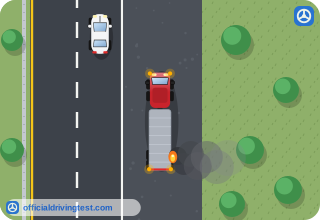
What is probably the best remedy for a tire fire?
- A fire extinguisher aimed at the tire
- Waiting for the tire to burn out
- An ample water supply
- Driving faster to cool the tire
Show answer
Correct answer: An ample water supply
The handbook says plenty of water is probably the best remedy for a tire fire, and you should get to a fire station if you can.
Source: Utah Driver Handbook (2026 edition (new 2026 laws effective May 6, 2026)), page 94 · Open this page in the manual (Manual page 94)
-
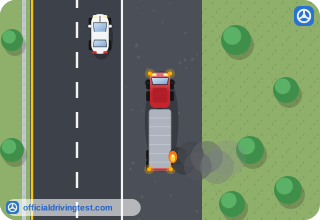
What does the handbook say about using fire extinguishers on a tire fire?
- They are the best remedy
- They are usually not very practical
- They work better than water
- They should be emptied quickly onto the tire
Show answer
Correct answer: They are usually not very practical
For a tire fire, fire extinguishers are usually not very practical.
Source: Utah Driver Handbook (2026 edition (new 2026 laws effective May 6, 2026)), page 94 · Open this page in the manual (Manual page 94)
-
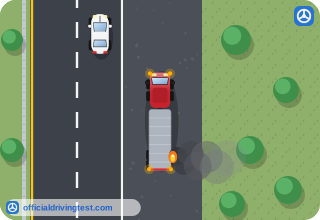
What can shoveling dirt on a burning tire sometimes do?
- Put the fire out completely and permanently
- Make the fire spread to the vehicle
- Keep the tire on the rim until you find water
- Slow the fire enough to let you get the tire off
Show answer
Correct answer: Slow the fire enough to let you get the tire off
Dirt can sometimes slow a tire fire enough for you to remove the tire.
Source: Utah Driver Handbook (2026 edition (new 2026 laws effective May 6, 2026)), page 94 · Open this page in the manual (Manual page 94)
-
You cannot get a burning tire off. What does the handbook say to try?
- Drive until the tire burns off the rim or you reach a good water source
- Park and wait beside the road until the fire goes out on its own
- Stay parked and cover the tire with a blanket until help arrives
- Drive straight to the nearest parking lot and shut off the engine
Show answer
Correct answer: Drive until the tire burns off the rim or you reach a good water source
Driving on until the tire burns off the rim or you reach water is better than sitting and waiting, because the vehicle will probably burn up.
Source: Utah Driver Handbook (2026 edition (new 2026 laws effective May 6, 2026)), page 94 · Open this page in the manual (Manual page 94)
-
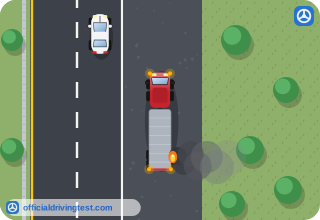
As a last resort in a tire fire, what should you do?
- Disconnect the battery
- Jack up the vehicle
- Drop your trailer
- Cut the tire loose
Show answer
Correct answer: Drop your trailer
Dropping the trailer saves at least one of the two units.
Source: Utah Driver Handbook (2026 edition (new 2026 laws effective May 6, 2026)), page 94 · Open this page in the manual (Manual page 94)
-
How should you use the limited contents of a fire extinguisher?
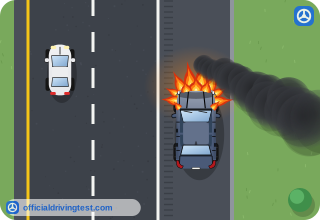
- Empty it quickly in one long burst
- Aim carefully so every burst counts
- Spray widely to cover the whole fire
- Hold it high and spray in a wide arc
Show answer
Correct answer: Aim carefully so every burst counts
The contents of an extinguisher are limited, so you should aim carefully and not waste them.
Source: Utah Driver Handbook (2026 edition (new 2026 laws effective May 6, 2026)), page 94 · Open this page in the manual (Manual page 94)
-
When fighting a fire, where should the wind be?
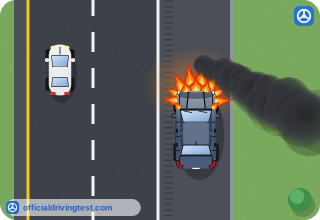
- In front of you
- At your left side
- It makes no difference
- At your back
Show answer
Correct answer: At your back
Fighting a fire with the wind at your back makes an extinguisher more effective and keeps poisonous or caustic gases out of your face.
Source: Utah Driver Handbook (2026 edition (new 2026 laws effective May 6, 2026)), page 94 · Open this page in the manual (Manual page 94)
-
What happens if you fight a gasoline or oil fire with water?
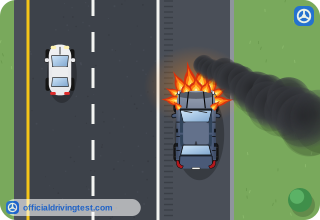
- It will only spread the fire
- It will cool the fuel and put out the fire
- It will smother the flames quickly
- It will make the fire burn out sooner
Show answer
Correct answer: It will only spread the fire
Water spreads a gasoline or oil fire instead of putting it out, so you need to know the different types of fires.
Source: Utah Driver Handbook (2026 edition (new 2026 laws effective May 6, 2026)), page 94 · Open this page in the manual (Manual page 94)