Utah: Emergencies and crashes — Runaway Ramps, Desert, Flooding, Lightning Practice Test
Questions in this part include: “Is a single-point urban interchange handled like a four-way stop during a power outage?” · “What happens if a single-point urban interchange loses power and has no battery backup?”
Independent educational site · not affiliated with any government agency or DMV
Ready? Test yourself
- Instant feedback with an explanation
- Every answer cites its source in the manual
- Your best score is saved on this device
- Keyboard: press 1 to 4 to answer and Enter for the next question
Questions are original and based on the official manual "Utah Driver Handbook" (2026 edition (new 2026 laws effective May 6, 2026)), Utah Department of Public Safety, Driver License Division.
All 22 questions in this practice test
Take the test above first, then use this list to study. Tap “Show answer” to see the correct answer and explanation.
Show the questions and answersHide the questions
-
When may you use a runaway vehicle ramp?
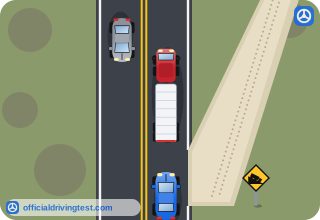
- Only in an emergency requiring the ramp to stop
- Whenever the freeway ahead is stopped or slow
- When you miss your exit and need to turn around
- When you need a place to rest
Show answer
Correct answer: Only in an emergency requiring the ramp to stop
A runaway vehicle ramp may not be used unless you have an emergency that requires it to stop your vehicle.
Source: Utah Driver Handbook (2026 edition (new 2026 laws effective May 6, 2026)), page 41 · Open this page in the manual (Manual page 41)
-
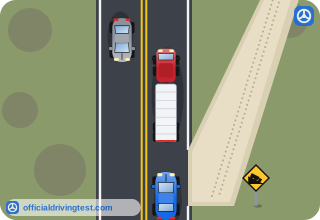
Which is prohibited on a runaway vehicle ramp or in its pathway?
- Entering with a trailer
- Driving without headlights
- Carrying more than two passengers
- Stopping, standing, or parking
Show answer
Correct answer: Stopping, standing, or parking
You may not stop, stand or park on a runaway vehicle ramp or in its pathway.
Source: Utah Driver Handbook (2026 edition (new 2026 laws effective May 6, 2026)), page 41 · Open this page in the manual (Manual page 41)
-
Is a single-point urban interchange handled like a four-way stop during a power outage?
- Yes, the first vehicle to stop goes first
- Yes, vehicles on the off-ramp go first
- No; proceed with extreme caution and courtesy
- No; all traffic must stop until power returns
Show answer
Correct answer: No; proceed with extreme caution and courtesy
In an outage the interchange is not treated as a four-way stop; proceed with extreme caution and courtesy.
Source: Utah Driver Handbook (2026 edition (new 2026 laws effective May 6, 2026)), page 41 · Open this page in the manual (Manual page 41)
-
What happens if a single-point urban interchange loses power and has no battery backup?
- An officer is sent as soon as possible to control traffic
- The signals switch to flashing red in all directions
- The interchange stays closed until power is restored
- Drivers wait for utility crews to restore power
Show answer
Correct answer: An officer is sent as soon as possible to control traffic
Without a battery backup, an officer is dispatched as soon as possible for traffic control.
Source: Utah Driver Handbook (2026 edition (new 2026 laws effective May 6, 2026)), page 41 · Open this page in the manual (Manual page 41)
-
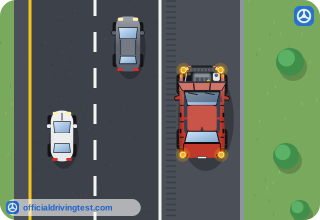
If you need help at the side of the road, what should you tie on the antenna or left door handle?
- Something red or yellow
- Something white or orange
- Something blue or green
- Something black or brown
Show answer
Correct answer: Something white or orange
The handbook says to pull to the side, turn on your emergency flashers, raise your hood and tie something white or orange on the antenna or left door handle.
Source: Utah Driver Handbook (2026 edition (new 2026 laws effective May 6, 2026)), page 57 · Open this page in the manual (Manual page 57)
-
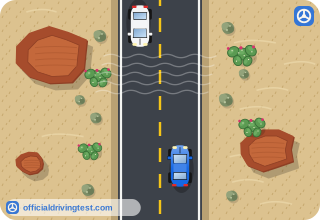
If you are not used to high temperatures and must drive through the desert in the summer, what does the handbook advise?
- Stay on freeways and use an air-conditioned vehicle
- Drive only at midday when traffic is lightest
- Use gravel roads away from the freeway
- Take side roads where there are fewer vehicles
Show answer
Correct answer: Stay on freeways and use an air-conditioned vehicle
The handbook says not to drive through the desert in summer if you are not used to the heat; if you must, stay on freeways and use a vehicle with air conditioning.
Source: Utah Driver Handbook (2026 edition (new 2026 laws effective May 6, 2026)), page 57 · Open this page in the manual (Manual page 57)
-
How much water does the handbook say to carry when driving in the desert?
- Only as much as you expect to drink during the trip
- One bottle for each hour of the planned drive
- Enough for everyone to survive if the vehicle breaks down
- Only enough for the driver, since passengers can wait
Show answer
Correct answer: Enough for everyone to survive if the vehicle breaks down
Drivers should always carry enough water for everyone in the vehicle to survive if it breaks down.
Source: Utah Driver Handbook (2026 edition (new 2026 laws effective May 6, 2026)), page 57 · Open this page in the manual (Manual page 57)
-
In desert driving, what should you watch because the vehicle's cooling system can be affected?
- The tire tread and spare tire pressure
- The radiator temperature and coolant levels
- The battery charge and headlight aim
- The oil pressure and exhaust color
Show answer
Correct answer: The radiator temperature and coolant levels
Heat can affect the cooling system, so you should carry water for the radiator and watch the radiator temperature and coolant levels.
Source: Utah Driver Handbook (2026 edition (new 2026 laws effective May 6, 2026)), page 57 · Open this page in the manual (Manual page 57)
-
If your vehicle breaks down in the desert, what should you do?
- Leave the vehicle and follow a side road to find help
- Walk along the road toward the nearest town
- Leave the vehicle at once to look for help on foot
- Stay with the vehicle rather than wandering away from it
Show answer
Correct answer: Stay with the vehicle rather than wandering away from it
The handbook says to stay with a broken-down vehicle, leaving only to reach a visible call box or an inhabited building within a few minutes' walk.
Source: Utah Driver Handbook (2026 edition (new 2026 laws effective May 6, 2026)), page 57 · Open this page in the manual (Manual page 57)
-
When driving in the desert, when should you take a side road off the freeway or highway?
- Whenever the freeway is crowded
- Whenever you want to find some shade
- Only if you know where it goes
- Whenever your gas is running low
Show answer
Correct answer: Only if you know where it goes
The handbook says not to take side roads off the freeway or highway unless you know where they go.
Source: Utah Driver Handbook (2026 edition (new 2026 laws effective May 6, 2026)), page 57 · Open this page in the manual (Manual page 57)
-
When you drive off the freeways or major highways in the desert, what must you make sure you have?
- Enough gas and water
- A paper map and a two-way radio
- A spare radiator and a tow rope
- Enough food and a sleeping bag
Show answer
Correct answer: Enough gas and water
The handbook says to ensure you have enough gas and water off the freeways, and that you can never have too much of either in the desert.
Source: Utah Driver Handbook (2026 edition (new 2026 laws effective May 6, 2026)), page 57 · Open this page in the manual (Manual page 57)
-
If you see a flooded roadway ahead, what should you do?
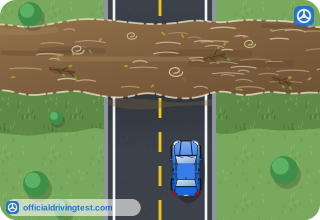
- Drive through it slowly in a low gear
- Follow the car ahead if it crosses safely
- Turn around and find another route
- Drive through it only if the water looks shallow
Show answer
Correct answer: Turn around and find another route
The handbook says not to drive through flooded areas: turn around and find another route to your destination.
Source: Utah Driver Handbook (2026 edition (new 2026 laws effective May 6, 2026)), page 58 · Open this page in the manual (Manual page 58)
-
How deep does water have to be to reach the bottom of most passenger cars, causing loss of control or possible stalling?
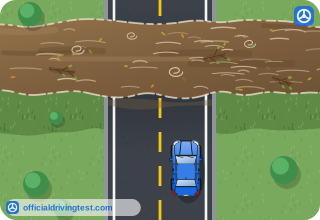
- Two inches
- Six inches
- One foot
- Three feet
Show answer
Correct answer: Six inches
The handbook says six inches of water will reach the bottom of most passenger cars.
Source: Utah Driver Handbook (2026 edition (new 2026 laws effective May 6, 2026)), page 58 · Open this page in the manual (Manual page 58)
-
How much moving water can carry away most vehicles, including sport utility vehicles and pick-up trucks?
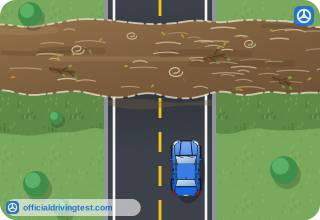
- One foot
- Ten inches
- Four feet
- Two feet
Show answer
Correct answer: Two feet
The handbook says two feet of moving water can carry away most vehicles, including SUVs and pick-up trucks.
Source: Utah Driver Handbook (2026 edition (new 2026 laws effective May 6, 2026)), page 58 · Open this page in the manual (Manual page 58)
-
If the water on a flooded road appears shallow enough to cross, what does the handbook say?
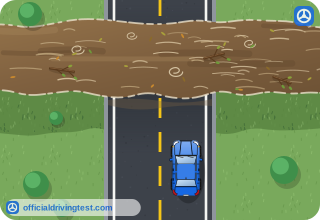
- Cross slowly in a low gear
- Cross only if you can see the road surface
- Do not cross, because water can hide dips
- Cross only in daylight
Show answer
Correct answer: Do not cross, because water can hide dips
Water can hide dips, and floodwaters can wash away the road surface underneath, so you should not attempt to cross even if it looks shallow.
Source: Utah Driver Handbook (2026 edition (new 2026 laws effective May 6, 2026)), page 58 · Open this page in the manual (Manual page 58)
-
If there is no other route around a flooded road, what should you do?
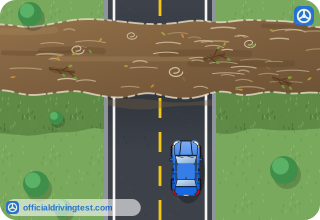
- Proceed to higher ground and wait for the waters to subside
- Stay in the low area with your flashers on
- Drive across at a walking pace when no cars are ahead
- Park beside the road and wait for another driver to cross first
Show answer
Correct answer: Proceed to higher ground and wait for the waters to subside
The handbook says that if there is no other route, you should go to higher ground and wait for the waters to go down.
Source: Utah Driver Handbook (2026 edition (new 2026 laws effective May 6, 2026)), page 58 · Open this page in the manual (Manual page 58)
-
How quickly can flash floods occur after excessive rainfall?
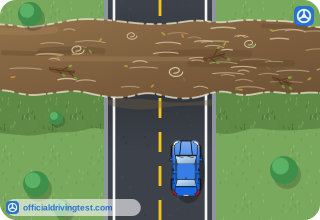
- Only after several days of rain
- Only after the rain has stopped for a day
- Only after a full week of rain
- Within a few minutes or hours
Show answer
Correct answer: Within a few minutes or hours
The handbook says flash floods can come rapidly and unexpectedly, within a few minutes or hours of excessive rainfall.
Source: Utah Driver Handbook (2026 edition (new 2026 laws effective May 6, 2026)), page 58 · Open this page in the manual (Manual page 58)
-
Which kind of vehicle will protect you in a lightning storm?
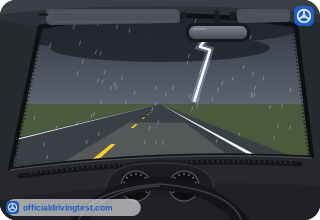
- A hard-topped vehicle
- A convertible with its top up
- A motorcycle with a windscreen
- A truck with an open cab
Show answer
Correct answer: A hard-topped vehicle
The handbook says only a hard-topped vehicle will protect you in a lightning storm.
Source: Utah Driver Handbook (2026 edition (new 2026 laws effective May 6, 2026)), page 60 · Open this page in the manual (Manual page 60)
-
In a vehicle during a lightning storm, what should you do?
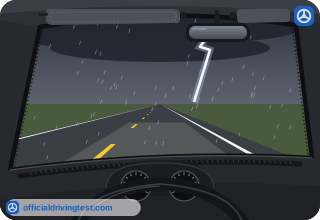
- Keep a window open so you can hear the thunder
- Hold onto the door frame to keep steady
- Make sure all doors are closed and the windows are up
- Keep the doors unlocked in case you need to leave
Show answer
Correct answer: Make sure all doors are closed and the windows are up
The handbook says to make sure all doors are closed and windows are up in a lightning storm.
Source: Utah Driver Handbook (2026 edition (new 2026 laws effective May 6, 2026)), page 60 · Open this page in the manual (Manual page 60)
-
During a lightning storm, what should you avoid touching in your vehicle?
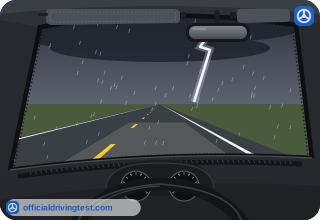
- The rubber floor mats
- Any metal surfaces
- The cloth seat covers
- The plastic dashboard vents
Show answer
Correct answer: Any metal surfaces
The handbook says not to touch any metal surfaces during a lightning storm.
Source: Utah Driver Handbook (2026 edition (new 2026 laws effective May 6, 2026)), page 60 · Open this page in the manual (Manual page 60)
-
During a lightning storm, which radio should you not use?
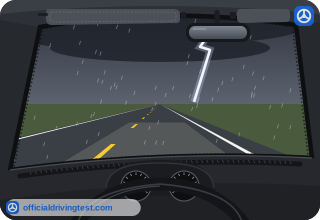
- Any radio, even one that is turned down very low
- A portable radio carried in a passenger's pocket
- A radio that plays only recorded music or podcasts
- A radio connected to an external antenna on the vehicle
Show answer
Correct answer: A radio connected to an external antenna on the vehicle
The handbook says not to use radios connected to an external antenna mounted on the vehicle during a lightning storm.
Source: Utah Driver Handbook (2026 edition (new 2026 laws effective May 6, 2026)), page 60 · Open this page in the manual (Manual page 60)
-
Other than a hard-topped vehicle, what is the safest place during a thunderstorm?
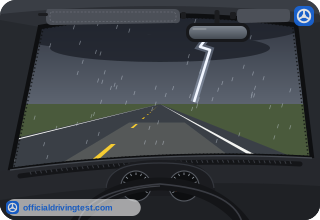
- Standing under a tall tree at the edge of an open field
- Inside a small open shelter near the side of the road
- Inside a well-constructed building with plumbing and electric wiring
- Lying flat on the ground away from any buildings or trees
Show answer
Correct answer: Inside a well-constructed building with plumbing and electric wiring
The handbook says the safest place during a thunderstorm, apart from a hard-topped vehicle, is inside a well-constructed building with plumbing and electric wiring.
Source: Utah Driver Handbook (2026 edition (new 2026 laws effective May 6, 2026)), page 60 · Open this page in the manual (Manual page 60)