Utah: Emergencies and crashes
Skids, brake and tire failures, flooding, desert and winter driving, a vehicle in water, being stranded, and what to do after a crash. Split into 8 shorter tests so you're not stuck in one long quiz.
Independent educational site · not affiliated with any government agency or DMV
Choose a part
Emergencies and crashes — Runaway Ramps, Desert, Flooding, Lightning
Questions in this part include: “Is a single-point urban interchange handled like a four-way stop during a power outage?”
StartEmergencies and crashes — Skidding, Trip Planning, Vehicle Underwater
Questions in this part include: “Before any trip, which of these does the handbook say to check?”
StartEmergencies and crashes — Hot Weather and Winter Driving
Questions in this part include: “When driving in very hot weather, how often should you inspect your tires?”
StartEmergencies and crashes — Winter Survival Kit, Stranded, Freezing Brakes
Questions in this part include: “What should you do with the emergency survival kit in your vehicle?”
StartEmergencies and crashes — Crashes, Defensive Driving, Vehicle Malfunction
Questions in this part include: “How is failing to stop at the scene of an injury crash classified?”
StartEmergencies and crashes — Brake Failure, ABS and Breakdowns
Questions in this part include: “According to the handbook, what is the first action for most drivers during an emergency?”
StartEmergencies and crashes — Power Failure, Tire Blowout, Warning Devices
Questions in this part include: “The engine shuts off while you are driving. What is true about the steering wheel?”
StartEmergencies and crashes — Flares, Tire Fires and General Fire Information
Questions in this part include: “How should you handle a lighted flare or fuse?”
StartAll 150 Emergencies and crashes questions with answers
Choose a part above to take a practice test, or study every question and answer here.
Show the questions and answersHide the questions
-
When may you use a runaway vehicle ramp?
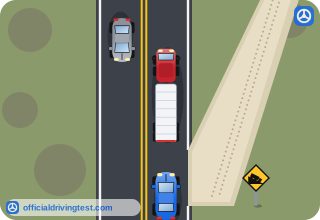
- Only in an emergency requiring the ramp to stop
- Whenever the freeway ahead is stopped or slow
- When you miss your exit and need to turn around
- When you need a place to rest
Show answer
Correct answer: Only in an emergency requiring the ramp to stop
A runaway vehicle ramp may not be used unless you have an emergency that requires it to stop your vehicle.
Source: Utah Driver Handbook (2026 edition (new 2026 laws effective May 6, 2026)), page 41 · Open this page in the manual (Manual page 41)
-
Which is prohibited on a runaway vehicle ramp or in its pathway?
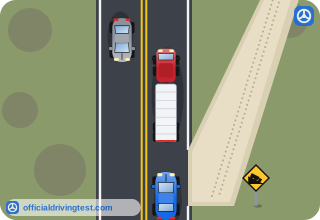
- Entering with a trailer
- Driving without headlights
- Carrying more than two passengers
- Stopping, standing, or parking
Show answer
Correct answer: Stopping, standing, or parking
You may not stop, stand or park on a runaway vehicle ramp or in its pathway.
Source: Utah Driver Handbook (2026 edition (new 2026 laws effective May 6, 2026)), page 41 · Open this page in the manual (Manual page 41)
-
Is a single-point urban interchange handled like a four-way stop during a power outage?
- Yes, the first vehicle to stop goes first
- Yes, vehicles on the off-ramp go first
- No; proceed with extreme caution and courtesy
- No; all traffic must stop until power returns
Show answer
Correct answer: No; proceed with extreme caution and courtesy
In an outage the interchange is not treated as a four-way stop; proceed with extreme caution and courtesy.
Source: Utah Driver Handbook (2026 edition (new 2026 laws effective May 6, 2026)), page 41 · Open this page in the manual (Manual page 41)
-
What happens if a single-point urban interchange loses power and has no battery backup?
- An officer is sent as soon as possible to control traffic
- The signals switch to flashing red in all directions
- The interchange stays closed until power is restored
- Drivers wait for utility crews to restore power
Show answer
Correct answer: An officer is sent as soon as possible to control traffic
Without a battery backup, an officer is dispatched as soon as possible for traffic control.
Source: Utah Driver Handbook (2026 edition (new 2026 laws effective May 6, 2026)), page 41 · Open this page in the manual (Manual page 41)
-
If you need help at the side of the road, what should you tie on the antenna or left door handle?
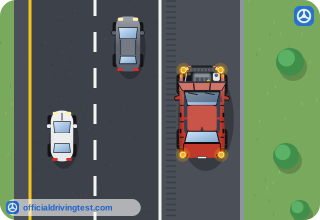
- Something red or yellow
- Something white or orange
- Something blue or green
- Something black or brown
Show answer
Correct answer: Something white or orange
The handbook says to pull to the side, turn on your emergency flashers, raise your hood and tie something white or orange on the antenna or left door handle.
Source: Utah Driver Handbook (2026 edition (new 2026 laws effective May 6, 2026)), page 57 · Open this page in the manual (Manual page 57)
-
If you are not used to high temperatures and must drive through the desert in the summer, what does the handbook advise?
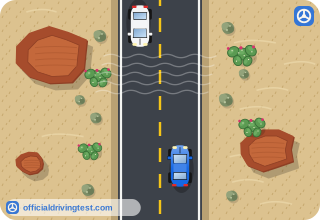
- Stay on freeways and use an air-conditioned vehicle
- Drive only at midday when traffic is lightest
- Use gravel roads away from the freeway
- Take side roads where there are fewer vehicles
Show answer
Correct answer: Stay on freeways and use an air-conditioned vehicle
The handbook says not to drive through the desert in summer if you are not used to the heat; if you must, stay on freeways and use a vehicle with air conditioning.
Source: Utah Driver Handbook (2026 edition (new 2026 laws effective May 6, 2026)), page 57 · Open this page in the manual (Manual page 57)
-
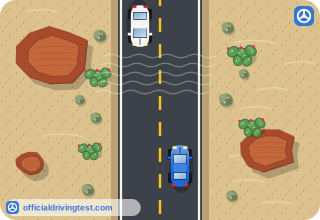
How much water does the handbook say to carry when driving in the desert?
- Only as much as you expect to drink during the trip
- One bottle for each hour of the planned drive
- Enough for everyone to survive if the vehicle breaks down
- Only enough for the driver, since passengers can wait
Show answer
Correct answer: Enough for everyone to survive if the vehicle breaks down
Drivers should always carry enough water for everyone in the vehicle to survive if it breaks down.
Source: Utah Driver Handbook (2026 edition (new 2026 laws effective May 6, 2026)), page 57 · Open this page in the manual (Manual page 57)
-
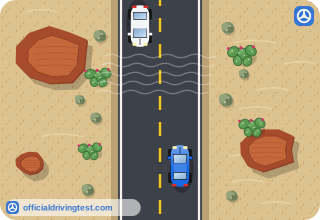
In desert driving, what should you watch because the vehicle's cooling system can be affected?
- The tire tread and spare tire pressure
- The radiator temperature and coolant levels
- The battery charge and headlight aim
- The oil pressure and exhaust color
Show answer
Correct answer: The radiator temperature and coolant levels
Heat can affect the cooling system, so you should carry water for the radiator and watch the radiator temperature and coolant levels.
Source: Utah Driver Handbook (2026 edition (new 2026 laws effective May 6, 2026)), page 57 · Open this page in the manual (Manual page 57)
-
If your vehicle breaks down in the desert, what should you do?
- Leave the vehicle and follow a side road to find help
- Walk along the road toward the nearest town
- Leave the vehicle at once to look for help on foot
- Stay with the vehicle rather than wandering away from it
Show answer
Correct answer: Stay with the vehicle rather than wandering away from it
The handbook says to stay with a broken-down vehicle, leaving only to reach a visible call box or an inhabited building within a few minutes' walk.
Source: Utah Driver Handbook (2026 edition (new 2026 laws effective May 6, 2026)), page 57 · Open this page in the manual (Manual page 57)
-
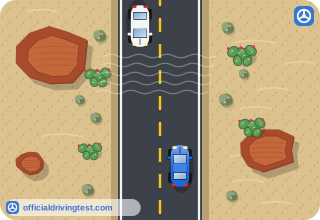
When driving in the desert, when should you take a side road off the freeway or highway?
- Whenever the freeway is crowded
- Whenever you want to find some shade
- Only if you know where it goes
- Whenever your gas is running low
Show answer
Correct answer: Only if you know where it goes
The handbook says not to take side roads off the freeway or highway unless you know where they go.
Source: Utah Driver Handbook (2026 edition (new 2026 laws effective May 6, 2026)), page 57 · Open this page in the manual (Manual page 57)
-
When you drive off the freeways or major highways in the desert, what must you make sure you have?
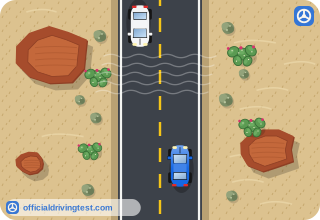
- Enough gas and water
- A paper map and a two-way radio
- A spare radiator and a tow rope
- Enough food and a sleeping bag
Show answer
Correct answer: Enough gas and water
The handbook says to ensure you have enough gas and water off the freeways, and that you can never have too much of either in the desert.
Source: Utah Driver Handbook (2026 edition (new 2026 laws effective May 6, 2026)), page 57 · Open this page in the manual (Manual page 57)
-
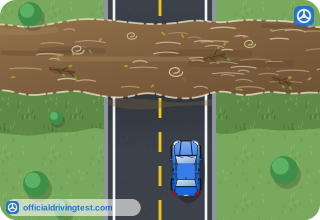
If you see a flooded roadway ahead, what should you do?
- Drive through it slowly in a low gear
- Follow the car ahead if it crosses safely
- Turn around and find another route
- Drive through it only if the water looks shallow
Show answer
Correct answer: Turn around and find another route
The handbook says not to drive through flooded areas: turn around and find another route to your destination.
Source: Utah Driver Handbook (2026 edition (new 2026 laws effective May 6, 2026)), page 58 · Open this page in the manual (Manual page 58)
-
How deep does water have to be to reach the bottom of most passenger cars, causing loss of control or possible stalling?
- Two inches
- Six inches
- One foot
- Three feet
Show answer
Correct answer: Six inches
The handbook says six inches of water will reach the bottom of most passenger cars.
Source: Utah Driver Handbook (2026 edition (new 2026 laws effective May 6, 2026)), page 58 · Open this page in the manual (Manual page 58)
-
How much moving water can carry away most vehicles, including sport utility vehicles and pick-up trucks?
- One foot
- Ten inches
- Four feet
- Two feet
Show answer
Correct answer: Two feet
The handbook says two feet of moving water can carry away most vehicles, including SUVs and pick-up trucks.
Source: Utah Driver Handbook (2026 edition (new 2026 laws effective May 6, 2026)), page 58 · Open this page in the manual (Manual page 58)
-
If the water on a flooded road appears shallow enough to cross, what does the handbook say?
- Cross slowly in a low gear
- Cross only if you can see the road surface
- Do not cross, because water can hide dips
- Cross only in daylight
Show answer
Correct answer: Do not cross, because water can hide dips
Water can hide dips, and floodwaters can wash away the road surface underneath, so you should not attempt to cross even if it looks shallow.
Source: Utah Driver Handbook (2026 edition (new 2026 laws effective May 6, 2026)), page 58 · Open this page in the manual (Manual page 58)
-
If there is no other route around a flooded road, what should you do?
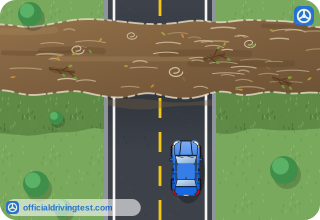
- Proceed to higher ground and wait for the waters to subside
- Stay in the low area with your flashers on
- Drive across at a walking pace when no cars are ahead
- Park beside the road and wait for another driver to cross first
Show answer
Correct answer: Proceed to higher ground and wait for the waters to subside
The handbook says that if there is no other route, you should go to higher ground and wait for the waters to go down.
Source: Utah Driver Handbook (2026 edition (new 2026 laws effective May 6, 2026)), page 58 · Open this page in the manual (Manual page 58)
-
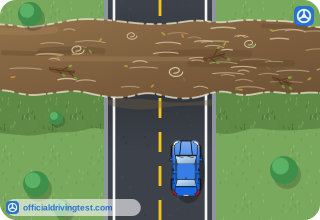
How quickly can flash floods occur after excessive rainfall?
- Only after several days of rain
- Only after the rain has stopped for a day
- Only after a full week of rain
- Within a few minutes or hours
Show answer
Correct answer: Within a few minutes or hours
The handbook says flash floods can come rapidly and unexpectedly, within a few minutes or hours of excessive rainfall.
Source: Utah Driver Handbook (2026 edition (new 2026 laws effective May 6, 2026)), page 58 · Open this page in the manual (Manual page 58)
-
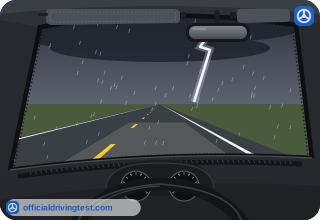
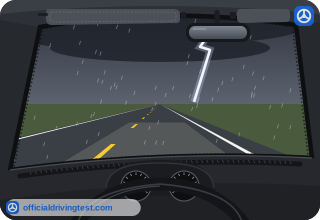
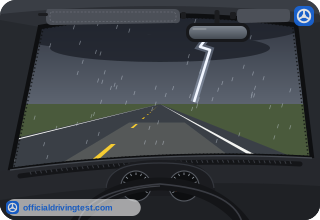
Which kind of vehicle will protect you in a lightning storm?
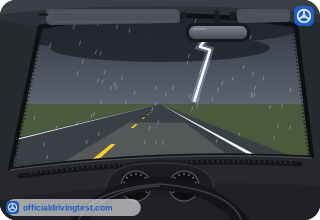
- A hard-topped vehicle
- A convertible with its top up
- A motorcycle with a windscreen
- A truck with an open cab
Show answer
Correct answer: A hard-topped vehicle
The handbook says only a hard-topped vehicle will protect you in a lightning storm.
Source: Utah Driver Handbook (2026 edition (new 2026 laws effective May 6, 2026)), page 60 · Open this page in the manual (Manual page 60)
-
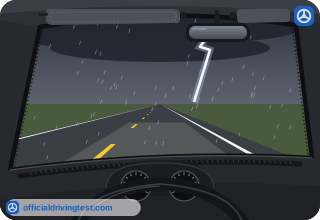
In a vehicle during a lightning storm, what should you do?
- Keep a window open so you can hear the thunder
- Hold onto the door frame to keep steady
- Make sure all doors are closed and the windows are up
- Keep the doors unlocked in case you need to leave
Show answer
Correct answer: Make sure all doors are closed and the windows are up
The handbook says to make sure all doors are closed and windows are up in a lightning storm.
Source: Utah Driver Handbook (2026 edition (new 2026 laws effective May 6, 2026)), page 60 · Open this page in the manual (Manual page 60)
-
During a lightning storm, what should you avoid touching in your vehicle?
- The rubber floor mats
- Any metal surfaces
- The cloth seat covers
- The plastic dashboard vents
Show answer
Correct answer: Any metal surfaces
The handbook says not to touch any metal surfaces during a lightning storm.
Source: Utah Driver Handbook (2026 edition (new 2026 laws effective May 6, 2026)), page 60 · Open this page in the manual (Manual page 60)
-
During a lightning storm, which radio should you not use?
- Any radio, even one that is turned down very low
- A portable radio carried in a passenger's pocket
- A radio that plays only recorded music or podcasts
- A radio connected to an external antenna on the vehicle
Show answer
Correct answer: A radio connected to an external antenna on the vehicle
The handbook says not to use radios connected to an external antenna mounted on the vehicle during a lightning storm.
Source: Utah Driver Handbook (2026 edition (new 2026 laws effective May 6, 2026)), page 60 · Open this page in the manual (Manual page 60)
-
Other than a hard-topped vehicle, what is the safest place during a thunderstorm?
- Standing under a tall tree at the edge of an open field
- Inside a small open shelter near the side of the road
- Inside a well-constructed building with plumbing and electric wiring
- Lying flat on the ground away from any buildings or trees
Show answer
Correct answer: Inside a well-constructed building with plumbing and electric wiring
The handbook says the safest place during a thunderstorm, apart from a hard-topped vehicle, is inside a well-constructed building with plumbing and electric wiring.
Source: Utah Driver Handbook (2026 edition (new 2026 laws effective May 6, 2026)), page 60 · Open this page in the manual (Manual page 60)
-
To keep a skid from happening, how should you adjust your speed?
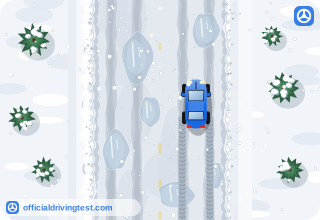
- Slow down to a speed you can control
- Keep a steady speed and brake lightly
- Speed up slightly to keep traction
- Drive the posted limit in every case
Show answer
Correct answer: Slow down to a speed you can control
The best policy is to prevent a skid by slowing to a speed you can control.
Source: Utah Driver Handbook (2026 edition (new 2026 laws effective May 6, 2026)), page 62 · Open this page in the manual (Manual page 62)
-
If you do skid, what should you do with your foot on the gas pedal?
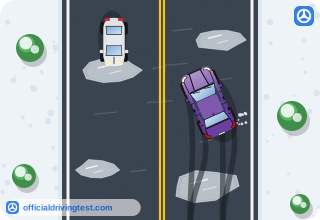
- Press harder to power through
- Pump it quickly
- Slowly take it off the gas pedal
- Hold it steady
Show answer
Correct answer: Slowly take it off the gas pedal
When a skid starts, the handbook says to ease your foot slowly off the gas.
Source: Utah Driver Handbook (2026 edition (new 2026 laws effective May 6, 2026)), page 62 · Open this page in the manual (Manual page 62)
-
If your rear wheels skid to the right, which way should you turn your front wheels?
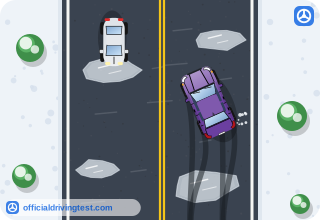
- To the left
- To the right
- Straight ahead
- Back and forth quickly
Show answer
Correct answer: To the right
You steer in the direction the rear wheels are skidding.
Source: Utah Driver Handbook (2026 edition (new 2026 laws effective May 6, 2026)), page 62 · Open this page in the manual (Manual page 62)
-
If your rear wheels skid to the left, which way should you turn your front wheels?
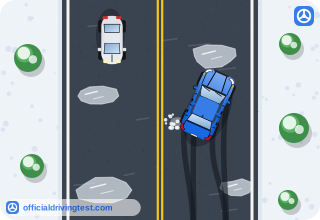
- To the right
- Straight ahead
- Back and forth quickly
- To the left
Show answer
Correct answer: To the left
You steer in the direction the rear wheels are skidding.
Source: Utah Driver Handbook (2026 edition (new 2026 laws effective May 6, 2026)), page 62 · Open this page in the manual (Manual page 62)
-
Why should you not steer too far when correcting a skid?
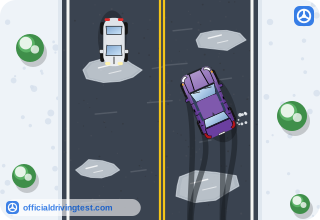
- It will make the car skid the other way
- It will lock the steering wheel
- It will cause the tires to go flat
- It will make the engine stall
Show answer
Correct answer: It will make the car skid the other way
Oversteering during a skid can send the car skidding the other way.
Source: Utah Driver Handbook (2026 edition (new 2026 laws effective May 6, 2026)), page 62 · Open this page in the manual (Manual page 62)
-
What should you avoid doing with the brakes during a skid?
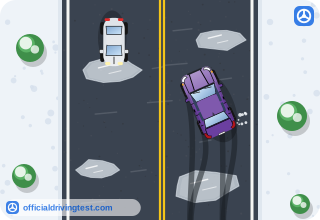
- Touching them at all
- Keeping your foot near them
- Slamming on them
- Checking them before a trip
Show answer
Correct answer: Slamming on them
The handbook says not to slam on your brakes when you skid.
Source: Utah Driver Handbook (2026 edition (new 2026 laws effective May 6, 2026)), page 62 · Open this page in the manual (Manual page 62)
-
What should you do once your car regains traction after a skid?
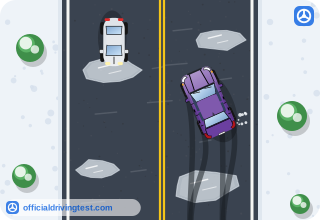
- Brake hard to stop at once
- Straighten out your wheels
- Turn the wheels toward the shoulder
- Speed up to leave the area
Show answer
Correct answer: Straighten out your wheels
After the car regains traction, straighten the wheels.
Source: Utah Driver Handbook (2026 edition (new 2026 laws effective May 6, 2026)), page 62 · Open this page in the manual (Manual page 62)
-
Before any trip, which of these does the handbook say to check?
- The radio presets
- The seat covers
- The floor mats
- Belts and hoses
Show answer
Correct answer: Belts and hoses
Trip preparation includes checking windshields and windows, lights, tires, fluid levels, belts, hoses and brakes.
Source: Utah Driver Handbook (2026 edition (new 2026 laws effective May 6, 2026)), page 62 · Open this page in the manual (Manual page 62)
-
What does the handbook advise for the night before a trip?
- Get a good night’s sleep
- Stay up late to finish packing
- Drive part of the route in advance
- Skip dinner to avoid sleepiness
Show answer
Correct answer: Get a good night’s sleep
Being rested is part of preparing for a trip.
Source: Utah Driver Handbook (2026 edition (new 2026 laws effective May 6, 2026)), page 62 · Open this page in the manual (Manual page 62)
-
Why should you consider the time of day before going on a trip?
- To avoid driving in sunlight
- To get lower fuel prices
- To avoid congestion in city areas
- To use shorter highway routes
Show answer
Correct answer: To avoid congestion in city areas
Timing your trip helps you avoid congestion in city areas.
Source: Utah Driver Handbook (2026 edition (new 2026 laws effective May 6, 2026)), page 62 · Open this page in the manual (Manual page 62)
-
What should your route plan include for the final destination?
- The names of every town you pass
- Route, entrance and exit numbers
- The speed limit for each road
- The phone numbers of rest stops
Show answer
Correct answer: Route, entrance and exit numbers
The handbook says to plan the route including the route number and the entrance and exit numbers.
Source: Utah Driver Handbook (2026 edition (new 2026 laws effective May 6, 2026)), page 62 · Open this page in the manual (Manual page 62)
-
For how long will a vehicle that enters water float on the surface?
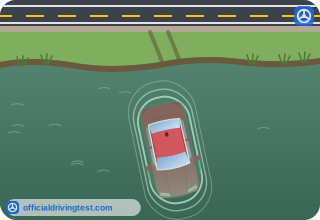
- 5 to 10 seconds
- 2 to 3 minutes
- 10 to 15 minutes
- 30 to 60 seconds
Show answer
Correct answer: 30 to 60 seconds
A vehicle floats only 30 to 60 seconds, so you must try to get out immediately.
Source: Utah Driver Handbook (2026 edition (new 2026 laws effective May 6, 2026)), page 62 · Open this page in the manual (Manual page 62)
-
If your vehicle enters a body of water, what is the first thing the handbook says to do to get out?
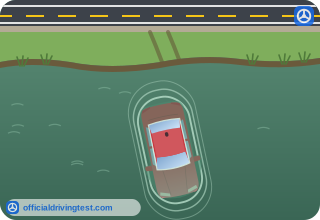
- Remove your safety belt
- Turn on the hazard lights
- Call for help on a cell phone
- Open the hood
Show answer
Correct answer: Remove your safety belt
The first step in escaping a vehicle in water is to remove the safety belt.
Source: Utah Driver Handbook (2026 edition (new 2026 laws effective May 6, 2026)), page 62 · Open this page in the manual (Manual page 62)
-
After you remove your safety belt in a vehicle that has entered water, what does the handbook say to do?
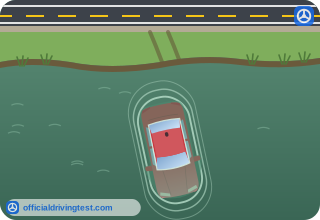
- Stay inside and wait for rescue
- Swim away through the window at once
- Lower the window and climb onto the top
- Move to the back seat and wait
Show answer
Correct answer: Lower the window and climb onto the top
After the belt is off, lower the window and climb onto the vehicle’s top.
Source: Utah Driver Handbook (2026 edition (new 2026 laws effective May 6, 2026)), page 62 · Open this page in the manual (Manual page 62)
-
What should you do before trying to swim away from a vehicle in water?
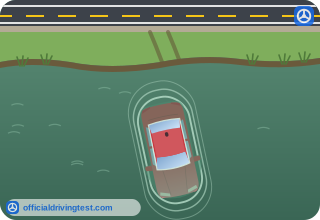
- Take off your shoes
- Assess the current of the water
- Wait for the vehicle to sink
- Turn on the headlights first
Show answer
Correct answer: Assess the current of the water
The handbook says to assess the water’s current before swimming away.
Source: Utah Driver Handbook (2026 edition (new 2026 laws effective May 6, 2026)), page 62 · Open this page in the manual (Manual page 62)
-
If your vehicle is sinking quickly and you cannot open the door or window, what should you keep on?
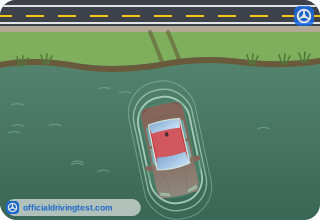
- Heavy clothing
- Your coat
- Your gloves
- Your shoes
Show answer
Correct answer: Your shoes
Take off heavy clothing that makes you sink, but keep your shoes on in case you must kick the window out.
Source: Utah Driver Handbook (2026 edition (new 2026 laws effective May 6, 2026)), page 62 · Open this page in the manual (Manual page 62)
-
If you cannot open the door or window of a vehicle in water, where will a small air pocket be?
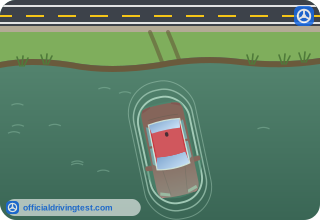
- Near the highest part of the vehicle
- Under the front seats
- Near the trunk lid
- Near the lowest part of the vehicle
Show answer
Correct answer: Near the highest part of the vehicle
An air pocket forms near whichever part of the vehicle is highest in the water.
Source: Utah Driver Handbook (2026 edition (new 2026 laws effective May 6, 2026)), page 62 · Open this page in the manual (Manual page 62)
-
If you can’t get a side window open and have kicked the window out, what should you do next?
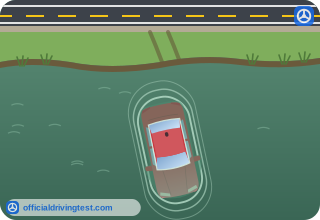
- Swim out at once without taking another breath
- Stay inside until the vehicle has stopped sinking
- Go to the air pocket for one more breath, then escape
- Close the window to trap air inside
Show answer
Correct answer: Go to the air pocket for one more breath, then escape
After kicking out the window, return to the air pocket for one more breath and then escape.
Source: Utah Driver Handbook (2026 edition (new 2026 laws effective May 6, 2026)), page 62 · Open this page in the manual (Manual page 62)
-
When driving in very hot weather, how often should you inspect your tires?
- Every hour or every 25 miles
- Every two hours or every 100 miles
- Every four hours or every 300 miles
- Every six hours or every 500 miles
Show answer
Correct answer: Every two hours or every 100 miles
In hot weather the handbook says to inspect the tires every two hours or every 100 miles.
Source: Utah Driver Handbook (2026 edition (new 2026 laws effective May 6, 2026)), page 62 · Open this page in the manual (Manual page 62)
-
In very hot weather, tire air pressure increases. What should you not do?
- Check the tire mounting
- Inspect the tires
- Stop to rest the tires
- Let air out of the tires
Show answer
Correct answer: Let air out of the tires
Air let out in the heat leaves the pressure too low once the tires cool.
Source: Utah Driver Handbook (2026 edition (new 2026 laws effective May 6, 2026)), page 62 · Open this page in the manual (Manual page 62)
-
In very hot weather, what does engine oil help do for the engine?
- Help keep it cool
- Help keep it clean
- Help it start faster
- Help it burn less fuel
Show answer
Correct answer: Help keep it cool
Engine oil helps keep the engine cool, so make sure there is enough.
Source: Utah Driver Handbook (2026 edition (new 2026 laws effective May 6, 2026)), page 63 · Open this page in the manual (Manual page 63)
-
Before driving in very hot weather, what should the engine cooling system have enough of?
- Brake fluid and oil
- Fuel and washer fluid
- Water and antifreeze
- Power steering fluid
Show answer
Correct answer: Water and antifreeze
The cooling system needs enough water and antifreeze before you drive.
Source: Utah Driver Handbook (2026 edition (new 2026 laws effective May 6, 2026)), page 63 · Open this page in the manual (Manual page 63)
-
If your temperature gauge goes above the highest safe temperature, what should you do?
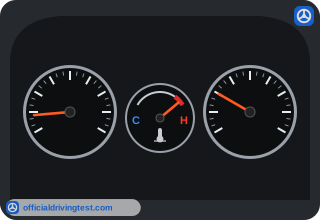
- Keep driving to the nearest exit
- Stop as soon as safely possible
- Turn off the engine while moving
- Drive slowly with the heater off
Show answer
Correct answer: Stop as soon as safely possible
A gauge above the safe range can lead to engine failure and fire, so stop as soon as it is safe.
Source: Utah Driver Handbook (2026 edition (new 2026 laws effective May 6, 2026)), page 63 · Open this page in the manual (Manual page 63)
-
Why should you use caution when you see tar bleeding to the road surface in hot weather?
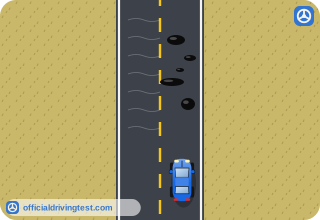
- Those spots grip the tires strongly
- Those spots mean the road is icy
- Those spots are always wet
- Those spots can be slippery
Show answer
Correct answer: Those spots can be slippery
Tar that rises to the surface in the heat can make the road slippery.
Source: Utah Driver Handbook (2026 edition (new 2026 laws effective May 6, 2026)), page 63 · Open this page in the manual (Manual page 63)
-
Which season does the handbook call the most challenging driving season?
- Winter
- Spring
- Summer
- Fall
Show answer
Correct answer: Winter
Winter has fewer hours of daylight and conditions like fog, storms, snow and ice.
Source: Utah Driver Handbook (2026 edition (new 2026 laws effective May 6, 2026)), page 63 · Open this page in the manual (Manual page 63)
-
When should you put good snow tires on your vehicle?
- After the first snowfall
- Before the first snowfall
- Once ice has formed
- Only when a weather advisory is issued
Show answer
Correct answer: Before the first snowfall
Snow tires should be on the vehicle before the first snowfall.
Source: Utah Driver Handbook (2026 edition (new 2026 laws effective May 6, 2026)), page 63 · Open this page in the manual (Manual page 63)
-
For a front-wheel drive vehicle, where is it best to put snow or “all-season” tires?
- On the front wheels only
- On the rear wheels only
- On the driving wheels only
- On all four wheels
Show answer
Correct answer: On all four wheels
Even on front-wheel drive vehicles, all four wheels should have snow or all-season tires.
Source: Utah Driver Handbook (2026 edition (new 2026 laws effective May 6, 2026)), page 63 · Open this page in the manual (Manual page 63)
-
When may snow tires with metal studs be used?
- October 15 through March 31
- September 1 through April 30
- November 1 through February 28
- All year round
Show answer
Correct answer: October 15 through March 31
Studded snow tires may be used only from October 15 through March 31 each year.
Source: Utah Driver Handbook (2026 edition (new 2026 laws effective May 6, 2026)), page 63 · Open this page in the manual (Manual page 63)
-
During ice or snowstorms, especially when a weather advisory is issued, when should you drive?
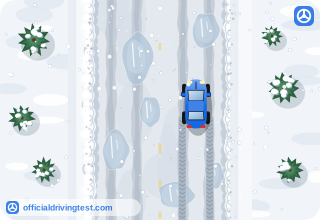
- Only after dark
- Only on freeways
- Only if it is essential
- Whenever you have snow tires
Show answer
Correct answer: Only if it is essential
The handbook says not to drive in ice or snowstorms unless it is essential.
Source: Utah Driver Handbook (2026 edition (new 2026 laws effective May 6, 2026)), page 63 · Open this page in the manual (Manual page 63)
-
If you must drive in an ice or snowstorm, what should you clear of ice and snow first?
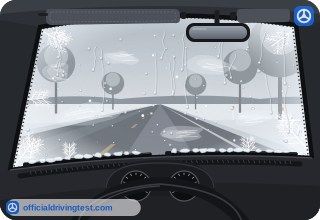
- Only the windshield and the driver’s window
- The whole vehicle, including lights and windows
- Only the windshield and the hood
- Only the windows and the license plate
Show answer
Correct answer: The whole vehicle, including lights and windows
Clear the ice and snow from the whole vehicle, including headlights, taillights, wipers and all windows.
Source: Utah Driver Handbook (2026 edition (new 2026 laws effective May 6, 2026)), page 63 · Open this page in the manual (Manual page 63)
-
In winter, what kind of cleaning solution should you use for the windshield wipers?
- Plain water from a bottle
- Any solution with strong scent
- A thick wax-based cleaner
- A freeze-resistant cleaning solution
Show answer
Correct answer: A freeze-resistant cleaning solution
The handbook says to use a freeze-resistant solution and keep the reservoir adequately filled.
Source: Utah Driver Handbook (2026 edition (new 2026 laws effective May 6, 2026)), page 63 · Open this page in the manual (Manual page 63)
-
Even if your vehicle has good traction in ice and snow, how should you drive?
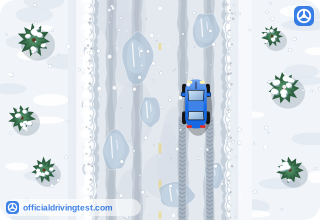
- Slowly, not faster than everyone else
- At the posted speed limit
- Faster to finish the trip sooner
- At the speed of the fastest driver
Show answer
Correct answer: Slowly, not faster than everyone else
Other drivers travel with caution, so drive slowly and do not disrupt traffic flow by going faster.
Source: Utah Driver Handbook (2026 edition (new 2026 laws effective May 6, 2026)), page 63 · Open this page in the manual (Manual page 63)
-
When sleet, freezing rain or snow starts to fall, which road areas are likely to freeze first?
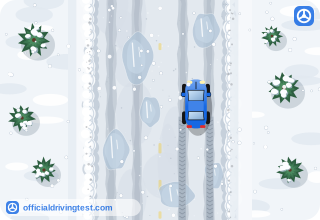
- Tunnels and mountain passes
- Straight rural highways
- Bridges, ramps and overpasses
- Shaded residential streets
Show answer
Correct answer: Bridges, ramps and overpasses
Bridges, ramps and overpasses freeze first because they are exposed.
Source: Utah Driver Handbook (2026 edition (new 2026 laws effective May 6, 2026)), page 63 · Open this page in the manual (Manual page 63)
-
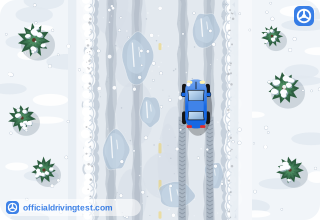
After road crews have cleared the roadways, what should you be aware of?
- Ice cannot form
- Slippery spots may remain
- The road is safe at full speed
- Only bridges will be slippery
Show answer
Correct answer: Slippery spots may remain
Slippery spots can remain even after crews clear the roads.
Source: Utah Driver Handbook (2026 edition (new 2026 laws effective May 6, 2026)), page 63 · Open this page in the manual (Manual page 63)
-
What should you do with the emergency survival kit in your vehicle?
- Store it at home until winter arrives
- Replace it only once each spring season
- Take it out once winter is over
- Keep it in the vehicle, restock after use
Show answer
Correct answer: Keep it in the vehicle, restock after use
The survival kit should always remain in the vehicle and be restocked after each use.
Source: Utah Driver Handbook (2026 edition (new 2026 laws effective May 6, 2026)), page 63 · Open this page in the manual (Manual page 63)
-
Which of these does the handbook list as a supply for an emergency survival kit?
- A bag of salt or sand
- A portable generator
- A can of gasoline
- A folding table
Show answer
Correct answer: A bag of salt or sand
The kit includes a spare tire, shovel, jumper cables, tire chains, salt or sand and a tool kit.
Source: Utah Driver Handbook (2026 edition (new 2026 laws effective May 6, 2026)), page 63 · Open this page in the manual (Manual page 63)
-
Which food does the handbook suggest for a winter survival kit?
- Fresh sandwiches
- Frozen dinners
- Unsalted canned nuts
- Salted potato chips
Show answer
Correct answer: Unsalted canned nuts
The kit should hold non-perishable energy foods such as unsalted canned nuts, dried fruits and hard candy.
Source: Utah Driver Handbook (2026 edition (new 2026 laws effective May 6, 2026)), page 63 · Open this page in the manual (Manual page 63)
-
If you become stranded while traveling in cold weather, what should you do?
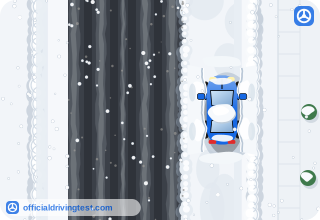
- Walk to find help
- Stay with your vehicle
- Leave in the direction of the nearest town
- Split up to search for help
Show answer
Correct answer: Stay with your vehicle
The handbook says to stay with your vehicle when stranded in the cold.
Source: Utah Driver Handbook (2026 edition (new 2026 laws effective May 6, 2026)), page 63 · Open this page in the manual (Manual page 63)
-
When may you leave your vehicle if you are stranded in cold weather?
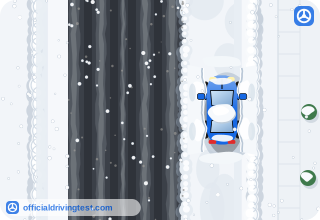
- Whenever the weather finally clears up
- After you have waited for at least one hour
- Whenever you see a light in the distance
- Only if you know where you are and how far help is
Show answer
Correct answer: Only if you know where you are and how far help is
Leave only when you know exactly where you are and the distance to help.
Source: Utah Driver Handbook (2026 edition (new 2026 laws effective May 6, 2026)), page 63 · Open this page in the manual (Manual page 63)
-
According to the handbook, when do most deaths occur for people stranded in cold weather?
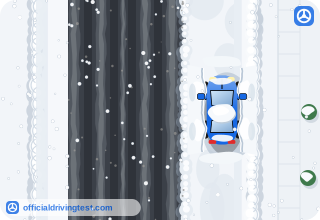
- They get out, become lost and suffer exposure to cold
- They run out of fuel while sitting inside the vehicle
- They stay awake inside the vehicle through the night
- They wait inside the vehicle for help to arrive
Show answer
Correct answer: They get out, become lost and suffer exposure to cold
Most deaths happen after people leave their vehicles, get lost, and stay out in the cold.
Source: Utah Driver Handbook (2026 edition (new 2026 laws effective May 6, 2026)), page 63 · Open this page in the manual (Manual page 63)
-
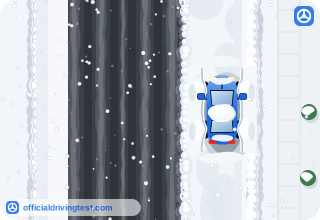
If you become stranded in cold weather, which lights should you turn on?
- Your high beams
- Your fog lights
- Your hazard warning lights
- Your interior lights only
Show answer
Correct answer: Your hazard warning lights
Turning on the hazard warning lights is the first stranded-in-cold-weather tip.
Source: Utah Driver Handbook (2026 edition (new 2026 laws effective May 6, 2026)), page 63 · Open this page in the manual (Manual page 63)
-
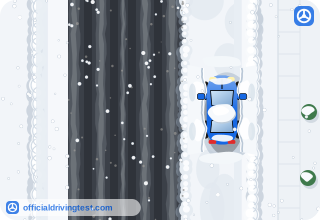
If you are stranded in cold weather, how many flares should you light to attract attention?
- One, at the front of the vehicle
- Two, one at each end of the vehicle
- Three, at the rear of the vehicle
- Four, one at each corner
Show answer
Correct answer: Two, one at each end of the vehicle
Light two flares and put one at each end of the vehicle a safe distance away.
Source: Utah Driver Handbook (2026 edition (new 2026 laws effective May 6, 2026)), page 63 · Open this page in the manual (Manual page 63)
-
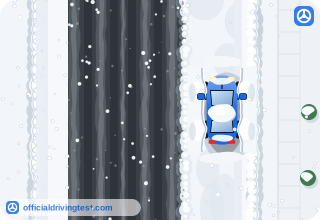
If you are stranded in cold weather, what should you hang from your driver-side window, mirror or door handle?
- A dark blanket
- A set of keys
- A folded paper road map
- A brightly colored cloth
Show answer
Correct answer: A brightly colored cloth
A brightly colored cloth helps attract attention.
Source: Utah Driver Handbook (2026 edition (new 2026 laws effective May 6, 2026)), page 63 · Open this page in the manual (Manual page 63)
-
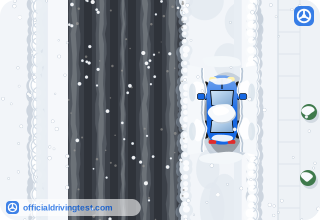
If you are stranded in cold weather, what should you keep clear of snow and debris?
- The exhaust pipe
- The glove box
- The hood latch
- The fuel cap
Show answer
Correct answer: The exhaust pipe
A blocked exhaust pipe can leak fumes into the vehicle, causing you to black out or even die.
Source: Utah Driver Handbook (2026 edition (new 2026 laws effective May 6, 2026)), page 63 · Open this page in the manual (Manual page 63)
-
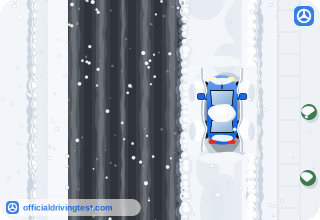
When stranded in cold weather, how should you use the engine and heater?
- Run them nonstop until help arrives
- Keep them off and use only the horn
- Run them until warm, then turn them off
- Run them only after dark
Show answer
Correct answer: Run them until warm, then turn them off
Run the engine and heater until warm, turn them off, and repeat as long as fuel is available.
Source: Utah Driver Handbook (2026 edition (new 2026 laws effective May 6, 2026)), page 63 · Open this page in the manual (Manual page 63)
-
When stranded in cold weather, about how long is running the engine each hour recommended?
- About 2 minutes
- About 10 minutes
- About 30 minutes
- About 45 minutes
Show answer
Correct answer: About 10 minutes
The handbook recommends roughly 10 minutes of running each hour to charge the battery and warm the interior.
Source: Utah Driver Handbook (2026 edition (new 2026 laws effective May 6, 2026)), page 63 · Open this page in the manual (Manual page 63)
-
When stranded in an idling vehicle in frigid temperatures, what should you do with the windows?
- Keep all the windows closed
- Open all of the windows
- Keep the windows closed but turn up the heater
- Leave at least one window open
Show answer
Correct answer: Leave at least one window open
Occupants of an idling vehicle can suffer carbon monoxide poisoning if ventilation is inadequate.
Source: Utah Driver Handbook (2026 edition (new 2026 laws effective May 6, 2026)), page 64 · Open this page in the manual (Manual page 64)
-
If several people are stranded in a vehicle in cold weather, how many should stay awake?
- At least one person
- Everyone at all times
- No one needs to stay awake
- Only the driver at night
Show answer
Correct answer: At least one person
At least one person should remain awake at all times.
Source: Utah Driver Handbook (2026 edition (new 2026 laws effective May 6, 2026)), page 64 · Open this page in the manual (Manual page 64)
-
What does the handbook say to use to protect yourself from frostbite and hypothermia when stranded?
- The seat belt
- The engine running all night
- Blankets
- The heater at full blast all night
Show answer
Correct answer: Blankets
Use blankets to keep warm and avoid frostbite and hypothermia.
Source: Utah Driver Handbook (2026 edition (new 2026 laws effective May 6, 2026)), page 64 · Open this page in the manual (Manual page 64)
-
In freezing weather, what may happen to your brakes?
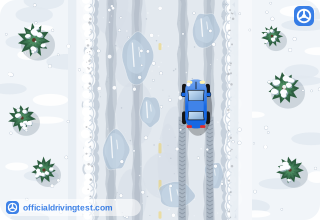
- They may work better than normal for a while
- They may fail for several hundred feet, then grab
- They may stay cool and quiet all winter
- They may grab at first, then slowly fade away
Show answer
Correct answer: They may fail for several hundred feet, then grab
In freezing weather, brakes may be ineffective for several hundred feet, then suddenly grab as the friction dries them out.
Source: Utah Driver Handbook (2026 edition (new 2026 laws effective May 6, 2026)), page 64 · Open this page in the manual (Manual page 64)
-
In freezing weather, what can happen if all moving parts freeze solid?
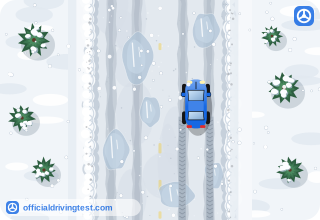
- Complete loss of steering only
- Complete loss of tire pressure
- Complete loss of headlights
- Complete loss of brakes
Show answer
Correct answer: Complete loss of brakes
Frozen moving parts can result in the complete loss of brakes.
Source: Utah Driver Handbook (2026 edition (new 2026 laws effective May 6, 2026)), page 64 · Open this page in the manual (Manual page 64)
-
In freezing weather, what may happen once you apply the brakes?
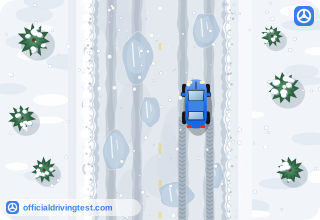
- They may not release
- They may release too quickly
- They may become much stronger
- They may vibrate and then reset
Show answer
Correct answer: They may not release
Freezing can keep the brakes from releasing after you apply them.
Source: Utah Driver Handbook (2026 edition (new 2026 laws effective May 6, 2026)), page 64 · Open this page in the manual (Manual page 64)
-
How can you help prevent brake problems from occurring in freezing weather?
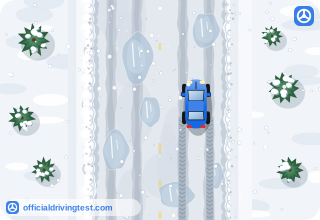
- Never use your brakes in cold weather
- Press the pedal hard every few minutes
- Touch your brakes lightly now and then
- Use only the parking brake while stopped
Show answer
Correct answer: Touch your brakes lightly now and then
Lightly touching the brakes now and then helps prevent freezing problems.
Source: Utah Driver Handbook (2026 edition (new 2026 laws effective May 6, 2026)), page 64 · Open this page in the manual (Manual page 64)
-
What must you do if you are involved in a crash?
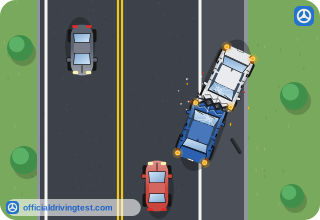
- Stop immediately
- Drive on and report it later
- Leave if no one is hurt
- Wait one hour before stopping
Show answer
Correct answer: Stop immediately
The handbook says to stop immediately when you are involved in a crash, because leaving the scene can bring severe penalties.
Source: Utah Driver Handbook (2026 edition (new 2026 laws effective May 6, 2026)), page 65 · Open this page in the manual (Manual page 65)
-
Besides losing your license, what other penalty may apply for not remaining at the scene of a crash in which you were involved?
- A fine of up to $250 with no jail time at all
- Jail of up to one year, a fine of up to $2500, or both
- A jail sentence of up to 30 days and no fine
- Community service for up to one year, or a fine
Show answer
Correct answer: Jail of up to one year, a fine of up to $2500, or both
The handbook lists a jail sentence of up to one year, a fine of up to $2500, or both.
Source: Utah Driver Handbook (2026 edition (new 2026 laws effective May 6, 2026)), page 65 · Open this page in the manual (Manual page 65)
-
How is failing to stop at the scene of an injury crash classified?
- A class B misdemeanor
- A class C misdemeanor
- A traffic infraction
- A third-degree felony
Show answer
Correct answer: A third-degree felony
Failing to stop at an injury crash is a third-degree felony in Utah.
Source: Utah Driver Handbook (2026 edition (new 2026 laws effective May 6, 2026)), page 65 · Open this page in the manual (Manual page 65)
-
You are required to render reasonable assistance to an injured person in a crash. When must you transport the person, or arrange transport, to a physician or hospital?
- If treatment is apparently necessary or the person requests it
- Only when a police officer at the scene orders it
- Only if the crash happened on a freeway or highway
- Only if the injured person is a passenger in your car
Show answer
Correct answer: If treatment is apparently necessary or the person requests it
Reasonable assistance includes transport or arranging it when treatment is apparently necessary or the injured person asks for it.
Source: Utah Driver Handbook (2026 edition (new 2026 laws effective May 6, 2026)), page 65 · Open this page in the manual (Manual page 65)
-
When should you move someone who appears to be seriously injured in a crash?
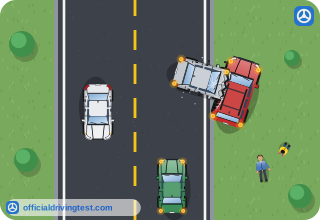
- Always, so they are out of the road right away
- Whenever they ask to be moved to a safer place
- Only if moving them is necessary to prevent more injury
- As soon as a bystander offers to help you move them
Show answer
Correct answer: Only if moving them is necessary to prevent more injury
You should avoid moving a seriously injured person unless that is necessary to prevent further injury.
Source: Utah Driver Handbook (2026 edition (new 2026 laws effective May 6, 2026)), page 65 · Open this page in the manual (Manual page 65)
-
A crash causes only property damage, with no injuries. What does the law allow the operator to do with the vehicle?
- Leave it in the travel lane until a police officer arrives
- Move it out of the travel lanes to a shoulder or other suitable spot
- Leave it where it is and walk away from the scene
- Drive home and report the crash to police the next day
Show answer
Correct answer: Move it out of the travel lanes to a shoulder or other suitable spot
In a property-damage-only crash the operator may move the vehicle out of the travel lanes to an adjacent shoulder or other suitable location that does not obstruct traffic.
Source: Utah Driver Handbook (2026 edition (new 2026 laws effective May 6, 2026)), page 65 · Open this page in the manual (Manual page 65)
-
At what amount of total property damage in a crash must you notify law enforcement (911) immediately?
- At least $500
- At least $1000
- At least $5000
- At least $2500
Show answer
Correct answer: At least $2500
Utah requires you to notify law enforcement immediately when a crash causes at least $2500 in total property damage (or injuries or death).
Source: Utah Driver Handbook (2026 edition (new 2026 laws effective May 6, 2026)), page 65 · Open this page in the manual (Manual page 65)
-
A crash causes an injury, but no other driver was involved. Must you notify law enforcement immediately?
- Yes, the rule applies to all crashes, even with no other driver
- No, only crashes between two drivers must be reported
- No, only crashes on a freeway must be reported
- Yes, but only if the injured person asks you to
Show answer
Correct answer: Yes, the rule applies to all crashes, even with no other driver
The reporting rule covers all crashes with injuries, death or enough property damage, regardless of whether another driver was involved.
Source: Utah Driver Handbook (2026 edition (new 2026 laws effective May 6, 2026)), page 65 · Open this page in the manual (Manual page 65)
-
Which of these must drivers exchange after a crash?
- Your Social Security number and your date of birth
- Your employer's name and the address of your workplace
- Your insurance information, including the provider's name
- Your age, height, weight, and eye color
Show answer
Correct answer: Your insurance information, including the provider's name
The handbook lists name and address, vehicle registration number, and insurance information as what must be exchanged.
Source: Utah Driver Handbook (2026 edition (new 2026 laws effective May 6, 2026)), page 65 · Open this page in the manual (Manual page 65)
-
The owner of an unattended vehicle you hit cannot be found. What must you do?
- Wait at the scene for at least 24 hours before leaving
- Leave a note with the driver's name, address, and plate number
- Drive away if the damage to the vehicle looks minor
- Leave only your phone number under the windshield wiper
Show answer
Correct answer: Leave a note with the driver's name, address, and plate number
If the owner is not available, you leave a note giving the name and address of your vehicle's driver and its plate number.
Source: Utah Driver Handbook (2026 edition (new 2026 laws effective May 6, 2026)), page 65 · Open this page in the manual (Manual page 65)
-
When is the operator of a vehicle exempt from giving the required crash information to the other persons involved?
- When the other driver was clearly at fault in the crash
- When the total property damage is less than $2500
- When the crash happens at night on a quiet street
- When the operator gives the information to a police officer there
Show answer
Correct answer: When the operator gives the information to a police officer there
Providing the required information to a police officer at the scene exempts the operator from giving it to the others involved.
Source: Utah Driver Handbook (2026 edition (new 2026 laws effective May 6, 2026)), page 65 · Open this page in the manual (Manual page 65)
-
What does defensive driving involve?
- Looking for possible crashes and mistakes other drivers may make
- Driving faster than other traffic to avoid conflicts with it
- Knowing the rules of the road and nothing more
- Staying only in the left lane of the road
Show answer
Correct answer: Looking for possible crashes and mistakes other drivers may make
Defensive driving means watching for possible crashes and for mistakes that other drivers may make.
Source: Utah Driver Handbook (2026 edition (new 2026 laws effective May 6, 2026)), page 65 · Open this page in the manual (Manual page 65)
-
If you experience a vehicle malfunction on the road, what should you do?
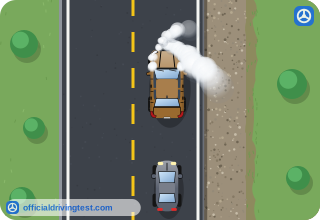
- Stop in your lane so that other drivers can see you
- Keep driving to the next exit at low speed
- Pull off the road as far as possible or exit the freeway
- Stop and stand in the lane to wave traffic by
Show answer
Correct answer: Pull off the road as far as possible or exit the freeway
The handbook says to pull off as far as possible or leave the freeway entirely, since a damaged tire or rim is better than risking your life.
Source: Utah Driver Handbook (2026 edition (new 2026 laws effective May 6, 2026)), page 66 · Open this page in the manual (Manual page 66)
-
You are off to the side of the road and need help. What does the handbook say to do?
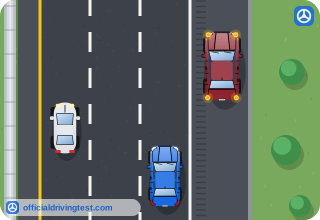
- Walk along the shoulder to the next exit right away
- Stay in your vehicle as much as possible and walk little on the road
- Stand behind your vehicle in the lane to signal to drivers
- Wait outside the vehicle in the nearest traffic lane
Show answer
Correct answer: Stay in your vehicle as much as possible and walk little on the road
The handbook says to stay in your vehicle as much as possible and keep walking on the road to a minimum when you are off to the side of the road and need help.
Source: Utah Driver Handbook (2026 edition (new 2026 laws effective May 6, 2026)), page 66 · Open this page in the manual (Manual page 66)
-
If you need assistance and do not have access to a mobile device, what should you do?
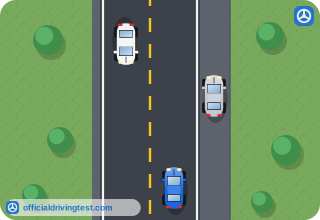
- Flash your high beams at passing traffic
- Keep your engine revving so others notice you
- Lay a blanket across the road behind your car
- Leave the hood up and your hazard lights on
Show answer
Correct answer: Leave the hood up and your hazard lights on
Raising the hood and leaving the hazard lights on tells the traveling public you need assistance.
Source: Utah Driver Handbook (2026 edition (new 2026 laws effective May 6, 2026)), page 66 · Open this page in the manual (Manual page 66)
-
If you need assistance on the road and have a mobile device, whom should you call?
- The local dispatcher
- Your car dealer
- A friend who lives far away
- The Division of Motor Vehicles
Show answer
Correct answer: The local dispatcher
The handbook says to use your mobile device to call the local dispatcher if you need assistance.
Source: Utah Driver Handbook (2026 edition (new 2026 laws effective May 6, 2026)), page 66 · Open this page in the manual (Manual page 66)
-
Which of these is one of the handbook's simple rules for preventing vehicle-malfunction emergencies?
- Keep the tank nearly empty to save weight
- Carry spare fuel in the passenger area
- Be sure your vehicle has enough fuel
- Fill the tank only when the light comes on
Show answer
Correct answer: Be sure your vehicle has enough fuel
One of the simple rules to prevent vehicle-malfunction emergencies is to be sure the vehicle has enough fuel.
Source: Utah Driver Handbook (2026 edition (new 2026 laws effective May 6, 2026)), page 66 · Open this page in the manual (Manual page 66)
-
What does the handbook recommend you do before a trip to help in an emergency?
- Drive without stopping until you arrive there
- Inform others when to expect you at your destination
- Tell no one so you are not delayed
- Plan to arrive after dark to avoid traffic
Show answer
Correct answer: Inform others when to expect you at your destination
The handbook says to inform family members or other persons when to expect you at your destination.
Source: Utah Driver Handbook (2026 edition (new 2026 laws effective May 6, 2026)), page 66 · Open this page in the manual (Manual page 66)
-
Where should you keep an emergency kit with blankets, extra food and water?
- Under the driver's seat only
- On the front passenger floor
- On the roof of your vehicle
- In the trunk of your vehicle
Show answer
Correct answer: In the trunk of your vehicle
The handbook recommends an emergency kit in the trunk with blankets, extra food and water.
Source: Utah Driver Handbook (2026 edition (new 2026 laws effective May 6, 2026)), page 66 · Open this page in the manual (Manual page 66)
-
According to the handbook, what is the first action for most drivers during an emergency?
- To stop
- To speed up
- To honk the horn
- To swerve left
Show answer
Correct answer: To stop
The handbook says that in an emergency the first action for most drivers is to stop.
Source: Utah Driver Handbook (2026 edition (new 2026 laws effective May 6, 2026)), page 66 · Open this page in the manual (Manual page 66)
-
What does a brake warning light tell you?
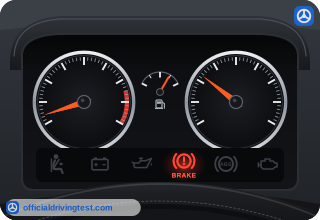
- That your brake fluid has just been changed
- That your parking brake needs adjusting soon
- That your brakes are not working
- That your tires are low on air
Show answer
Correct answer: That your brakes are not working
The handbook says a brake warning light tells you that your brakes are not working.
Source: Utah Driver Handbook (2026 edition (new 2026 laws effective May 6, 2026)), page 66 · Open this page in the manual (Manual page 66)
-
What should you do if you see the brake warning light?
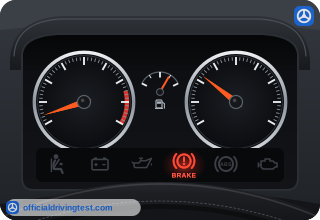
- Drive carefully to the nearest exit
- Do not drive
- Keep driving at a low speed
- Drive only at night when traffic is light
Show answer
Correct answer: Do not drive
The handbook says not to drive if you see the brake warning light.
Source: Utah Driver Handbook (2026 edition (new 2026 laws effective May 6, 2026)), page 66 · Open this page in the manual (Manual page 66)
-
If your brakes stop working while you are driving, what should you use?
- The turn signal
- The accelerator pedal
- Reverse gear
- The parking brake
Show answer
Correct answer: The parking brake
The handbook tells you to use the parking brake if the brakes stop working.
Source: Utah Driver Handbook (2026 edition (new 2026 laws effective May 6, 2026)), page 66 · Open this page in the manual (Manual page 66)
-
How should you apply the parking brake when your regular brakes fail?
- Slowly, to avoid locking the rear wheels
- Quickly and as hard as possible
- In short, rapid pumps
- Only after you turn off the engine
Show answer
Correct answer: Slowly, to avoid locking the rear wheels
Applying the parking brake slowly keeps the rear wheels from locking.
Source: Utah Driver Handbook (2026 edition (new 2026 laws effective May 6, 2026)), page 66 · Open this page in the manual (Manual page 66)
-
While using the parking brake because your brakes failed, what should you be ready to do?
- Shift into reverse
- Turn the steering wheel hard
- Release the brake if you start to skid
- Pull the brake harder if you skid
Show answer
Correct answer: Release the brake if you start to skid
If the vehicle starts to skid, you should be ready to release the parking brake.
Source: Utah Driver Handbook (2026 edition (new 2026 laws effective May 6, 2026)), page 66 · Open this page in the manual (Manual page 66)
-
What should you do if the parking brake also fails?
- Keep driving slowly until you reach a repair shop
- Turn off the engine and look for a safe place to stop
- Shift into reverse and back up slowly
- Press the brake pedal and the gas pedal together
Show answer
Correct answer: Turn off the engine and look for a safe place to stop
If the parking brake fails, turn off the engine and stop well off the roadway, because you must not drive without brakes.
Source: Utah Driver Handbook (2026 edition (new 2026 laws effective May 6, 2026)), page 67 · Open this page in the manual (Manual page 67)
-
What does ABS (Anti-lock Braking System) help you do?
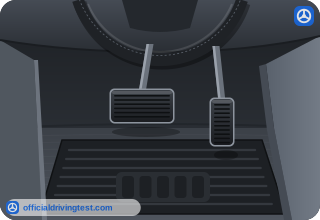
- Stop in a shorter distance than any other system
- Brake without pressing the pedal
- Steer without holding the steering wheel
- Stop without skidding and keep steering control
Show answer
Correct answer: Stop without skidding and keep steering control
The handbook says ABS helps you stop without skidding and helps keep steering control.
Source: Utah Driver Handbook (2026 edition (new 2026 laws effective May 6, 2026)), page 67 · Open this page in the manual (Manual page 67)
-
How do you use ABS when you must stop quickly?
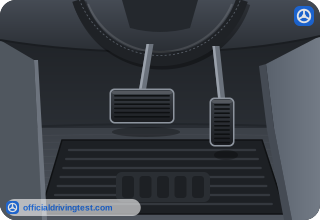
- Press the brake pedal as hard as possible
- Pump the brake pedal quickly
- Tap the brake pedal and release it
- Press lightly and slowly increase the force
Show answer
Correct answer: Press the brake pedal as hard as possible
ABS only works if you stay on the brake pedal, so you press hard and keep applying pressure.
Source: Utah Driver Handbook (2026 edition (new 2026 laws effective May 6, 2026)), page 67 · Open this page in the manual (Manual page 67)
-
What is normal when ABS is working?
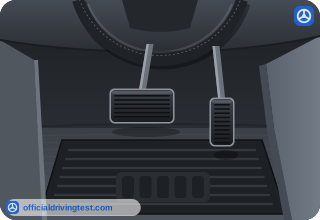
- The steering wheel will lock until you release the pedal
- The brakes will stop working for a moment
- The pedal may vibrate and you may hear a clicking noise
- The vehicle can no longer be steered at all
Show answer
Correct answer: The pedal may vibrate and you may hear a clicking noise
A vibrating pedal and a clicking noise are normal, and you can still steer with ABS on.
Source: Utah Driver Handbook (2026 edition (new 2026 laws effective May 6, 2026)), page 67 · Open this page in the manual (Manual page 67)
-
If your vehicle does not have ABS, where does the handbook tell you to look for how to use the brakes?
- On the dashboard warning label
- In your vehicle's owner's manual
- In the Utah Driver Handbook index
- On the inside of the driver's door
Show answer
Correct answer: In your vehicle's owner's manual
The handbook refers drivers without ABS to their vehicle's owner's manual for how to use the brakes.
Source: Utah Driver Handbook (2026 edition (new 2026 laws effective May 6, 2026)), page 67 · Open this page in the manual (Manual page 67)
-
Why must you make sure other drivers can see your disabled vehicle?
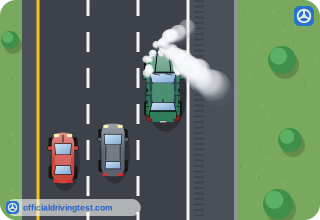
- Disabled vehicles can be towed only when other drivers see them
- Drivers are required to stop beside any disabled vehicle
- Insurance pays more when a disabled vehicle is seen
- Drivers often do not see a disabled vehicle until it is too late
Show answer
Correct answer: Drivers often do not see a disabled vehicle until it is too late
Drivers who fail to notice a disabled vehicle in time cause crashes, so you must make it visible.
Source: Utah Driver Handbook (2026 edition (new 2026 laws effective May 6, 2026)), page 67 · Open this page in the manual (Manual page 67)
-
If your vehicle breaks down, you attach something to the antenna or door handle. What color should it be?
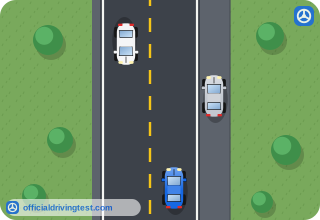
- White or orange
- Yellow or green
- Black or brown
- Blue or purple
Show answer
Correct answer: White or orange
The handbook says to attach something white or orange to the antenna or door handle.
Source: Utah Driver Handbook (2026 edition (new 2026 laws effective May 6, 2026)), page 67 · Open this page in the manual (Manual page 67)
-
If your vehicle breaks down, how far behind it should you put emergency flares or triangles?
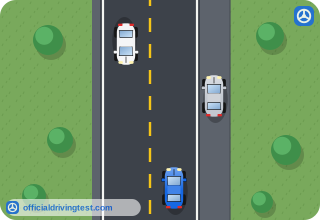
- 25 to 50 feet
- 500 to 600 feet
- 200 to 300 feet
- 1,000 to 1,500 feet
Show answer
Correct answer: 200 to 300 feet
Flares or triangles 200 to 300 feet behind the vehicle give other drivers time to change lanes or slow down.
Source: Utah Driver Handbook (2026 edition (new 2026 laws effective May 6, 2026)), page 67 · Open this page in the manual (Manual page 67)
-
Whom should you call about a breakdown, according to the handbook?
- The Driver License Division
- Law enforcement (911)
- Your insurance agent only
- The Division of Motor Vehicles
Show answer
Correct answer: Law enforcement (911)
The handbook lists calling law enforcement (911) about the breakdown as one of the steps.
Source: Utah Driver Handbook (2026 edition (new 2026 laws effective May 6, 2026)), page 67 · Open this page in the manual (Manual page 67)
-
What should you do right away with your vehicle if you have a breakdown?
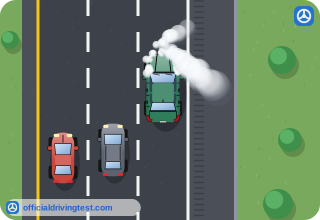
- Leave it in the lane with the engine running
- Leave it in the lane and walk to safety
- Move it only if a police officer asks you to
- Get it off the roadway and away from traffic
Show answer
Correct answer: Get it off the roadway and away from traffic
The first step after a breakdown is to get the vehicle off the roadway and away from traffic.
Source: Utah Driver Handbook (2026 edition (new 2026 laws effective May 6, 2026)), page 67 · Open this page in the manual (Manual page 67)
-
The engine shuts off while you are driving. What is true about the steering wheel?
- It may be hard to turn, but you can turn it
- It locks and cannot be turned
- It turns more easily than usual
- It turns only after the engine is restarted
Show answer
Correct answer: It may be hard to turn, but you can turn it
After a power failure the steering wheel may be hard to turn, but you can still turn it, so you keep a firm grip.
Source: Utah Driver Handbook (2026 edition (new 2026 laws effective May 6, 2026)), page 67 · Open this page in the manual (Manual page 67)
-
After a power failure you pull off the road and the engine will not restart. What should you do?
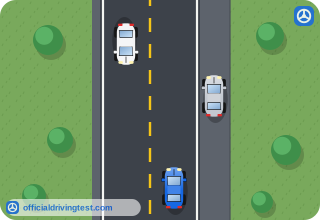
- Wait with the hood closed and the emergency flashers off
- Keep trying to restart the engine until it starts
- Raise the hood, turn on the emergency flashers, call for help
- Lock the doors and wait without any signals
Show answer
Correct answer: Raise the hood, turn on the emergency flashers, call for help
If the engine will not start, you raise the hood, turn on the emergency flashers, and call for help.
Source: Utah Driver Handbook (2026 edition (new 2026 laws effective May 6, 2026)), page 67 · Open this page in the manual (Manual page 67)
-
How should you grip the steering wheel to quickly steer around a hazard?
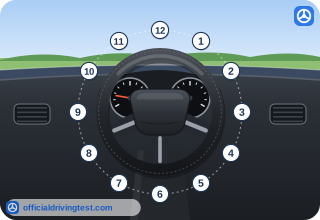
- With one hand on the top of the wheel
- With a good grip using both hands
- With your palms resting on the rim
- With two fingers on the lower rim
Show answer
Correct answer: With a good grip using both hands
To swerve safely, you need a good grip with both hands on the steering wheel.
Source: Utah Driver Handbook (2026 edition (new 2026 laws effective May 6, 2026)), page 67 · Open this page in the manual (Manual page 67)
-
After you have steered around a hazard, what should you do?
- Brake hard to stop at once
- Keep going in the same direction
- Speed up to leave the hazard behind
- Straighten your vehicle and slow down
Show answer
Correct answer: Straighten your vehicle and slow down
Once the hazard is missed, you straighten the vehicle and slow down.
Source: Utah Driver Handbook (2026 edition (new 2026 laws effective May 6, 2026)), page 67 · Open this page in the manual (Manual page 67)
-
If your vehicle is speeding out of control because the gas pedal is stuck, what should you do first?
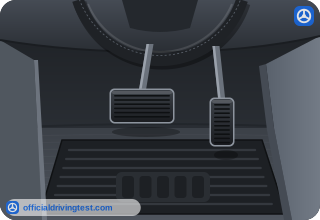
- Shift to neutral
- Shift to park
- Switch off the ignition and coast
- Press the gas pedal repeatedly
Show answer
Correct answer: Shift to neutral
With a stuck gas pedal, you shift to neutral, then look for a safe place to pull off, steer smoothly and brake gently.
Source: Utah Driver Handbook (2026 edition (new 2026 laws effective May 6, 2026)), page 67 · Open this page in the manual (Manual page 67)
-
If a front tire blows out, which way will your vehicle pull?
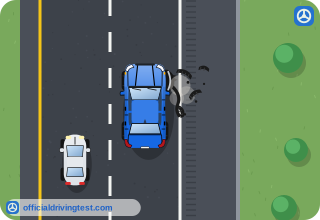
- Hard away from the blown tire
- Straight ahead with no pull
- Hard toward the blown tire
- Toward the opposite side of the vehicle
Show answer
Correct answer: Hard toward the blown tire
The vehicle pulls hard toward the blown tire, and you must not slam on the brakes.
Source: Utah Driver Handbook (2026 edition (new 2026 laws effective May 6, 2026)), page 67 · Open this page in the manual (Manual page 67)
-
What should you not do if a front tire blows out?
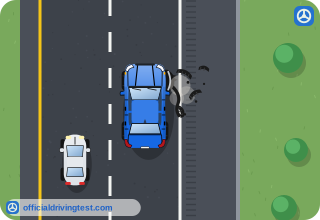
- Hold the steering wheel firmly
- Slam on the brakes
- Take your foot off the gas pedal
- Turn on the emergency flashers
Show answer
Correct answer: Slam on the brakes
The handbook says not to slam on the brakes after a front tire blowout.
Source: Utah Driver Handbook (2026 edition (new 2026 laws effective May 6, 2026)), page 67 · Open this page in the manual (Manual page 67)
-
What will your vehicle do if a rear tire blows out?
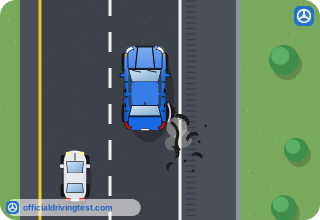
- Pull hard toward the opposite side of the road
- Speed up and steer itself straight ahead
- Lift and slide sideways with no warning
- Wobble, shake, and pull toward the blown tire
Show answer
Correct answer: Wobble, shake, and pull toward the blown tire
A rear blowout makes the vehicle wobble, shake and pull toward the blown tire.
Source: Utah Driver Handbook (2026 edition (new 2026 laws effective May 6, 2026)), page 67 · Open this page in the manual (Manual page 67)
-
What should you do if a tire goes flat while you are driving?
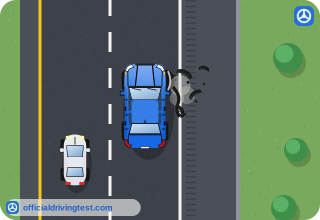
- Grip the wheel firmly, steer straight, slow gradually, and do not brake
- Brake hard and steer toward the shoulder as quickly as you can
- Press the gas pedal to keep control of the vehicle
- Turn off the engine and brake as hard as you can
Show answer
Correct answer: Grip the wheel firmly, steer straight, slow gradually, and do not brake
For a flat tire you steer straight, slow gradually and take your foot off the gas, and you do not brake.
Source: Utah Driver Handbook (2026 edition (new 2026 laws effective May 6, 2026)), page 67 · Open this page in the manual (Manual page 67)
-
After a tire problem, when should you brake and where should you not stop?
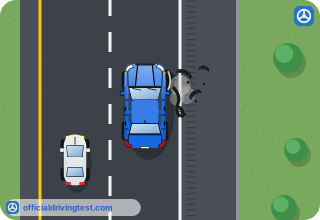
- Brake hard to stop as quickly as possible on the road
- Speed up and stop on the road after the tire is fixed
- Brake gently only if you must, and do not stop on the road
- Stop on the road so other drivers can see you
Show answer
Correct answer: Brake gently only if you must, and do not stop on the road
Let the vehicle slow down, brake gently only if you must, and pull off to a safe, level spot rather than stopping on the road.
Source: Utah Driver Handbook (2026 edition (new 2026 laws effective May 6, 2026)), page 67 · Open this page in the manual (Manual page 67)
-
What should you do if your wheels drop off the paved road surface?
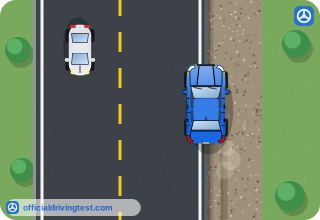
- Brake hard and turn sharply back onto the pavement
- Slow down gradually and then turn back onto the roadway
- Speed up to climb back onto the road
- Turn sharply back onto the road before slowing
Show answer
Correct answer: Slow down gradually and then turn back onto the roadway
Drop-offs cause crashes unless you handle them right: do not panic, slow down gradually, then turn back onto the roadway.
Source: Utah Driver Handbook (2026 edition (new 2026 laws effective May 6, 2026)), page 68 · Open this page in the manual (Manual page 68)
-
Which of these may NOT receive a copy of a crash report?
- A witness to the crash
- An attorney
- A licensed private investigator
- An insurance company
Show answer
Correct answer: A witness to the crash
Crash reports can go to persons involved in the crash, excluding witnesses, and to others the law lists.
Source: Utah Driver Handbook (2026 edition (new 2026 laws effective May 6, 2026)), page 69 · Open this page in the manual (Manual page 69)
-
Which information may be released to the news media about a crash?
- The driver's exact home street address
- The driver's license number
- The location and description of the crash
- The driver's phone number
Show answer
Correct answer: The location and description of the crash
Information to the media is limited to name, age, sex, city of residence, vehicle make and model, and the location and description of the crash.
Source: Utah Driver Handbook (2026 edition (new 2026 laws effective May 6, 2026)), page 69 · Open this page in the manual (Manual page 69)
-
A disabled vehicle must display warning devices if it is at least how wide or how long?
- 80 inches wide or 30 feet long
- 70 inches wide or 25 feet long
- 90 inches wide or 35 feet long
- 96 inches wide or 40 feet long
Show answer
Correct answer: 80 inches wide or 30 feet long
Warning devices are required when a vehicle at least 80 inches wide or 30 feet long is disabled or stopped along the road for more than 10 minutes.
Source: Utah Driver Handbook (2026 edition (new 2026 laws effective May 6, 2026)), page 93 · Open this page in the manual (Manual page 93)
-
Warning devices must be displayed when a large vehicle is disabled or stopped along the road for more than how long?
- 5 minutes
- 15 minutes
- 10 minutes
- 30 minutes
Show answer
Correct answer: 10 minutes
The requirement applies once the vehicle has been disabled or stopped along the road for more than 10 minutes.
Source: Utah Driver Handbook (2026 edition (new 2026 laws effective May 6, 2026)), page 93 · Open this page in the manual (Manual page 93)
-
In which situation are warning devices not required?
- When you are stopped on the shoulder waiting for a tow truck
- When you are lawfully picking up or letting off passengers
- When your vehicle is disabled and it is raining hard
- When you have stopped to rest for more than 10 minutes
Show answer
Correct answer: When you are lawfully picking up or letting off passengers
The handbook lists lawfully picking up or letting off passengers as one case where warning devices are not required.
Source: Utah Driver Handbook (2026 edition (new 2026 laws effective May 6, 2026)), page 93 · Open this page in the manual (Manual page 93)
-
In an emergency, what is the first of the two simple steps for placing warning devices?
- Place a flare on the roof of the vehicle to be seen from far away
- Place a device 200 feet behind the vehicle before anything else
- Wait 10 minutes to see if help arrives before placing any device
- Place a device to the side of the vehicle toward the nearest oncoming traffic
Show answer
Correct answer: Place a device to the side of the vehicle toward the nearest oncoming traffic
First you immediately place a flare, lighted fuse, lantern, or reflector to the side of the vehicle, in the direction of the nearest oncoming traffic.
Source: Utah Driver Handbook (2026 edition (new 2026 laws effective May 6, 2026)), page 93 · Open this page in the manual (Manual page 93)
-
How far in front of and behind your vehicle do you place flares, electric lights, or reflectors?
- 100 feet
- 50 feet
- 150 feet
- 300 feet
Show answer
Correct answer: 100 feet
After the first device, you place flares, lights, or reflectors 100 feet to the front and to the rear of the vehicle.
Source: Utah Driver Handbook (2026 edition (new 2026 laws effective May 6, 2026)), page 93 · Open this page in the manual (Manual page 93)
-
A warning device on the traffic side of your vehicle must be at least how far from the rear of the vehicle?
- 5 feet
- 25 feet
- 10 feet
- 50 feet
Show answer
Correct answer: 10 feet
A device is also placed on the traffic side of, and not less than 10 feet from, the rear of your vehicle.
Source: Utah Driver Handbook (2026 edition (new 2026 laws effective May 6, 2026)), page 93 · Open this page in the manual (Manual page 93)
-
Which vehicles may not carry flares and fuses?
- Vehicles that are towing another vehicle with a chain or cable
- Vehicles transporting explosives, flammable liquids, or compressed gas
- Vehicles transporting passengers for hire across state lines
- Vehicles hauling heavy loads of sand, gravel, or farm produce
Show answer
Correct answer: Vehicles transporting explosives, flammable liquids, or compressed gas
Flares and fuses may not be carried in vehicles that transport explosives, flammable liquids, or compressed gas.
Source: Utah Driver Handbook (2026 edition (new 2026 laws effective May 6, 2026)), page 93 · Open this page in the manual (Manual page 93)
-
On a one-way street, how far to the rear should the rear flag be placed?
- 150 feet
- 300 feet
- 400 feet
- 200 feet
Show answer
Correct answer: 200 feet
On a one-way street the rear flag goes 200 feet to the rear.
Source: Utah Driver Handbook (2026 edition (new 2026 laws effective May 6, 2026)), page 93 · Open this page in the manual (Manual page 93)
-
Warning devices need not be displayed if sufficient light reveals persons or vehicles from what distance?
- 1,000 feet
- 250 feet
- 750 feet
- 2,000 feet
Show answer
Correct answer: 1,000 feet
If there is enough light for persons or vehicles to be seen from 1,000 feet, warning devices need not be displayed.
Source: Utah Driver Handbook (2026 edition (new 2026 laws effective May 6, 2026)), page 93 · Open this page in the manual (Manual page 93)
-
Your vehicle breaks down close to a curve or hilltop that blocks the view. At most, how far from the vehicle may the warning device in that direction be placed?
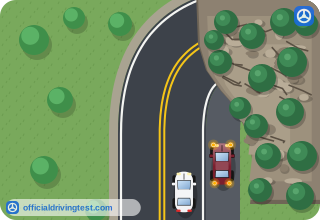
- 200 feet
- 750 feet
- 500 feet
- 1,000 feet
Show answer
Correct answer: 500 feet
The device must give ample warning to approaching motorists, but it may not be placed more than 500 feet from the vehicle.
Source: Utah Driver Handbook (2026 edition (new 2026 laws effective May 6, 2026)), page 93 · Open this page in the manual (Manual page 93)
-
Where do you place warning devices if your vehicle is entirely off the road?
- On the shoulder, as close as possible to the road surface
- In the center of the nearest traffic lane
- On the shoulder, as far from the road surface as possible
- On the roof of your vehicle
Show answer
Correct answer: On the shoulder, as close as possible to the road surface
A vehicle that is completely off the road has its devices placed on the shoulder as close as possible to the road surface.
Source: Utah Driver Handbook (2026 edition (new 2026 laws effective May 6, 2026)), page 93 · Open this page in the manual (Manual page 93)
-
How should you handle a lighted flare or fuse?
- Hold it close to your body so it stays steady
- Hold it directly in front of your face to watch it burn
- Keep the lighted end well away from your face and eyes
- Hold it against your vehicle to keep it in place
Show answer
Correct answer: Keep the lighted end well away from your face and eyes
The lighted end must be kept well away from the face and eyes because fuses especially can cause nasty burns.
Source: Utah Driver Handbook (2026 edition (new 2026 laws effective May 6, 2026)), page 94 · Open this page in the manual (Manual page 94)
-
What does the handbook say about attaching a flare or fuse to your vehicle?
- It is allowed if the vehicle is stopped off the road
- It is hazardous and also illegal
- It is allowed only at night
- It is legal but hazardous
Show answer
Correct answer: It is hazardous and also illegal
Attaching a flare or fuse to your vehicle is both hazardous and illegal.
Source: Utah Driver Handbook (2026 edition (new 2026 laws effective May 6, 2026)), page 94 · Open this page in the manual (Manual page 94)
-
Where should burning flares or fuses be kept?
- Directly beside the fuel tank
- Next to the rear tires
- Under the hood of the vehicle
- Away from fuel leakages and spills
Show answer
Correct answer: Away from fuel leakages and spills
Burning flares or fuses must be kept away from fuel leaks and spills to avoid starting a fire.
Source: Utah Driver Handbook (2026 edition (new 2026 laws effective May 6, 2026)), page 94 · Open this page in the manual (Manual page 94)
-
What should you do frequently to decrease the chance of a tire fire?
- Check tires and brakes for unusual heat
- Wash the tires and rims with water
- Reduce tire pressure to cool the tires
- Drive with the parking brake slightly applied
Show answer
Correct answer: Check tires and brakes for unusual heat
Checking tires and brakes often for unusual heat helps you catch a problem before it causes a tire fire.
Source: Utah Driver Handbook (2026 edition (new 2026 laws effective May 6, 2026)), page 94 · Open this page in the manual (Manual page 94)
-
What can result from driving for a long time on a soft or flat tire, or with a dragging brake?
- A stronger grip on the road surface
- Lower temperatures in the wheel area
- Heat buildup that can cause a tire fire
- Extra wear only on the steering linkage
Show answer
Correct answer: Heat buildup that can cause a tire fire
Driving on a soft or flat tire or with a dragging brake can build up heat and cause a tire fire.
Source: Utah Driver Handbook (2026 edition (new 2026 laws effective May 6, 2026)), page 94 · Open this page in the manual (Manual page 94)
-
What should you do about a hot tire?
- Continue driving and check the tire at your next planned stop
- Stay with the vehicle until the tire is cool or change it
- Drive faster so air flow cools the tire
- Leave the vehicle and return when the tire is cool
Show answer
Correct answer: Stay with the vehicle until the tire is cool or change it
A hot tire must never be ignored: either stay with the vehicle until the tire cools or change the tire.
Source: Utah Driver Handbook (2026 edition (new 2026 laws effective May 6, 2026)), page 94 · Open this page in the manual (Manual page 94)
-
To help avoid heat problems and tire fires, what should you always do before moving the vehicle?
- Set the parking brake
- Check the oil level
- Turn on the hazard lights
- Release the parking brake
Show answer
Correct answer: Release the parking brake
Always releasing the parking brake before moving the vehicle is one of the habits that helps prevent a tire fire.
Source: Utah Driver Handbook (2026 edition (new 2026 laws effective May 6, 2026)), page 94 · Open this page in the manual (Manual page 94)
-
Which condition makes the odds of a fire very high?
- Dual tires that are partially deflated
- Tires inflated to the recommended pressure
- Tires that are cold after a long rest
- A parking brake that is fully released
Show answer
Correct answer: Dual tires that are partially deflated
Dragging or overheating brakes, leaking oil seals, or partially deflated dual tires make a fire very likely.
Source: Utah Driver Handbook (2026 edition (new 2026 laws effective May 6, 2026)), page 94 · Open this page in the manual (Manual page 94)
-
What is probably the best remedy for a tire fire?
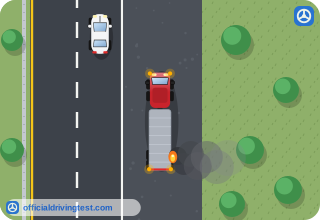
- A fire extinguisher aimed at the tire
- Waiting for the tire to burn out
- An ample water supply
- Driving faster to cool the tire
Show answer
Correct answer: An ample water supply
The handbook says plenty of water is probably the best remedy for a tire fire, and you should get to a fire station if you can.
Source: Utah Driver Handbook (2026 edition (new 2026 laws effective May 6, 2026)), page 94 · Open this page in the manual (Manual page 94)
-
What does the handbook say about using fire extinguishers on a tire fire?
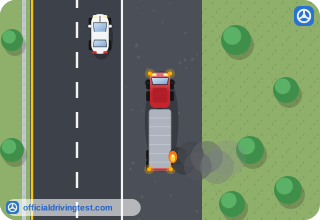
- They are the best remedy
- They are usually not very practical
- They work better than water
- They should be emptied quickly onto the tire
Show answer
Correct answer: They are usually not very practical
For a tire fire, fire extinguishers are usually not very practical.
Source: Utah Driver Handbook (2026 edition (new 2026 laws effective May 6, 2026)), page 94 · Open this page in the manual (Manual page 94)
-
What can shoveling dirt on a burning tire sometimes do?
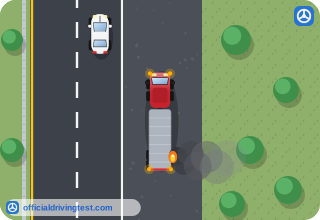
- Put the fire out completely and permanently
- Make the fire spread to the vehicle
- Keep the tire on the rim until you find water
- Slow the fire enough to let you get the tire off
Show answer
Correct answer: Slow the fire enough to let you get the tire off
Dirt can sometimes slow a tire fire enough for you to remove the tire.
Source: Utah Driver Handbook (2026 edition (new 2026 laws effective May 6, 2026)), page 94 · Open this page in the manual (Manual page 94)
-
You cannot get a burning tire off. What does the handbook say to try?
- Drive until the tire burns off the rim or you reach a good water source
- Park and wait beside the road until the fire goes out on its own
- Stay parked and cover the tire with a blanket until help arrives
- Drive straight to the nearest parking lot and shut off the engine
Show answer
Correct answer: Drive until the tire burns off the rim or you reach a good water source
Driving on until the tire burns off the rim or you reach water is better than sitting and waiting, because the vehicle will probably burn up.
Source: Utah Driver Handbook (2026 edition (new 2026 laws effective May 6, 2026)), page 94 · Open this page in the manual (Manual page 94)
-
As a last resort in a tire fire, what should you do?
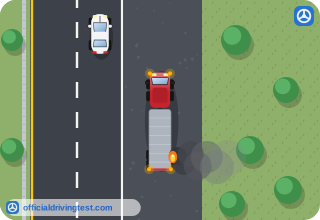
- Disconnect the battery
- Jack up the vehicle
- Drop your trailer
- Cut the tire loose
Show answer
Correct answer: Drop your trailer
Dropping the trailer saves at least one of the two units.
Source: Utah Driver Handbook (2026 edition (new 2026 laws effective May 6, 2026)), page 94 · Open this page in the manual (Manual page 94)
-
How should you use the limited contents of a fire extinguisher?
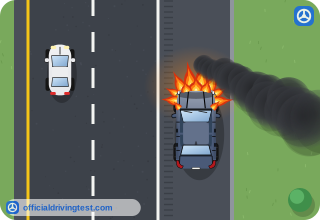
- Empty it quickly in one long burst
- Aim carefully so every burst counts
- Spray widely to cover the whole fire
- Hold it high and spray in a wide arc
Show answer
Correct answer: Aim carefully so every burst counts
The contents of an extinguisher are limited, so you should aim carefully and not waste them.
Source: Utah Driver Handbook (2026 edition (new 2026 laws effective May 6, 2026)), page 94 · Open this page in the manual (Manual page 94)
-
When fighting a fire, where should the wind be?
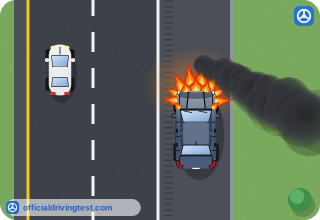
- In front of you
- At your left side
- It makes no difference
- At your back
Show answer
Correct answer: At your back
Fighting a fire with the wind at your back makes an extinguisher more effective and keeps poisonous or caustic gases out of your face.
Source: Utah Driver Handbook (2026 edition (new 2026 laws effective May 6, 2026)), page 94 · Open this page in the manual (Manual page 94)
-
What happens if you fight a gasoline or oil fire with water?
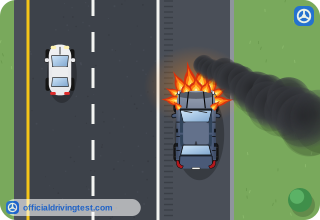
- It will only spread the fire
- It will cool the fuel and put out the fire
- It will smother the flames quickly
- It will make the fire burn out sooner
Show answer
Correct answer: It will only spread the fire
Water spreads a gasoline or oil fire instead of putting it out, so you need to know the different types of fires.
Source: Utah Driver Handbook (2026 edition (new 2026 laws effective May 6, 2026)), page 94 · Open this page in the manual (Manual page 94)