Utah: Emergencies and crashes — Skidding, Trip Planning, Vehicle Underwater Practice Test
Questions in this part include: “Before any trip, which of these does the handbook say to check?” · “Why should you consider the time of day before going on a trip?”
Independent educational site · not affiliated with any government agency or DMV
Ready? Test yourself
- Instant feedback with an explanation
- Every answer cites its source in the manual
- Your best score is saved on this device
- Keyboard: press 1 to 4 to answer and Enter for the next question
Questions are original and based on the official manual "Utah Driver Handbook" (2026 edition (new 2026 laws effective May 6, 2026)), Utah Department of Public Safety, Driver License Division.
All 18 questions in this practice test
Take the test above first, then use this list to study. Tap “Show answer” to see the correct answer and explanation.
Show the questions and answersHide the questions
-
To keep a skid from happening, how should you adjust your speed?

- Slow down to a speed you can control
- Keep a steady speed and brake lightly
- Speed up slightly to keep traction
- Drive the posted limit in every case
Show answer
Correct answer: Slow down to a speed you can control
The best policy is to prevent a skid by slowing to a speed you can control.
Source: Utah Driver Handbook (2026 edition (new 2026 laws effective May 6, 2026)), page 62 · Open this page in the manual (Manual page 62)
-
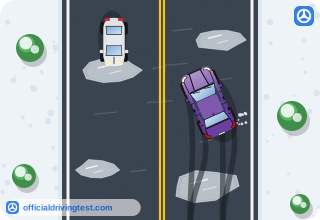
If you do skid, what should you do with your foot on the gas pedal?
- Press harder to power through
- Pump it quickly
- Slowly take it off the gas pedal
- Hold it steady
Show answer
Correct answer: Slowly take it off the gas pedal
When a skid starts, the handbook says to ease your foot slowly off the gas.
Source: Utah Driver Handbook (2026 edition (new 2026 laws effective May 6, 2026)), page 62 · Open this page in the manual (Manual page 62)
-
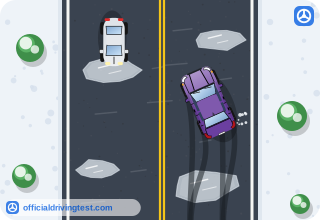
If your rear wheels skid to the right, which way should you turn your front wheels?
- To the left
- To the right
- Straight ahead
- Back and forth quickly
Show answer
Correct answer: To the right
You steer in the direction the rear wheels are skidding.
Source: Utah Driver Handbook (2026 edition (new 2026 laws effective May 6, 2026)), page 62 · Open this page in the manual (Manual page 62)
-
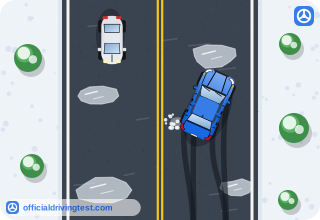
If your rear wheels skid to the left, which way should you turn your front wheels?
- To the right
- Straight ahead
- Back and forth quickly
- To the left
Show answer
Correct answer: To the left
You steer in the direction the rear wheels are skidding.
Source: Utah Driver Handbook (2026 edition (new 2026 laws effective May 6, 2026)), page 62 · Open this page in the manual (Manual page 62)
-
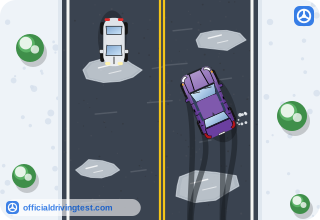
Why should you not steer too far when correcting a skid?
- It will make the car skid the other way
- It will lock the steering wheel
- It will cause the tires to go flat
- It will make the engine stall
Show answer
Correct answer: It will make the car skid the other way
Oversteering during a skid can send the car skidding the other way.
Source: Utah Driver Handbook (2026 edition (new 2026 laws effective May 6, 2026)), page 62 · Open this page in the manual (Manual page 62)
-
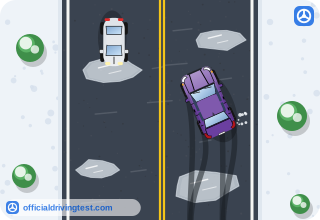
What should you avoid doing with the brakes during a skid?
- Touching them at all
- Keeping your foot near them
- Slamming on them
- Checking them before a trip
Show answer
Correct answer: Slamming on them
The handbook says not to slam on your brakes when you skid.
Source: Utah Driver Handbook (2026 edition (new 2026 laws effective May 6, 2026)), page 62 · Open this page in the manual (Manual page 62)
-
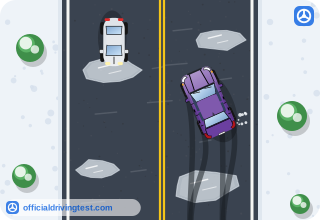
What should you do once your car regains traction after a skid?
- Brake hard to stop at once
- Straighten out your wheels
- Turn the wheels toward the shoulder
- Speed up to leave the area
Show answer
Correct answer: Straighten out your wheels
After the car regains traction, straighten the wheels.
Source: Utah Driver Handbook (2026 edition (new 2026 laws effective May 6, 2026)), page 62 · Open this page in the manual (Manual page 62)
-
Before any trip, which of these does the handbook say to check?
- The radio presets
- The seat covers
- The floor mats
- Belts and hoses
Show answer
Correct answer: Belts and hoses
Trip preparation includes checking windshields and windows, lights, tires, fluid levels, belts, hoses and brakes.
Source: Utah Driver Handbook (2026 edition (new 2026 laws effective May 6, 2026)), page 62 · Open this page in the manual (Manual page 62)
-
What does the handbook advise for the night before a trip?
- Get a good night’s sleep
- Stay up late to finish packing
- Drive part of the route in advance
- Skip dinner to avoid sleepiness
Show answer
Correct answer: Get a good night’s sleep
Being rested is part of preparing for a trip.
Source: Utah Driver Handbook (2026 edition (new 2026 laws effective May 6, 2026)), page 62 · Open this page in the manual (Manual page 62)
-
Why should you consider the time of day before going on a trip?
- To avoid driving in sunlight
- To get lower fuel prices
- To avoid congestion in city areas
- To use shorter highway routes
Show answer
Correct answer: To avoid congestion in city areas
Timing your trip helps you avoid congestion in city areas.
Source: Utah Driver Handbook (2026 edition (new 2026 laws effective May 6, 2026)), page 62 · Open this page in the manual (Manual page 62)
-
What should your route plan include for the final destination?
- The names of every town you pass
- Route, entrance and exit numbers
- The speed limit for each road
- The phone numbers of rest stops
Show answer
Correct answer: Route, entrance and exit numbers
The handbook says to plan the route including the route number and the entrance and exit numbers.
Source: Utah Driver Handbook (2026 edition (new 2026 laws effective May 6, 2026)), page 62 · Open this page in the manual (Manual page 62)
-
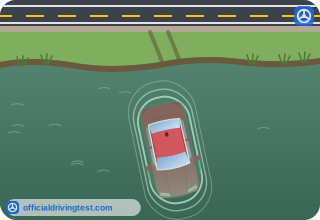
For how long will a vehicle that enters water float on the surface?
- 5 to 10 seconds
- 2 to 3 minutes
- 10 to 15 minutes
- 30 to 60 seconds
Show answer
Correct answer: 30 to 60 seconds
A vehicle floats only 30 to 60 seconds, so you must try to get out immediately.
Source: Utah Driver Handbook (2026 edition (new 2026 laws effective May 6, 2026)), page 62 · Open this page in the manual (Manual page 62)
-
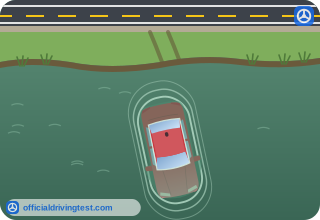
If your vehicle enters a body of water, what is the first thing the handbook says to do to get out?
- Remove your safety belt
- Turn on the hazard lights
- Call for help on a cell phone
- Open the hood
Show answer
Correct answer: Remove your safety belt
The first step in escaping a vehicle in water is to remove the safety belt.
Source: Utah Driver Handbook (2026 edition (new 2026 laws effective May 6, 2026)), page 62 · Open this page in the manual (Manual page 62)
-
After you remove your safety belt in a vehicle that has entered water, what does the handbook say to do?
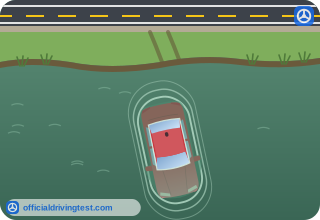
- Stay inside and wait for rescue
- Swim away through the window at once
- Lower the window and climb onto the top
- Move to the back seat and wait
Show answer
Correct answer: Lower the window and climb onto the top
After the belt is off, lower the window and climb onto the vehicle’s top.
Source: Utah Driver Handbook (2026 edition (new 2026 laws effective May 6, 2026)), page 62 · Open this page in the manual (Manual page 62)
-
What should you do before trying to swim away from a vehicle in water?
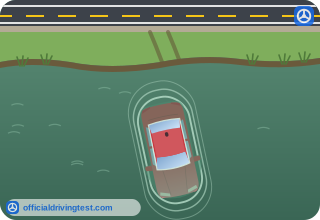
- Take off your shoes
- Assess the current of the water
- Wait for the vehicle to sink
- Turn on the headlights first
Show answer
Correct answer: Assess the current of the water
The handbook says to assess the water’s current before swimming away.
Source: Utah Driver Handbook (2026 edition (new 2026 laws effective May 6, 2026)), page 62 · Open this page in the manual (Manual page 62)
-
If your vehicle is sinking quickly and you cannot open the door or window, what should you keep on?
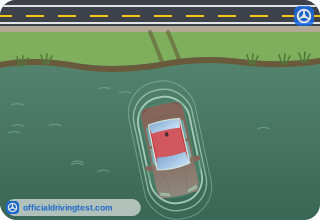
- Heavy clothing
- Your coat
- Your gloves
- Your shoes
Show answer
Correct answer: Your shoes
Take off heavy clothing that makes you sink, but keep your shoes on in case you must kick the window out.
Source: Utah Driver Handbook (2026 edition (new 2026 laws effective May 6, 2026)), page 62 · Open this page in the manual (Manual page 62)
-
If you cannot open the door or window of a vehicle in water, where will a small air pocket be?
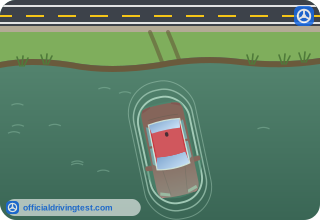
- Near the highest part of the vehicle
- Under the front seats
- Near the trunk lid
- Near the lowest part of the vehicle
Show answer
Correct answer: Near the highest part of the vehicle
An air pocket forms near whichever part of the vehicle is highest in the water.
Source: Utah Driver Handbook (2026 edition (new 2026 laws effective May 6, 2026)), page 62 · Open this page in the manual (Manual page 62)
-
If you can’t get a side window open and have kicked the window out, what should you do next?
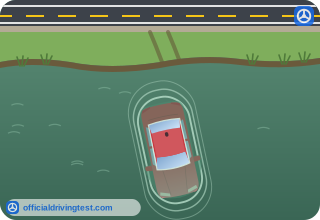
- Swim out at once without taking another breath
- Stay inside until the vehicle has stopped sinking
- Go to the air pocket for one more breath, then escape
- Close the window to trap air inside
Show answer
Correct answer: Go to the air pocket for one more breath, then escape
After kicking out the window, return to the air pocket for one more breath and then escape.
Source: Utah Driver Handbook (2026 edition (new 2026 laws effective May 6, 2026)), page 62 · Open this page in the manual (Manual page 62)