Utah: Emergencies and crashes — Brake Failure, ABS and Breakdowns Practice Test
Questions in this part include: “According to the handbook, what is the first action for most drivers during an emergency?” · “While using the parking brake because your brakes failed, what should you be ready to do?”
Independent educational site · not affiliated with any government agency or DMV
Ready? Test yourself
- Instant feedback with an explanation
- Every answer cites its source in the manual
- Your best score is saved on this device
- Keyboard: press 1 to 4 to answer and Enter for the next question
Questions are original and based on the official manual "Utah Driver Handbook" (2026 edition (new 2026 laws effective May 6, 2026)), Utah Department of Public Safety, Driver License Division.
All 16 questions in this practice test
Take the test above first, then use this list to study. Tap “Show answer” to see the correct answer and explanation.
Show the questions and answersHide the questions
-
According to the handbook, what is the first action for most drivers during an emergency?
- To stop
- To speed up
- To honk the horn
- To swerve left
Show answer
Correct answer: To stop
The handbook says that in an emergency the first action for most drivers is to stop.
Source: Utah Driver Handbook (2026 edition (new 2026 laws effective May 6, 2026)), page 66 · Open this page in the manual (Manual page 66)
-
What does a brake warning light tell you?
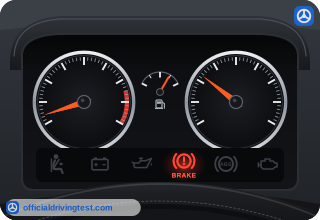
- That your brake fluid has just been changed
- That your parking brake needs adjusting soon
- That your brakes are not working
- That your tires are low on air
Show answer
Correct answer: That your brakes are not working
The handbook says a brake warning light tells you that your brakes are not working.
Source: Utah Driver Handbook (2026 edition (new 2026 laws effective May 6, 2026)), page 66 · Open this page in the manual (Manual page 66)
-
What should you do if you see the brake warning light?
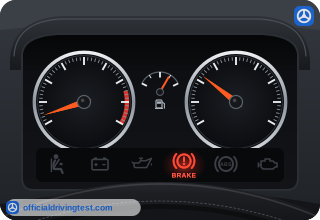
- Drive carefully to the nearest exit
- Do not drive
- Keep driving at a low speed
- Drive only at night when traffic is light
Show answer
Correct answer: Do not drive
The handbook says not to drive if you see the brake warning light.
Source: Utah Driver Handbook (2026 edition (new 2026 laws effective May 6, 2026)), page 66 · Open this page in the manual (Manual page 66)
-
If your brakes stop working while you are driving, what should you use?
- The turn signal
- The accelerator pedal
- Reverse gear
- The parking brake
Show answer
Correct answer: The parking brake
The handbook tells you to use the parking brake if the brakes stop working.
Source: Utah Driver Handbook (2026 edition (new 2026 laws effective May 6, 2026)), page 66 · Open this page in the manual (Manual page 66)
-
How should you apply the parking brake when your regular brakes fail?
- Slowly, to avoid locking the rear wheels
- Quickly and as hard as possible
- In short, rapid pumps
- Only after you turn off the engine
Show answer
Correct answer: Slowly, to avoid locking the rear wheels
Applying the parking brake slowly keeps the rear wheels from locking.
Source: Utah Driver Handbook (2026 edition (new 2026 laws effective May 6, 2026)), page 66 · Open this page in the manual (Manual page 66)
-
While using the parking brake because your brakes failed, what should you be ready to do?
- Shift into reverse
- Turn the steering wheel hard
- Release the brake if you start to skid
- Pull the brake harder if you skid
Show answer
Correct answer: Release the brake if you start to skid
If the vehicle starts to skid, you should be ready to release the parking brake.
Source: Utah Driver Handbook (2026 edition (new 2026 laws effective May 6, 2026)), page 66 · Open this page in the manual (Manual page 66)
-
What should you do if the parking brake also fails?
- Keep driving slowly until you reach a repair shop
- Turn off the engine and look for a safe place to stop
- Shift into reverse and back up slowly
- Press the brake pedal and the gas pedal together
Show answer
Correct answer: Turn off the engine and look for a safe place to stop
If the parking brake fails, turn off the engine and stop well off the roadway, because you must not drive without brakes.
Source: Utah Driver Handbook (2026 edition (new 2026 laws effective May 6, 2026)), page 67 · Open this page in the manual (Manual page 67)
-
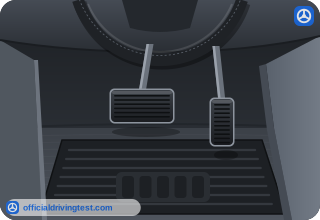
What does ABS (Anti-lock Braking System) help you do?
- Stop in a shorter distance than any other system
- Brake without pressing the pedal
- Steer without holding the steering wheel
- Stop without skidding and keep steering control
Show answer
Correct answer: Stop without skidding and keep steering control
The handbook says ABS helps you stop without skidding and helps keep steering control.
Source: Utah Driver Handbook (2026 edition (new 2026 laws effective May 6, 2026)), page 67 · Open this page in the manual (Manual page 67)
-
How do you use ABS when you must stop quickly?
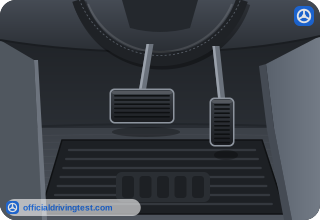
- Press the brake pedal as hard as possible
- Pump the brake pedal quickly
- Tap the brake pedal and release it
- Press lightly and slowly increase the force
Show answer
Correct answer: Press the brake pedal as hard as possible
ABS only works if you stay on the brake pedal, so you press hard and keep applying pressure.
Source: Utah Driver Handbook (2026 edition (new 2026 laws effective May 6, 2026)), page 67 · Open this page in the manual (Manual page 67)
-
What is normal when ABS is working?
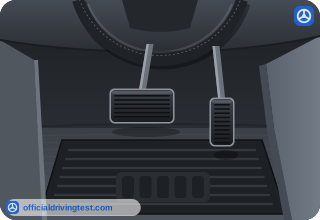
- The steering wheel will lock until you release the pedal
- The brakes will stop working for a moment
- The pedal may vibrate and you may hear a clicking noise
- The vehicle can no longer be steered at all
Show answer
Correct answer: The pedal may vibrate and you may hear a clicking noise
A vibrating pedal and a clicking noise are normal, and you can still steer with ABS on.
Source: Utah Driver Handbook (2026 edition (new 2026 laws effective May 6, 2026)), page 67 · Open this page in the manual (Manual page 67)
-
If your vehicle does not have ABS, where does the handbook tell you to look for how to use the brakes?
- On the dashboard warning label
- In your vehicle's owner's manual
- In the Utah Driver Handbook index
- On the inside of the driver's door
Show answer
Correct answer: In your vehicle's owner's manual
The handbook refers drivers without ABS to their vehicle's owner's manual for how to use the brakes.
Source: Utah Driver Handbook (2026 edition (new 2026 laws effective May 6, 2026)), page 67 · Open this page in the manual (Manual page 67)
-
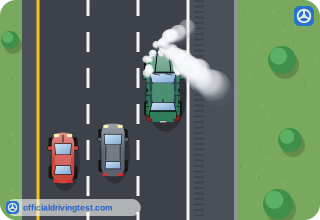
Why must you make sure other drivers can see your disabled vehicle?
- Disabled vehicles can be towed only when other drivers see them
- Drivers are required to stop beside any disabled vehicle
- Insurance pays more when a disabled vehicle is seen
- Drivers often do not see a disabled vehicle until it is too late
Show answer
Correct answer: Drivers often do not see a disabled vehicle until it is too late
Drivers who fail to notice a disabled vehicle in time cause crashes, so you must make it visible.
Source: Utah Driver Handbook (2026 edition (new 2026 laws effective May 6, 2026)), page 67 · Open this page in the manual (Manual page 67)
-
If your vehicle breaks down, you attach something to the antenna or door handle. What color should it be?
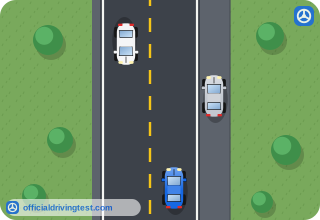
- White or orange
- Yellow or green
- Black or brown
- Blue or purple
Show answer
Correct answer: White or orange
The handbook says to attach something white or orange to the antenna or door handle.
Source: Utah Driver Handbook (2026 edition (new 2026 laws effective May 6, 2026)), page 67 · Open this page in the manual (Manual page 67)
-
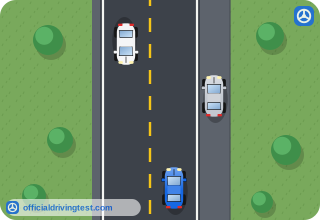
If your vehicle breaks down, how far behind it should you put emergency flares or triangles?
- 25 to 50 feet
- 500 to 600 feet
- 200 to 300 feet
- 1,000 to 1,500 feet
Show answer
Correct answer: 200 to 300 feet
Flares or triangles 200 to 300 feet behind the vehicle give other drivers time to change lanes or slow down.
Source: Utah Driver Handbook (2026 edition (new 2026 laws effective May 6, 2026)), page 67 · Open this page in the manual (Manual page 67)
-
Whom should you call about a breakdown, according to the handbook?
- The Driver License Division
- Law enforcement (911)
- Your insurance agent only
- The Division of Motor Vehicles
Show answer
Correct answer: Law enforcement (911)
The handbook lists calling law enforcement (911) about the breakdown as one of the steps.
Source: Utah Driver Handbook (2026 edition (new 2026 laws effective May 6, 2026)), page 67 · Open this page in the manual (Manual page 67)
-
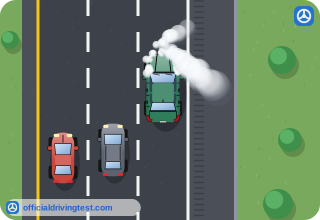
What should you do right away with your vehicle if you have a breakdown?
- Leave it in the lane with the engine running
- Leave it in the lane and walk to safety
- Move it only if a police officer asks you to
- Get it off the roadway and away from traffic
Show answer
Correct answer: Get it off the roadway and away from traffic
The first step after a breakdown is to get the vehicle off the roadway and away from traffic.
Source: Utah Driver Handbook (2026 edition (new 2026 laws effective May 6, 2026)), page 67 · Open this page in the manual (Manual page 67)