Utah: Emergencies and crashes — Crashes, Defensive Driving, Vehicle Malfunction Practice Test
Questions in this part include: “How is failing to stop at the scene of an injury crash classified?” · “What does defensive driving involve?”
Independent educational site · not affiliated with any government agency or DMV
Ready? Test yourself
- Instant feedback with an explanation
- Every answer cites its source in the manual
- Your best score is saved on this device
- Keyboard: press 1 to 4 to answer and Enter for the next question
Questions are original and based on the official manual "Utah Driver Handbook" (2026 edition (new 2026 laws effective May 6, 2026)), Utah Department of Public Safety, Driver License Division.
All 21 questions in this practice test
Take the test above first, then use this list to study. Tap “Show answer” to see the correct answer and explanation.
Show the questions and answersHide the questions
-
What must you do if you are involved in a crash?
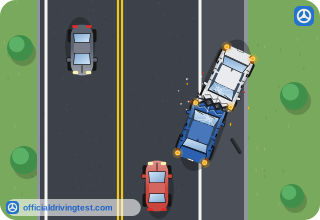
- Stop immediately
- Drive on and report it later
- Leave if no one is hurt
- Wait one hour before stopping
Show answer
Correct answer: Stop immediately
The handbook says to stop immediately when you are involved in a crash, because leaving the scene can bring severe penalties.
Source: Utah Driver Handbook (2026 edition (new 2026 laws effective May 6, 2026)), page 65 · Open this page in the manual (Manual page 65)
-
Besides losing your license, what other penalty may apply for not remaining at the scene of a crash in which you were involved?
- A fine of up to $250 with no jail time at all
- Jail of up to one year, a fine of up to $2500, or both
- A jail sentence of up to 30 days and no fine
- Community service for up to one year, or a fine
Show answer
Correct answer: Jail of up to one year, a fine of up to $2500, or both
The handbook lists a jail sentence of up to one year, a fine of up to $2500, or both.
Source: Utah Driver Handbook (2026 edition (new 2026 laws effective May 6, 2026)), page 65 · Open this page in the manual (Manual page 65)
-
How is failing to stop at the scene of an injury crash classified?
- A class B misdemeanor
- A class C misdemeanor
- A traffic infraction
- A third-degree felony
Show answer
Correct answer: A third-degree felony
Failing to stop at an injury crash is a third-degree felony in Utah.
Source: Utah Driver Handbook (2026 edition (new 2026 laws effective May 6, 2026)), page 65 · Open this page in the manual (Manual page 65)
-
You are required to render reasonable assistance to an injured person in a crash. When must you transport the person, or arrange transport, to a physician or hospital?
- If treatment is apparently necessary or the person requests it
- Only when a police officer at the scene orders it
- Only if the crash happened on a freeway or highway
- Only if the injured person is a passenger in your car
Show answer
Correct answer: If treatment is apparently necessary or the person requests it
Reasonable assistance includes transport or arranging it when treatment is apparently necessary or the injured person asks for it.
Source: Utah Driver Handbook (2026 edition (new 2026 laws effective May 6, 2026)), page 65 · Open this page in the manual (Manual page 65)
-
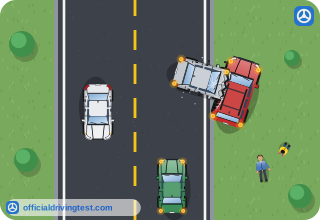
When should you move someone who appears to be seriously injured in a crash?
- Always, so they are out of the road right away
- Whenever they ask to be moved to a safer place
- Only if moving them is necessary to prevent more injury
- As soon as a bystander offers to help you move them
Show answer
Correct answer: Only if moving them is necessary to prevent more injury
You should avoid moving a seriously injured person unless that is necessary to prevent further injury.
Source: Utah Driver Handbook (2026 edition (new 2026 laws effective May 6, 2026)), page 65 · Open this page in the manual (Manual page 65)
-
A crash causes only property damage, with no injuries. What does the law allow the operator to do with the vehicle?
- Leave it in the travel lane until a police officer arrives
- Move it out of the travel lanes to a shoulder or other suitable spot
- Leave it where it is and walk away from the scene
- Drive home and report the crash to police the next day
Show answer
Correct answer: Move it out of the travel lanes to a shoulder or other suitable spot
In a property-damage-only crash the operator may move the vehicle out of the travel lanes to an adjacent shoulder or other suitable location that does not obstruct traffic.
Source: Utah Driver Handbook (2026 edition (new 2026 laws effective May 6, 2026)), page 65 · Open this page in the manual (Manual page 65)
-
At what amount of total property damage in a crash must you notify law enforcement (911) immediately?
- At least $500
- At least $1000
- At least $5000
- At least $2500
Show answer
Correct answer: At least $2500
Utah requires you to notify law enforcement immediately when a crash causes at least $2500 in total property damage (or injuries or death).
Source: Utah Driver Handbook (2026 edition (new 2026 laws effective May 6, 2026)), page 65 · Open this page in the manual (Manual page 65)
-
A crash causes an injury, but no other driver was involved. Must you notify law enforcement immediately?
- Yes, the rule applies to all crashes, even with no other driver
- No, only crashes between two drivers must be reported
- No, only crashes on a freeway must be reported
- Yes, but only if the injured person asks you to
Show answer
Correct answer: Yes, the rule applies to all crashes, even with no other driver
The reporting rule covers all crashes with injuries, death or enough property damage, regardless of whether another driver was involved.
Source: Utah Driver Handbook (2026 edition (new 2026 laws effective May 6, 2026)), page 65 · Open this page in the manual (Manual page 65)
-
Which of these must drivers exchange after a crash?
- Your Social Security number and your date of birth
- Your employer's name and the address of your workplace
- Your insurance information, including the provider's name
- Your age, height, weight, and eye color
Show answer
Correct answer: Your insurance information, including the provider's name
The handbook lists name and address, vehicle registration number, and insurance information as what must be exchanged.
Source: Utah Driver Handbook (2026 edition (new 2026 laws effective May 6, 2026)), page 65 · Open this page in the manual (Manual page 65)
-
The owner of an unattended vehicle you hit cannot be found. What must you do?
- Wait at the scene for at least 24 hours before leaving
- Leave a note with the driver's name, address, and plate number
- Drive away if the damage to the vehicle looks minor
- Leave only your phone number under the windshield wiper
Show answer
Correct answer: Leave a note with the driver's name, address, and plate number
If the owner is not available, you leave a note giving the name and address of your vehicle's driver and its plate number.
Source: Utah Driver Handbook (2026 edition (new 2026 laws effective May 6, 2026)), page 65 · Open this page in the manual (Manual page 65)
-
When is the operator of a vehicle exempt from giving the required crash information to the other persons involved?
- When the other driver was clearly at fault in the crash
- When the total property damage is less than $2500
- When the crash happens at night on a quiet street
- When the operator gives the information to a police officer there
Show answer
Correct answer: When the operator gives the information to a police officer there
Providing the required information to a police officer at the scene exempts the operator from giving it to the others involved.
Source: Utah Driver Handbook (2026 edition (new 2026 laws effective May 6, 2026)), page 65 · Open this page in the manual (Manual page 65)
-
What does defensive driving involve?
- Looking for possible crashes and mistakes other drivers may make
- Driving faster than other traffic to avoid conflicts with it
- Knowing the rules of the road and nothing more
- Staying only in the left lane of the road
Show answer
Correct answer: Looking for possible crashes and mistakes other drivers may make
Defensive driving means watching for possible crashes and for mistakes that other drivers may make.
Source: Utah Driver Handbook (2026 edition (new 2026 laws effective May 6, 2026)), page 65 · Open this page in the manual (Manual page 65)
-
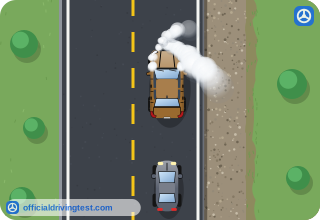
If you experience a vehicle malfunction on the road, what should you do?
- Stop in your lane so that other drivers can see you
- Keep driving to the next exit at low speed
- Pull off the road as far as possible or exit the freeway
- Stop and stand in the lane to wave traffic by
Show answer
Correct answer: Pull off the road as far as possible or exit the freeway
The handbook says to pull off as far as possible or leave the freeway entirely, since a damaged tire or rim is better than risking your life.
Source: Utah Driver Handbook (2026 edition (new 2026 laws effective May 6, 2026)), page 66 · Open this page in the manual (Manual page 66)
-
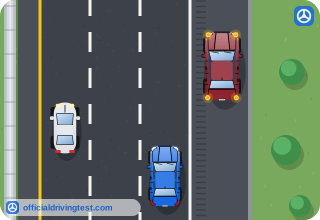
You are off to the side of the road and need help. What does the handbook say to do?
- Walk along the shoulder to the next exit right away
- Stay in your vehicle as much as possible and walk little on the road
- Stand behind your vehicle in the lane to signal to drivers
- Wait outside the vehicle in the nearest traffic lane
Show answer
Correct answer: Stay in your vehicle as much as possible and walk little on the road
The handbook says to stay in your vehicle as much as possible and keep walking on the road to a minimum when you are off to the side of the road and need help.
Source: Utah Driver Handbook (2026 edition (new 2026 laws effective May 6, 2026)), page 66 · Open this page in the manual (Manual page 66)
-
If you need assistance and do not have access to a mobile device, what should you do?
- Flash your high beams at passing traffic
- Keep your engine revving so others notice you
- Lay a blanket across the road behind your car
- Leave the hood up and your hazard lights on
Show answer
Correct answer: Leave the hood up and your hazard lights on
Raising the hood and leaving the hazard lights on tells the traveling public you need assistance.
Source: Utah Driver Handbook (2026 edition (new 2026 laws effective May 6, 2026)), page 66 · Open this page in the manual (Manual page 66)
-
If you need assistance on the road and have a mobile device, whom should you call?
- The local dispatcher
- Your car dealer
- A friend who lives far away
- The Division of Motor Vehicles
Show answer
Correct answer: The local dispatcher
The handbook says to use your mobile device to call the local dispatcher if you need assistance.
Source: Utah Driver Handbook (2026 edition (new 2026 laws effective May 6, 2026)), page 66 · Open this page in the manual (Manual page 66)
-
Which of these is one of the handbook's simple rules for preventing vehicle-malfunction emergencies?
- Keep the tank nearly empty to save weight
- Carry spare fuel in the passenger area
- Be sure your vehicle has enough fuel
- Fill the tank only when the light comes on
Show answer
Correct answer: Be sure your vehicle has enough fuel
One of the simple rules to prevent vehicle-malfunction emergencies is to be sure the vehicle has enough fuel.
Source: Utah Driver Handbook (2026 edition (new 2026 laws effective May 6, 2026)), page 66 · Open this page in the manual (Manual page 66)
-
What does the handbook recommend you do before a trip to help in an emergency?
- Drive without stopping until you arrive there
- Inform others when to expect you at your destination
- Tell no one so you are not delayed
- Plan to arrive after dark to avoid traffic
Show answer
Correct answer: Inform others when to expect you at your destination
The handbook says to inform family members or other persons when to expect you at your destination.
Source: Utah Driver Handbook (2026 edition (new 2026 laws effective May 6, 2026)), page 66 · Open this page in the manual (Manual page 66)
-
Where should you keep an emergency kit with blankets, extra food and water?
- Under the driver's seat only
- On the front passenger floor
- On the roof of your vehicle
- In the trunk of your vehicle
Show answer
Correct answer: In the trunk of your vehicle
The handbook recommends an emergency kit in the trunk with blankets, extra food and water.
Source: Utah Driver Handbook (2026 edition (new 2026 laws effective May 6, 2026)), page 66 · Open this page in the manual (Manual page 66)
-
Which of these may NOT receive a copy of a crash report?
- A witness to the crash
- An attorney
- A licensed private investigator
- An insurance company
Show answer
Correct answer: A witness to the crash
Crash reports can go to persons involved in the crash, excluding witnesses, and to others the law lists.
Source: Utah Driver Handbook (2026 edition (new 2026 laws effective May 6, 2026)), page 69 · Open this page in the manual (Manual page 69)
-
Which information may be released to the news media about a crash?
- The driver's exact home street address
- The driver's license number
- The location and description of the crash
- The driver's phone number
Show answer
Correct answer: The location and description of the crash
Information to the media is limited to name, age, sex, city of residence, vehicle make and model, and the location and description of the crash.
Source: Utah Driver Handbook (2026 edition (new 2026 laws effective May 6, 2026)), page 69 · Open this page in the manual (Manual page 69)