Utah: Emergencies and crashes — Hot Weather and Winter Driving Practice Test
Questions in this part include: “When driving in very hot weather, how often should you inspect your tires?” · “Which season does the handbook call the most challenging driving season?”
Independent educational site · not affiliated with any government agency or DMV
Ready? Test yourself
- Instant feedback with an explanation
- Every answer cites its source in the manual
- Your best score is saved on this device
- Keyboard: press 1 to 4 to answer and Enter for the next question
Questions are original and based on the official manual "Utah Driver Handbook" (2026 edition (new 2026 laws effective May 6, 2026)), Utah Department of Public Safety, Driver License Division.
All 16 questions in this practice test
Take the test above first, then use this list to study. Tap “Show answer” to see the correct answer and explanation.
Show the questions and answersHide the questions
-
When driving in very hot weather, how often should you inspect your tires?
- Every hour or every 25 miles
- Every two hours or every 100 miles
- Every four hours or every 300 miles
- Every six hours or every 500 miles
Show answer
Correct answer: Every two hours or every 100 miles
In hot weather the handbook says to inspect the tires every two hours or every 100 miles.
Source: Utah Driver Handbook (2026 edition (new 2026 laws effective May 6, 2026)), page 62 · Open this page in the manual (Manual page 62)
-
In very hot weather, tire air pressure increases. What should you not do?
- Check the tire mounting
- Inspect the tires
- Stop to rest the tires
- Let air out of the tires
Show answer
Correct answer: Let air out of the tires
Air let out in the heat leaves the pressure too low once the tires cool.
Source: Utah Driver Handbook (2026 edition (new 2026 laws effective May 6, 2026)), page 62 · Open this page in the manual (Manual page 62)
-
In very hot weather, what does engine oil help do for the engine?
- Help keep it cool
- Help keep it clean
- Help it start faster
- Help it burn less fuel
Show answer
Correct answer: Help keep it cool
Engine oil helps keep the engine cool, so make sure there is enough.
Source: Utah Driver Handbook (2026 edition (new 2026 laws effective May 6, 2026)), page 63 · Open this page in the manual (Manual page 63)
-
Before driving in very hot weather, what should the engine cooling system have enough of?
- Brake fluid and oil
- Fuel and washer fluid
- Water and antifreeze
- Power steering fluid
Show answer
Correct answer: Water and antifreeze
The cooling system needs enough water and antifreeze before you drive.
Source: Utah Driver Handbook (2026 edition (new 2026 laws effective May 6, 2026)), page 63 · Open this page in the manual (Manual page 63)
-
If your temperature gauge goes above the highest safe temperature, what should you do?
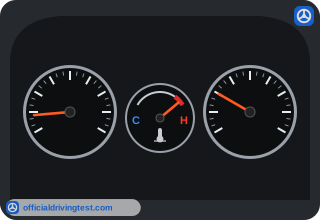
- Keep driving to the nearest exit
- Stop as soon as safely possible
- Turn off the engine while moving
- Drive slowly with the heater off
Show answer
Correct answer: Stop as soon as safely possible
A gauge above the safe range can lead to engine failure and fire, so stop as soon as it is safe.
Source: Utah Driver Handbook (2026 edition (new 2026 laws effective May 6, 2026)), page 63 · Open this page in the manual (Manual page 63)
-
Why should you use caution when you see tar bleeding to the road surface in hot weather?
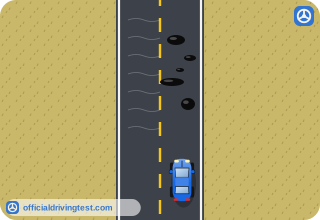
- Those spots grip the tires strongly
- Those spots mean the road is icy
- Those spots are always wet
- Those spots can be slippery
Show answer
Correct answer: Those spots can be slippery
Tar that rises to the surface in the heat can make the road slippery.
Source: Utah Driver Handbook (2026 edition (new 2026 laws effective May 6, 2026)), page 63 · Open this page in the manual (Manual page 63)
-
Which season does the handbook call the most challenging driving season?
- Winter
- Spring
- Summer
- Fall
Show answer
Correct answer: Winter
Winter has fewer hours of daylight and conditions like fog, storms, snow and ice.
Source: Utah Driver Handbook (2026 edition (new 2026 laws effective May 6, 2026)), page 63 · Open this page in the manual (Manual page 63)
-
When should you put good snow tires on your vehicle?
- After the first snowfall
- Before the first snowfall
- Once ice has formed
- Only when a weather advisory is issued
Show answer
Correct answer: Before the first snowfall
Snow tires should be on the vehicle before the first snowfall.
Source: Utah Driver Handbook (2026 edition (new 2026 laws effective May 6, 2026)), page 63 · Open this page in the manual (Manual page 63)
-
For a front-wheel drive vehicle, where is it best to put snow or “all-season” tires?
- On the front wheels only
- On the rear wheels only
- On the driving wheels only
- On all four wheels
Show answer
Correct answer: On all four wheels
Even on front-wheel drive vehicles, all four wheels should have snow or all-season tires.
Source: Utah Driver Handbook (2026 edition (new 2026 laws effective May 6, 2026)), page 63 · Open this page in the manual (Manual page 63)
-
When may snow tires with metal studs be used?
- October 15 through March 31
- September 1 through April 30
- November 1 through February 28
- All year round
Show answer
Correct answer: October 15 through March 31
Studded snow tires may be used only from October 15 through March 31 each year.
Source: Utah Driver Handbook (2026 edition (new 2026 laws effective May 6, 2026)), page 63 · Open this page in the manual (Manual page 63)
-
During ice or snowstorms, especially when a weather advisory is issued, when should you drive?

- Only after dark
- Only on freeways
- Only if it is essential
- Whenever you have snow tires
Show answer
Correct answer: Only if it is essential
The handbook says not to drive in ice or snowstorms unless it is essential.
Source: Utah Driver Handbook (2026 edition (new 2026 laws effective May 6, 2026)), page 63 · Open this page in the manual (Manual page 63)
-
If you must drive in an ice or snowstorm, what should you clear of ice and snow first?
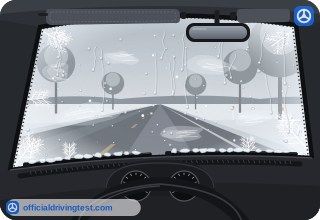
- Only the windshield and the driver’s window
- The whole vehicle, including lights and windows
- Only the windshield and the hood
- Only the windows and the license plate
Show answer
Correct answer: The whole vehicle, including lights and windows
Clear the ice and snow from the whole vehicle, including headlights, taillights, wipers and all windows.
Source: Utah Driver Handbook (2026 edition (new 2026 laws effective May 6, 2026)), page 63 · Open this page in the manual (Manual page 63)
-
In winter, what kind of cleaning solution should you use for the windshield wipers?
- Plain water from a bottle
- Any solution with strong scent
- A thick wax-based cleaner
- A freeze-resistant cleaning solution
Show answer
Correct answer: A freeze-resistant cleaning solution
The handbook says to use a freeze-resistant solution and keep the reservoir adequately filled.
Source: Utah Driver Handbook (2026 edition (new 2026 laws effective May 6, 2026)), page 63 · Open this page in the manual (Manual page 63)
-
Even if your vehicle has good traction in ice and snow, how should you drive?

- Slowly, not faster than everyone else
- At the posted speed limit
- Faster to finish the trip sooner
- At the speed of the fastest driver
Show answer
Correct answer: Slowly, not faster than everyone else
Other drivers travel with caution, so drive slowly and do not disrupt traffic flow by going faster.
Source: Utah Driver Handbook (2026 edition (new 2026 laws effective May 6, 2026)), page 63 · Open this page in the manual (Manual page 63)
-
When sleet, freezing rain or snow starts to fall, which road areas are likely to freeze first?

- Tunnels and mountain passes
- Straight rural highways
- Bridges, ramps and overpasses
- Shaded residential streets
Show answer
Correct answer: Bridges, ramps and overpasses
Bridges, ramps and overpasses freeze first because they are exposed.
Source: Utah Driver Handbook (2026 edition (new 2026 laws effective May 6, 2026)), page 63 · Open this page in the manual (Manual page 63)
-
After road crews have cleared the roadways, what should you be aware of?

- Ice cannot form
- Slippery spots may remain
- The road is safe at full speed
- Only bridges will be slippery
Show answer
Correct answer: Slippery spots may remain
Slippery spots can remain even after crews clear the roads.
Source: Utah Driver Handbook (2026 edition (new 2026 laws effective May 6, 2026)), page 63 · Open this page in the manual (Manual page 63)