Utah: Emergencies and crashes — Power Failure, Tire Blowout, Warning Devices Practice Test
Questions in this part include: “The engine shuts off while you are driving. What is true about the steering wheel?” · “How far in front of and behind your vehicle do you place flares, electric lights, or reflectors?”
Independent educational site · not affiliated with any government agency or DMV
Ready? Test yourself
- Instant feedback with an explanation
- Every answer cites its source in the manual
- Your best score is saved on this device
- Keyboard: press 1 to 4 to answer and Enter for the next question
Questions are original and based on the official manual "Utah Driver Handbook" (2026 edition (new 2026 laws effective May 6, 2026)), Utah Department of Public Safety, Driver License Division.
All 22 questions in this practice test
Take the test above first, then use this list to study. Tap “Show answer” to see the correct answer and explanation.
Show the questions and answersHide the questions
-
The engine shuts off while you are driving. What is true about the steering wheel?
- It may be hard to turn, but you can turn it
- It locks and cannot be turned
- It turns more easily than usual
- It turns only after the engine is restarted
Show answer
Correct answer: It may be hard to turn, but you can turn it
After a power failure the steering wheel may be hard to turn, but you can still turn it, so you keep a firm grip.
Source: Utah Driver Handbook (2026 edition (new 2026 laws effective May 6, 2026)), page 67 · Open this page in the manual (Manual page 67)
-
After a power failure you pull off the road and the engine will not restart. What should you do?
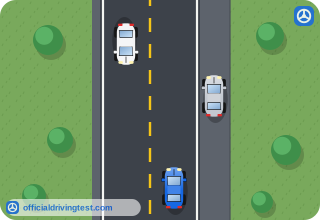
- Wait with the hood closed and the emergency flashers off
- Keep trying to restart the engine until it starts
- Raise the hood, turn on the emergency flashers, call for help
- Lock the doors and wait without any signals
Show answer
Correct answer: Raise the hood, turn on the emergency flashers, call for help
If the engine will not start, you raise the hood, turn on the emergency flashers, and call for help.
Source: Utah Driver Handbook (2026 edition (new 2026 laws effective May 6, 2026)), page 67 · Open this page in the manual (Manual page 67)
-
How should you grip the steering wheel to quickly steer around a hazard?
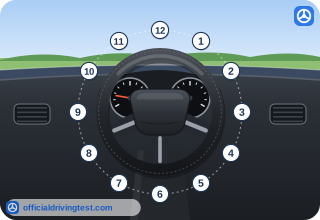
- With one hand on the top of the wheel
- With a good grip using both hands
- With your palms resting on the rim
- With two fingers on the lower rim
Show answer
Correct answer: With a good grip using both hands
To swerve safely, you need a good grip with both hands on the steering wheel.
Source: Utah Driver Handbook (2026 edition (new 2026 laws effective May 6, 2026)), page 67 · Open this page in the manual (Manual page 67)
-
After you have steered around a hazard, what should you do?
- Brake hard to stop at once
- Keep going in the same direction
- Speed up to leave the hazard behind
- Straighten your vehicle and slow down
Show answer
Correct answer: Straighten your vehicle and slow down
Once the hazard is missed, you straighten the vehicle and slow down.
Source: Utah Driver Handbook (2026 edition (new 2026 laws effective May 6, 2026)), page 67 · Open this page in the manual (Manual page 67)
-
If your vehicle is speeding out of control because the gas pedal is stuck, what should you do first?
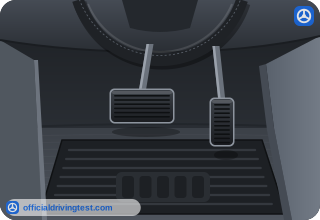
- Shift to neutral
- Shift to park
- Switch off the ignition and coast
- Press the gas pedal repeatedly
Show answer
Correct answer: Shift to neutral
With a stuck gas pedal, you shift to neutral, then look for a safe place to pull off, steer smoothly and brake gently.
Source: Utah Driver Handbook (2026 edition (new 2026 laws effective May 6, 2026)), page 67 · Open this page in the manual (Manual page 67)
-
If a front tire blows out, which way will your vehicle pull?
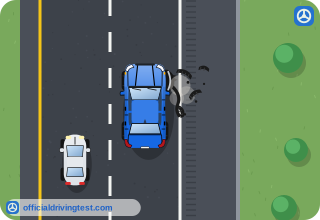
- Hard away from the blown tire
- Straight ahead with no pull
- Hard toward the blown tire
- Toward the opposite side of the vehicle
Show answer
Correct answer: Hard toward the blown tire
The vehicle pulls hard toward the blown tire, and you must not slam on the brakes.
Source: Utah Driver Handbook (2026 edition (new 2026 laws effective May 6, 2026)), page 67 · Open this page in the manual (Manual page 67)
-
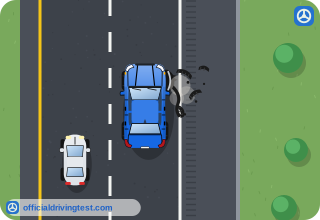
What should you not do if a front tire blows out?
- Hold the steering wheel firmly
- Slam on the brakes
- Take your foot off the gas pedal
- Turn on the emergency flashers
Show answer
Correct answer: Slam on the brakes
The handbook says not to slam on the brakes after a front tire blowout.
Source: Utah Driver Handbook (2026 edition (new 2026 laws effective May 6, 2026)), page 67 · Open this page in the manual (Manual page 67)
-
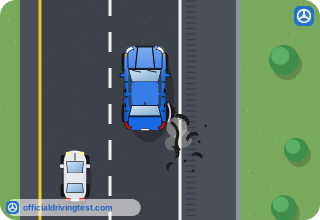
What will your vehicle do if a rear tire blows out?
- Pull hard toward the opposite side of the road
- Speed up and steer itself straight ahead
- Lift and slide sideways with no warning
- Wobble, shake, and pull toward the blown tire
Show answer
Correct answer: Wobble, shake, and pull toward the blown tire
A rear blowout makes the vehicle wobble, shake and pull toward the blown tire.
Source: Utah Driver Handbook (2026 edition (new 2026 laws effective May 6, 2026)), page 67 · Open this page in the manual (Manual page 67)
-
What should you do if a tire goes flat while you are driving?
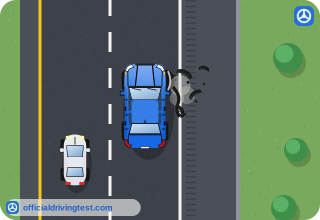
- Grip the wheel firmly, steer straight, slow gradually, and do not brake
- Brake hard and steer toward the shoulder as quickly as you can
- Press the gas pedal to keep control of the vehicle
- Turn off the engine and brake as hard as you can
Show answer
Correct answer: Grip the wheel firmly, steer straight, slow gradually, and do not brake
For a flat tire you steer straight, slow gradually and take your foot off the gas, and you do not brake.
Source: Utah Driver Handbook (2026 edition (new 2026 laws effective May 6, 2026)), page 67 · Open this page in the manual (Manual page 67)
-
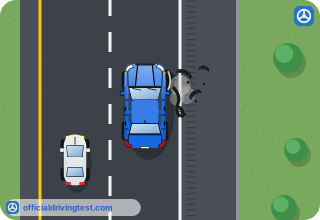
After a tire problem, when should you brake and where should you not stop?
- Brake hard to stop as quickly as possible on the road
- Speed up and stop on the road after the tire is fixed
- Brake gently only if you must, and do not stop on the road
- Stop on the road so other drivers can see you
Show answer
Correct answer: Brake gently only if you must, and do not stop on the road
Let the vehicle slow down, brake gently only if you must, and pull off to a safe, level spot rather than stopping on the road.
Source: Utah Driver Handbook (2026 edition (new 2026 laws effective May 6, 2026)), page 67 · Open this page in the manual (Manual page 67)
-
What should you do if your wheels drop off the paved road surface?
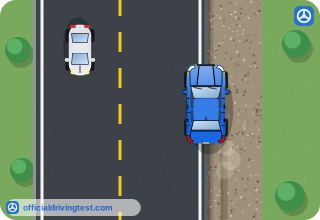
- Brake hard and turn sharply back onto the pavement
- Slow down gradually and then turn back onto the roadway
- Speed up to climb back onto the road
- Turn sharply back onto the road before slowing
Show answer
Correct answer: Slow down gradually and then turn back onto the roadway
Drop-offs cause crashes unless you handle them right: do not panic, slow down gradually, then turn back onto the roadway.
Source: Utah Driver Handbook (2026 edition (new 2026 laws effective May 6, 2026)), page 68 · Open this page in the manual (Manual page 68)
-
A disabled vehicle must display warning devices if it is at least how wide or how long?
- 80 inches wide or 30 feet long
- 70 inches wide or 25 feet long
- 90 inches wide or 35 feet long
- 96 inches wide or 40 feet long
Show answer
Correct answer: 80 inches wide or 30 feet long
Warning devices are required when a vehicle at least 80 inches wide or 30 feet long is disabled or stopped along the road for more than 10 minutes.
Source: Utah Driver Handbook (2026 edition (new 2026 laws effective May 6, 2026)), page 93 · Open this page in the manual (Manual page 93)
-
Warning devices must be displayed when a large vehicle is disabled or stopped along the road for more than how long?
- 5 minutes
- 15 minutes
- 10 minutes
- 30 minutes
Show answer
Correct answer: 10 minutes
The requirement applies once the vehicle has been disabled or stopped along the road for more than 10 minutes.
Source: Utah Driver Handbook (2026 edition (new 2026 laws effective May 6, 2026)), page 93 · Open this page in the manual (Manual page 93)
-
In which situation are warning devices not required?
- When you are stopped on the shoulder waiting for a tow truck
- When you are lawfully picking up or letting off passengers
- When your vehicle is disabled and it is raining hard
- When you have stopped to rest for more than 10 minutes
Show answer
Correct answer: When you are lawfully picking up or letting off passengers
The handbook lists lawfully picking up or letting off passengers as one case where warning devices are not required.
Source: Utah Driver Handbook (2026 edition (new 2026 laws effective May 6, 2026)), page 93 · Open this page in the manual (Manual page 93)
-
In an emergency, what is the first of the two simple steps for placing warning devices?
- Place a flare on the roof of the vehicle to be seen from far away
- Place a device 200 feet behind the vehicle before anything else
- Wait 10 minutes to see if help arrives before placing any device
- Place a device to the side of the vehicle toward the nearest oncoming traffic
Show answer
Correct answer: Place a device to the side of the vehicle toward the nearest oncoming traffic
First you immediately place a flare, lighted fuse, lantern, or reflector to the side of the vehicle, in the direction of the nearest oncoming traffic.
Source: Utah Driver Handbook (2026 edition (new 2026 laws effective May 6, 2026)), page 93 · Open this page in the manual (Manual page 93)
-
How far in front of and behind your vehicle do you place flares, electric lights, or reflectors?
- 100 feet
- 50 feet
- 150 feet
- 300 feet
Show answer
Correct answer: 100 feet
After the first device, you place flares, lights, or reflectors 100 feet to the front and to the rear of the vehicle.
Source: Utah Driver Handbook (2026 edition (new 2026 laws effective May 6, 2026)), page 93 · Open this page in the manual (Manual page 93)
-
A warning device on the traffic side of your vehicle must be at least how far from the rear of the vehicle?
- 5 feet
- 25 feet
- 10 feet
- 50 feet
Show answer
Correct answer: 10 feet
A device is also placed on the traffic side of, and not less than 10 feet from, the rear of your vehicle.
Source: Utah Driver Handbook (2026 edition (new 2026 laws effective May 6, 2026)), page 93 · Open this page in the manual (Manual page 93)
-
Which vehicles may not carry flares and fuses?
- Vehicles that are towing another vehicle with a chain or cable
- Vehicles transporting explosives, flammable liquids, or compressed gas
- Vehicles transporting passengers for hire across state lines
- Vehicles hauling heavy loads of sand, gravel, or farm produce
Show answer
Correct answer: Vehicles transporting explosives, flammable liquids, or compressed gas
Flares and fuses may not be carried in vehicles that transport explosives, flammable liquids, or compressed gas.
Source: Utah Driver Handbook (2026 edition (new 2026 laws effective May 6, 2026)), page 93 · Open this page in the manual (Manual page 93)
-
On a one-way street, how far to the rear should the rear flag be placed?
- 150 feet
- 300 feet
- 400 feet
- 200 feet
Show answer
Correct answer: 200 feet
On a one-way street the rear flag goes 200 feet to the rear.
Source: Utah Driver Handbook (2026 edition (new 2026 laws effective May 6, 2026)), page 93 · Open this page in the manual (Manual page 93)
-
Warning devices need not be displayed if sufficient light reveals persons or vehicles from what distance?
- 1,000 feet
- 250 feet
- 750 feet
- 2,000 feet
Show answer
Correct answer: 1,000 feet
If there is enough light for persons or vehicles to be seen from 1,000 feet, warning devices need not be displayed.
Source: Utah Driver Handbook (2026 edition (new 2026 laws effective May 6, 2026)), page 93 · Open this page in the manual (Manual page 93)
-
Your vehicle breaks down close to a curve or hilltop that blocks the view. At most, how far from the vehicle may the warning device in that direction be placed?
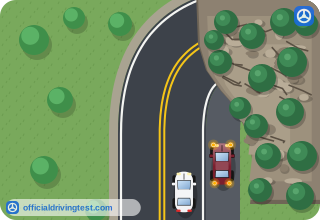
- 200 feet
- 750 feet
- 500 feet
- 1,000 feet
Show answer
Correct answer: 500 feet
The device must give ample warning to approaching motorists, but it may not be placed more than 500 feet from the vehicle.
Source: Utah Driver Handbook (2026 edition (new 2026 laws effective May 6, 2026)), page 93 · Open this page in the manual (Manual page 93)
-
Where do you place warning devices if your vehicle is entirely off the road?
- On the shoulder, as close as possible to the road surface
- In the center of the nearest traffic lane
- On the shoulder, as far from the road surface as possible
- On the roof of your vehicle
Show answer
Correct answer: On the shoulder, as close as possible to the road surface
A vehicle that is completely off the road has its devices placed on the shoulder as close as possible to the road surface.
Source: Utah Driver Handbook (2026 edition (new 2026 laws effective May 6, 2026)), page 93 · Open this page in the manual (Manual page 93)