South Dakota: Sharing the road — Part 6 Practice Test
Questions in this part include: “About how far does the rear of an articulated bus swing out into traffic (tail swing)?”
Independent educational site · not affiliated with any government agency or DMV
Ready? Test yourself
- Instant feedback with an explanation
- Every answer cites its source in the manual
- Your best score is saved on this device
- Keyboard: press 1 to 4 to answer and Enter for the next question
Questions are original and based on the official manual "South Dakota Driver License Manual" (Revised 11/2024), South Dakota Department of Public Safety.
All 18 questions in this practice test
Take the test above first, then use this list to study. Tap “Show answer” to see the correct answer and explanation.
Show the questions and answersHide the questions
-
Why should you not merge in front of a truck or bus and then slow down?
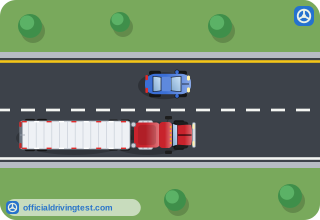
- Trucks and buses cannot slow down as quickly as automobiles
- Trucks and buses accelerate faster than automobiles
- Trucks and buses must stay in the right lane
- The driver may mistake you for an emergency vehicle
Show answer
Correct answer: Trucks and buses cannot slow down as quickly as automobiles
Trucks and buses are unable to slow down as quickly as cars, so slowing in front of them is dangerous.
Source: South Dakota Driver License Manual (Revised 11/2024), page 63
-
How can you help a truck or bus that is entering a freeway?
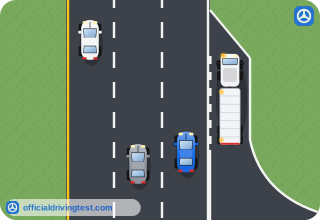
- Maintain the proper speed for the flow of traffic
- Slow down well below the flow of traffic
- Speed up well past the flow of traffic
- Stop in the acceleration lane to let it in
Show answer
Correct answer: Maintain the proper speed for the flow of traffic
Holding a speed that fits the flow of traffic lets the truck or bus enter smoothly without having to stop.
Source: South Dakota Driver License Manual (Revised 11/2024), page 63
-
Why should you never park on a runaway truck ramp or in its entrance?
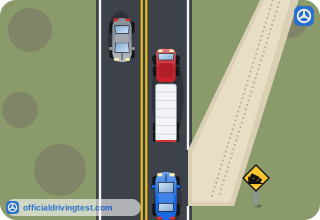
- The ramp surface may damage your tires
- It is a private road for trucking companies
- You may deny a driver access to the ramp and the chance to survive
- Vehicles parked there block the view of the interchange
Show answer
Correct answer: You may deny a driver access to the ramp and the chance to survive
Out-of-control trucks need the ramp, and parking there is illegal and may deprive a driver of the chance to survive.
Source: South Dakota Driver License Manual (Revised 11/2024), page 64
-
What is one indication of a runaway truck or bus?
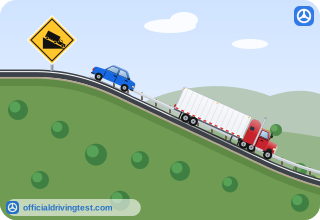
- Flashing headlights
- Smoke coming from the brakes
- A continuously sounding horn
- Both turn signals flashing
Show answer
Correct answer: Smoke coming from the brakes
The manual says smoke coming from a truck or bus’s brakes is one indication that it has lost its braking ability.
Source: South Dakota Driver License Manual (Revised 11/2024), page 64
-
You see a truck or bus with smoke coming from its brakes. What should you do?
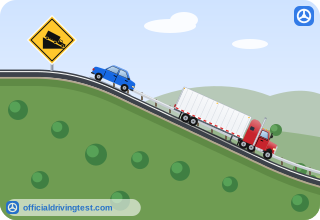
- Follow closely behind it to help it stop
- Pass it and then stay just ahead of it in the lane
- Pull alongside it and signal to the driver to stop
- Get out of the way and do not get in front of it
Show answer
Correct answer: Get out of the way and do not get in front of it
Smoke from the brakes can mean the vehicle cannot stop, so get out of the way and stay out of its path.
Source: South Dakota Driver License Manual (Revised 11/2024), page 64
-
In a construction area, why should you not suddenly pull in front of a truck or bus and stop abruptly?
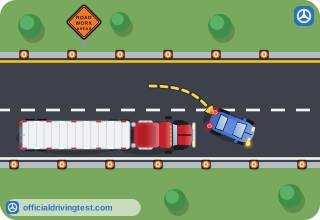
- Trucks and buses have the right-of-way in construction areas
- Construction areas have a lower speed limit for trucks
- Large vehicles cannot use their brakes there
- The driver may not see you or may not be able to stop in time
Show answer
Correct answer: The driver may not see you or may not be able to stop in time
A truck or bus driver may fail to see you or be unable to stop in time.
Source: South Dakota Driver License Manual (Revised 11/2024), page 64
-
How can you avoid getting caught behind an inter-city bus that makes a stop?
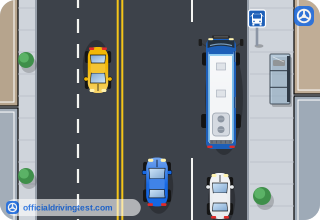
- Follow it closely so you can pass at the stop
- Move to another lane before the bus stops
- Pass it as it signals
- Sound your horn as you approach the stop
Show answer
Correct answer: Move to another lane before the bus stops
The manual says to read the road ahead and move to another lane of traffic before the bus stops.
Source: South Dakota Driver License Manual (Revised 11/2024), page 64
-
Why should you pass a parked bus with care?
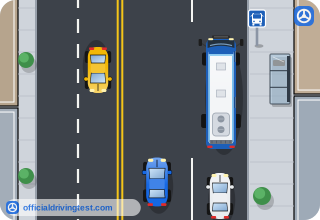
- Its doors may suddenly open into the lane
- Its passengers may throw items into the road
- The bus may start to move out into the lane of traffic
- It may be waiting for an emergency vehicle to pass
Show answer
Correct answer: The bus may start to move out into the lane of traffic
A parked bus may start to move out into the lane of traffic as you pass it.
Source: South Dakota Driver License Manual (Revised 11/2024), page 64
-
When passing a parked bus, what should you be on the lookout for?
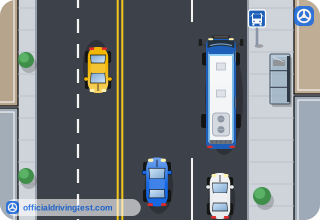
- Pedestrians running in front of the vehicle
- Other buses backing up
- Passengers throwing items from windows
- Slow-moving farm equipment
Show answer
Correct answer: Pedestrians running in front of the vehicle
Children and others have been known to run in front of buses, so watch for pedestrians running in front of the vehicle.
Source: South Dakota Driver License Manual (Revised 11/2024), page 64
-
About how far does the rear of an articulated bus swing out into traffic (tail swing)?
- Approximately 3 feet
- Approximately 1 foot
- Approximately 8 feet
- Approximately 12 feet
Show answer
Correct answer: Approximately 3 feet
The tail swing on articulated buses is approximately 3 feet, so leave enough room behind them.
Source: South Dakota Driver License Manual (Revised 11/2024), page 64
-
What should you remember about the operator of farm machinery?
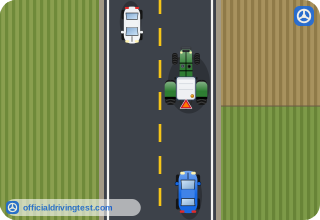
- The operator can hear a horn from far away
- The operator always signals before turning
- The operator cannot hear approaching vehicles
- The operator must pull over for every vehicle
Show answer
Correct answer: The operator cannot hear approaching vehicles
The manual says the operator of farm machinery cannot hear approaching vehicles, so pass with caution.
Source: South Dakota Driver License Manual (Revised 11/2024), page 65
-
What rights do animal-drawn vehicles and horseback riders have on the road?
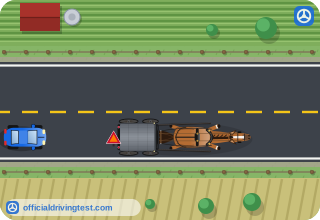
- The same rights to use the road as a motor vehicle
- The right-of-way over all motor vehicles
- The right to use the road only when no vehicle is behind them
- No right to use the road beyond the shoulder
Show answer
Correct answer: The same rights to use the road as a motor vehicle
They have the same rights to use the road as a motor vehicle and must follow the same rules.
Source: South Dakota Driver License Manual (Revised 11/2024), page 65
-
Why should you not use the horn or rev the engine when passing a horse?
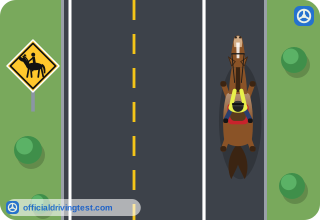
- It may scare the horse and cause a crash
- It is illegal within 200 feet of a horse
- It tells the rider to pull over
- It may make the horse stop in the road
Show answer
Correct answer: It may scare the horse and cause a crash
The noise may scare the horse and cause a crash, so pass with caution instead.
Source: South Dakota Driver License Manual (Revised 11/2024), page 65
-
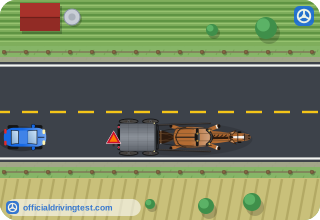
What turns should you anticipate from animal-drawn vehicles?
- U-turns on state highways at night
- Right turns onto the road shoulder
- Left turns into fields and driveways
- Sudden stops at rural intersections
Show answer
Correct answer: Left turns into fields and driveways
The manual says to anticipate left turns made by animal-drawn vehicles into fields and driveways.
Source: South Dakota Driver License Manual (Revised 11/2024), page 65
-
On roads with a posted speed limit of 35 mph or more, how far must you stay behind a snowplow when its red or amber lights are on?

- At least 50 feet
- At least 200 feet
- At least 100 feet
- At least 400 feet
Show answer
Correct answer: At least 200 feet
The law requires drivers to stay at least 200 feet behind a snowplow with red or amber lights on, on roads posted at 35 mph or more.
Source: South Dakota Driver License Manual (Revised 11/2024), page 67
-
The law requires you to stay at least 200 feet behind a snowplow with its red or amber lights on. On which roads does this apply?

- Roads with a posted speed limit of 35 mph or more
- Roads with a posted speed limit of 25 mph or more
- Roads with a posted speed limit of 45 mph or more
- Roads with a posted speed limit of 55 mph or more
Show answer
Correct answer: Roads with a posted speed limit of 35 mph or more
The 200-foot rule applies on roads posted at 35 mph or higher.
Source: South Dakota Driver License Manual (Revised 11/2024), page 67
-
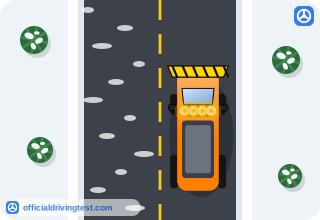
Where do snowplows often need to operate?
- Only on the shoulder
- Only in the right lane
- Very close to the center line
- Far from the center line of the road
Show answer
Correct answer: Very close to the center line
Snowplows are wide and often need to work very close to the center line, so you should give them room.
Source: South Dakota Driver License Manual (Revised 11/2024), page 67
-
What should you do when you see a snowplow throwing up clouds of snow?

- Slow down and give it as much room as possible
- Pass it quickly before the snow cloud grows
- Follow it closely to stay in clear pavement
- Flash your high beams to signal the driver
Show answer
Correct answer: Slow down and give it as much room as possible
Clouds of snow affect your vision, so you slow down and leave as much room as possible.
Source: South Dakota Driver License Manual (Revised 11/2024), page 67