South Dakota: Sharing the road — Part 2 Practice Test
Questions in this part include: “Which road users does the manual say are harder to see than cars and trucks?” · “Where may deer cross the road?”
Independent educational site · not affiliated with any government agency or DMV
Ready? Test yourself
- Instant feedback with an explanation
- Every answer cites its source in the manual
- Your best score is saved on this device
- Keyboard: press 1 to 4 to answer and Enter for the next question
Questions are original and based on the official manual "South Dakota Driver License Manual" (Revised 11/2024), South Dakota Department of Public Safety.
All 18 questions in this practice test
Take the test above first, then use this list to study. Tap “Show answer” to see the correct answer and explanation.
Show the questions and answersHide the questions
-
Which road users does the manual say are harder to see than cars and trucks?
- Buses, vans, and tractor trailers
- Police cars and ambulances
- School buses and delivery trucks
- Motorcycles, bicycles, and pedestrians
Show answer
Correct answer: Motorcycles, bicycles, and pedestrians
Motorcycles, bicycles and pedestrians are harder to see, so be especially alert when entering the roadway from a curb or driveway.
Source: South Dakota Driver License Manual (Revised 11/2024), page 49
-
In which months should you be especially alert for deer?
- March and April
- June and July
- October and November
- January and February
Show answer
Correct answer: October and November
The manual says to be especially alert for deer in October and November.
Source: South Dakota Driver License Manual (Revised 11/2024), page 50
-
When are deer most active?
- Dusk and dawn
- Midday
- Early afternoon
- Midnight to 3 a.m.
Show answer
Correct answer: Dusk and dawn
Deer are most active at dusk and dawn, so be especially alert then.
Source: South Dakota Driver License Manual (Revised 11/2024), page 50
-
You see the reflection of your headlights in the eyes of deer by the road. What should you do?
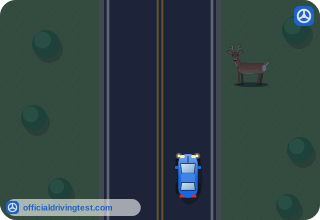
- Slow down, blow the horn, and be ready to stop
- Keep your speed and flash the high beams
- Speed up to pass them before they move
- Turn off your headlights and wait
Show answer
Correct answer: Slow down, blow the horn, and be ready to stop
A reflection means deer are near the road, so slow down, sound the horn and be ready to stop, and watch for more than one deer.
Source: South Dakota Driver License Manual (Revised 11/2024), page 50
-
Where may deer cross the road?
- Only in rural settings, and never in towns or cities
- Only at marked deer crossing signs
- Anywhere and at any time, even in towns or cities
- Only after dark
Show answer
Correct answer: Anywhere and at any time, even in towns or cities
Crossings are typical in rural settings, but deer sometimes wander into towns or cities and may cross anywhere at any time.
Source: South Dakota Driver License Manual (Revised 11/2024), page 50
-
Why do you need extra following distance behind motorcycles or bicyclists?
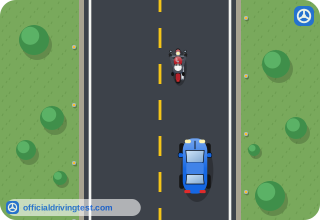
- They always stop faster than cars on any road surface
- They cannot use their brakes on wet roads
- They need room to pass you safely
- If the cycle falls, you need room to avoid hitting the rider
Show answer
Correct answer: If the cycle falls, you need room to avoid hitting the rider
Riders can fall, so more distance helps you avoid hitting them.
Source: South Dakota Driver License Manual (Revised 11/2024), page 51
-
Where are the chances of a motorcycle or bicycle fall greatest?
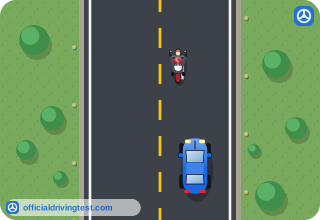
- On smooth, dry asphalt in good weather with light traffic
- On freshly painted lane lines in sunshine
- On metal surfaces such as bridges, gratings, or railroad tracks
- On wide, straight, dry highways
Show answer
Correct answer: On metal surfaces such as bridges, gratings, or railroad tracks
The chances of a fall are greatest on wet or icy roads, gravel roads and metal surfaces such as bridges, gratings and railroad tracks.
Source: South Dakota Driver License Manual (Revised 11/2024), page 51
-
How far can the blind spot behind a large truck extend?
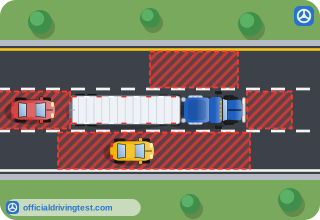
- As much as 200 feet
- As much as 50 feet
- As much as 100 feet
- As much as 300 feet
Show answer
Correct answer: As much as 200 feet
Drivers of large trucks may not see you directly behind them, and that rear blind spot can reach 200 feet.
Source: South Dakota Driver License Manual (Revised 11/2024), page 51
-
When a tractor trailer or other large vehicle is passing you, how can you leave a little more space?
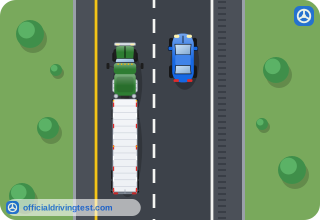
- Move to the outside portion of your lane, away from the truck
- Move toward the truck in your lane to leave more room
- Slow down sharply and brake
- Drive on the shoulder
Show answer
Correct answer: Move to the outside portion of your lane, away from the truck
Moving to the outside portion of your lane away from the truck gives more space as it passes.
Source: South Dakota Driver License Manual (Revised 11/2024), page 52
-
Why should you keep extra space between your vehicle and parked cars?
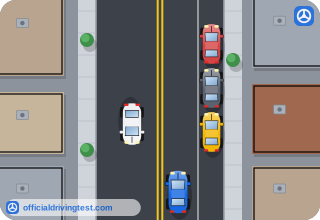
- Someone could step out, or a parked vehicle could pull out
- Parked cars may be towed without any warning at all
- Parked cars have the right-of-way
- Doors on parked cars cannot be seen
Show answer
Correct answer: Someone could step out, or a parked vehicle could pull out
People may step out from a parked vehicle or from between vehicles, or a parked car may pull out.
Source: South Dakota Driver License Manual (Revised 11/2024), page 52
-
You must pass between oncoming and parked vehicles, and the oncoming vehicle is a large truck. What should you do?
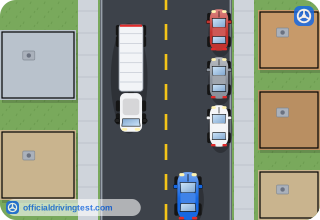
- Steer directly next to the parked cars
- Leave a little more room on the parked-car side
- Leave a little more room on the side the truck will pass
- Stay exactly in the middle of the lane
Show answer
Correct answer: Leave a little more room on the side the truck will pass
Split the difference between two hazards, but leave a little more space on the more dangerous side.
Source: South Dakota Driver License Manual (Revised 11/2024), page 52
-
You are overtaking a bicycle while a vehicle approaches from the opposite direction. What does the manual say to do?
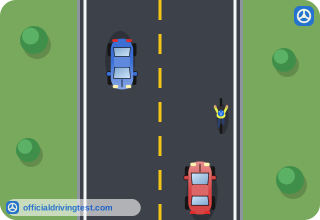
- Speed up to pass the bicycle first
- Slow down and let the oncoming vehicle pass first
- Pass the bicycle and the vehicle together
- Sound the horn and pass the bicycle
Show answer
Correct answer: Slow down and let the oncoming vehicle pass first
Taking hazards one at a time lets you give extra room to the bicycle.
Source: South Dakota Driver License Manual (Revised 11/2024), page 52
-
Where should you stop if you need to pick up or let off passengers?
- In the lane with your hazard lights on
- Next to the center line
- A safe place out of traffic
- Wherever the passengers ask
Show answer
Correct answer: A safe place out of traffic
The manual says to find a safe place out of traffic for this.
Source: South Dakota Driver License Manual (Revised 11/2024), page 52
-
Where should you drive if you are driving more slowly than other traffic on a multi-lane road?
- In the left most travel lane
- In the lane closest to the center line
- In any lane that is open
- In the right most travel lane
Show answer
Correct answer: In the right most travel lane
Slower traffic stays in the right most travel lane.
Source: South Dakota Driver License Manual (Revised 11/2024), page 52
-
If you are being followed too closely and there is a right lane, what should you do?
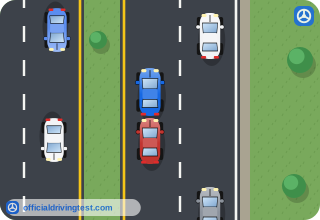
- Brake sharply to make the driver back off
- Move over to the right
- Speed up past the speed limit
- Stay in your lane and flash the brake lights
Show answer
Correct answer: Move over to the right
Moving to the right lets the tailgater pass.
Source: South Dakota Driver License Manual (Revised 11/2024), page 52
-
Why should you never slow down quickly to discourage a tailgater?
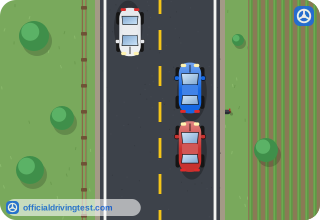
- It makes the tailgater speed up even more
- It increases the risk of being hit from behind
- It damages the brakes
- It is not allowed on a two-lane road
Show answer
Correct answer: It increases the risk of being hit from behind
Slowing quickly only increases the risk of being hit from behind.
Source: South Dakota Driver License Manual (Revised 11/2024), page 52
-
Why should you give large trucks and buses extra room when they are behind you?
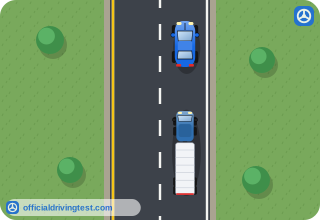
- They cannot turn right
- They have no brake lights
- They must always use the left lane
- They cannot stop as quickly as a car
Show answer
Correct answer: They cannot stop as quickly as a car
The risk of being hit from behind is especially true for large trucks and buses.
Source: South Dakota Driver License Manual (Revised 11/2024), page 52
-
Which of these is a driver who could have trouble seeing you?
- A driver whose windows are covered with snow or ice, or steamed up
- A driver with a clear windshield stopped at a red light
- A driver stopped in the lane ahead facing you
- A driver waiting at a stop sign with a clear view
Show answer
Correct answer: A driver whose windows are covered with snow or ice, or steamed up
Anyone who cannot see you may enter your path without knowing you are there, so give them extra room.
Source: South Dakota Driver License Manual (Revised 11/2024), page 53