South Dakota: Speed and following distance — Part 1 Practice Test
Questions in this part include: “What does stopping suddenly usually point to?” · “According to the manual, how much time does speeding save?”
Independent educational site · not affiliated with any government agency or DMV
Ready? Test yourself
- Instant feedback with an explanation
- Every answer cites its source in the manual
- Your best score is saved on this device
- Keyboard: press 1 to 4 to answer and Enter for the next question
Questions are original and based on the official manual "South Dakota Driver License Manual" (Revised 11/2024), South Dakota Department of Public Safety.
All 18 questions in this practice test
Take the test above first, then use this list to study. Tap “Show answer” to see the correct answer and explanation.
Show the questions and answersHide the questions
-
What does stopping suddenly usually point to?
- A driver with a worn clutch
- A driver who is too far from the curb
- A driver in a good vehicle
- A driver who was not paying attention
Show answer
Correct answer: A driver who was not paying attention
The manual says stopping suddenly is dangerous and usually points to a driver who was not paying attention.
Source: South Dakota Driver License Manual (Revised 11/2024), page 29
-
What can happen when you brake quickly?
- You will always stop in a much shorter distance than usual
- You could skid, and drivers behind may not be able to stop in time
- Your tires will grip the road better on a slippery surface
- Drivers behind will have more room
Show answer
Correct answer: You could skid, and drivers behind may not be able to stop in time
Quick braking can make you skid and lose control, and it makes it harder for drivers behind you to stop.
Source: South Dakota Driver License Manual (Revised 11/2024), page 29
-
How can you avoid panic stops?
- By braking only at the last moment
- By following other vehicles closely so you can brake together
- By seeing events well in advance and slowing down or changing lanes
- By driving in the left lane at all times
Show answer
Correct answer: By seeing events well in advance and slowing down or changing lanes
Seeing events well in advance lets you slow down or change lanes and make a more gradual, safer stop.
Source: South Dakota Driver License Manual (Revised 11/2024), page 29
-
According to the manual, what is the best way not to speed?
- Follow the speed of the vehicle ahead of you closely
- Judge your speed by the sound of the engine and tires
- Drive with the flow of traffic
- Know how fast you are going by checking the speedometer often
Show answer
Correct answer: Know how fast you are going by checking the speedometer often
The manual says the best way not to speed is to know how fast you are going and to check the speedometer often.
Source: South Dakota Driver License Manual (Revised 11/2024), page 29
-
What does the manual say about how well people judge their own speed?
- People judge their speed accurately
- Only new drivers misjudge their speed
- People judge slow speeds poorly but fast speeds well
- People are not very good at judging how fast they are going
Show answer
Correct answer: People are not very good at judging how fast they are going
The manual notes that people are not very good at judging their speed, so the speedometer should be checked.
Source: South Dakota Driver License Manual (Revised 11/2024), page 29
-
When is it especially easy to be traveling much faster than you think?
- When you leave slow local roads and enter high speed roads
- When you leave high speed roads for much slower local roads
- When you drive at night
- When you drive in the rain
Show answer
Correct answer: When you leave high speed roads for much slower local roads
It is especially easy to drive faster than you think when you leave high speed roads for slower local roads.
Source: South Dakota Driver License Manual (Revised 11/2024), page 29
-
The maximum speed limit should be driven only in what conditions?
- Daylight hours only
- Ideal driving conditions
- Rural areas only
- Any conditions, because it is the legal limit
Show answer
Correct answer: Ideal driving conditions
The posted maximum is for ideal conditions, and you must slow down when conditions require it.
Source: South Dakota Driver License Manual (Revised 11/2024), page 35
-
Why are minimum speed limits posted on some high-speed roads?
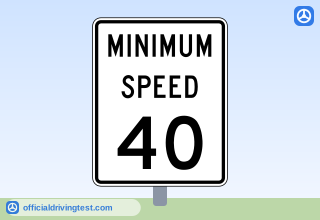
- So slow drivers are not a hazard to others
- So drivers save fuel on long trips
- So drivers have time to read road signs
- So traffic noise is kept low near towns
Show answer
Correct answer: So slow drivers are not a hazard to others
Drivers must travel at least the minimum speed so they do not become a hazard to other drivers.
Source: South Dakota Driver License Manual (Revised 11/2024), page 35
-
The minimum posted speed on a road is too fast for you. What should you do?
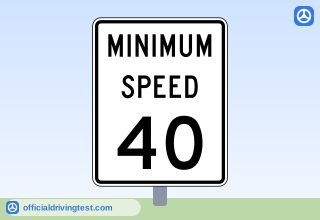
- Drive in the right lane at a slower speed
- Turn on your hazard lights and drive slower
- Use another road
- Drive at the maximum limit instead
Show answer
Correct answer: Use another road
If you cannot drive at the minimum speed, the manual says to use another road.
Source: South Dakota Driver License Manual (Revised 11/2024), page 35
-
According to the manual, how much time does speeding save?
- Only a few minutes for each hour of driving
- About half an hour for each hour of driving
- A large amount of time on every long trip
- About ten minutes for each mile driven
Show answer
Correct answer: Only a few minutes for each hour of driving
Speeding does not save more than a few minutes for each hour of driving.
Source: South Dakota Driver License Manual (Revised 11/2024), page 45
-
What can happen if you drive much slower than other vehicles?
- You can be ticketed for impeding traffic
- Nothing, because slow driving is always safe
- Your license will be suspended automatically
- Your vehicle will be impounded
Show answer
Correct answer: You can be ticketed for impeding traffic
Driving much slower than other traffic is dangerous and you can be ticketed for impeding traffic.
Source: South Dakota Driver License Manual (Revised 11/2024), page 45
-
If vehicles are lined up behind you, what should you do?
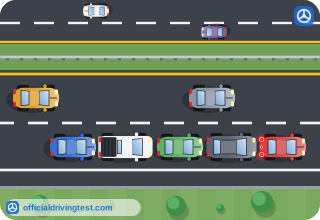
- Slow down further to discourage passing
- Speed up above the posted limit
- Pull over when safe and let them pass
- Stop in your lane and wave them past
Show answer
Correct answer: Pull over when safe and let them pass
You should pull over when it is safe to do so and let the vehicles pass.
Source: South Dakota Driver License Manual (Revised 11/2024), page 45
-
When you turn from a high-speed, two-lane roadway with traffic following you, what should you try not to do?
- Signal your turn
- Slow down too early
- Tap the brakes
- Reduce your speed
Show answer
Correct answer: Slow down too early
The manual says to try not to slow down too early, tapping the brakes quickly but safely to reduce speed.
Source: South Dakota Driver License Manual (Revised 11/2024), page 45
-
Which vehicles can lose speed on long or steep uphill climbs?
- Only large trucks and buses
- Only small cars and motorcycles
- Only farm tractors and wagons
- Large trucks and small cars
Show answer
Correct answer: Large trucks and small cars
Large trucks and small cars can lose speed on long or steep climbs and take longer to get up to speed when entering traffic.
Source: South Dakota Driver License Manual (Revised 11/2024), page 45
-
Why should you slow down at narrow bridges and tunnels?
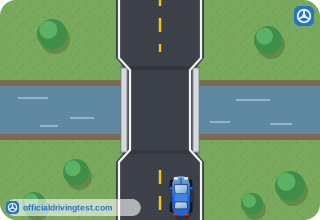
- The pavement is usually rougher than on open roads
- Vehicles from opposite sides pass closer together
- Traffic signals on them change more quickly
- Passing is required on them
Show answer
Correct answer: Vehicles from opposite sides pass closer together
Narrow bridges and tunnels force vehicles approaching from opposite sides closer together.
Source: South Dakota Driver License Manual (Revised 11/2024), page 46
-
How far ahead should you ideally try to look at what is occurring?
- 20 to 30 seconds in front of the car
- 5 to 10 seconds in front of the car
- 10 to 15 seconds in front of the car
- 40 to 50 seconds in front of the car
Show answer
Correct answer: 20 to 30 seconds in front of the car
Looking well down your planned path gives you time to adjust and avoid emergency braking. The manual says to look about 20 to 30 seconds ahead.
Source: South Dakota Driver License Manual (Revised 11/2024), page 48
-
Which situation can limit how far you are able to see ahead?
- Driving on a highway in daylight
- Keeping a large space cushion ahead
- Following too close to a larger vehicle
- Looking well down the planned path
Show answer
Correct answer: Following too close to a larger vehicle
A large vehicle in front blocks your view of the road. The manual says to avoid following too close to one and to adjust your speed and position so you can see.
Source: South Dakota Driver License Manual (Revised 11/2024), page 48
-
How does looking well ahead help you save fuel?
- You can drive with the engine off on hills
- You avoid unnecessary quick stops that lower miles per gallon
- You can follow closer to the vehicle ahead and brake less
- You can use the high beams more often
Show answer
Correct answer: You avoid unnecessary quick stops that lower miles per gallon
Quick stops cost time and fuel to get back up to speed. Drivers who look ahead can slow gradually or change lanes instead.
Source: South Dakota Driver License Manual (Revised 11/2024), page 48