South Dakota: Sharing the road — Part 3 Practice Test
Questions in this part include: “Which of these does the manual list among people who may be distracted?” · “How do large trucks and buses compare with smaller vehicles?”
Independent educational site · not affiliated with any government agency or DMV
Ready? Test yourself
- Instant feedback with an explanation
- Every answer cites its source in the manual
- Your best score is saved on this device
- Keyboard: press 1 to 4 to answer and Enter for the next question
Questions are original and based on the official manual "South Dakota Driver License Manual" (Revised 11/2024), South Dakota Department of Public Safety.
All 18 questions in this practice test
Take the test above first, then use this list to study. Tap “Show answer” to see the correct answer and explanation.
Show the questions and answersHide the questions
-
Which of these does the manual list among people who may be distracted?
- Tourists
- Drivers waiting at a stop sign with a clear view
- Pedestrians who have been drinking
- Construction workers
Show answer
Correct answer: Construction workers
The manual lists delivery persons, construction workers, children and inattentive drivers as people who may be distracted.
Source: South Dakota Driver License Manual (Revised 11/2024), page 53
-
Which of these does the manual list among people who may be confused?
- Delivery persons carrying packages
- Drivers looking for house numbers
- Drivers stopped at a red light
- Children
Show answer
Correct answer: Drivers looking for house numbers
Confused people, such as drivers looking for street signs or house numbers, may cause an unsafe situation.
Source: South Dakota Driver License Manual (Revised 11/2024), page 54
-
Which drivers does the manual say may be confused, especially at a complicated intersection?
- Drivers of tow trucks going to a crash
- Persons driving cars with out of state plates
- Drivers of school buses
- Drivers of police cars
Show answer
Correct answer: Persons driving cars with out of state plates
The manual lists persons driving cars with out of state plates, especially at a complicated intersection, among people who may be confused; give such drivers extra room.
Source: South Dakota Driver License Manual (Revised 11/2024), page 54
-
How do large trucks and buses compare with smaller vehicles?
- They can stop faster because of their larger brakes
- They can turn in smaller spaces
- They can accelerate faster on hills
- They cannot accelerate, stop, or change direction as quickly
Show answer
Correct answer: They cannot accelerate, stop, or change direction as quickly
Give large vehicles extra room to move, including in roundabouts.
Source: South Dakota Driver License Manual (Revised 11/2024), page 54
-
Another driver passes without enough room. What does the manual say you should do?
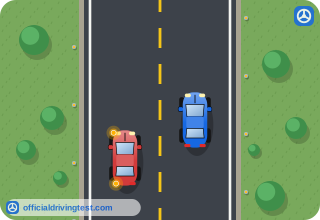
- Slow down and let them return to the driving lane safely
- Speed up so they cannot return to the driving lane
- Sound the horn and stay beside them
- Move onto the shoulder and stop
Show answer
Correct answer: Slow down and let them return to the driving lane safely
If another driver makes a mistake, do not make it worse.
Source: South Dakota Driver License Manual (Revised 11/2024), page 54
-
Another driver needs to change lanes suddenly. What should you do?
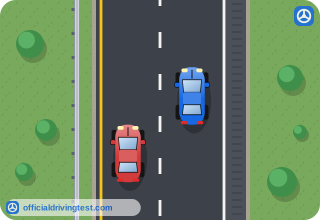
- Speed up and close the gap
- Sound the horn
- Slow down and let them merge
- Stay beside them in the lane
Show answer
Correct answer: Slow down and let them merge
Slowing down and letting the driver merge keeps traffic moving smoothly and safely.
Source: South Dakota Driver License Manual (Revised 11/2024), page 54
-
What does separating risks give you?
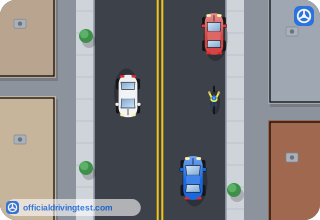
- A shorter trip over the same route
- The right-of-way at intersections
- A lower speed limit
- Space to move in case of an emergency
Show answer
Correct answer: Space to move in case of an emergency
Taking risks one at a time controls the space to the sides, which leaves space to move in an emergency.
Source: South Dakota Driver License Manual (Revised 11/2024), page 54
-
You cannot separate two risks. How do you compromise?
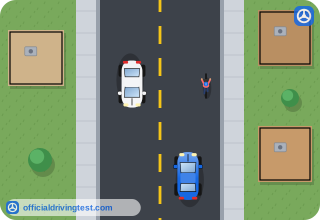
- Give equal room to both dangers
- Give the most room to the worst danger
- Give the most room to the nearest vehicle
- Speed up and pass both at once
Show answer
Correct answer: Give the most room to the worst danger
A child on a bike is more likely to move suddenly than oncoming cars, so you give the child more space.
Source: South Dakota Driver License Manual (Revised 11/2024), page 54
-
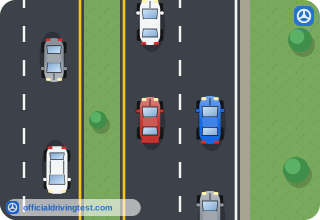
What should you do when passing another vehicle regarding its blind spot?
- Stay in the blind spot to keep up with traffic
- Slow down in the blind spot
- Get through the blind spot as quickly as possible
- Stop in the blind spot
Show answer
Correct answer: Get through the blind spot as quickly as possible
The longer you stay in a blind spot, the longer you are in danger because they may not see you.
Source: South Dakota Driver License Manual (Revised 11/2024), page 56
-
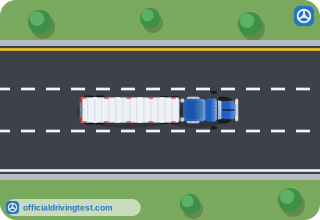
How far in front of the cab can a car disappear from a truck driver’s view?
- Up to 20 feet
- Up to 5 feet
- Up to 50 feet
- Up to 100 feet
Show answer
Correct answer: Up to 20 feet
The No Zone includes up to 20 feet in front of the cab, either side of the truck, and up to 200 feet behind.
Source: South Dakota Driver License Manual (Revised 11/2024), page 56
-
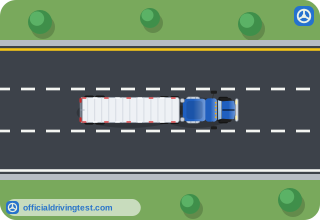
What good rule of thumb applies when sharing the road with a truck or bus?
- If you can see the whole truck, the driver can see you well
- If the truck is higher, the driver sees you
- If their mirrors are large, they see you
- If you can’t see the driver in their side mirror, they can’t see you
Show answer
Correct answer: If you can’t see the driver in their side mirror, they can’t see you
Trucks have very serious blind spots even with bigger mirrors.
Source: South Dakota Driver License Manual (Revised 11/2024), page 56
-
What rules of the road are bicyclists required to follow?
- The same rules as motorized vehicles
- Only the rules that apply to pedestrians
- Only the rules posted on bike-path signs
- None, if they ride on the shoulder
Show answer
Correct answer: The same rules as motorized vehicles
Bicycles are considered vehicles on roadways, and bicyclists must follow the same rules as motorized vehicles.
Source: South Dakota Driver License Manual (Revised 11/2024), page 61
-
How does the manual describe a skillful bicyclist?
- Rides predictably and holds a steady line
- Rides in the center of the lane at all times
- Rides only on sidewalks
- Rides with one hand off the handlebars
Show answer
Correct answer: Rides predictably and holds a steady line
A skillful bicyclist rides predictably and holds a steady line.
Source: South Dakota Driver License Manual (Revised 11/2024), page 61
-
If you see an unskillful bicyclist, what should you be ready for?
- A steady line of travel
- Hand signals for every turn
- Any sudden movements
- A bicyclist who always yields to you
Show answer
Correct answer: Any sudden movements
An unskillful bicyclist may swerve unpredictably, so be ready for any sudden movements.
Source: South Dakota Driver License Manual (Revised 11/2024), page 61
-
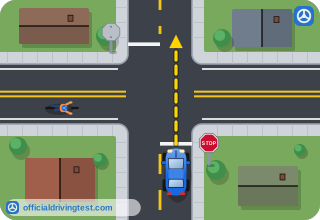
How should you treat bicyclists at intersections?
- Expect them to yield to every motor vehicle
- Yield to them as you would for pedestrians and other vehicles
- Pass them quickly before the intersection
- Treat them as pedestrians who never have the right-of-way
Show answer
Correct answer: Yield to them as you would for pedestrians and other vehicles
The manual says to yield to bicyclists in intersections as you would to pedestrians and other vehicles.
Source: South Dakota Driver License Manual (Revised 11/2024), page 61
-
A bicycle path or bike lane intersects the road you are driving on. What must you do?
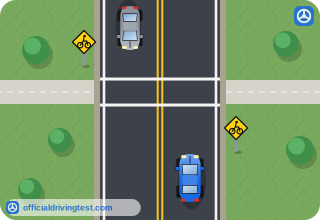
- Sound your horn and proceed
- Proceed if no bicyclist is in sight
- Stop and park beside the lane
- Yield the right-of-way
Show answer
Correct answer: Yield the right-of-way
You must yield the right-of-way when a bicycle path or bike lane intersects a road.
Source: South Dakota Driver License Manual (Revised 11/2024), page 61
-
When may you drive on a designated bicycle lane?
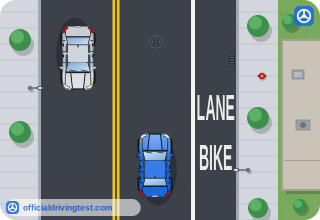
- To pass slow traffic in your own lane
- To wait for a parking space to open up
- To avoid waiting at a traffic signal
- When entering or leaving an alley or driveway
Show answer
Correct answer: When entering or leaving an alley or driveway
You may not stop, park, or drive in a bicycle lane except for entering or leaving an alley or driveway, official duties, directions from police, or an emergency.
Source: South Dakota Driver License Manual (Revised 11/2024), page 61
-
What should you do when approaching or passing a bicyclist?
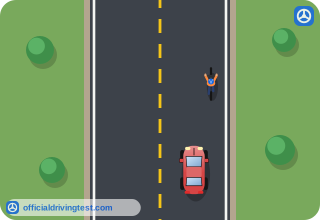
- Speed up to pass quickly
- Allow as much space as possible and slow down
- Stay close behind the bicyclist
- Sound your horn to alert the bicyclist
Show answer
Correct answer: Allow as much space as possible and slow down
The manual says to allow as much space as possible and slow down when approaching or passing a bicyclist.
Source: South Dakota Driver License Manual (Revised 11/2024), page 61