South Dakota: 30 Hardest Driving Test Questions
Questions that need a second thought, picked for close numbers, exceptions and easy-to-confuse rules. Take your time.
Independent educational site · not affiliated with any government agency or DMV
Ready? Test yourself
- Instant feedback with an explanation
- Every answer cites its source in the manual
- Your best score is saved on this device
- Keyboard: press 1 to 4 to answer and Enter for the next question
Questions are original and based on the official manual "South Dakota Driver License Manual" (Revised 11/2024), South Dakota Department of Public Safety.
All 30 questions in this practice test
Take the test above first, then use this list to study. Tap “Show answer” to see the correct answer and explanation.
Show the questions and answersHide the questions
-
On a two-direction roadway, a dashed yellow line is next to a solid yellow line. When may you pass?
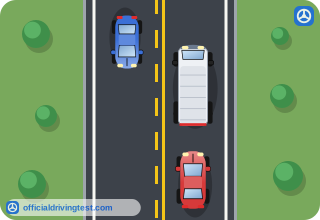
- When the solid yellow line is on your side
- Never, because passing is prohibited in both directions
- Only when the dashed line is on the other driver's side
- When the dashed yellow line is on your side
Show answer
Correct answer: When the dashed yellow line is on your side
Passing is permitted only for the driver on whose side the yellow line is dashed.
Source: South Dakota Driver License Manual (Revised 11/2024), page 36
-
Your traffic light is green but pedestrians are still in the intersection. What should you do?
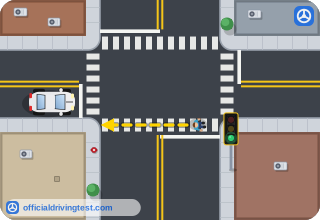
- Yield the right-of-way to them
- Go ahead because you have the green light
- Honk to ask them to hurry
- Go ahead if there is traffic behind you
Show answer
Correct answer: Yield the right-of-way to them
Pedestrians in the intersection have the right-of-way even if the traffic light is green.
Source: South Dakota Driver License Manual (Revised 11/2024), page 61
-
You must stop at an intersection and no crosswalk is apparent. Where must you stop?
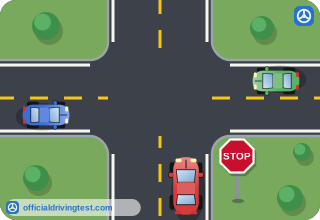
- In the middle of the intersection
- Just past the intersection
- Before entering the intersection
- At the far side of the intersection
Show answer
Correct answer: Before entering the intersection
Not all crosswalks are marked, so if none is apparent you must stop before you enter the intersection.
Source: South Dakota Driver License Manual (Revised 11/2024), page 37
-
Which warning signs may be fluorescent yellow?
- School zone, school crossing, and pedestrian crossing signs
- Low clearance, steep hill, and slippery when wet signs
- Roundabout, merging traffic, and lane ends signs
- Stop sign ahead, traffic signal, and sharp curve signs
Show answer
Correct answer: School zone, school crossing, and pedestrian crossing signs
Some warning signs, such as those for school zones, school crossings, and pedestrian crossings, may be fluorescent yellow.
Source: South Dakota Driver License Manual (Revised 11/2024), page 33
-
On a long trip, how often does the manual say to plan to stop?
- About every 50 miles or 1 hour
- About every 200 miles or 4 hours
- About every 100 miles or 2 hours
- About every 300 miles or 6 hours
Show answer
Correct answer: About every 100 miles or 2 hours
The manual advises stopping about every 100 miles or 2 hours.
Source: South Dakota Driver License Manual (Revised 11/2024), page 18
-
Which permit holders may not use any type of wireless communication device while operating a motor vehicle on public roadways?
- Only Instruction Permit holders under age 18
- Instruction Permit and Restricted Minor's Permit holders
- Only Restricted Minor's Permit holders under age 16
- Only permit holders who are driving after 10 p.m.
Show answer
Correct answer: Instruction Permit and Restricted Minor's Permit holders
Both Instruction Permit holders and Restricted Minor's Permit holders are prohibited from using any type of wireless communication device while driving.
Source: South Dakota Driver License Manual (Revised 11/2024), page 8
-
A bell or horn is sounding at a railroad crossing. When may you cross?
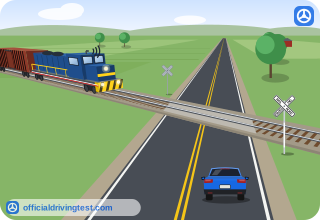
- After you have looked both ways first
- As soon as you have slowed to a crawl
- Not until the bell or horn has stopped
- Once the first train has passed you
Show answer
Correct answer: Not until the bell or horn has stopped
You must not cross while the bell or horn is sounding.
Source: South Dakota Driver License Manual (Revised 11/2024), page 34
-
A pedestrian hybrid beacon (PHB) head has which lenses?
- Two yellow lenses above a single red lens
- One red, one yellow, and one green lens
- Three red lenses in a vertical row
- Two red lenses above a single yellow lens
Show answer
Correct answer: Two red lenses above a single yellow lens
The pedestrian hybrid beacon head is made up of two red lenses above one yellow lens.
Source: South Dakota Driver License Manual (Revised 11/2024), page 31
-
If you park on a rural highway, how much road width must be left for other traffic to pass your vehicle?
- At least 10 feet
- At least 15 feet
- At least 20 feet
- At least 25 feet
Show answer
Correct answer: At least 15 feet
There must be at least 15 feet of road width for other traffic to pass a vehicle parked on a rural highway.
Source: South Dakota Driver License Manual (Revised 11/2024), page 43
-
How far behind a disabled vehicle should you place emergency flares?
- About 25 to 50 feet
- About 75 to 100 feet
- About 400 to 500 feet
- About 200 to 300 feet
Show answer
Correct answer: About 200 to 300 feet
Flares placed about 200 to 300 feet behind the vehicle give other drivers time to change lanes.
Source: South Dakota Driver License Manual (Revised 11/2024), page 58
-
On the interstate, you should avoid unnecessary lane changing and stay in which lane unless passing?
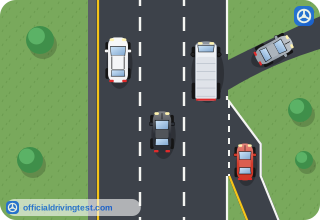
- The right lane
- The left lane
- The center lane
- The lane with the fastest traffic
Show answer
Correct answer: The right lane
The manual says to stay in the right lane unless overtaking and passing another vehicle.
Source: South Dakota Driver License Manual (Revised 11/2024), page 42
-
You must not make a U-turn upon a curve or near the crest of a grade on an undivided highway where your vehicle cannot be seen from what distance?
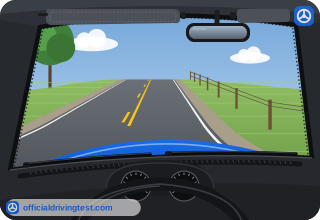
- 100 feet
- 300 feet
- 1,000 feet
- 500 feet
Show answer
Correct answer: 500 feet
The manual prohibits a U-turn there when the vehicle cannot be seen by other drivers within 500 feet.
Source: South Dakota Driver License Manual (Revised 11/2024), page 39
-
What minimum following distance should you always try to keep behind the vehicle in front?
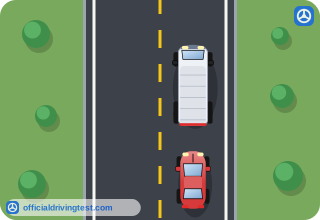
- 1 second
- 2 seconds
- 4 seconds
- 3 seconds
Show answer
Correct answer: 4 seconds
Following closely limits your view and your time to react, so keep at least 4 seconds between your car and the vehicle ahead.
Source: South Dakota Driver License Manual (Revised 11/2024), page 51
-
On a two-lane highway posted above 20 mph, how much must you slow when approaching a stopped vehicle with amber, yellow, or blue lights?
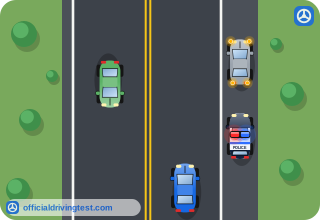
- To at least 20 mph less than the posted speed limit
- To at least 10 mph less than the posted speed limit
- To at least 5 mph less than the posted speed limit
- To at least 30 mph less than the posted speed limit
Show answer
Correct answer: To at least 20 mph less than the posted speed limit
On two-lane highways, motorists must slow to a speed at least twenty miles per hour less than the posted limit.
Source: South Dakota Driver License Manual (Revised 11/2024), page 2
-
On a two-lane highway where the speed limit is posted at 20 mph or less, to what speed must you slow near a stopped vehicle with amber, yellow, or blue lights?
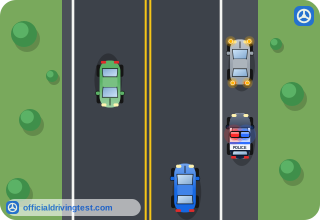
- 5 mph
- 10 mph
- 15 mph
- A complete stop
Show answer
Correct answer: 5 mph
When the limit is posted at twenty miles per hour or less, the required speed is five miles per hour.
Source: South Dakota Driver License Manual (Revised 11/2024), page 2
-
How far from an intersection must all drivers signal a turn?
- At least 25 feet
- At least 50 feet
- At least 300 feet
- At least 100 feet
Show answer
Correct answer: At least 100 feet
The manual lists signaling at least 100 feet from an intersection when turning or changing lanes.
Source: South Dakota Driver License Manual (Revised 11/2024), page 49
-
How close to an oncoming vehicle should you be when you dim your high beams?
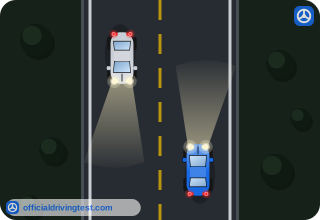
- Within 500 feet
- Within 100 feet
- Within 200 feet
- Within 1000 feet
Show answer
Correct answer: Within 500 feet
Dim the high beams whenever you come within 500 feet, about one block, of an oncoming vehicle.
Source: South Dakota Driver License Manual (Revised 11/2024), page 55
-
Under the South Dakota law quoted in the manual, front windshields and front side windows may not be covered with film or glass that reduces light transmittance below what level?
- 25%
- 45%
- 35%
- 55%
Show answer
Correct answer: 35%
The cited law does not allow windshields and front side windows to be covered so that light transmittance falls below 35%.
Source: South Dakota Driver License Manual (Revised 11/2024), page 24
-
How soon must a commercial driver license (CDL) holder apply for a South Dakota license after establishing residency in South Dakota?
- Within 10 days
- Within 60 days
- Within 30 days
- Within 120 days
Show answer
Correct answer: Within 30 days
A CDL holder has a shorter period than other drivers: 30 days after establishing South Dakota residency.
Source: South Dakota Driver License Manual (Revised 11/2024), page 5
-
On roads with a posted speed limit of 35 mph or more, how far must you stay behind a snowplow when its red or amber lights are on?

- At least 50 feet
- At least 200 feet
- At least 100 feet
- At least 400 feet
Show answer
Correct answer: At least 200 feet
The law requires drivers to stay at least 200 feet behind a snowplow with red or amber lights on, on roads posted at 35 mph or more.
Source: South Dakota Driver License Manual (Revised 11/2024), page 67
-
How far can the blind spot behind a large truck extend?
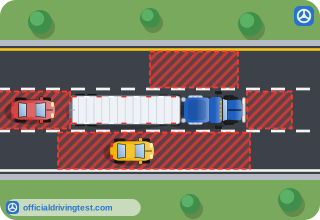
- As much as 200 feet
- As much as 50 feet
- As much as 100 feet
- As much as 300 feet
Show answer
Correct answer: As much as 200 feet
Drivers of large trucks may not see you directly behind them, and that rear blind spot can reach 200 feet.
Source: South Dakota Driver License Manual (Revised 11/2024), page 51
-
A minor at least 14 but under 18 must hold an Instruction Permit continuously for how many days before upgrading, if no approved driver education course was completed?
- 90 days
- 275 days
- 120 days
- 365 days
Show answer
Correct answer: 275 days
Without a completed approved driver education course, a minor must hold the permit continuously for 275 days.
Source: South Dakota Driver License Manual (Revised 11/2024), page 8
-
Even people who show no outward signs of drunkenness increase their chances of a crash if they drive with a BAC of what level or higher?
- 0.10%
- 0.12%
- 0.15%
- 0.05%
Show answer
Correct answer: 0.05%
People who hide the signs still raise their crash risk at a BAC of 0.05% or higher.
Source: South Dakota Driver License Manual (Revised 11/2024), page 21
-
At 50 mph on dry pavement with good brakes, how far can braking distance be?
- About 50 feet
- About 100 feet
- About 250 feet
- About 158 feet
Show answer
Correct answer: About 158 feet
The manual gives about 158 feet of braking distance at 50 mph on dry pavement with good brakes.
Source: South Dakota Driver License Manual (Revised 11/2024), page 50
-
How much table wine contains as much alcohol as a 12 fl oz regular beer?
- 5 fl oz
- 8 fl oz
- 12 fl oz
- 16 fl oz
Show answer
Correct answer: 5 fl oz
A 5 fl oz glass of table wine equals a 12 fl oz regular beer in alcohol.
Source: South Dakota Driver License Manual (Revised 11/2024), page 21
-
What is a third DWI offense?
- A Class 1 misdemeanor
- A Class 6 felony
- A Class 2 misdemeanor
- A Class 3 felony
Show answer
Correct answer: A Class 6 felony
A third DWI offense is a Class 6 felony.
Source: South Dakota Driver License Manual (Revised 11/2024), page 21
-
At an intersection where a police officer is controlling traffic, when may you make a U-turn?
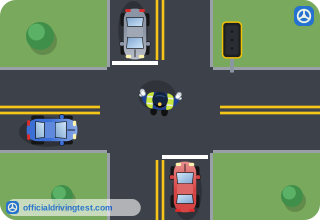
- Whenever the lanes are clear of traffic
- Only if you signal your intention first
- Only if the officer instructs you to
- Never, in any situation
Show answer
Correct answer: Only if the officer instructs you to
A U-turn is not allowed there unless the officer instructs you to make one.
Source: South Dakota Driver License Manual (Revised 11/2024), page 39
-
At 55 mph, about how much distance do you need to pass safely, counting the distance traveled by an oncoming vehicle?
- About 400 feet, or about one-tenth of a mile
- Over 1600 feet, or about one-third of a mile
- About 800 feet, or about one-half of a mile
- About 2000 feet, or about one mile
Show answer
Correct answer: Over 1600 feet, or about one-third of a mile
You travel over 800 feet in 10 seconds and so does an oncoming vehicle, which is over 1600 feet.
Source: South Dakota Driver License Manual (Revised 11/2024), page 53
-
How many points in any 24 consecutive months make an operator subject to a driver license suspension?
- 18
- 22
- 20
- 30
Show answer
Correct answer: 22
Accumulating 22 points in 24 consecutive months makes an operator subject to suspension.
Source: South Dakota Driver License Manual (Revised 11/2024), page 14
-
A driver on an Instruction or Restricted Minor's Permit is convicted of a second traffic violation. How long is the suspension?
- 30 days or until the driver's 16th birthday, whichever is longer
- 180 days or until the driver's 16th birthday, whichever is shorter
- 180 days or until the driver's 16th birthday, whichever is longer
- One year
Show answer
Correct answer: 180 days or until the driver's 16th birthday, whichever is longer
A second traffic violation on these permits brings a suspension of 180 days or until the 16th birthday, whichever is longer.
Source: South Dakota Driver License Manual (Revised 11/2024), page 13