South Dakota: Sharing the road — Part 4 Practice Test
Questions in this part include: “In which direction are bicyclists required to ride?” · “What are bicyclists required to use when turning and stopping?”
Independent educational site · not affiliated with any government agency or DMV
Ready? Test yourself
- Instant feedback with an explanation
- Every answer cites its source in the manual
- Your best score is saved on this device
- Keyboard: press 1 to 4 to answer and Enter for the next question
Questions are original and based on the official manual "South Dakota Driver License Manual" (Revised 11/2024), South Dakota Department of Public Safety.
All 18 questions in this practice test
Take the test above first, then use this list to study. Tap “Show answer” to see the correct answer and explanation.
Show the questions and answersHide the questions
-
A bicyclist is crossing the intersection where you want to turn. What should you do?
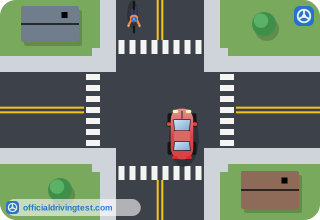
- Turn quickly in front of the bicyclist to save time
- Sound your horn and complete the turn at once
- Slow down and let the bicyclist clear the intersection first
- Turn beside the bicyclist at the same speed
Show answer
Correct answer: Slow down and let the bicyclist clear the intersection first
You should slow down and let the cyclist clear the intersection before making the turn.
Source: South Dakota Driver License Manual (Revised 11/2024), page 61
-
Why should you avoid slowing down or stopping quickly around bicyclists?
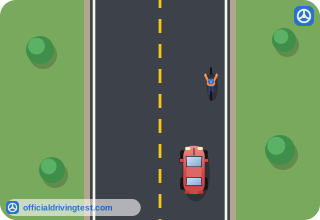
- A motor vehicle’s brakes are more powerful than a bicycle’s
- A bicycle’s brakes are more powerful than a motor vehicle’s
- Bicyclists are required to stop whenever you stop
- Bicyclists cannot see brake lights from behind
Show answer
Correct answer: A motor vehicle’s brakes are more powerful than a bicycle’s
A motor vehicle's brakes are more powerful than a bicycle's, so stopping quickly in front of a bicyclist could cause a crash.
Source: South Dakota Driver License Manual (Revised 11/2024), page 61
-
Why should you avoid sounding the horn close to bicyclists unless there is a chance of a crash?
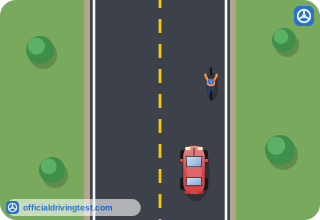
- It may startle them and cause them to steer into your path
- It may cause them to stop in the middle of the lane
- Bicyclists cannot hear a horn from a motor vehicle
- It may be mistaken for the horn of an emergency vehicle
Show answer
Correct answer: It may startle them and cause them to steer into your path
The horn may startle a bicyclist into steering into your path and crashing.
Source: South Dakota Driver License Manual (Revised 11/2024), page 61
-
Why should you be especially careful if you see children riding bikes on the sidewalk?
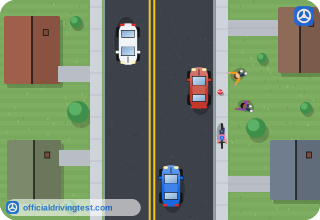
- Their bicycles have no brakes
- They are required to ride in the road
- They may come onto the road
- Sidewalk riders have the right-of-way over all traffic
Show answer
Correct answer: They may come onto the road
Children riding on the sidewalk may come onto the road, so watch for them.
Source: South Dakota Driver License Manual (Revised 11/2024), page 61
-
Which action does the manual say to avoid when sharing the road with a bicyclist?
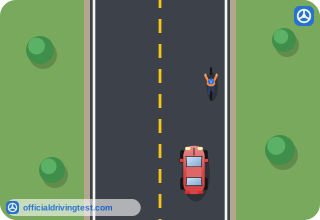
- Leaving plenty of room when passing
- Turning sharply in front of the bicyclist
- Checking for bicyclists before opening a door
- Slowing down when approaching a bicyclist
Show answer
Correct answer: Turning sharply in front of the bicyclist
The manual says to avoid turning sharply in front of a bicyclist and not to force a bicyclist off the road.
Source: South Dakota Driver License Manual (Revised 11/2024), page 61
-
In which direction are bicyclists required to ride?
- Facing oncoming traffic
- Either direction on the shoulder
- Against traffic in bike lanes only
- In the direction of traffic
Show answer
Correct answer: In the direction of traffic
Bicyclists must ride in the direction of traffic, although you should look for them anywhere on the roadway.
Source: South Dakota Driver License Manual (Revised 11/2024), page 61
-
When should you be particularly careful around bicyclists?
- When the roadway is dry and the pavement is smooth
- When bicyclists are using hand signals to turn
- When bicyclists are riding in a marked bike lane
- When the road is wet or covered with sand or gravel
Show answer
Correct answer: When the road is wet or covered with sand or gravel
Wet roads, sand, and gravel affect bicycles much more than vehicles.
Source: South Dakota Driver License Manual (Revised 11/2024), page 61
-
What are bicyclists required to use when turning and stopping?
- A horn
- Hand signals
- Brake lights
- A whistle
Show answer
Correct answer: Hand signals
Bicyclists must use hand signals when turning and stopping, though they may be unable to if both hands are needed on the handlebars.
Source: South Dakota Driver License Manual (Revised 11/2024), page 62
-
Which clue can show a bicyclist’s intent to change lane position?
- Ringing a bell mounted on the handlebars
- Pedaling faster than the traffic around them
- Turning the head or looking over the shoulder
- Standing up on the pedals for a few seconds
Show answer
Correct answer: Turning the head or looking over the shoulder
The manual says to look for clues such as a bicyclist turning the head or looking over the shoulder before changing lane position.
Source: South Dakota Driver License Manual (Revised 11/2024), page 62
-
Before you open the door of your vehicle parked on the street, what should you check?
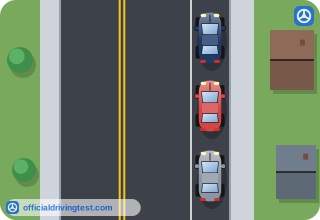
- The sides and rear for bicyclists
- Only the front for pedestrians
- Only the passenger side mirror
- That your seatbelt is off
Show answer
Correct answer: The sides and rear for bicyclists
The manual says to check to the sides and rear for bicyclists before opening the vehicle door.
Source: South Dakota Driver License Manual (Revised 11/2024), page 62
-
Where should you be especially cautious about bicyclists when you back up?
- Near schools or residential areas
- On interstate highways with heavy traffic
- In construction zones on state highways
- At railroad crossings with flashing lights
Show answer
Correct answer: Near schools or residential areas
Bicyclists may be present near schools or residential areas, so check the path before backing.
Source: South Dakota Driver License Manual (Revised 11/2024), page 62
-
From which part of your vehicle is the separation from an overtaken bicycle measured?
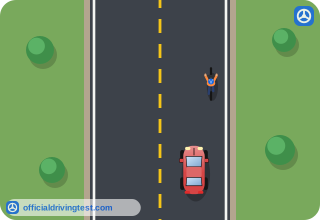
- The right-side wheels only, not counting any mirror or projection
- The center of the vehicle to the left side of the bicycle
- The front bumper, as you pull alongside the bicycle
- The right side, including any mirror or other projection
Show answer
Correct answer: The right side, including any mirror or other projection
The law measures from the right side of the vehicle including any mirror or other projection to the left side of the bicycle.
Source: South Dakota Driver License Manual (Revised 11/2024), page 62
-
How long must you maintain the required separation when overtaking a bicycle?
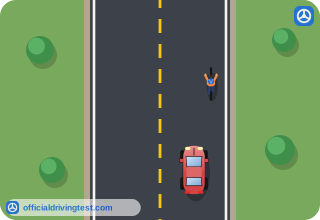
- Until the bicyclist signals you
- Until safely past the overtaken bicycle
- Until you have changed lanes twice
- Until the next intersection
Show answer
Correct answer: Until safely past the overtaken bicycle
The driver must maintain the separation until safely past the overtaken bicycle.
Source: South Dakota Driver License Manual (Revised 11/2024), page 62
-
How much of a lane should you allow a motorcyclist?
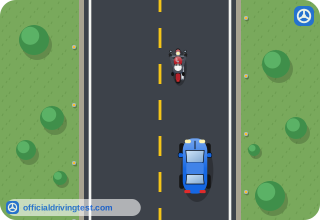
- A full lane width
- Half of the lane
- Whatever space remains beside you
- Two-thirds of the lane
Show answer
Correct answer: A full lane width
A motorcyclist needs a full lane width, so you should not share the lane.
Source: South Dakota Driver License Manual (Revised 11/2024), page 62
-
Because motorcycles are small and hard to see, what should you always check for them?

- Mirrors and blind spots
- Only the rearview mirror
- Only the area directly ahead
- Only the side of the road
Show answer
Correct answer: Mirrors and blind spots
The manual says to always check mirrors and blind spots for motorcycles.
Source: South Dakota Driver License Manual (Revised 11/2024), page 62
-
Before turning left, where should you look carefully for motorcycles?
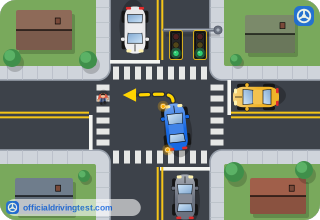
- Only behind your vehicle
- Only at the far corner of the intersection
- To the front and sides of your vehicle
- Only to the right side of your vehicle
Show answer
Correct answer: To the front and sides of your vehicle
Before turning left you should look carefully to the front and sides for motorcycles.
Source: South Dakota Driver License Manual (Revised 11/2024), page 62
-
A motorcycle ahead has its turn signal flashing. What should you do?
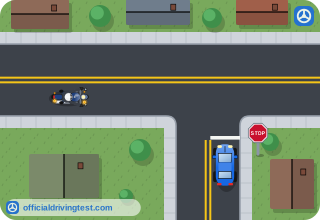
- Assume the rider is turning and go ahead
- Wait to be sure the rider is going to turn
- Sound your horn and pass the motorcycle
- Slow down and flash your headlights
Show answer
Correct answer: Wait to be sure the rider is going to turn
Motorcycle turn signals may not self-cancel, so wait until you are sure the rider is turning.
Source: South Dakota Driver License Manual (Revised 11/2024), page 62
-
What does the manual give as the minimum following distance behind a motorcyclist?
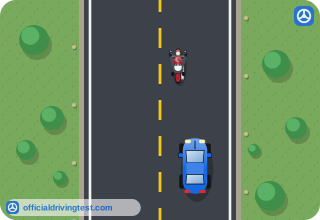
- 2 seconds
- 3 seconds
- 1 second
- 4 seconds
Show answer
Correct answer: 4 seconds
The manual says to allow a minimum 4-second following distance, or more in wet conditions.
Source: South Dakota Driver License Manual (Revised 11/2024), page 62