South Dakota: Sharing the road — Part 5 Practice Test
Questions in this part include: “How do commercial vehicles such as large trucks and buses compare with cars?” · “How should you position your vehicle when following a large vehicle?”
Independent educational site · not affiliated with any government agency or DMV
Ready? Test yourself
- Instant feedback with an explanation
- Every answer cites its source in the manual
- Your best score is saved on this device
- Keyboard: press 1 to 4 to answer and Enter for the next question
Questions are original and based on the official manual "South Dakota Driver License Manual" (Revised 11/2024), South Dakota Department of Public Safety.
All 18 questions in this practice test
Take the test above first, then use this list to study. Tap “Show answer” to see the correct answer and explanation.
Show the questions and answersHide the questions
-
Which of these is a hazard that may make a motorcycle rider suddenly change lane position?
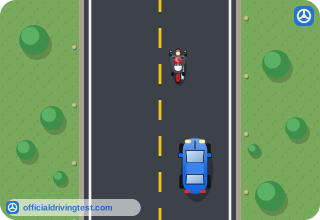
- Smooth dry pavement
- Clear lane markings
- Wide paved shoulders
- Pavement seams
Show answer
Correct answer: Pavement seams
Potholes, gravel, slippery surfaces, pavement seams, railroad crossings, and grooved pavement can force a rider to change lane position.
Source: South Dakota Driver License Manual (Revised 11/2024), page 62
-
How do scooters and mopeds compare with motorcycles in speed?
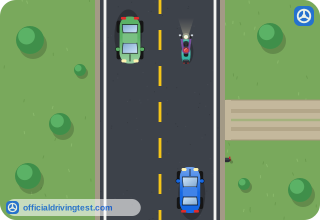
- They travel at much higher speeds
- They travel at much lower speeds
- They travel at the same speeds
- They travel only on the shoulder
Show answer
Correct answer: They travel at much lower speeds
The manual notes that scooters and mopeds travel at much lower speeds than motorcycles.
Source: South Dakota Driver License Manual (Revised 11/2024), page 62
-
How do commercial vehicles such as large trucks and buses compare with cars?
- They stop faster and need less room to turn than cars
- They have smaller blind spots but accelerate slowly
- They have longer stopping distances and need more room to turn
- They are more maneuverable and accelerate faster
Show answer
Correct answer: They have longer stopping distances and need more room to turn
Large trucks and buses have longer stopping and accelerating distances, bigger blind spots, and need more room to turn.
Source: South Dakota Driver License Manual (Revised 11/2024), page 62
-
What is the No-Zone around large trucks and buses?
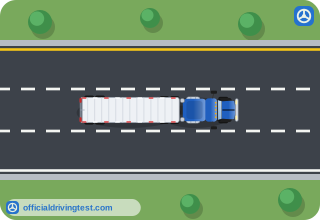
- The area around them where vehicles disappear into blind spots
- The area of the highway where trucks and buses may not drive
- The zone around bus stops where parking is not allowed
- The lane on the interstate reserved for large vehicles
Show answer
Correct answer: The area around them where vehicles disappear into blind spots
The No-Zone is the area around large trucks or buses where vehicles disappear from the commercial driver’s view into blind spots.
Source: South Dakota Driver License Manual (Revised 11/2024), page 63
-
Which side of a truck has the larger blind spot, starting behind the cab?
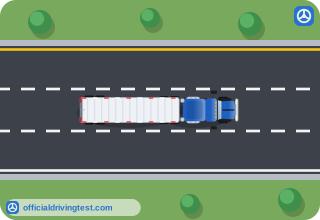
- The right side
- The left side
- Neither side; its blind spots are only behind it
- Neither side; its blind spots are only in front
Show answer
Correct answer: The right side
Trucks have a larger blind spot on the right side, starting behind the cab and extending up to the length of the truck.
Source: South Dakota Driver License Manual (Revised 11/2024), page 63
-
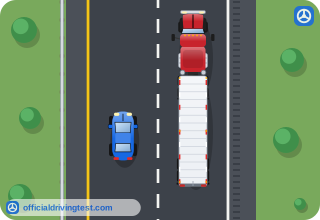
You cannot see a truck driver's face in the side-view mirror. What does that mean?
- The driver is about to change lanes
- The driver cannot see you
- The truck is slowing to stop
- You are in a safe spot to stay
Show answer
Correct answer: The driver cannot see you
If you cannot see the truck driver's face in the side-view mirror, the driver cannot see you.
Source: South Dakota Driver License Manual (Revised 11/2024), page 63
-
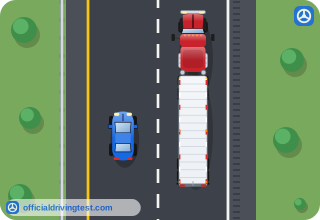
How long should you drive alongside a large vehicle?
- As long as you stay under the speed limit
- No longer than required
- Long enough to match its speed
- Until the driver signals
Show answer
Correct answer: No longer than required
The manual says to avoid driving alongside a large vehicle for any longer than required.
Source: South Dakota Driver License Manual (Revised 11/2024), page 63
-
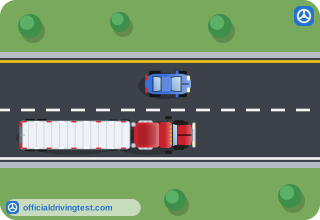
Why should you not change lanes in front of a large vehicle?
- Large vehicles are able to stop in a shorter distance than cars
- Large vehicles are not allowed to share a lane with cars
- Large vehicles can only be seen in their rearview mirrors
- Because of its size and weight, it takes longer to stop than a car
Show answer
Correct answer: Because of its size and weight, it takes longer to stop than a car
Large vehicles take longer to stop than cars, so entering or changing lanes in front of one is dangerous.
Source: South Dakota Driver License Manual (Revised 11/2024), page 63
-
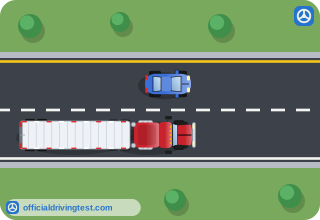
When passing a large vehicle, when should you pull in front of it?
- As soon as any part of it appears in your rearview mirror
- Right after you have passed the cab of the vehicle
- When the driver flashes the headlights to let you in
- After you can see the whole front of it in your rearview mirror
Show answer
Correct answer: After you can see the whole front of it in your rearview mirror
The manual says to look for the whole front of the large vehicle in the rearview mirror before pulling in front.
Source: South Dakota Driver License Manual (Revised 11/2024), page 63
-
How should you position your vehicle when following a large vehicle?
- As close behind it as possible
- Directly behind it, below the driver’s view
- So the driver can see it in the side mirrors
- Directly behind the trailer’s center
Show answer
Correct answer: So the driver can see it in the side mirrors
The manual says to avoid following too closely and to position your vehicle so the driver can see it in their side mirrors.
Source: South Dakota Driver License Manual (Revised 11/2024), page 63
-
About what speed do large vehicles drive going up or down steep hills, according to the manual?
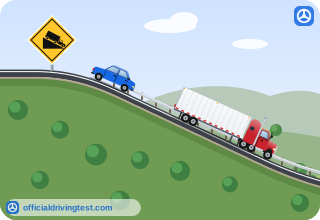
- About 35 mph
- About 15 mph
- About 45 mph
- About 55 mph
Show answer
Correct answer: About 35 mph
On steep hills large vehicles must drive slowly, approximately 35 mph, and so use the right lane.
Source: South Dakota Driver License Manual (Revised 11/2024), page 63
-
Besides on steep hills, where should you avoid driving in the right lane if possible?
- Near truck weigh stations
- On bridges over rivers
- Near gas stations along the road
- Near school zones in town
Show answer
Correct answer: Near truck weigh stations
Large vehicles re-enter faster traffic near truck weigh stations, so avoiding the right lane there reduces the chance of a crash.
Source: South Dakota Driver License Manual (Revised 11/2024), page 63
-
Why does a truck or bus sometimes swing wide to the left before turning right?
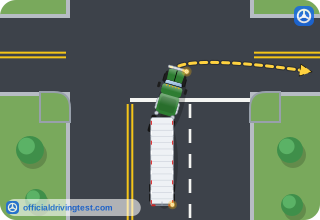
- To keep other vehicles from passing it
- To signal the turn to the other drivers
- To clear the corner of a curb or other obstruction
- To avoid crossing the stop line at the corner
Show answer
Correct answer: To clear the corner of a curb or other obstruction
Swinging wide lets the driver safely turn right and clear the corner of a curb or other obstruction.
Source: South Dakota Driver License Manual (Revised 11/2024), page 63
-
What should you do to avoid a crash with a truck or bus that is making a turn?
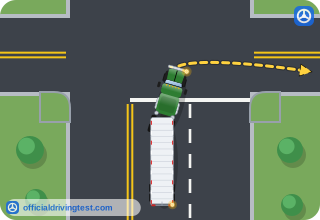
- Move into the space between it and the curb
- Do not turn until it has completed its turn
- Sound your horn so the driver knows you are there
- Pass it on the left before it turns
Show answer
Correct answer: Do not turn until it has completed its turn
Getting between a turning truck or bus and the curb can squeeze you in, so wait until it has completed its turn.
Source: South Dakota Driver License Manual (Revised 11/2024), page 63
-
When you meet a truck coming from the opposite direction, what should you do?
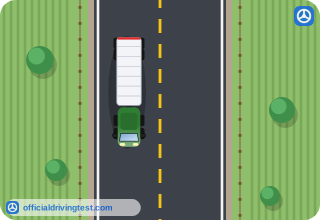
- Keep toward the center line to give it more room
- Move to the left side of the road to let it pass
- Slow down to a stop in your lane and wait
- Keep as far as possible to the right side of the roadway
Show answer
Correct answer: Keep as far as possible to the right side of the roadway
Keeping far to the right avoids a side-swipe crash and reduces the wind turbulence that pushes the vehicles apart.
Source: South Dakota Driver License Manual (Revised 11/2024), page 63
-
You are unsure of the speed of an oncoming truck or bus and want to turn left. What should you do?
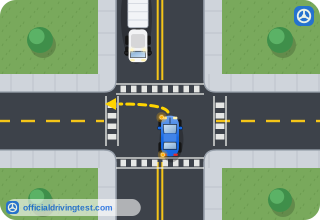
- Turn left quickly before it arrives
- Assume it is traveling slowly and turn
- Flash your headlights and go
- Do not turn left in its path
Show answer
Correct answer: Do not turn left in its path
The truck or bus may be going faster than you think and takes longer to stop than a car.
Source: South Dakota Driver License Manual (Revised 11/2024), page 63
-
Why do stop lines set you back farther at an intersection, according to the manual?
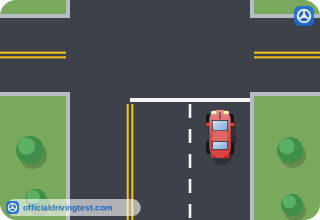
- To give you a better view of cross traffic
- To give larger vehicles more turning space
- To keep your headlights out of oncoming lanes
- To keep emergency vehicles from being blocked
Show answer
Correct answer: To give larger vehicles more turning space
Stop lines help set you farther back to give larger vehicles more room to turn.
Source: South Dakota Driver License Manual (Revised 11/2024), page 63
-
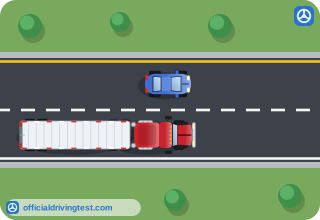
Which action does the manual say not to do near large vehicles?
- Keep moving when you merge onto a highway
- Stop behind the stop line at an intersection
- Cut one off to reach an exit or beat it into a construction zone
- Keep far to the right when it passes in the opposite direction
Show answer
Correct answer: Cut one off to reach an exit or beat it into a construction zone
The manual says not to cut off a large vehicle to reach an exit, turn, or beat it into a single-lane construction zone.
Source: South Dakota Driver License Manual (Revised 11/2024), page 63