South Dakota: Sharing the road
Bicyclists and the passing-distance law, motorcyclists, large trucks and their No-Zones, school buses and slow-moving vehicles. Split into 6 shorter tests so you're not stuck in one long quiz.
Independent educational site · not affiliated with any government agency or DMV
Choose a part
Sharing the road — Part 1
Questions in this part include: “When driving near which vehicles should you be particularly conscious of blind spots?”
StartSharing the road — Part 2
Questions in this part include: “Which road users does the manual say are harder to see than cars and trucks?”
StartSharing the road — Part 3
Questions in this part include: “Which of these does the manual list among people who may be distracted?”
StartSharing the road — Part 4
Questions in this part include: “In which direction are bicyclists required to ride?”
StartSharing the road — Part 5
Questions in this part include: “How do commercial vehicles such as large trucks and buses compare with cars?”
StartSharing the road — Part 6
Questions in this part include: “About how far does the rear of an articulated bus swing out into traffic (tail swing)?”
StartAll 108 Sharing the road questions with answers
Choose a part above to take a practice test, or study every question and answer here.
Show the questions and answersHide the questions
-
What does a reflective orange triangle on the rear of a vehicle mean?
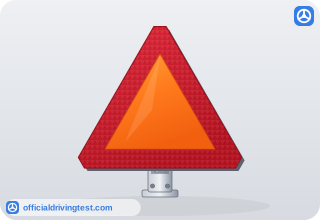
- The vehicle is traveling less than 25 mph
- The vehicle is traveling less than 35 mph
- The vehicle is traveling less than 45 mph
- The vehicle is carrying a wide load
Show answer
Correct answer: The vehicle is traveling less than 25 mph
The reflective orange triangle marks a slow-moving vehicle that travels less than 25 mph.
Source: South Dakota Driver License Manual (Revised 11/2024), page 36
-
What may bicyclists use at a diverging diamond interchange (DDI)?
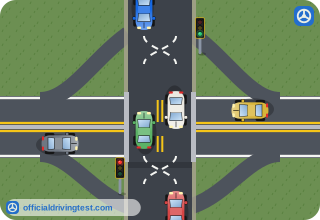
- Only the center lanes used by vehicles
- Only the shoulder of the freeway ramps
- Only the bike lane, never the crosswalks
- A bike lane or the pedestrian walkways
Show answer
Correct answer: A bike lane or the pedestrian walkways
Bicyclists may choose the bike lane or the pedestrian walkways and crosswalks.
Source: South Dakota Driver License Manual (Revised 11/2024), page 42
-
When are you not required to stop for a school bus with its red lights flashing or its stop arm extended?
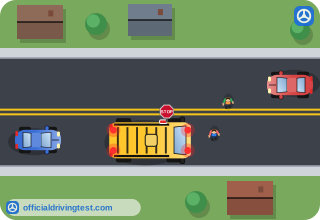
- When the bus is on the opposite side of a painted center line
- When no children are visible outside the bus
- When the roadway is separated by a physical barrier
- When the bus is more than a block away
Show answer
Correct answer: When the roadway is separated by a physical barrier
You must always stop unless the roadway is separated by a physical barrier.
Source: South Dakota Driver License Manual (Revised 11/2024), page 43
-
What should you do after a school bus’s red lights have stopped flashing and its stop arm is no longer visible?
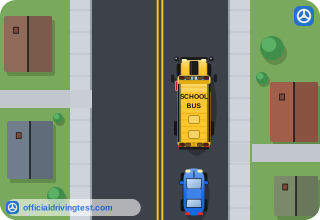
- Proceed at normal speed
- Proceed slowly, watching for children
- Wait until the bus is out of sight
- Wait for the bus driver to wave you on
Show answer
Correct answer: Proceed slowly, watching for children
After the lights stop and the arm is no longer visible, you proceed slowly while watching for children.
Source: South Dakota Driver License Manual (Revised 11/2024), page 43
-
When driving near which vehicles should you be particularly conscious of blind spots?
- Passenger cars
- Parked vehicles
- Commercial vehicles
- Vehicles moving slower than you
Show answer
Correct answer: Commercial vehicles
The manual says to be particularly conscious of blind spots when driving near commercial vehicles.
Source: South Dakota Driver License Manual (Revised 11/2024), page 45
-
Generally, what should farm tractors, animal-drawn vehicles, and roadway maintenance vehicles have on the back?
- A red flag
- A flashing white light
- A slow-moving vehicle sign
- A flashing blue light
Show answer
Correct answer: A slow-moving vehicle sign
These vehicles should generally display a slow-moving vehicle sign on the back.
Source: South Dakota Driver License Manual (Revised 11/2024), page 45
-
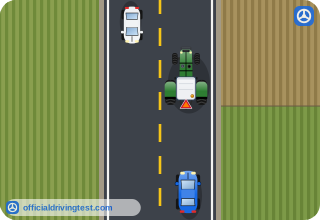
If possible, which direction do you move over to pass a slow-moving vehicle?
- To the right
- Onto the shoulder
- Onto the median
- To the left
Show answer
Correct answer: To the left
You move over to the left to pass if possible; never pass on the right.
Source: South Dakota Driver License Manual (Revised 11/2024), page 45
-
On multi-lane roads, what is the left-most lane intended to be used for?
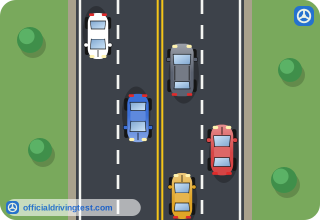
- Passing slower vehicles
- Vehicles turning right
- Slow-moving vehicles
- Heavy trucks only
Show answer
Correct answer: Passing slower vehicles
The left-most lane on multi-lane roads is intended for passing slower vehicles.
Source: South Dakota Driver License Manual (Revised 11/2024), page 46
-
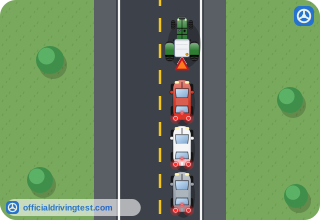
What does the manual say about passing on the shoulder?
- It is allowed only if it is paved
- It is allowed when traffic ahead is slow
- Never pass on it, whether paved or not
- It is allowed if you signal first
Show answer
Correct answer: Never pass on it, whether paved or not
Never pass on the shoulder, whether it is paved or not.
Source: South Dakota Driver License Manual (Revised 11/2024), page 46
-
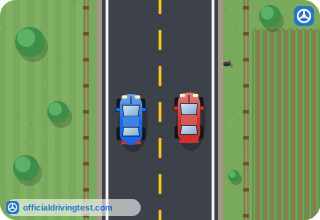
How should you pass another vehicle?
- Slowly, to keep the other driver aware of you
- As quickly and safely as possible
- Alongside at the same speed for as long as you can
- By staying in the other driver’s blind spot
Show answer
Correct answer: As quickly and safely as possible
The longer you stay alongside, the longer you are in danger of the other vehicle moving toward your lane.
Source: South Dakota Driver License Manual (Revised 11/2024), page 46
-
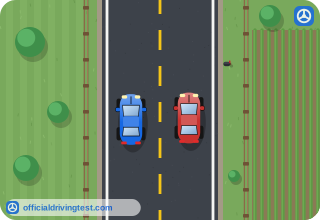
While passing, you should continue to pass until what is visible in your rearview mirror?
- Only the headlights of the passed vehicle
- The passed vehicle’s side mirror
- The passed vehicle’s rear bumper
- The complete front of the passed vehicle
Show answer
Correct answer: The complete front of the passed vehicle
You continue until the complete front of the passed vehicle is visible in the rearview mirror, then signal and return to the lane.
Source: South Dakota Driver License Manual (Revised 11/2024), page 46
-
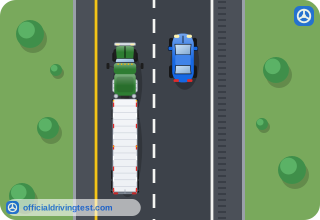
What should you do when another driver is passing you?
- Speed up to keep the other driver behind you
- Move to the shoulder to give the vehicle room
- Stay in your lane and maintain a constant speed
- Drift toward the edge of your lane to make room
Show answer
Correct answer: Stay in your lane and maintain a constant speed
When being passed you stay in your lane and keep a constant speed so the driver can pass.
Source: South Dakota Driver License Manual (Revised 11/2024), page 46
-
In which of these situations should you not attempt to pass?
- When your view is blocked by a curve or a hill
- When the road ahead is straight and clear
- When the vehicle ahead is traveling slowly
- When you are in the left-most lane
Show answer
Correct answer: When your view is blocked by a curve or a hill
Do not pass when an oncoming vehicle approaches or your view is blocked by a curve or hill, among other cases.
Source: South Dakota Driver License Manual (Revised 11/2024), page 46
-
Before which of these must you not attempt to pass?
- A rest area or service plaza
- A mile marker or reflector post
- A speed limit sign on the road
- A highway-railroad crossing
Show answer
Correct answer: A highway-railroad crossing
The manual says not to pass at intersections, before a highway-railroad crossing, or before a bridge.
Source: South Dakota Driver License Manual (Revised 11/2024), page 46
-
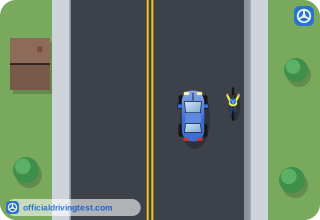
Where the posted limit is 35 mph or less, what is the minimum separation a driver must allow when overtaking a bicycle?
- Two feet
- Three feet
- Five feet
- Six feet
Show answer
Correct answer: Three feet
South Dakota law requires at least a three-foot separation when the posted limit is 35 mph or less.
Source: South Dakota Driver License Manual (Revised 11/2024), page 46
-
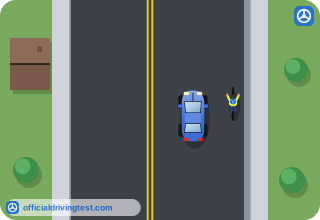
Where the posted limit is greater than 35 mph, what is the minimum separation a driver must allow when overtaking a bicycle?
- Three feet
- Six feet
- Four feet
- Ten feet
Show answer
Correct answer: Six feet
South Dakota law requires at least six feet of separation when the posted limit is greater than 35 mph.
Source: South Dakota Driver License Manual (Revised 11/2024), page 46
-
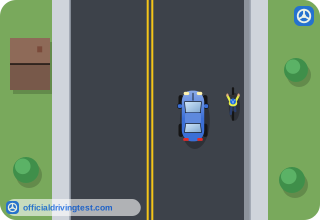
When overtaking a bicycle going the same direction, under what condition may you partially cross the centerline?
- Only if you sound your horn first
- Only when the posted limit is above 35 mph
- Never; the centerline may never be crossed
- If it can be performed safely
Show answer
Correct answer: If it can be performed safely
State law lets a driver partially cross the centerline or lane dividing line to overtake a bicycle if it can be done safely.
Source: South Dakota Driver License Manual (Revised 11/2024), page 46
-
What is a violation of the law on overtaking a bicycle?
- A Class 2 misdemeanor
- A Class 3 misdemeanor
- A Class 4 misdemeanor
- A Class 5 felony
Show answer
Correct answer: A Class 2 misdemeanor
The law states that a violation of the bicycle-overtaking section is a Class 2 misdemeanor.
Source: South Dakota Driver License Manual (Revised 11/2024), page 46
-
Which road users does the manual say are harder to see than cars and trucks?
- Buses, vans, and tractor trailers
- Police cars and ambulances
- School buses and delivery trucks
- Motorcycles, bicycles, and pedestrians
Show answer
Correct answer: Motorcycles, bicycles, and pedestrians
Motorcycles, bicycles and pedestrians are harder to see, so be especially alert when entering the roadway from a curb or driveway.
Source: South Dakota Driver License Manual (Revised 11/2024), page 49
-
In which months should you be especially alert for deer?
- March and April
- June and July
- October and November
- January and February
Show answer
Correct answer: October and November
The manual says to be especially alert for deer in October and November.
Source: South Dakota Driver License Manual (Revised 11/2024), page 50
-
When are deer most active?
- Dusk and dawn
- Midday
- Early afternoon
- Midnight to 3 a.m.
Show answer
Correct answer: Dusk and dawn
Deer are most active at dusk and dawn, so be especially alert then.
Source: South Dakota Driver License Manual (Revised 11/2024), page 50
-
You see the reflection of your headlights in the eyes of deer by the road. What should you do?
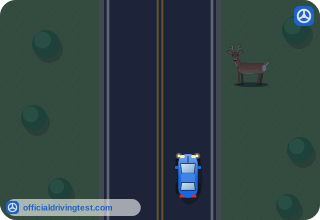
- Slow down, blow the horn, and be ready to stop
- Keep your speed and flash the high beams
- Speed up to pass them before they move
- Turn off your headlights and wait
Show answer
Correct answer: Slow down, blow the horn, and be ready to stop
A reflection means deer are near the road, so slow down, sound the horn and be ready to stop, and watch for more than one deer.
Source: South Dakota Driver License Manual (Revised 11/2024), page 50
-
Where may deer cross the road?
- Only in rural settings, and never in towns or cities
- Only at marked deer crossing signs
- Anywhere and at any time, even in towns or cities
- Only after dark
Show answer
Correct answer: Anywhere and at any time, even in towns or cities
Crossings are typical in rural settings, but deer sometimes wander into towns or cities and may cross anywhere at any time.
Source: South Dakota Driver License Manual (Revised 11/2024), page 50
-
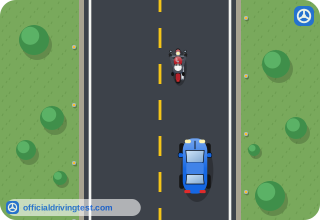
Why do you need extra following distance behind motorcycles or bicyclists?
- They always stop faster than cars on any road surface
- They cannot use their brakes on wet roads
- They need room to pass you safely
- If the cycle falls, you need room to avoid hitting the rider
Show answer
Correct answer: If the cycle falls, you need room to avoid hitting the rider
Riders can fall, so more distance helps you avoid hitting them.
Source: South Dakota Driver License Manual (Revised 11/2024), page 51
-
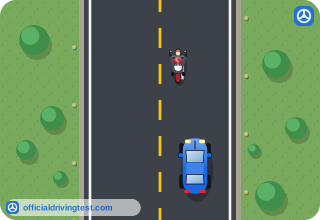
Where are the chances of a motorcycle or bicycle fall greatest?
- On smooth, dry asphalt in good weather with light traffic
- On freshly painted lane lines in sunshine
- On metal surfaces such as bridges, gratings, or railroad tracks
- On wide, straight, dry highways
Show answer
Correct answer: On metal surfaces such as bridges, gratings, or railroad tracks
The chances of a fall are greatest on wet or icy roads, gravel roads and metal surfaces such as bridges, gratings and railroad tracks.
Source: South Dakota Driver License Manual (Revised 11/2024), page 51
-
How far can the blind spot behind a large truck extend?
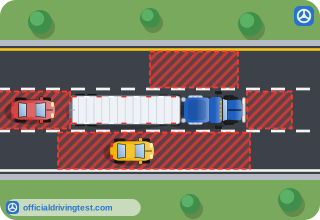
- As much as 200 feet
- As much as 50 feet
- As much as 100 feet
- As much as 300 feet
Show answer
Correct answer: As much as 200 feet
Drivers of large trucks may not see you directly behind them, and that rear blind spot can reach 200 feet.
Source: South Dakota Driver License Manual (Revised 11/2024), page 51
-
When a tractor trailer or other large vehicle is passing you, how can you leave a little more space?
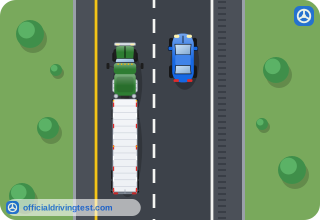
- Move to the outside portion of your lane, away from the truck
- Move toward the truck in your lane to leave more room
- Slow down sharply and brake
- Drive on the shoulder
Show answer
Correct answer: Move to the outside portion of your lane, away from the truck
Moving to the outside portion of your lane away from the truck gives more space as it passes.
Source: South Dakota Driver License Manual (Revised 11/2024), page 52
-
Why should you keep extra space between your vehicle and parked cars?
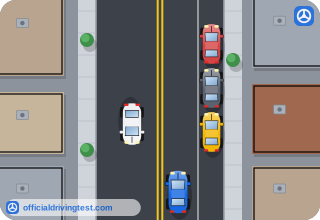
- Someone could step out, or a parked vehicle could pull out
- Parked cars may be towed without any warning at all
- Parked cars have the right-of-way
- Doors on parked cars cannot be seen
Show answer
Correct answer: Someone could step out, or a parked vehicle could pull out
People may step out from a parked vehicle or from between vehicles, or a parked car may pull out.
Source: South Dakota Driver License Manual (Revised 11/2024), page 52
-
You must pass between oncoming and parked vehicles, and the oncoming vehicle is a large truck. What should you do?
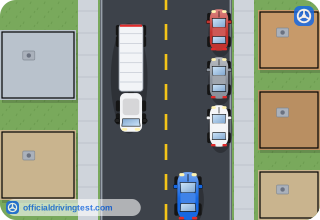
- Steer directly next to the parked cars
- Leave a little more room on the parked-car side
- Leave a little more room on the side the truck will pass
- Stay exactly in the middle of the lane
Show answer
Correct answer: Leave a little more room on the side the truck will pass
Split the difference between two hazards, but leave a little more space on the more dangerous side.
Source: South Dakota Driver License Manual (Revised 11/2024), page 52
-
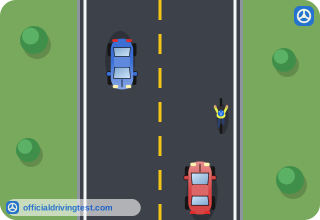
You are overtaking a bicycle while a vehicle approaches from the opposite direction. What does the manual say to do?
- Speed up to pass the bicycle first
- Slow down and let the oncoming vehicle pass first
- Pass the bicycle and the vehicle together
- Sound the horn and pass the bicycle
Show answer
Correct answer: Slow down and let the oncoming vehicle pass first
Taking hazards one at a time lets you give extra room to the bicycle.
Source: South Dakota Driver License Manual (Revised 11/2024), page 52
-
Where should you stop if you need to pick up or let off passengers?
- In the lane with your hazard lights on
- Next to the center line
- A safe place out of traffic
- Wherever the passengers ask
Show answer
Correct answer: A safe place out of traffic
The manual says to find a safe place out of traffic for this.
Source: South Dakota Driver License Manual (Revised 11/2024), page 52
-
Where should you drive if you are driving more slowly than other traffic on a multi-lane road?
- In the left most travel lane
- In the lane closest to the center line
- In any lane that is open
- In the right most travel lane
Show answer
Correct answer: In the right most travel lane
Slower traffic stays in the right most travel lane.
Source: South Dakota Driver License Manual (Revised 11/2024), page 52
-
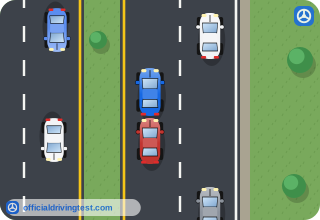
If you are being followed too closely and there is a right lane, what should you do?
- Brake sharply to make the driver back off
- Move over to the right
- Speed up past the speed limit
- Stay in your lane and flash the brake lights
Show answer
Correct answer: Move over to the right
Moving to the right lets the tailgater pass.
Source: South Dakota Driver License Manual (Revised 11/2024), page 52
-
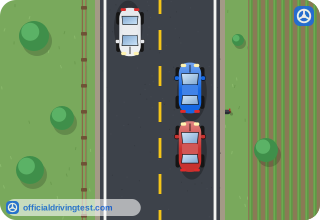
Why should you never slow down quickly to discourage a tailgater?
- It makes the tailgater speed up even more
- It increases the risk of being hit from behind
- It damages the brakes
- It is not allowed on a two-lane road
Show answer
Correct answer: It increases the risk of being hit from behind
Slowing quickly only increases the risk of being hit from behind.
Source: South Dakota Driver License Manual (Revised 11/2024), page 52
-
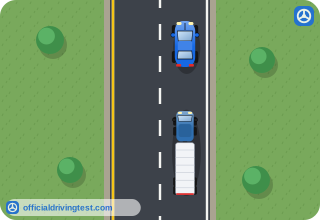
Why should you give large trucks and buses extra room when they are behind you?
- They cannot turn right
- They have no brake lights
- They must always use the left lane
- They cannot stop as quickly as a car
Show answer
Correct answer: They cannot stop as quickly as a car
The risk of being hit from behind is especially true for large trucks and buses.
Source: South Dakota Driver License Manual (Revised 11/2024), page 52
-
Which of these is a driver who could have trouble seeing you?
- A driver whose windows are covered with snow or ice, or steamed up
- A driver with a clear windshield stopped at a red light
- A driver stopped in the lane ahead facing you
- A driver waiting at a stop sign with a clear view
Show answer
Correct answer: A driver whose windows are covered with snow or ice, or steamed up
Anyone who cannot see you may enter your path without knowing you are there, so give them extra room.
Source: South Dakota Driver License Manual (Revised 11/2024), page 53
-
Which of these does the manual list among people who may be distracted?
- Tourists
- Drivers waiting at a stop sign with a clear view
- Pedestrians who have been drinking
- Construction workers
Show answer
Correct answer: Construction workers
The manual lists delivery persons, construction workers, children and inattentive drivers as people who may be distracted.
Source: South Dakota Driver License Manual (Revised 11/2024), page 53
-
Which of these does the manual list among people who may be confused?
- Delivery persons carrying packages
- Drivers looking for house numbers
- Drivers stopped at a red light
- Children
Show answer
Correct answer: Drivers looking for house numbers
Confused people, such as drivers looking for street signs or house numbers, may cause an unsafe situation.
Source: South Dakota Driver License Manual (Revised 11/2024), page 54
-
Which drivers does the manual say may be confused, especially at a complicated intersection?
- Drivers of tow trucks going to a crash
- Persons driving cars with out of state plates
- Drivers of school buses
- Drivers of police cars
Show answer
Correct answer: Persons driving cars with out of state plates
The manual lists persons driving cars with out of state plates, especially at a complicated intersection, among people who may be confused; give such drivers extra room.
Source: South Dakota Driver License Manual (Revised 11/2024), page 54
-
How do large trucks and buses compare with smaller vehicles?
- They can stop faster because of their larger brakes
- They can turn in smaller spaces
- They can accelerate faster on hills
- They cannot accelerate, stop, or change direction as quickly
Show answer
Correct answer: They cannot accelerate, stop, or change direction as quickly
Give large vehicles extra room to move, including in roundabouts.
Source: South Dakota Driver License Manual (Revised 11/2024), page 54
-
Another driver passes without enough room. What does the manual say you should do?
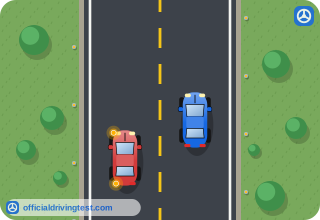
- Slow down and let them return to the driving lane safely
- Speed up so they cannot return to the driving lane
- Sound the horn and stay beside them
- Move onto the shoulder and stop
Show answer
Correct answer: Slow down and let them return to the driving lane safely
If another driver makes a mistake, do not make it worse.
Source: South Dakota Driver License Manual (Revised 11/2024), page 54
-
Another driver needs to change lanes suddenly. What should you do?
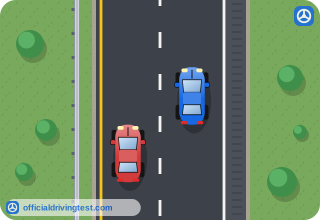
- Speed up and close the gap
- Sound the horn
- Slow down and let them merge
- Stay beside them in the lane
Show answer
Correct answer: Slow down and let them merge
Slowing down and letting the driver merge keeps traffic moving smoothly and safely.
Source: South Dakota Driver License Manual (Revised 11/2024), page 54
-
What does separating risks give you?
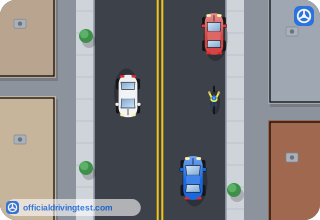
- A shorter trip over the same route
- The right-of-way at intersections
- A lower speed limit
- Space to move in case of an emergency
Show answer
Correct answer: Space to move in case of an emergency
Taking risks one at a time controls the space to the sides, which leaves space to move in an emergency.
Source: South Dakota Driver License Manual (Revised 11/2024), page 54
-
You cannot separate two risks. How do you compromise?
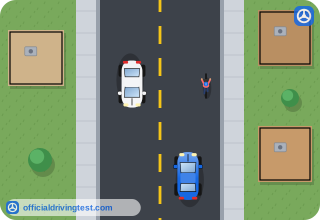
- Give equal room to both dangers
- Give the most room to the worst danger
- Give the most room to the nearest vehicle
- Speed up and pass both at once
Show answer
Correct answer: Give the most room to the worst danger
A child on a bike is more likely to move suddenly than oncoming cars, so you give the child more space.
Source: South Dakota Driver License Manual (Revised 11/2024), page 54
-
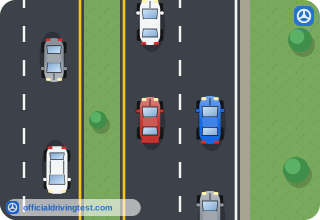
What should you do when passing another vehicle regarding its blind spot?
- Stay in the blind spot to keep up with traffic
- Slow down in the blind spot
- Get through the blind spot as quickly as possible
- Stop in the blind spot
Show answer
Correct answer: Get through the blind spot as quickly as possible
The longer you stay in a blind spot, the longer you are in danger because they may not see you.
Source: South Dakota Driver License Manual (Revised 11/2024), page 56
-
How far in front of the cab can a car disappear from a truck driver’s view?
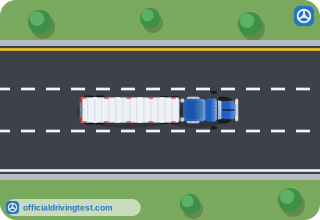
- Up to 20 feet
- Up to 5 feet
- Up to 50 feet
- Up to 100 feet
Show answer
Correct answer: Up to 20 feet
The No Zone includes up to 20 feet in front of the cab, either side of the truck, and up to 200 feet behind.
Source: South Dakota Driver License Manual (Revised 11/2024), page 56
-
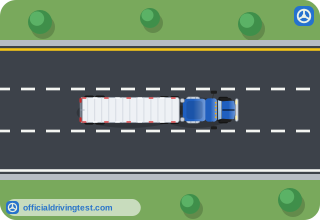
What good rule of thumb applies when sharing the road with a truck or bus?
- If you can see the whole truck, the driver can see you well
- If the truck is higher, the driver sees you
- If their mirrors are large, they see you
- If you can’t see the driver in their side mirror, they can’t see you
Show answer
Correct answer: If you can’t see the driver in their side mirror, they can’t see you
Trucks have very serious blind spots even with bigger mirrors.
Source: South Dakota Driver License Manual (Revised 11/2024), page 56
-
What rules of the road are bicyclists required to follow?
- The same rules as motorized vehicles
- Only the rules that apply to pedestrians
- Only the rules posted on bike-path signs
- None, if they ride on the shoulder
Show answer
Correct answer: The same rules as motorized vehicles
Bicycles are considered vehicles on roadways, and bicyclists must follow the same rules as motorized vehicles.
Source: South Dakota Driver License Manual (Revised 11/2024), page 61
-
How does the manual describe a skillful bicyclist?
- Rides predictably and holds a steady line
- Rides in the center of the lane at all times
- Rides only on sidewalks
- Rides with one hand off the handlebars
Show answer
Correct answer: Rides predictably and holds a steady line
A skillful bicyclist rides predictably and holds a steady line.
Source: South Dakota Driver License Manual (Revised 11/2024), page 61
-
If you see an unskillful bicyclist, what should you be ready for?
- A steady line of travel
- Hand signals for every turn
- Any sudden movements
- A bicyclist who always yields to you
Show answer
Correct answer: Any sudden movements
An unskillful bicyclist may swerve unpredictably, so be ready for any sudden movements.
Source: South Dakota Driver License Manual (Revised 11/2024), page 61
-
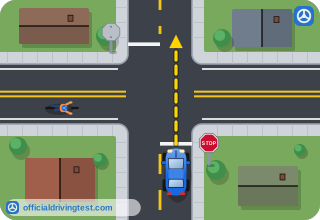
How should you treat bicyclists at intersections?
- Expect them to yield to every motor vehicle
- Yield to them as you would for pedestrians and other vehicles
- Pass them quickly before the intersection
- Treat them as pedestrians who never have the right-of-way
Show answer
Correct answer: Yield to them as you would for pedestrians and other vehicles
The manual says to yield to bicyclists in intersections as you would to pedestrians and other vehicles.
Source: South Dakota Driver License Manual (Revised 11/2024), page 61
-
A bicycle path or bike lane intersects the road you are driving on. What must you do?
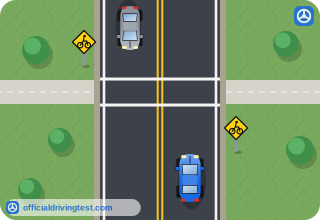
- Sound your horn and proceed
- Proceed if no bicyclist is in sight
- Stop and park beside the lane
- Yield the right-of-way
Show answer
Correct answer: Yield the right-of-way
You must yield the right-of-way when a bicycle path or bike lane intersects a road.
Source: South Dakota Driver License Manual (Revised 11/2024), page 61
-
When may you drive on a designated bicycle lane?
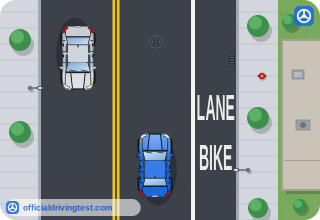
- To pass slow traffic in your own lane
- To wait for a parking space to open up
- To avoid waiting at a traffic signal
- When entering or leaving an alley or driveway
Show answer
Correct answer: When entering or leaving an alley or driveway
You may not stop, park, or drive in a bicycle lane except for entering or leaving an alley or driveway, official duties, directions from police, or an emergency.
Source: South Dakota Driver License Manual (Revised 11/2024), page 61
-
What should you do when approaching or passing a bicyclist?
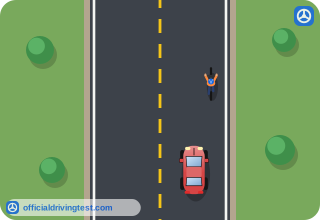
- Speed up to pass quickly
- Allow as much space as possible and slow down
- Stay close behind the bicyclist
- Sound your horn to alert the bicyclist
Show answer
Correct answer: Allow as much space as possible and slow down
The manual says to allow as much space as possible and slow down when approaching or passing a bicyclist.
Source: South Dakota Driver License Manual (Revised 11/2024), page 61
-
A bicyclist is crossing the intersection where you want to turn. What should you do?
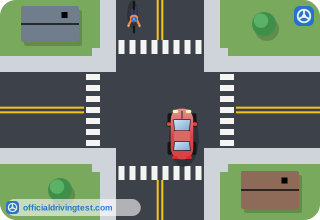
- Turn quickly in front of the bicyclist to save time
- Sound your horn and complete the turn at once
- Slow down and let the bicyclist clear the intersection first
- Turn beside the bicyclist at the same speed
Show answer
Correct answer: Slow down and let the bicyclist clear the intersection first
You should slow down and let the cyclist clear the intersection before making the turn.
Source: South Dakota Driver License Manual (Revised 11/2024), page 61
-
Why should you avoid slowing down or stopping quickly around bicyclists?
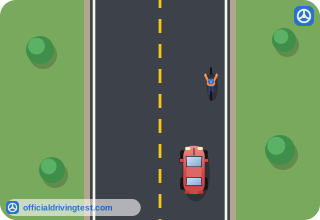
- A motor vehicle’s brakes are more powerful than a bicycle’s
- A bicycle’s brakes are more powerful than a motor vehicle’s
- Bicyclists are required to stop whenever you stop
- Bicyclists cannot see brake lights from behind
Show answer
Correct answer: A motor vehicle’s brakes are more powerful than a bicycle’s
A motor vehicle's brakes are more powerful than a bicycle's, so stopping quickly in front of a bicyclist could cause a crash.
Source: South Dakota Driver License Manual (Revised 11/2024), page 61
-
Why should you avoid sounding the horn close to bicyclists unless there is a chance of a crash?
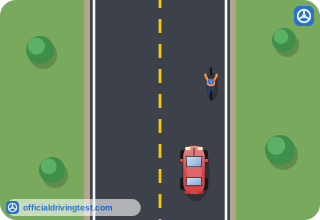
- It may startle them and cause them to steer into your path
- It may cause them to stop in the middle of the lane
- Bicyclists cannot hear a horn from a motor vehicle
- It may be mistaken for the horn of an emergency vehicle
Show answer
Correct answer: It may startle them and cause them to steer into your path
The horn may startle a bicyclist into steering into your path and crashing.
Source: South Dakota Driver License Manual (Revised 11/2024), page 61
-
Why should you be especially careful if you see children riding bikes on the sidewalk?
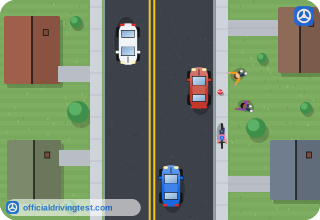
- Their bicycles have no brakes
- They are required to ride in the road
- They may come onto the road
- Sidewalk riders have the right-of-way over all traffic
Show answer
Correct answer: They may come onto the road
Children riding on the sidewalk may come onto the road, so watch for them.
Source: South Dakota Driver License Manual (Revised 11/2024), page 61
-
Which action does the manual say to avoid when sharing the road with a bicyclist?
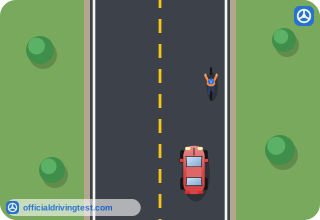
- Leaving plenty of room when passing
- Turning sharply in front of the bicyclist
- Checking for bicyclists before opening a door
- Slowing down when approaching a bicyclist
Show answer
Correct answer: Turning sharply in front of the bicyclist
The manual says to avoid turning sharply in front of a bicyclist and not to force a bicyclist off the road.
Source: South Dakota Driver License Manual (Revised 11/2024), page 61
-
In which direction are bicyclists required to ride?
- Facing oncoming traffic
- Either direction on the shoulder
- Against traffic in bike lanes only
- In the direction of traffic
Show answer
Correct answer: In the direction of traffic
Bicyclists must ride in the direction of traffic, although you should look for them anywhere on the roadway.
Source: South Dakota Driver License Manual (Revised 11/2024), page 61
-
When should you be particularly careful around bicyclists?
- When the roadway is dry and the pavement is smooth
- When bicyclists are using hand signals to turn
- When bicyclists are riding in a marked bike lane
- When the road is wet or covered with sand or gravel
Show answer
Correct answer: When the road is wet or covered with sand or gravel
Wet roads, sand, and gravel affect bicycles much more than vehicles.
Source: South Dakota Driver License Manual (Revised 11/2024), page 61
-
What are bicyclists required to use when turning and stopping?
- A horn
- Hand signals
- Brake lights
- A whistle
Show answer
Correct answer: Hand signals
Bicyclists must use hand signals when turning and stopping, though they may be unable to if both hands are needed on the handlebars.
Source: South Dakota Driver License Manual (Revised 11/2024), page 62
-
Which clue can show a bicyclist’s intent to change lane position?
- Ringing a bell mounted on the handlebars
- Pedaling faster than the traffic around them
- Turning the head or looking over the shoulder
- Standing up on the pedals for a few seconds
Show answer
Correct answer: Turning the head or looking over the shoulder
The manual says to look for clues such as a bicyclist turning the head or looking over the shoulder before changing lane position.
Source: South Dakota Driver License Manual (Revised 11/2024), page 62
-
Before you open the door of your vehicle parked on the street, what should you check?
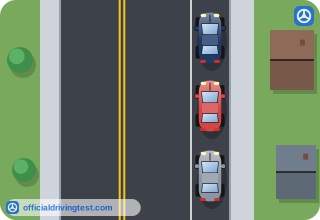
- The sides and rear for bicyclists
- Only the front for pedestrians
- Only the passenger side mirror
- That your seatbelt is off
Show answer
Correct answer: The sides and rear for bicyclists
The manual says to check to the sides and rear for bicyclists before opening the vehicle door.
Source: South Dakota Driver License Manual (Revised 11/2024), page 62
-
Where should you be especially cautious about bicyclists when you back up?
- Near schools or residential areas
- On interstate highways with heavy traffic
- In construction zones on state highways
- At railroad crossings with flashing lights
Show answer
Correct answer: Near schools or residential areas
Bicyclists may be present near schools or residential areas, so check the path before backing.
Source: South Dakota Driver License Manual (Revised 11/2024), page 62
-
From which part of your vehicle is the separation from an overtaken bicycle measured?
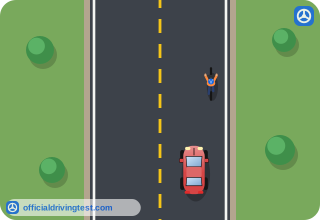
- The right-side wheels only, not counting any mirror or projection
- The center of the vehicle to the left side of the bicycle
- The front bumper, as you pull alongside the bicycle
- The right side, including any mirror or other projection
Show answer
Correct answer: The right side, including any mirror or other projection
The law measures from the right side of the vehicle including any mirror or other projection to the left side of the bicycle.
Source: South Dakota Driver License Manual (Revised 11/2024), page 62
-
How long must you maintain the required separation when overtaking a bicycle?
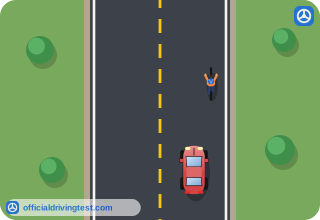
- Until the bicyclist signals you
- Until safely past the overtaken bicycle
- Until you have changed lanes twice
- Until the next intersection
Show answer
Correct answer: Until safely past the overtaken bicycle
The driver must maintain the separation until safely past the overtaken bicycle.
Source: South Dakota Driver License Manual (Revised 11/2024), page 62
-
How much of a lane should you allow a motorcyclist?
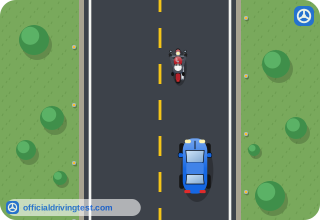
- A full lane width
- Half of the lane
- Whatever space remains beside you
- Two-thirds of the lane
Show answer
Correct answer: A full lane width
A motorcyclist needs a full lane width, so you should not share the lane.
Source: South Dakota Driver License Manual (Revised 11/2024), page 62
-
Because motorcycles are small and hard to see, what should you always check for them?
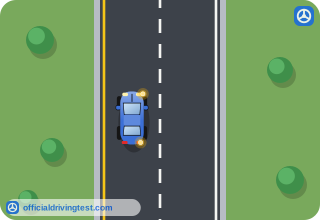
- Mirrors and blind spots
- Only the rearview mirror
- Only the area directly ahead
- Only the side of the road
Show answer
Correct answer: Mirrors and blind spots
The manual says to always check mirrors and blind spots for motorcycles.
Source: South Dakota Driver License Manual (Revised 11/2024), page 62
-
Before turning left, where should you look carefully for motorcycles?
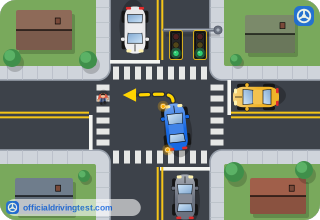
- Only behind your vehicle
- Only at the far corner of the intersection
- To the front and sides of your vehicle
- Only to the right side of your vehicle
Show answer
Correct answer: To the front and sides of your vehicle
Before turning left you should look carefully to the front and sides for motorcycles.
Source: South Dakota Driver License Manual (Revised 11/2024), page 62
-
A motorcycle ahead has its turn signal flashing. What should you do?
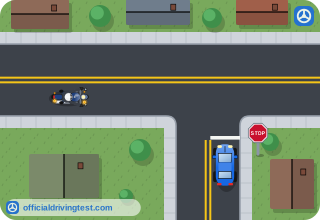
- Assume the rider is turning and go ahead
- Wait to be sure the rider is going to turn
- Sound your horn and pass the motorcycle
- Slow down and flash your headlights
Show answer
Correct answer: Wait to be sure the rider is going to turn
Motorcycle turn signals may not self-cancel, so wait until you are sure the rider is turning.
Source: South Dakota Driver License Manual (Revised 11/2024), page 62
-
What does the manual give as the minimum following distance behind a motorcyclist?
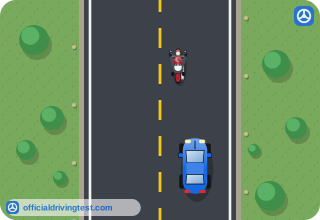
- 2 seconds
- 3 seconds
- 1 second
- 4 seconds
Show answer
Correct answer: 4 seconds
The manual says to allow a minimum 4-second following distance, or more in wet conditions.
Source: South Dakota Driver License Manual (Revised 11/2024), page 62
-
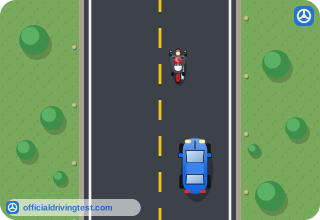
Which of these is a hazard that may make a motorcycle rider suddenly change lane position?
- Smooth dry pavement
- Clear lane markings
- Wide paved shoulders
- Pavement seams
Show answer
Correct answer: Pavement seams
Potholes, gravel, slippery surfaces, pavement seams, railroad crossings, and grooved pavement can force a rider to change lane position.
Source: South Dakota Driver License Manual (Revised 11/2024), page 62
-
How do scooters and mopeds compare with motorcycles in speed?
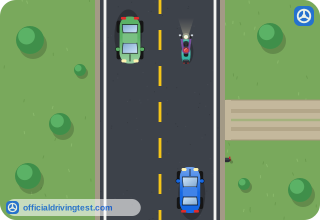
- They travel at much higher speeds
- They travel at much lower speeds
- They travel at the same speeds
- They travel only on the shoulder
Show answer
Correct answer: They travel at much lower speeds
The manual notes that scooters and mopeds travel at much lower speeds than motorcycles.
Source: South Dakota Driver License Manual (Revised 11/2024), page 62
-
How do commercial vehicles such as large trucks and buses compare with cars?
- They stop faster and need less room to turn than cars
- They have smaller blind spots but accelerate slowly
- They have longer stopping distances and need more room to turn
- They are more maneuverable and accelerate faster
Show answer
Correct answer: They have longer stopping distances and need more room to turn
Large trucks and buses have longer stopping and accelerating distances, bigger blind spots, and need more room to turn.
Source: South Dakota Driver License Manual (Revised 11/2024), page 62
-
What is the No-Zone around large trucks and buses?
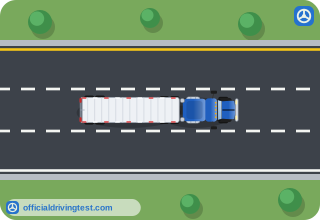
- The area around them where vehicles disappear into blind spots
- The area of the highway where trucks and buses may not drive
- The zone around bus stops where parking is not allowed
- The lane on the interstate reserved for large vehicles
Show answer
Correct answer: The area around them where vehicles disappear into blind spots
The No-Zone is the area around large trucks or buses where vehicles disappear from the commercial driver’s view into blind spots.
Source: South Dakota Driver License Manual (Revised 11/2024), page 63
-
Which side of a truck has the larger blind spot, starting behind the cab?
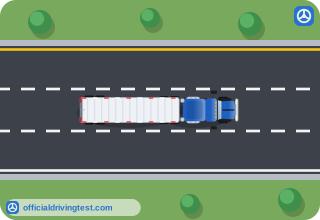
- The right side
- The left side
- Neither side; its blind spots are only behind it
- Neither side; its blind spots are only in front
Show answer
Correct answer: The right side
Trucks have a larger blind spot on the right side, starting behind the cab and extending up to the length of the truck.
Source: South Dakota Driver License Manual (Revised 11/2024), page 63
-
You cannot see a truck driver's face in the side-view mirror. What does that mean?
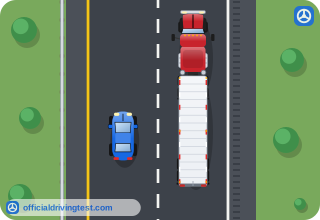
- The driver is about to change lanes
- The driver cannot see you
- The truck is slowing to stop
- You are in a safe spot to stay
Show answer
Correct answer: The driver cannot see you
If you cannot see the truck driver's face in the side-view mirror, the driver cannot see you.
Source: South Dakota Driver License Manual (Revised 11/2024), page 63
-
How long should you drive alongside a large vehicle?
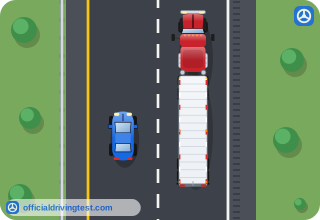
- As long as you stay under the speed limit
- No longer than required
- Long enough to match its speed
- Until the driver signals
Show answer
Correct answer: No longer than required
The manual says to avoid driving alongside a large vehicle for any longer than required.
Source: South Dakota Driver License Manual (Revised 11/2024), page 63
-
Why should you not change lanes in front of a large vehicle?
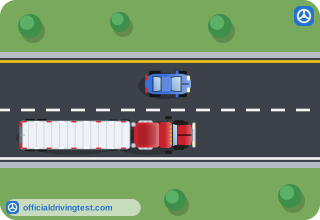
- Large vehicles are able to stop in a shorter distance than cars
- Large vehicles are not allowed to share a lane with cars
- Large vehicles can only be seen in their rearview mirrors
- Because of its size and weight, it takes longer to stop than a car
Show answer
Correct answer: Because of its size and weight, it takes longer to stop than a car
Large vehicles take longer to stop than cars, so entering or changing lanes in front of one is dangerous.
Source: South Dakota Driver License Manual (Revised 11/2024), page 63
-
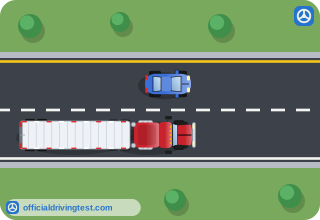
When passing a large vehicle, when should you pull in front of it?
- As soon as any part of it appears in your rearview mirror
- Right after you have passed the cab of the vehicle
- When the driver flashes the headlights to let you in
- After you can see the whole front of it in your rearview mirror
Show answer
Correct answer: After you can see the whole front of it in your rearview mirror
The manual says to look for the whole front of the large vehicle in the rearview mirror before pulling in front.
Source: South Dakota Driver License Manual (Revised 11/2024), page 63
-
How should you position your vehicle when following a large vehicle?
- As close behind it as possible
- Directly behind it, below the driver’s view
- So the driver can see it in the side mirrors
- Directly behind the trailer’s center
Show answer
Correct answer: So the driver can see it in the side mirrors
The manual says to avoid following too closely and to position your vehicle so the driver can see it in their side mirrors.
Source: South Dakota Driver License Manual (Revised 11/2024), page 63
-
About what speed do large vehicles drive going up or down steep hills, according to the manual?
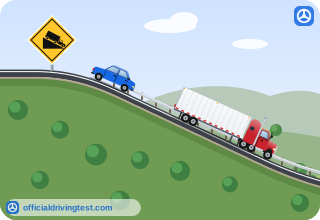
- About 35 mph
- About 15 mph
- About 45 mph
- About 55 mph
Show answer
Correct answer: About 35 mph
On steep hills large vehicles must drive slowly, approximately 35 mph, and so use the right lane.
Source: South Dakota Driver License Manual (Revised 11/2024), page 63
-
Besides on steep hills, where should you avoid driving in the right lane if possible?
- Near truck weigh stations
- On bridges over rivers
- Near gas stations along the road
- Near school zones in town
Show answer
Correct answer: Near truck weigh stations
Large vehicles re-enter faster traffic near truck weigh stations, so avoiding the right lane there reduces the chance of a crash.
Source: South Dakota Driver License Manual (Revised 11/2024), page 63
-
Why does a truck or bus sometimes swing wide to the left before turning right?
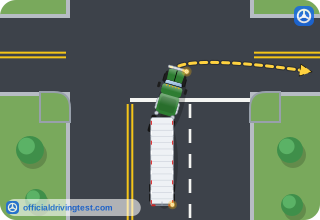
- To keep other vehicles from passing it
- To signal the turn to the other drivers
- To clear the corner of a curb or other obstruction
- To avoid crossing the stop line at the corner
Show answer
Correct answer: To clear the corner of a curb or other obstruction
Swinging wide lets the driver safely turn right and clear the corner of a curb or other obstruction.
Source: South Dakota Driver License Manual (Revised 11/2024), page 63
-
What should you do to avoid a crash with a truck or bus that is making a turn?
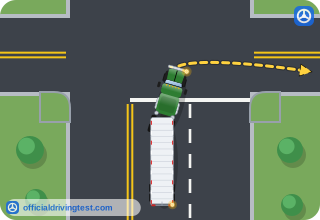
- Move into the space between it and the curb
- Do not turn until it has completed its turn
- Sound your horn so the driver knows you are there
- Pass it on the left before it turns
Show answer
Correct answer: Do not turn until it has completed its turn
Getting between a turning truck or bus and the curb can squeeze you in, so wait until it has completed its turn.
Source: South Dakota Driver License Manual (Revised 11/2024), page 63
-
When you meet a truck coming from the opposite direction, what should you do?
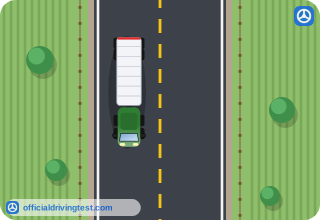
- Keep toward the center line to give it more room
- Move to the left side of the road to let it pass
- Slow down to a stop in your lane and wait
- Keep as far as possible to the right side of the roadway
Show answer
Correct answer: Keep as far as possible to the right side of the roadway
Keeping far to the right avoids a side-swipe crash and reduces the wind turbulence that pushes the vehicles apart.
Source: South Dakota Driver License Manual (Revised 11/2024), page 63
-
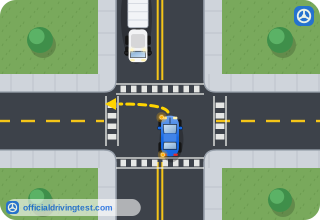
You are unsure of the speed of an oncoming truck or bus and want to turn left. What should you do?
- Turn left quickly before it arrives
- Assume it is traveling slowly and turn
- Flash your headlights and go
- Do not turn left in its path
Show answer
Correct answer: Do not turn left in its path
The truck or bus may be going faster than you think and takes longer to stop than a car.
Source: South Dakota Driver License Manual (Revised 11/2024), page 63
-
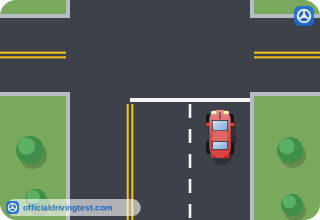
Why do stop lines set you back farther at an intersection, according to the manual?
- To give you a better view of cross traffic
- To give larger vehicles more turning space
- To keep your headlights out of oncoming lanes
- To keep emergency vehicles from being blocked
Show answer
Correct answer: To give larger vehicles more turning space
Stop lines help set you farther back to give larger vehicles more room to turn.
Source: South Dakota Driver License Manual (Revised 11/2024), page 63
-
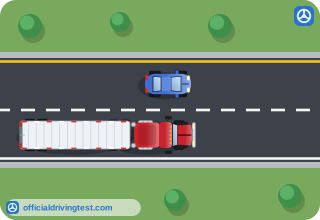
Which action does the manual say not to do near large vehicles?
- Keep moving when you merge onto a highway
- Stop behind the stop line at an intersection
- Cut one off to reach an exit or beat it into a construction zone
- Keep far to the right when it passes in the opposite direction
Show answer
Correct answer: Cut one off to reach an exit or beat it into a construction zone
The manual says not to cut off a large vehicle to reach an exit, turn, or beat it into a single-lane construction zone.
Source: South Dakota Driver License Manual (Revised 11/2024), page 63
-
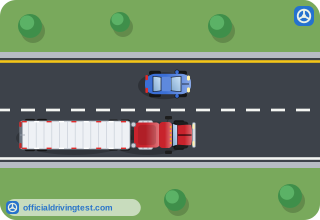
Why should you not merge in front of a truck or bus and then slow down?
- Trucks and buses cannot slow down as quickly as automobiles
- Trucks and buses accelerate faster than automobiles
- Trucks and buses must stay in the right lane
- The driver may mistake you for an emergency vehicle
Show answer
Correct answer: Trucks and buses cannot slow down as quickly as automobiles
Trucks and buses are unable to slow down as quickly as cars, so slowing in front of them is dangerous.
Source: South Dakota Driver License Manual (Revised 11/2024), page 63
-
How can you help a truck or bus that is entering a freeway?
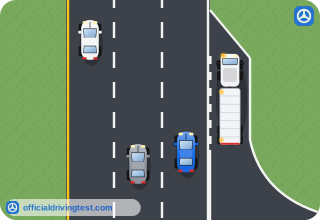
- Maintain the proper speed for the flow of traffic
- Slow down well below the flow of traffic
- Speed up well past the flow of traffic
- Stop in the acceleration lane to let it in
Show answer
Correct answer: Maintain the proper speed for the flow of traffic
Holding a speed that fits the flow of traffic lets the truck or bus enter smoothly without having to stop.
Source: South Dakota Driver License Manual (Revised 11/2024), page 63
-
Why should you never park on a runaway truck ramp or in its entrance?
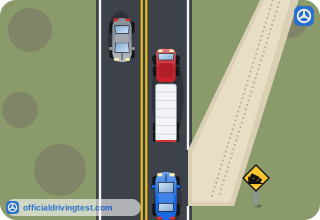
- The ramp surface may damage your tires
- It is a private road for trucking companies
- You may deny a driver access to the ramp and the chance to survive
- Vehicles parked there block the view of the interchange
Show answer
Correct answer: You may deny a driver access to the ramp and the chance to survive
Out-of-control trucks need the ramp, and parking there is illegal and may deprive a driver of the chance to survive.
Source: South Dakota Driver License Manual (Revised 11/2024), page 64
-
What is one indication of a runaway truck or bus?
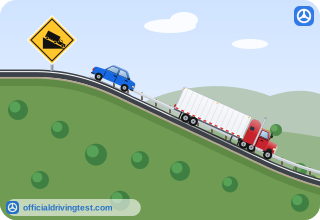
- Flashing headlights
- Smoke coming from the brakes
- A continuously sounding horn
- Both turn signals flashing
Show answer
Correct answer: Smoke coming from the brakes
The manual says smoke coming from a truck or bus’s brakes is one indication that it has lost its braking ability.
Source: South Dakota Driver License Manual (Revised 11/2024), page 64
-
You see a truck or bus with smoke coming from its brakes. What should you do?
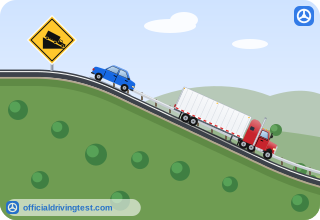
- Follow closely behind it to help it stop
- Pass it and then stay just ahead of it in the lane
- Pull alongside it and signal to the driver to stop
- Get out of the way and do not get in front of it
Show answer
Correct answer: Get out of the way and do not get in front of it
Smoke from the brakes can mean the vehicle cannot stop, so get out of the way and stay out of its path.
Source: South Dakota Driver License Manual (Revised 11/2024), page 64
-
In a construction area, why should you not suddenly pull in front of a truck or bus and stop abruptly?
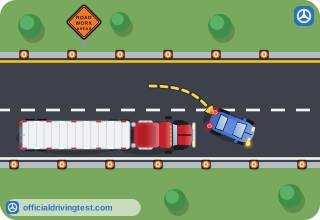
- Trucks and buses have the right-of-way in construction areas
- Construction areas have a lower speed limit for trucks
- Large vehicles cannot use their brakes there
- The driver may not see you or may not be able to stop in time
Show answer
Correct answer: The driver may not see you or may not be able to stop in time
A truck or bus driver may fail to see you or be unable to stop in time.
Source: South Dakota Driver License Manual (Revised 11/2024), page 64
-
How can you avoid getting caught behind an inter-city bus that makes a stop?
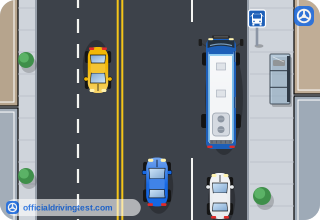
- Follow it closely so you can pass at the stop
- Move to another lane before the bus stops
- Pass it as it signals
- Sound your horn as you approach the stop
Show answer
Correct answer: Move to another lane before the bus stops
The manual says to read the road ahead and move to another lane of traffic before the bus stops.
Source: South Dakota Driver License Manual (Revised 11/2024), page 64
-
Why should you pass a parked bus with care?
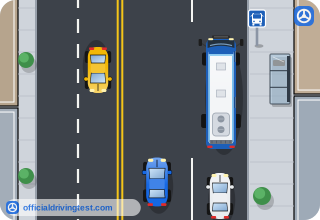
- Its doors may suddenly open into the lane
- Its passengers may throw items into the road
- The bus may start to move out into the lane of traffic
- It may be waiting for an emergency vehicle to pass
Show answer
Correct answer: The bus may start to move out into the lane of traffic
A parked bus may start to move out into the lane of traffic as you pass it.
Source: South Dakota Driver License Manual (Revised 11/2024), page 64
-
When passing a parked bus, what should you be on the lookout for?
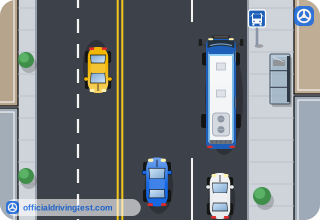
- Pedestrians running in front of the vehicle
- Other buses backing up
- Passengers throwing items from windows
- Slow-moving farm equipment
Show answer
Correct answer: Pedestrians running in front of the vehicle
Children and others have been known to run in front of buses, so watch for pedestrians running in front of the vehicle.
Source: South Dakota Driver License Manual (Revised 11/2024), page 64
-
About how far does the rear of an articulated bus swing out into traffic (tail swing)?
- Approximately 3 feet
- Approximately 1 foot
- Approximately 8 feet
- Approximately 12 feet
Show answer
Correct answer: Approximately 3 feet
The tail swing on articulated buses is approximately 3 feet, so leave enough room behind them.
Source: South Dakota Driver License Manual (Revised 11/2024), page 64
-
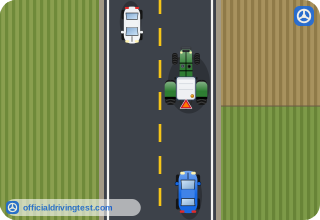
What should you remember about the operator of farm machinery?
- The operator can hear a horn from far away
- The operator always signals before turning
- The operator cannot hear approaching vehicles
- The operator must pull over for every vehicle
Show answer
Correct answer: The operator cannot hear approaching vehicles
The manual says the operator of farm machinery cannot hear approaching vehicles, so pass with caution.
Source: South Dakota Driver License Manual (Revised 11/2024), page 65
-
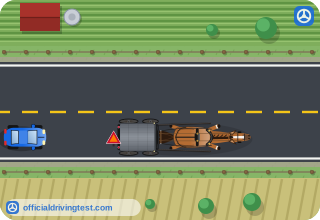
What rights do animal-drawn vehicles and horseback riders have on the road?
- The same rights to use the road as a motor vehicle
- The right-of-way over all motor vehicles
- The right to use the road only when no vehicle is behind them
- No right to use the road beyond the shoulder
Show answer
Correct answer: The same rights to use the road as a motor vehicle
They have the same rights to use the road as a motor vehicle and must follow the same rules.
Source: South Dakota Driver License Manual (Revised 11/2024), page 65
-
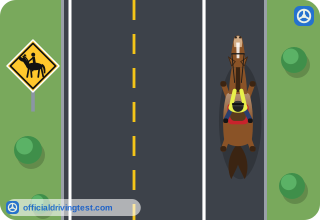
Why should you not use the horn or rev the engine when passing a horse?
- It may scare the horse and cause a crash
- It is illegal within 200 feet of a horse
- It tells the rider to pull over
- It may make the horse stop in the road
Show answer
Correct answer: It may scare the horse and cause a crash
The noise may scare the horse and cause a crash, so pass with caution instead.
Source: South Dakota Driver License Manual (Revised 11/2024), page 65
-
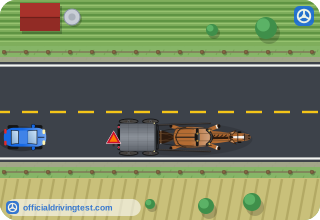
What turns should you anticipate from animal-drawn vehicles?
- U-turns on state highways at night
- Right turns onto the road shoulder
- Left turns into fields and driveways
- Sudden stops at rural intersections
Show answer
Correct answer: Left turns into fields and driveways
The manual says to anticipate left turns made by animal-drawn vehicles into fields and driveways.
Source: South Dakota Driver License Manual (Revised 11/2024), page 65
-
On roads with a posted speed limit of 35 mph or more, how far must you stay behind a snowplow when its red or amber lights are on?
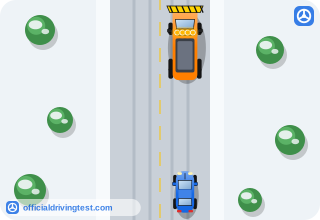
- At least 50 feet
- At least 200 feet
- At least 100 feet
- At least 400 feet
Show answer
Correct answer: At least 200 feet
The law requires drivers to stay at least 200 feet behind a snowplow with red or amber lights on, on roads posted at 35 mph or more.
Source: South Dakota Driver License Manual (Revised 11/2024), page 67
-
The law requires you to stay at least 200 feet behind a snowplow with its red or amber lights on. On which roads does this apply?
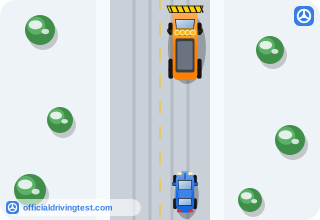
- Roads with a posted speed limit of 35 mph or more
- Roads with a posted speed limit of 25 mph or more
- Roads with a posted speed limit of 45 mph or more
- Roads with a posted speed limit of 55 mph or more
Show answer
Correct answer: Roads with a posted speed limit of 35 mph or more
The 200-foot rule applies on roads posted at 35 mph or higher.
Source: South Dakota Driver License Manual (Revised 11/2024), page 67
-
Where do snowplows often need to operate?
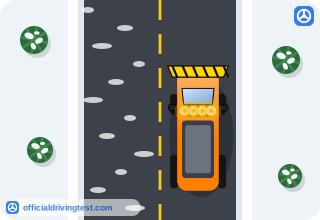
- Only on the shoulder
- Only in the right lane
- Very close to the center line
- Far from the center line of the road
Show answer
Correct answer: Very close to the center line
Snowplows are wide and often need to work very close to the center line, so you should give them room.
Source: South Dakota Driver License Manual (Revised 11/2024), page 67
-
What should you do when you see a snowplow throwing up clouds of snow?

- Slow down and give it as much room as possible
- Pass it quickly before the snow cloud grows
- Follow it closely to stay in clear pavement
- Flash your high beams to signal the driver
Show answer
Correct answer: Slow down and give it as much room as possible
Clouds of snow affect your vision, so you slow down and leave as much room as possible.
Source: South Dakota Driver License Manual (Revised 11/2024), page 67