New York: Sharing the road
Safely sharing the road with motorcycles, bicycles, trucks, and buses. Split into 4 shorter tests so you're not stuck in one long quiz.
Independent educational site · not affiliated with any government agency or DMV
Choose a part
Sharing the road — Part 1
Questions in this part include: “Under most conditions, on which side should you pass another vehicle traveling in the same direction as you?”
Sharing the road — Part 2
Questions in this part include: “What is the maximum fine for passing a stopped school bus if it is your third violation within three years?”
Sharing the road — Part 3
Questions in this part include: “When should you pay particular attention to in-line skaters, skateboarders and non-motorized scooters?”
Sharing the road — Part 4
Questions in this part include: “Are mopeds permitted on expressways or other controlled access highways?”
Questions are original and based on the official manual "New York State Driver's Manual" (Form MV-21), New York State Department of Motor Vehicles (DMV).
All 72 Sharing the road questions with answers
Choose a part above to take a practice test, or study every question and answer here.
Show the questions and answersHide the questions
1Part 118 questions
-
Under most conditions, on which side should you pass another vehicle traveling in the same direction as you?
- On the left side
- On the right side
- On either side, whichever is quicker
- You should never pass another vehicle
Show answer
Correct answer: On the left side
The manual states that when passing is allowed, you usually pass on the left side.
Source: New York State Driver's Manual (Form MV-21), page 39 · Open this page in the manual (Manual page 39)
-
According to the manual, what must you never do when passing another vehicle?
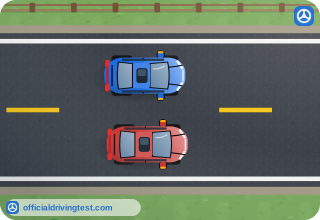
- Check your mirrors
- Exceed the speed limit
- Signal your intention
- Move into the left lane
Show answer
Correct answer: Exceed the speed limit
You must not exceed the speed limit to pass another vehicle.
Source: New York State Driver's Manual (Form MV-21), page 39 · Open this page in the manual (Manual page 39)
-
When you pass a motorcycle, what should you do?
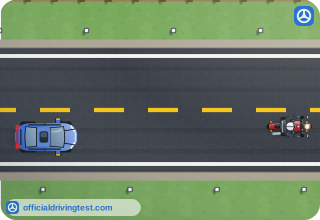
- Move partly into the motorcycle's lane if it is wide
- Pass as closely as possible to save time
- Give the motorcycle the same full-lane width as other vehicles
- Only pass motorcycles on the right
Show answer
Correct answer: Give the motorcycle the same full-lane width as other vehicles
Never move into the same lane space as a motorcycle, even if the lane is wide and the motorcycle is to one side.
Source: New York State Driver's Manual (Form MV-21), page 39 · Open this page in the manual (Manual page 39)
-
When overtaking a bicyclist from behind, what does the law require?
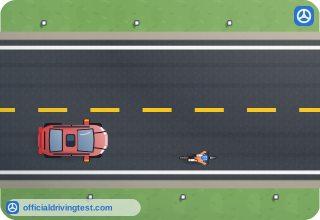
- Sound your horn continuously
- Pass on the right at any distance
- Wait until the bicyclist stops
- Pass on the left at a safe distance
Show answer
Correct answer: Pass on the left at a safe distance
The law requires you to pass a bicyclist on the left at a safe distance until the bicycle has been cleared.
Source: New York State Driver's Manual (Form MV-21), page 39 · Open this page in the manual (Manual page 39)
-
How far before making a lane change must you signal your intention, according to the manual?
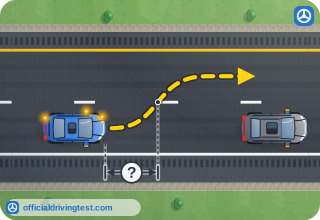
- At least 100 feet (30 m)
- At least 50 feet (15 m)
- At least 150 feet (45 m)
- At least 200 feet (60 m)
Show answer
Correct answer: At least 100 feet (30 m)
The law requires you to signal at least 100 feet (30 m) before you make a lane change.
Source: New York State Driver's Manual (Form MV-21), page 39 · Open this page in the manual (Manual page 39)
-
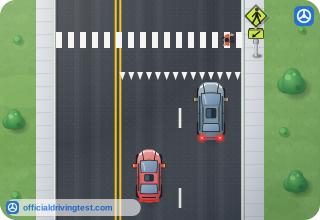
You must never pass a vehicle that has stopped at a crosswalk when it is doing what?
- Waiting for a traffic light
- Allowing a pedestrian to cross
- Turning left
- Checking for oncoming traffic
Show answer
Correct answer: Allowing a pedestrian to cross
You must never pass a vehicle that has stopped at a crosswalk to allow a pedestrian to go across.
Source: New York State Driver's Manual (Form MV-21), page 39 · Open this page in the manual (Manual page 39)
-
You cannot pass another vehicle on the left if your lane has what?
- A dashed white line
- A broken yellow center line
- A solid yellow center line
- No markings at all
Show answer
Correct answer: A solid yellow center line
One condition that prohibits passing on the left is a solid yellow center line in your lane.
Source: New York State Driver's Manual (Form MV-21), page 39 · Open this page in the manual (Manual page 39)
-
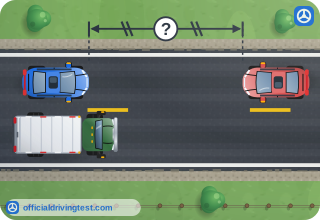
You cannot pass on the left if you cannot safely return to the right lane before an oncoming vehicle comes within how many feet of you?
- 100 feet (30 m)
- 150 feet (45 m)
- 300 feet (90 m)
- 200 feet (60 m)
Show answer
Correct answer: 200 feet (60 m)
You cannot pass on the left if you cannot safely return before any oncoming vehicle comes within 200 feet (60 m) of you.
Source: New York State Driver's Manual (Form MV-21), page 39 · Open this page in the manual (Manual page 39)
-
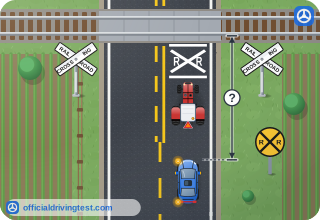
You cannot pass a vehicle on the left if you are within how many feet of a railroad crossing on a two-way roadway?
- 100 feet (30 m)
- 50 feet (15 m)
- 75 feet (23 m)
- 200 feet (60 m)
Show answer
Correct answer: 100 feet (30 m)
You cannot pass on the left within 100 feet (30 m) of a railroad crossing on a two-way roadway.
Source: New York State Driver's Manual (Form MV-21), page 39 · Open this page in the manual (Manual page 39)
-
You cannot pass on the left if you are within 100 feet of a bridge, tunnel or viaduct on a two-way road and what is true?
- There is a speed limit sign
- Your view is obstructed
- The road is wet
- There is a passing lane
Show answer
Correct answer: Your view is obstructed
You cannot pass on the left within 100 feet (30 m) of a bridge, tunnel or viaduct on a two-way road if your view is obstructed.
Source: New York State Driver's Manual (Form MV-21), page 39 · Open this page in the manual (Manual page 39)
-
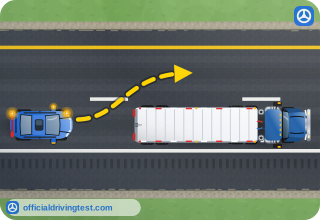
Before you pull into the left lane to pass, in addition to checking your mirrors, what should you also do?
- Flash your high beams
- Honk your horn twice
- Look quickly over your left shoulder
- Reduce to half the speed limit
Show answer
Correct answer: Look quickly over your left shoulder
Never depend only on your mirrors, since they leave blind spots; always look over your shoulder before you change lanes or pass.
Source: New York State Driver's Manual (Form MV-21), page 39 · Open this page in the manual (Manual page 39)
-
Before you return to the right lane after passing a vehicle, what should you be able to see in your interior rear-view mirror?
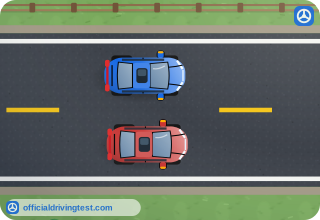
- The rear bumper of your own vehicle
- Only the vehicle behind you
- No mirror check is necessary
- The front bumper of the vehicle you passed
Show answer
Correct answer: The front bumper of the vehicle you passed
Make sure you can see the front bumper of the vehicle you passed before returning to the right lane.
Source: New York State Driver's Manual (Form MV-21), page 39 · Open this page in the manual (Manual page 39)
-
In which situation can you pass another vehicle on the right?
- When the vehicle ahead is making a left turn
- Whenever traffic is heavy
- When your lane has a solid yellow line
- Whenever you are late
Show answer
Correct answer: When the vehicle ahead is making a left turn
You can pass on the right when a vehicle ahead of you makes a left turn.
Source: New York State Driver's Manual (Form MV-21), page 39 · Open this page in the manual (Manual page 39)
-
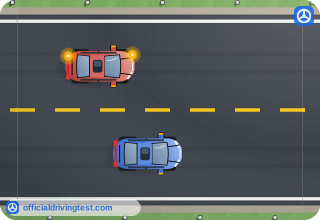
If another vehicle passes you on the left, what should you do?
- Speed up to stay ahead
- Slow slightly and stay centered in your lane
- Move to the left lane
- Flash your lights at the passing vehicle
Show answer
Correct answer: Slow slightly and stay centered in your lane
Decrease your speed slightly and stay centered in your lane; resume normal speed once the vehicle has safely passed.
Source: New York State Driver's Manual (Form MV-21), page 40 · Open this page in the manual (Manual page 40)
-
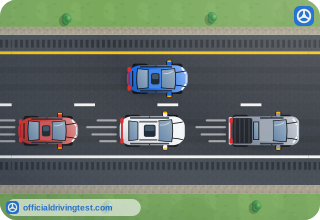
If you find that you are being passed on the right by many vehicles, what should you do?
- Speed up to prevent them from passing
- Stop your vehicle immediately
- Move into the right lane and let them pass
- Honk continuously
Show answer
Correct answer: Move into the right lane and let them pass
You should move into the right lane and allow those vehicles to pass you on the left.
Source: New York State Driver's Manual (Form MV-21), page 40 · Open this page in the manual (Manual page 40)
-
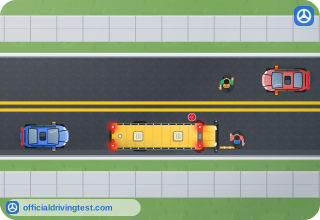
How far away must you stop when a school bus ahead of you flashes its red lights?
- At least 10 feet (3 m)
- At least 30 feet (9 m)
- At least 50 feet (15 m)
- At least 20 feet (6 m)
Show answer
Correct answer: At least 20 feet (6 m)
You should stop at least 20 feet (6 m) away from a school bus that is flashing its red lights.
Source: New York State Driver's Manual (Form MV-21), page 40 · Open this page in the manual (Manual page 40)
-
Before a school bus stops to load or discharge passengers, what does the driver usually do?
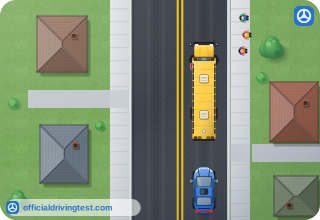
- Flash yellow warning lights
- Sound the horn
- Turn on hazard lights only
- Pull off the roadway entirely
Show answer
Correct answer: Flash yellow warning lights
The bus driver usually flashes yellow warning lights located near the roof, front and back, before stopping; you should decrease speed and be prepared to stop.
Source: New York State Driver's Manual (Form MV-21), page 40 · Open this page in the manual (Manual page 40)
-
Must you stop for a school bus with flashing red lights if it is on the opposite side of a divided highway?
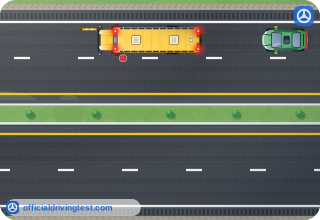
- No, only vehicles on the same side must stop
- Yes, you must stop even on a divided highway
- Only if there are no children visible
- Only during school hours
Show answer
Correct answer: Yes, you must stop even on a divided highway
The manual states that you must stop for a school bus even if it is on the opposite side of a divided highway.
Source: New York State Driver's Manual (Form MV-21), page 40 · Open this page in the manual (Manual page 40)
2Part 218 questions
-
What is the maximum fine for passing a stopped school bus if it is your third violation within three years?
- $250
- $500
- $1,000
- $750
Show answer
Correct answer: $1,000
The fine ranges from a minimum of $250 for a first violation to a maximum of $1,000 for three violations in three years.
Source: New York State Driver's Manual (Form MV-21), page 40 · Open this page in the manual (Manual page 40)
-
Under the 2019 law authorizing stop-arm cameras on school buses, what is the penalty for a first violation?
- $275
- $300
- $500
- $250
Show answer
Correct answer: $250
Under the stop-arm camera law, a first violation carries a penalty of $250; a second within 18 months is $275, and a third or more is $300.
Source: New York State Driver's Manual (Form MV-21), page 40 · Open this page in the manual (Manual page 40)
-
What right do bicyclists have on the road, according to the manual?
- The right to travel against the flow of traffic at all times
- The right to ride only on sidewalks everywhere
- The right to ignore all traffic signals
- The right to share the road in the same direction as motor vehicles
Show answer
Correct answer: The right to share the road in the same direction as motor vehicles
Bicyclists have the right to share the road and travel in the same direction as motor vehicles.
Source: New York State Driver's Manual (Form MV-21), page 68 · Open this page in the manual (Manual page 68)
-
Before you make a turn, parallel park, open a door or leave a curb, what should you do to check for bicyclists?
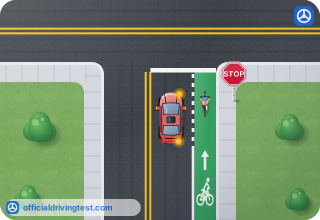
- Depend only on your side and rearview mirrors
- Assume no bicyclist is nearby unless you hear one
- Turn your head to check blind spots, not only your mirrors
- Honk your horn once and then proceed without looking
Show answer
Correct answer: Turn your head to check blind spots, not only your mirrors
Check your blind spots before you make a turn, parallel park, open a door or leave a curb. Do not depend only on your mirrors -- turn your head to look for bicyclists that may be next to you or approaching.
Source: New York State Driver's Manual (Form MV-21), page 68 · Open this page in the manual (Manual page 68)
-
What should you do when you pass a bicyclist, and why?
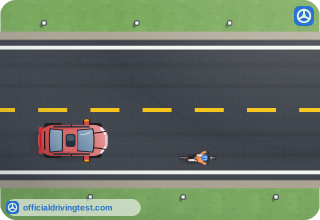
- Speed up so you spend less time beside them in the lane
- Stay as close as possible so you do not block other traffic
- Sound your horn so they know you are about to pass
- Reduce speed and give room, as air pressure can send them off balance
Show answer
Correct answer: Reduce speed and give room, as air pressure can send them off balance
Give bicyclists room when you drive and reduce speed as you pass them. Air pressure from a vehicle that passes them quickly can send them off balance.
Source: New York State Driver's Manual (Form MV-21), page 68 · Open this page in the manual (Manual page 68)
-
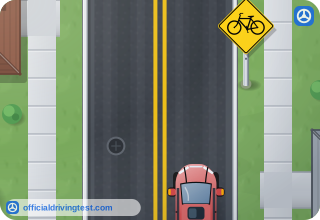
Where must bicyclists ride when there is no bicycle lane?
- In the center of the lane at all times, like a car
- Near the right curb or edge of the road, or on a right shoulder
- In the left lane or on the left shoulder, facing traffic
- On the sidewalk in all cases, never on the road
Show answer
Correct answer: Near the right curb or edge of the road, or on a right shoulder
Where there is no bicycle lane, bicyclists must remain near the right curb or edge of the road or on a right shoulder of the road, to prevent interference with other traffic.
Source: New York State Driver's Manual (Form MV-21), page 69 · Open this page in the manual (Manual page 69)
-
Do bicyclists have to remain to the right when preparing for a left turn or avoiding a hazard?
- Yes, they must always remain to the right in every situation
- Only at night
- No, they do not have to remain to the right in that situation
- Only on expressways
Show answer
Correct answer: No, they do not have to remain to the right in that situation
When bicyclists prepare for a left turn or must move left to avoid hazards, they do not have to remain to the right.
Source: New York State Driver's Manual (Form MV-21), page 69 · Open this page in the manual (Manual page 69)
-
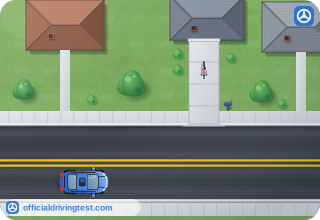
What must bicyclists do before entering a roadway from a driveway, an alley or over a curb?
- Ring their bell continuously
- Dismount and walk their bicycle across
- Speed up to merge quickly
- Come to a full stop
Show answer
Correct answer: Come to a full stop
Bicyclists must come to a full stop before they enter a roadway from a driveway, an alley or over a curb.
Source: New York State Driver's Manual (Form MV-21), page 69 · Open this page in the manual (Manual page 69)
-
How many bicyclists may travel side-by-side in a single lane at most?
- One
- Two
- Three
- Four
Show answer
Correct answer: Two
Bicyclists must never travel with more than two side-by-side in a single lane.
Source: New York State Driver's Manual (Form MV-21), page 69 · Open this page in the manual (Manual page 69)
-
Which bicyclists and passengers must wear an approved helmet?
- Only riders over age 18
- Bicyclists and their passengers ages 1 through 13
- Only passengers, never the bicyclist
- No one; helmets are never required in New York
Show answer
Correct answer: Bicyclists and their passengers ages 1 through 13
Bicyclists and their passengers ages 1 - 13 must wear an approved helmet. Adults must obey any local laws or regulations about helmet use.
Source: New York State Driver's Manual (Form MV-21), page 69 · Open this page in the manual (Manual page 69)
-
How does a bicyclist signal a right turn using a hand signal?
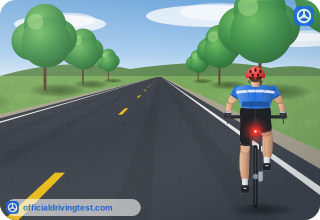
- By extending the right arm straight out to the right
- By extending the left arm straight out to the left
- By waving both arms overhead
- By pointing downward with the right hand
Show answer
Correct answer: By extending the right arm straight out to the right
A bicyclist can signal a right turn when they extend the right arm straight out to the right.
Source: New York State Driver's Manual (Form MV-21), page 69 · Open this page in the manual (Manual page 69)
-
What does the manual say about carrying an infant under a year old as a bicycle passenger?
- It is allowed if the infant wears a helmet
- It is allowed only in a bicycle safety seat during the day
- It is against the law
- It is allowed if an adult holds the infant
Show answer
Correct answer: It is against the law
Bicyclists must never carry an infant under a year old as a passenger. It is against the law.
Source: New York State Driver's Manual (Form MV-21), page 69 · Open this page in the manual (Manual page 69)
-
How must child passengers ages 1 through 4 be carried on a bicycle?
- In attached bicycle safety seats
- On the handlebars
- Seated on the rider's lap
- Standing on the rear wheel pegs
Show answer
Correct answer: In attached bicycle safety seats
Child passengers ages 1 - 4 must ride in attached bicycle safety seats.
Source: New York State Driver's Manual (Form MV-21), page 69 · Open this page in the manual (Manual page 69)
-
What lighting must a bicycle used at night have, according to the manual?
- A headlight visible from at least 300 feet ahead and a red taillight from at least 500 feet behind
- Only a red taillight visible from at least 300 feet behind
- No lighting is required if reflectors are present
- A headlight visible from at least 500 feet ahead and a red taillight from at least 300 feet behind
Show answer
Correct answer: A headlight visible from at least 500 feet ahead and a red taillight from at least 300 feet behind
A bicycle used at night must have a headlight visible from at least 500 feet ahead and a red taillight visible from at least 300 feet behind.
Source: New York State Driver's Manual (Form MV-21), page 69 · Open this page in the manual (Manual page 69)
-
What must be done if a bicycle crash causes death or serious injury?
- It must be reported to the DMV within 10 days of the incident
- Nothing needs to be reported
- It must be reported within 30 days to the local library
- It must be reported only if a motor vehicle was involved
Show answer
Correct answer: It must be reported to the DMV within 10 days of the incident
Any bicycle crash that causes death or serious injury must be reported to DMV within 10 days of the incident. Bicycle Crash Report forms (MV-104C) are available at any motor vehicle office, and you can also submit your report online.
Source: New York State Driver's Manual (Form MV-21), page 69 · Open this page in the manual (Manual page 69)
-
What is a "bike box," as described in the manual?
- A locked storage box for bicycles at a train or bus station
- A rack or trailer used to carry bicycles behind a car
- A marked bicycle lane that allows travel in both directions
- A marked area for bicyclists ahead of where traffic must stop
Show answer
Correct answer: A marked area for bicyclists ahead of where traffic must stop
A bike box is a marked area at an intersection, ahead of where traffic is required to stop. This area provides extra space for bicyclists, and some bike boxes extend across the entire intersection, functioning similar to a crosswalk for pedestrians.
Source: New York State Driver's Manual (Form MV-21), page 70 · Open this page in the manual (Manual page 70)
-
Besides pedestrians and bicyclists, which other road users does the manual specifically mention as vulnerable to careless drivers?
- In-line skaters, skateboarders and non-motorized scooters
- Taxi drivers, bus drivers and tow truck operators
- Delivery truck drivers, mail carriers and couriers
- Traffic officers, toll collectors and crossing guards
Show answer
Correct answer: In-line skaters, skateboarders and non-motorized scooters
As with pedestrians and bicyclists, other road users such as in-line skaters, skateboarders and non-motorized scooters are vulnerable to the careless actions of motor vehicle drivers.
Source: New York State Driver's Manual (Form MV-21), page 70 · Open this page in the manual (Manual page 70)
-
Who is responsible for safe and lawful operation around in-line skaters, skateboarders and non-motorized scooters?
- Only the local police who patrol the area
- Motor vehicle operators, who must exercise due care
- Only the skaters and scooter riders themselves
- No one; there is no such requirement
Show answer
Correct answer: Motor vehicle operators, who must exercise due care
Motor vehicle operators are responsible for safe and lawful operation of the vehicles they drive. As a driver, you are responsible to exercise due care by being aware, alert, and driving defensively.
Source: New York State Driver's Manual (Form MV-21), page 70 · Open this page in the manual (Manual page 70)
3Part 318 questions
-
When should you pay particular attention to in-line skaters, skateboarders and non-motorized scooters?
- Only on weekends and holidays, when parks are busiest
- Along the roadside, in bike lanes, at intersections and crosswalks
- Only when they ride in the street without wearing helmets
- Only at night or in rain, fog or other poor visibility
Show answer
Correct answer: Along the roadside, in bike lanes, at intersections and crosswalks
Pay particular attention when you observe in-line skaters, skateboarders and non-motorized scooters operating along the roadside, in a designated bike lane, when approaching intersections and at crosswalks.
Source: New York State Driver's Manual (Form MV-21), page 70 · Open this page in the manual (Manual page 70)
-
What rights and responsibilities do motorcyclists have compared to drivers of other vehicles?
- Motorcyclists have fewer rights and are exempt from most traffic laws
- Motorcyclists have extra rights not given to other drivers
- Motorcyclists have the same rights and responsibilities as other drivers
- Motorcyclists are governed by a completely separate set of rules
Show answer
Correct answer: Motorcyclists have the same rights and responsibilities as other drivers
Motorcyclists have the same rights and responsibilities as drivers of other vehicles, and must follow the same traffic laws.
Source: New York State Driver's Manual (Form MV-21), page 70 · Open this page in the manual (Manual page 70)
-
In a crash involving a motorcycle and another vehicle, who has a much higher chance of being seriously hurt or killed?
- The driver and passengers of the other vehicle
- The motorcycle rider and passenger
- Neither party, since motorcycles are equally protective
- Only pedestrians nearby
Show answer
Correct answer: The motorcycle rider and passenger
When there is a crash involving a motorcycle and another vehicle, the rider (and passenger) have a much higher chance of being seriously hurt or killed than the driver (and passengers) of the other vehicle.
Source: New York State Driver's Manual (Form MV-21), page 71 · Open this page in the manual (Manual page 71)
-
What protective equipment are motorcyclists required to wear?
- A reflective vest only
- No protective equipment is legally required
- Steel-toed boots only
- Approved helmets and goggles or a face shield
Show answer
Correct answer: Approved helmets and goggles or a face shield
Motorcyclists are required to wear approved helmets and goggles or a face shield, though motorcycles themselves do not offer the rider the protections of other vehicle types.
Source: New York State Driver's Manual (Form MV-21), page 71 · Open this page in the manual (Manual page 71)
-
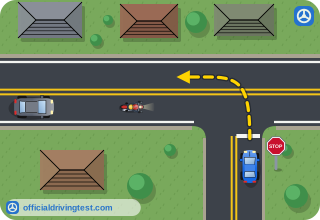
Why can it be difficult for a driver to judge how far away or how fast a motorcycle is traveling?
- Motorcycles always travel slower than other vehicles
- Its smaller size makes it seem much farther away than it is
- Motorcycles are not allowed on most roads
- Motorcycles do not have headlights
Show answer
Correct answer: Its smaller size makes it seem much farther away than it is
Motorcycles may appear to move faster than other vehicles. A motorcycle's smaller size makes it seem much farther away, and makes it difficult to judge how far away they are or how fast they are going.
Source: New York State Driver's Manual (Form MV-21), page 71 · Open this page in the manual (Manual page 71)
-
How many motorcyclists are allowed to ride side-by-side in a single lane, and what is a motorcyclist NOT allowed to do?
- Three may ride side-by-side, and they may pass any vehicle in the lane
- Any number may ride side-by-side, as long as they signal before passing a car
- Only one may ride in a lane, but it may pass or share the lane with a car
- Two may ride side-by-side, but may not pass or share a lane with a non-motorcycle vehicle
Show answer
Correct answer: Two may ride side-by-side, but may not pass or share a lane with a non-motorcycle vehicle
Two motorcyclists are allowed to ride side-by-side in a single lane, but a motorcyclist cannot pass or share a lane with another motor vehicle that is not a motorcycle.
Source: New York State Driver's Manual (Form MV-21), page 71 · Open this page in the manual (Manual page 71)
-
Why can motorcycle headlights fail to stand out to other drivers?
- Motorcycle headlights are not required to be on while driving
- So many vehicles have daytime running lights that are always on
- Motorcycles are required to use only yellow headlights
- Motorcycle headlights are dimmer than a bicycle's
Show answer
Correct answer: So many vehicles have daytime running lights that are always on
Headlights and taillights on motorcycles must be illuminated when driving, but with so many vehicles equipped with daytime running lights that are always on even in daylight, motorcycle headlights don't stand out.
Source: New York State Driver's Manual (Form MV-21), page 71 · Open this page in the manual (Manual page 71)
-
Why are motorcycle brake lights often harder to notice than those on a car or truck?
- Most motorcycle brake lights sit below eye level
- Motorcycle brake lights are always turned off
- Motorcycle brake lights are illegal in New York
- Motorcycle brake lights only work in reverse
Show answer
Correct answer: Most motorcycle brake lights sit below eye level
Most cars and trucks are equipped with a Center High Mount Stop Light (CHMSL) designed to be at, or close to, eye level. Most motorcycle brake lights are mounted lower than eye level, which makes them less obvious to many motorists.
Source: New York State Driver's Manual (Form MV-21), page 71 · Open this page in the manual (Manual page 71)
-
Why might a motorcycle's turn signal be on even when the rider has no intention of turning?
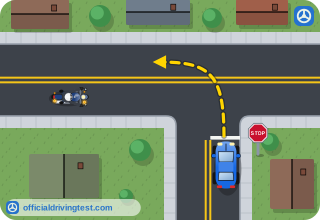
- On most motorcycles, the signal does not turn off automatically after a turn
- Motorcycle turn signals are always on regardless of use
- Turn signals on motorcycles are purely decorative
- New York law requires motorcycle turn signals to stay on at all times
Show answer
Correct answer: On most motorcycles, the signal does not turn off automatically after a turn
On most motorcycles, the directional signal does not turn off automatically after a turn, so their turn signal may be on inadvertently when the motorcyclist has no intention of turning.
Source: New York State Driver's Manual (Form MV-21), page 71 · Open this page in the manual (Manual page 71)
-
According to a 2015 National Highway Traffic Safety Administration report cited in the manual, what was a common circumstance in fatal motorcycle crashes?
- 41 percent involved the other vehicle turning left as the motorcycle went straight or passed
- Most occurred because motorcycles were exceeding the speed limit on expressways
- Most occurred at railroad crossings
- Most occurred because motorcycles lacked headlights
Show answer
Correct answer: 41 percent involved the other vehicle turning left as the motorcycle went straight or passed
The National Highway Traffic Safety Administration reports that, in 2015, 41 percent of fatal motorcycle crashes in the US occurred with the other vehicle turning left while the motorcycle was going straight, passing, or overtaking other vehicles.
Source: New York State Driver's Manual (Form MV-21), page 72 · Open this page in the manual (Manual page 72)
-
In 2014, what percentage of reported motorcycle crashes in New York State involved another vehicle?
- 15.2%
- 53.6%
- 78.9%
- 99%
Show answer
Correct answer: 53.6%
In 2014, there were 4,750 reported motorcycle crashes in New York State. Of these, 2,546 involved another vehicle -- that's 53.6% of the reported crashes.
Source: New York State Driver's Manual (Form MV-21), page 72 · Open this page in the manual (Manual page 72)
-
Why shouldn't you tailgate a motorcycle?
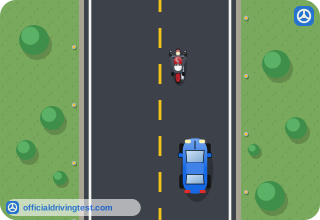
- It has no effect on safety either way
- Motorcycles always take longer to stop than cars, even on dry, clear pavement
- Tailgating a motorcycle is required to keep it visible
- They can stop shorter than cars under the right conditions; slowing may be hard to notice
Show answer
Correct answer: They can stop shorter than cars under the right conditions; slowing may be hard to notice
Don't tailgate. Motorcycles can stop in a shorter distance than cars under the right conditions, and it may be more difficult to notice they are slowing or stopping.
Source: New York State Driver's Manual (Form MV-21), page 73 · Open this page in the manual (Manual page 73)
-
What are mopeds, as described in the manual?
- Low speed, two- or three-wheeled limited use motorcycles
- Full-size motorcycles requiring a class M license only
- Non-motorized bicycles with an added basket
- Four-wheeled vehicles limited to farm use
Show answer
Correct answer: Low speed, two- or three-wheeled limited use motorcycles
Limited use motorcycles, often called mopeds, are low speed, two- or three-wheeled vehicles for limited use on public highways. There are three different classes based on maximum performance speed.
Source: New York State Driver's Manual (Form MV-21), page 73 · Open this page in the manual (Manual page 73)
-
According to the moped operation chart, what is the top speed range for a Class A limited use motorcycle, and what license is required?
- 20 mph or less, no license required
- 21 to 30 mph, any Class 4 license
- 31 to 40 mph, a Class M license or permit
- Over 55 mph, a commercial license
Show answer
Correct answer: 31 to 40 mph, a Class M license or permit
A Class A limited use motorcycle (moped) has a top speed range of 31 to 40 mph and requires a Class M license or learner permit.
Source: New York State Driver's Manual (Form MV-21), page 73 · Open this page in the manual (Manual page 73)
-
What is the top speed range for a Class C limited use motorcycle (moped)?
- 31 to 40 mph
- 21 to 30 mph
- 20 mph or less
- 45 mph or more
Show answer
Correct answer: 20 mph or less
A Class C limited use motorcycle (moped) has a top speed range of 20 mph or less.
Source: New York State Driver's Manual (Form MV-21), page 73 · Open this page in the manual (Manual page 73)
-
According to the moped operation chart, when must the headlight be on?
- Only at night
- Only in Class C mopeds
- Whenever operating, in all three classes
- Only when requested by a passenger
Show answer
Correct answer: Whenever operating, in all three classes
The moped operation chart shows that the headlight must be on when operating for all three classes -- A, B, and C.
Source: New York State Driver's Manual (Form MV-21), page 73 · Open this page in the manual (Manual page 73)
-
For which classes of limited use motorcycles (mopeds) is helmet and eye protection required, according to the chart?
- It is required for A and B, recommended for C
- It is required for none of the classes
- It is required only for Class C
- It is optional for all classes
Show answer
Correct answer: It is required for A and B, recommended for C
According to the chart, helmet and eye protection are required when operating a Class A or Class B moped, while it is only recommended for Class C.
Source: New York State Driver's Manual (Form MV-21), page 73 · Open this page in the manual (Manual page 73)
-
Where can Class B and C mopeds be driven?
- In any lane of traffic
- Only on sidewalks
- Only in the right lane, as far to the right as possible
- Only in the left lane, as far to the left as possible
Show answer
Correct answer: Only in the right lane, as far to the right as possible
Class B and C mopeds can be driven only in the right lane of traffic, as far to the right as possible. Class A mopeds are allowed to drive in any lane and any section of a lane.
Source: New York State Driver's Manual (Form MV-21), page 74 · Open this page in the manual (Manual page 74)
4Part 418 questions
-
Are mopeds permitted on expressways or other controlled access highways?
- Yes, always, without exception
- Yes, but only at night
- Yes, but only Class C mopeds
- No, unless posted signs permit it
Show answer
Correct answer: No, unless posted signs permit it
Mopeds are not permitted on expressways or other controlled access highways unless posted signs permit it.
Source: New York State Driver's Manual (Form MV-21), page 74 · Open this page in the manual (Manual page 74)
-
What precautions should you use when you approach a moped?
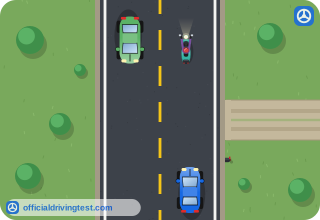
- None; mopeds do not require special caution
- The same precautions you would use with a bicyclist
- Only slow down if the moped is a Class A
- Sound your horn continuously
Show answer
Correct answer: The same precautions you would use with a bicyclist
When you approach a moped, use the same precautions you would when you approach a bicyclist.
Source: New York State Driver's Manual (Form MV-21), page 74 · Open this page in the manual (Manual page 74)
-
In more than 60 percent of fatal crashes involving cars and big trucks, who contributes to the cause of the crash?
- The truck driver
- The car driver
- Weather conditions only
- Road construction crews
Show answer
Correct answer: The car driver
In more than 60 percent of all fatal crashes that involve cars and big trucks, the car driver, not the truck driver, contributes to the cause of the traffic crash, and four out of five times it is the car driver who is killed.
Source: New York State Driver's Manual (Form MV-21), page 74 · Open this page in the manual (Manual page 74)
-
The bigger a large vehicle is, the more of which of the following is true?
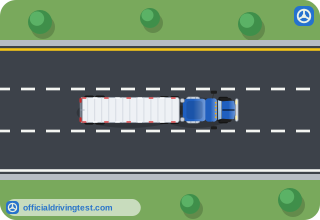
- The smaller their blind spots and the shorter it takes them to stop
- Bigger blind spots, longer to stop, and more room needed to maneuver
- They need less room to turn
- It takes automobiles less time to pass them
Show answer
Correct answer: Bigger blind spots, longer to stop, and more room needed to maneuver
Large trucks, recreational vehicles and buses are not big cars. The bigger they are, the bigger their blind spots, the longer it takes them to stop, the more room they need to maneuver, and the longer it takes for an automobile to pass them.
Source: New York State Driver's Manual (Form MV-21), page 74 · Open this page in the manual (Manual page 74)
-
How large can the blind spot be in front of a tractor with a long hood?
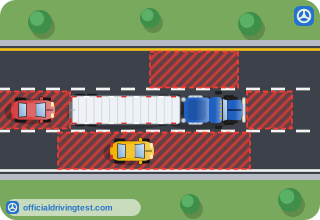
- 5 feet
- 10 feet
- 20 feet
- 50 feet
Show answer
Correct answer: 20 feet
Tractors with long hoods can have a blind spot of 20 feet in front of the vehicle. You should avoid these "no zones."
Source: New York State Driver's Manual (Form MV-21), page 74 · Open this page in the manual (Manual page 74)
-
What happens if you remain in the back blind spot of a large vehicle?
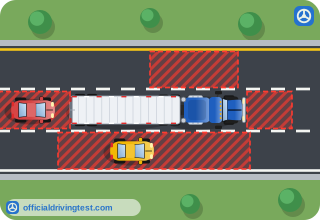
- Nothing changes; the other driver can still see you in the mirrors
- Your headlights automatically turn on
- The other driver cannot see your car, and your view of traffic is blocked
- The large vehicle is legally required to stop
Show answer
Correct answer: The other driver cannot see your car, and your view of traffic is blocked
If you remain in the back blind spot of a large vehicle, you increase the chance of a crash. The other driver cannot see your car and your view of other traffic will be blocked.
Source: New York State Driver's Manual (Form MV-21), page 74 · Open this page in the manual (Manual page 74)
-
Why do large vehicles like tractor-trailers take longer to stop than smaller vehicles traveling at the same speed?
- Because their tires are smaller
- Because they are required by law to stop slowly
- Because they have no brakes on the trailer, only on the tractor
- Because of brake delay as air brakes send power from tractor to trailer
Show answer
Correct answer: Because of brake delay as air brakes send power from tractor to trailer
For tractor trailers, the difference in stopping distance comes from brake delay. Air brakes transmit brake power from the tractor to the trailer, and this can add many feet to the distance it takes to stop.
Source: New York State Driver's Manual (Form MV-21), page 74 · Open this page in the manual (Manual page 74)
-
When passing a large vehicle, what should you make sure of before you return to your lane?
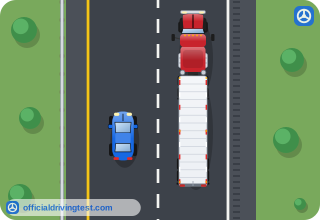
- That you have used your horn
- That you can see the whole front of the vehicle in your mirror
- That the large vehicle has turned on its hazard lights
- That you are on a downhill grade
Show answer
Correct answer: That you can see the whole front of the vehicle in your mirror
When you pass a large vehicle, make sure you can see the whole front of the vehicle in your mirror before you return to your lane.
Source: New York State Driver's Manual (Form MV-21), page 74 · Open this page in the manual (Manual page 74)
-
What should you do if a truck ahead of you is backing up to load or unload goods?
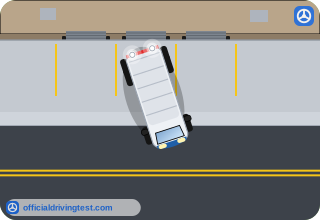
- Pass close behind it quickly
- Be patient and never pass close behind it
- Honk repeatedly until it stops
- Drive around it on the shoulder immediately
Show answer
Correct answer: Be patient and never pass close behind it
Never pass close behind a large vehicle that is backing up. Often a truck driver has to block a road to back into an area to load or unload goods -- be patient.
Source: New York State Driver's Manual (Form MV-21), page 75 · Open this page in the manual (Manual page 75)
-
Why should you always leave space when you stop behind a truck or bus at a traffic light or stop sign, especially facing uphill?
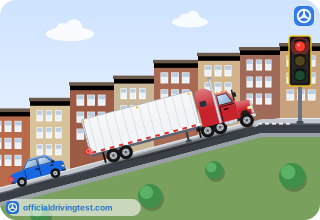
- It could move backward slightly when it starts
- It is required only to be polite
- It helps you see the traffic light better
- It is only necessary in the rain
Show answer
Correct answer: It could move backward slightly when it starts
Always leave space when you stop behind a truck or bus at a traffic light or stop sign, especially when you face up a hill. The truck or bus could move backward slightly when it starts.
Source: New York State Driver's Manual (Form MV-21), page 75 · Open this page in the manual (Manual page 75)
-
What does the "slow-moving vehicle" symbol look like, and what does it indicate?
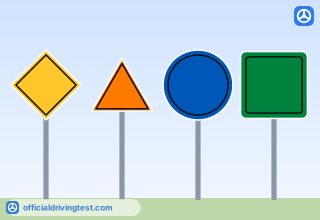
- A blue circle, indicating a vehicle powered by electricity
- A green square, indicating a hybrid vehicle
- A yellow diamond, required on all buses
- A reflective orange triangle, required on most farm vehicles
Show answer
Correct answer: A reflective orange triangle, required on most farm vehicles
The "slow-moving vehicle" symbol, a reflective orange triangle, must be displayed on the back of vehicles drawn by animals, most farm vehicles, and construction equipment.
Source: New York State Driver's Manual (Form MV-21), page 76 · Open this page in the manual (Manual page 76)
-
Besides farm vehicles and construction equipment, what other vehicles are required to display the orange slow-moving vehicle triangle?
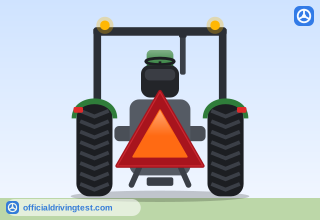
- School buses
- Rural mail vehicles
- Taxicabs
- Police vehicles
Show answer
Correct answer: Rural mail vehicles
The United States Postal Service also requires these orange safety triangles to be displayed on all rural mail delivery vehicles.
Source: New York State Driver's Manual (Form MV-21), page 76 · Open this page in the manual (Manual page 76)
-
What does New York State law allow all-terrain vehicles (ATVs) and snowmobiles to do?
- To cross many state highways and local roadways
- To drive on expressways at full highway speed
- To park in any handicapped space
- To ignore all traffic control devices
Show answer
Correct answer: To cross many state highways and local roadways
State law allows all-terrain vehicles (ATVs) and snowmobiles to legally go across many state highways and local roadways.
Source: New York State Driver's Manual (Form MV-21), page 76 · Open this page in the manual (Manual page 76)
-
What must ATVs and snowmobiles do before crossing a state highway or local roadway?
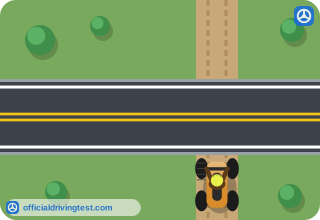
- Come to a stop and yield to traffic
- Sound a horn continuously
- Turn on hazard lights and proceed without stopping
- Radio ahead to the local police department
Show answer
Correct answer: Come to a stop and yield to traffic
Before ATVs and snowmobiles cross a state highway or local roadway, they must come to a stop and yield to traffic.
Source: New York State Driver's Manual (Form MV-21), page 76 · Open this page in the manual (Manual page 76)
-
At what angle must ATVs and snowmobiles cross a road surface?
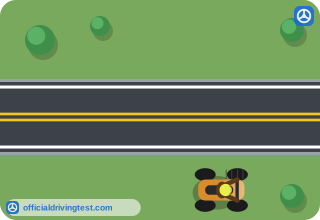
- A 45-degree angle
- A 90-degree angle
- Any angle they choose
- A 180-degree angle
Show answer
Correct answer: A 90-degree angle
ATVs and snowmobiles must go across the road surface at a 90-degree angle.
Source: New York State Driver's Manual (Form MV-21), page 76 · Open this page in the manual (Manual page 76)
-
Are horse riders subject to and protected by the rules of the road?
- No, horse riders are completely exempt from them
- Yes, they are subject to and protected by them
- Only if they are on a sidewalk
- Only during daylight hours
Show answer
Correct answer: Yes, they are subject to and protected by them
Horse riders are subject to, and protected by, the rules of the road.
Source: New York State Driver's Manual (Form MV-21), page 76 · Open this page in the manual (Manual page 76)
-
Where must horse riders ride along the road?
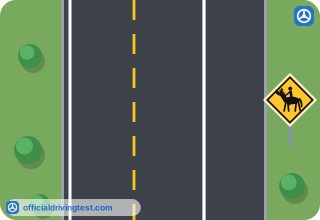
- Single file near the right curb or road edge, or on a right shoulder
- In the center of the road, two abreast
- Only on sidewalks
- Single file near the left curb or road edge, facing traffic
Show answer
Correct answer: Single file near the right curb or road edge, or on a right shoulder
Horse riders must ride single file near the right curb or road edge or on a right shoulder, lane or path that can be used.
Source: New York State Driver's Manual (Form MV-21), page 76 · Open this page in the manual (Manual page 76)
-
What is illegal to do when you approach or pass a horse being ridden or walked along a road?
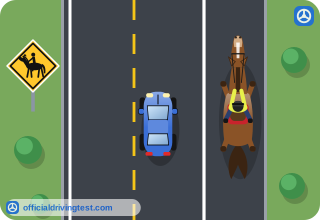
- Reducing your speed
- Sounding your horn
- Leaving extra distance
- Stopping completely
Show answer
Correct answer: Sounding your horn
You must drive at an acceptable speed and at an acceptable distance away from the horse. It is illegal to sound your horn when you approach or pass a horse.
Source: New York State Driver's Manual (Form MV-21), page 76 · Open this page in the manual (Manual page 76)