New York: 30 Hardest Driving Test Questions
Questions that need a second thought, picked for close numbers, exceptions and easy-to-confuse rules. Take your time.
Independent educational site · not affiliated with any government agency or DMV
Ready? Test yourself
Answer to start, or tap Start below:
Unless another limit is posted, what is the speed limit in New York City, according to the manual?
- Instant feedback with an explanation
- Every answer cites its source in the manual
- Your best score is saved on this device
- Keyboard: press 1 to 4 to answer and Enter for the next question
Questions are original and based on the official manual "New York State Driver's Manual" (Form MV-21), New York State Department of Motor Vehicles (DMV).
All 30 questions in this practice test
Take the test above first, then use this list to study. Tap “Show answer” to see the correct answer and explanation.
Show the questions and answersHide the questions
-
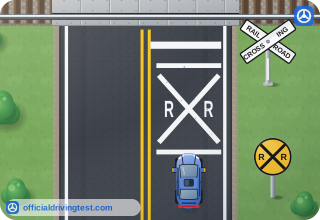
What should you do if your vehicle is actually crossing railroad tracks?
- Speed up as much as possible
- Shift gears to find the best one
- Stay in your lane and in the same gear
- Change lanes to pass slower vehicles
Show answer
Correct answer: Stay in your lane and in the same gear
When crossing tracks, always stay in your lane and in the same gear.
Source: New York State Driver's Manual (Form MV-21), page 60 · Open this page in the manual (Manual page 60)
-
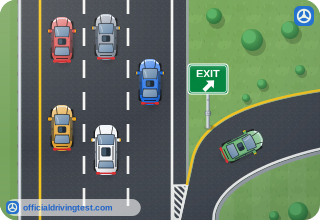
If you enter an expressway going the wrong direction or take the wrong exit, what should you do?
- Back up on the ramp to correct your mistake
- Cross the median to turn around
- Stay on the expressway until the next exit
- Stop your vehicle on the shoulder and wait for help
Show answer
Correct answer: Stay on the expressway until the next exit
If you enter an expressway going a different direction than you intended, or at the wrong exit, stay on the expressway until the next exit. It is dangerous to back up on an entrance or exit ramp, or to try to cross a median.
Source: New York State Driver's Manual (Form MV-21), page 62 · Open this page in the manual (Manual page 62)
-
What is the rule about turning on a red light in New York City?
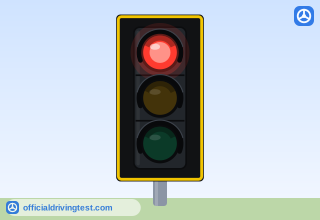
- Turns on red are not allowed unless a sign permits them
- Turns on red are always allowed in New York City
- Turns on red are never allowed anywhere in New York City
- Only left turns on red are allowed in New York City
Show answer
Correct answer: Turns on red are not allowed unless a sign permits them
In New York City, turning on a red light is not allowed unless a sign permits it.
Source: New York State Driver's Manual (Form MV-21), page 31 · Open this page in the manual (Manual page 31)
-
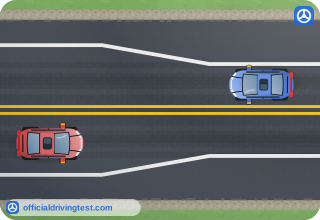
What does it mean if an edge line angles toward the center of the road?
- A passing zone is beginning
- A rest area is ahead
- The speed limit is increasing
- The road ahead is narrower
Show answer
Correct answer: The road ahead is narrower
An edge line that angles toward the center of the road shows that the road is narrower ahead.
Source: New York State Driver's Manual (Form MV-21), page 31 · Open this page in the manual (Manual page 31)
-
When is it legal to drive across an edge line?
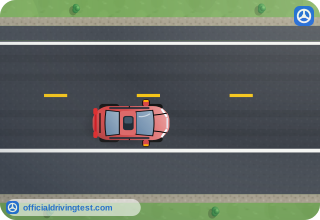
- Never, under any circumstances
- Anytime you want to use the shoulder to pass
- When directed by an officer or allowed by a sign
- Only at night
Show answer
Correct answer: When directed by an officer or allowed by a sign
It is illegal to drive across the edge line, except when told to by a police officer or other authorized official, or when allowed by an official sign.
Source: New York State Driver's Manual (Form MV-21), page 31 · Open this page in the manual (Manual page 31)
-
According to the manual, how low can a posted work area speed limit be?
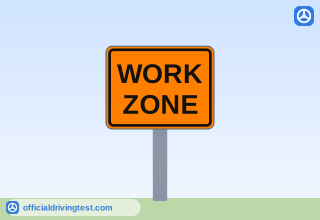
- 15 MPH
- 45 MPH
- 35 MPH
- 25 MPH
Show answer
Correct answer: 25 MPH
A work area speed limit as low as 25 MPH (40 km/h) can be posted.
Source: New York State Driver's Manual (Form MV-21), page 30 · Open this page in the manual (Manual page 30)
-
Unless another limit is posted, what is the speed limit in New York City, according to the manual?
- 15 mph
- 20 mph
- 30 mph
- 25 mph
Show answer
Correct answer: 25 mph
The manual gives the example that the speed limit is 25 mph (48 km/h) in New York City unless another limit is posted.
Source: New York State Driver's Manual (Form MV-21), page 47 · Open this page in the manual (Manual page 47)
-
According to the manual, roundabouts are designed to restrict vehicle speed within the circle to:
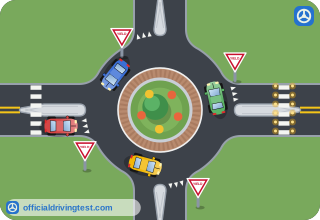
- 15 mph or less
- 45 mph or less
- 60 mph or less
- 30 mph or less
Show answer
Correct answer: 30 mph or less
The manual states roundabouts are designed so that the speed of all vehicles is restricted to 30 mph (50 km/h) or less within the roundabout.
Source: New York State Driver's Manual (Form MV-21), page 50 · Open this page in the manual (Manual page 50)
-
Vehicles responding to emergencies for a Police Department, Sheriff Department, or the New York State Troopers:
- Must always flash their headlights instead of using a siren
- Are not always required to use an audible siren or horn
- Must always use a siren when responding
- Are prohibited from using sirens in cities
Show answer
Correct answer: Are not always required to use an audible siren or horn
The manual notes that vehicles responding to emergencies for a Police Department, Sheriff Department, or the New York State Troopers are not always required to use an audible siren or horn.
Source: New York State Driver's Manual (Form MV-21), page 35 · Open this page in the manual (Manual page 35)
-
On parkways, interstates, and other controlled access roads with multiple lanes, the Move Over Law further requires drivers to:
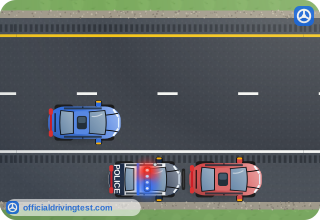
- Move out of the lane next to the vehicle unless unsafe to do so
- Stop completely on the shoulder behind the vehicle
- Honk the horn continuously as they pass the vehicle
- Increase speed to pass the vehicle as quickly as possible
Show answer
Correct answer: Move out of the lane next to the vehicle unless unsafe to do so
The manual states that on parkways, interstates, and other controlled access roads with multiple lanes, drivers are further required to move from the lane adjacent to the emergency or hazard vehicle unless traffic or other hazards prevent doing so safely.
Source: New York State Driver's Manual (Form MV-21), page 35 · Open this page in the manual (Manual page 35)
-
Parking or standing is not allowed within how many feet of a traffic light, STOP sign or YIELD sign?
- 15 feet (5 m)
- 20 feet (6 m)
- 30 feet (10 m)
- 50 feet (15 m)
Show answer
Correct answer: 30 feet (10 m)
Parking or standing is not allowed within 30 feet (10 m) of a traffic light, STOP sign or YIELD sign.
Source: New York State Driver's Manual (Form MV-21), page 43 · Open this page in the manual (Manual page 43)
-
Parking or standing is not allowed within how many feet of a crosswalk at an intersection?
- 15 feet (5 m)
- 20 feet (6 m)
- 30 feet (10 m)
- 50 feet (15 m)
Show answer
Correct answer: 20 feet (6 m)
Parking or standing is not allowed within 20 feet (6 m) of a crosswalk at an intersection.
Source: New York State Driver's Manual (Form MV-21), page 43 · Open this page in the manual (Manual page 43)
-
How far away must you stop when a school bus ahead of you flashes its red lights?
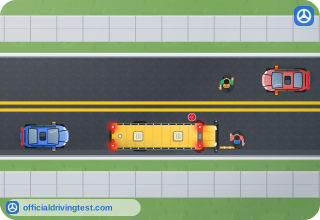
- At least 10 feet (3 m)
- At least 30 feet (9 m)
- At least 50 feet (15 m)
- At least 20 feet (6 m)
Show answer
Correct answer: At least 20 feet (6 m)
You should stop at least 20 feet (6 m) away from a school bus that is flashing its red lights.
Source: New York State Driver's Manual (Form MV-21), page 40 · Open this page in the manual (Manual page 40)
-
At what angle must ATVs and snowmobiles cross a road surface?

- A 45-degree angle
- A 90-degree angle
- Any angle they choose
- A 180-degree angle
Show answer
Correct answer: A 90-degree angle
ATVs and snowmobiles must go across the road surface at a 90-degree angle.
Source: New York State Driver's Manual (Form MV-21), page 76 · Open this page in the manual (Manual page 76)
-
Where does the manual recommend placing your hands on the steering wheel to keep them away from a deploying air bag?
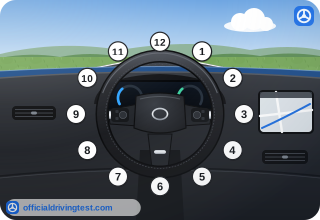
- At the 3 and 9 o'clock positions
- At the 12 and 6 o'clock positions
- At the 10 and 2 o'clock positions
- Anywhere on the wheel is fine
Show answer
Correct answer: At the 3 and 9 o'clock positions
The manual recommends placing your hands on opposite sides of the steering wheel, at the 3 and 9 o'clock positions, to keep them away if the air bag engages.
Source: New York State Driver's Manual (Form MV-21), page 49 · Open this page in the manual (Manual page 49)
-
According to the manual, a BAC of more than what percentage is legal evidence that a driver is impaired?
- .02 percent
- .10 percent
- .18 percent
- .05 percent
Show answer
Correct answer: .05 percent
The manual states that a BAC of more than .05 percent is legal evidence that you are impaired.
Source: New York State Driver's Manual (Form MV-21), page 55 · Open this page in the manual (Manual page 55)
-
According to the manual, what is the minimum legal tread depth for tires?
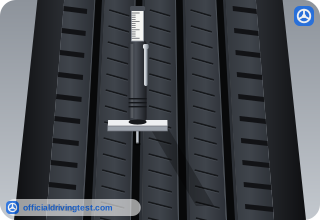
- 1/32 of an inch
- 2/32 of an inch
- 4/32 of an inch
- 8/32 of an inch
Show answer
Correct answer: 2/32 of an inch
The manual states that the law requires tires to have at least 2/32nds of an inch (.16 cm) of tread.
Source: New York State Driver's Manual (Form MV-21), page 53 · Open this page in the manual (Manual page 53)
-
According to the regional restrictions chart, during what hours must a junior permit holder in New York City or Long Island NOT drive at all?
- 5AM to 9PM
- 6AM to 12PM
- 9PM to 5AM
- 12PM to 6PM
Show answer
Correct answer: 9PM to 5AM
The regional restrictions chart for a junior permit states that in New York City and Long Island, you must NOT drive between 9PM and 5AM.
Source: New York State Driver's Manual (Form MV-21), page 12 · Open this page in the manual (Manual page 12)
-
Within what distances must you switch your headlights to low beam?
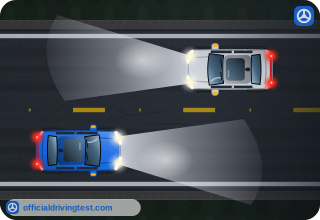
- 500 feet of an oncoming vehicle or 200 feet of one ahead
- 1,000 feet of any vehicle in any direction
- 50 feet of an oncoming vehicle only
- There is no set distance; it is left to driver judgment
Show answer
Correct answer: 500 feet of an oncoming vehicle or 200 feet of one ahead
Your headlights must be on low beam when you are within 500 feet (150 m) of an oncoming vehicle or within 200 feet (60 m) of a vehicle ahead of you, even if the vehicle ahead is in a different lane.
Source: New York State Driver's Manual (Form MV-21), page 63 · Open this page in the manual (Manual page 63)
-
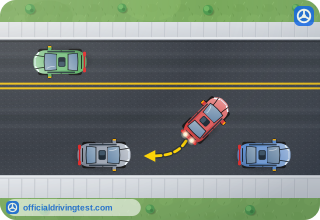
In your final parallel-parked position, your wheels must be no more than how far from the curb?
- Three feet (90 cm)
- Two feet (60 cm)
- Six inches (15 cm)
- One foot (30 cm)
Show answer
Correct answer: One foot (30 cm)
In your final parking position, your wheels must be no more than one foot (30 cm) from the curb.
Source: New York State Driver's Manual (Form MV-21), page 42 · Open this page in the manual (Manual page 42)
-
During which dates can tires with metal studs be used in New York State?
- January 1 through March 31
- Year-round, with no restriction
- November 1 through February 28
- October 16 through April 30
Show answer
Correct answer: October 16 through April 30
Tires with metal studs can be used in New York State only from October 16 through April 30.
Source: New York State Driver's Manual (Form MV-21), page 64 · Open this page in the manual (Manual page 64)
-
In New York State, what is a first-offense penalty for speaking into or listening to a hand-held mobile telephone while driving, according to the manual?
- A fine of up to $50 with no license points
- Automatic license revocation
- A fine of up to $500 and ten license points
- A fine of up to $200 and five license points
Show answer
Correct answer: A fine of up to $200 and five license points
The manual states a first offense for using a hand-held mobile telephone while driving could result in a fine of up to $200 and five license points.
Source: New York State Driver's Manual (Form MV-21), page 52 · Open this page in the manual (Manual page 52)
-
Your driver license will be revoked for at least six months if you are found guilty of three speeding and/or misdemeanor traffic violations within what time period?
- 6 months
- 12 months
- 18 months
- 24 months
Show answer
Correct answer: 18 months
The manual states your license will be revoked for at least six months if you are found guilty of three speeding and/or misdemeanor traffic violations within 18 months, based on the date of violation, not the date of conviction.
Source: New York State Driver's Manual (Form MV-21), page 21 · Open this page in the manual (Manual page 21)
-
You cannot make a U-turn near the top of a hill, a curve, or any other location where other drivers cannot see your vehicle from how far away in either direction?
- 100 feet (30 m)
- 500 feet (150 m)
- 1,000 feet (300 m)
- 50 feet (15 m)
Show answer
Correct answer: 500 feet (150 m)
The manual states you cannot make a U-turn near the top of a hill, a curve, or any other location where other drivers cannot see your vehicle from 500 feet (150 m) away in either direction.
Source: New York State Driver's Manual (Form MV-21), page 37 · Open this page in the manual (Manual page 37)
-
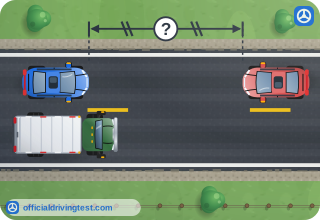
You cannot pass on the left if you cannot safely return to the right lane before an oncoming vehicle comes within how many feet of you?
- 100 feet (30 m)
- 150 feet (45 m)
- 300 feet (90 m)
- 200 feet (60 m)
Show answer
Correct answer: 200 feet (60 m)
You cannot pass on the left if you cannot safely return before any oncoming vehicle comes within 200 feet (60 m) of you.
Source: New York State Driver's Manual (Form MV-21), page 39 · Open this page in the manual (Manual page 39)
-
For a 150-pound male, about how much does one standard drink increase his BAC, and about how long does it take the body to remove that much alcohol?
- About .01 percent, and about four hours
- About .10 percent, and about ten minutes
- About .05 percent, and about thirty minutes
- About .02 percent, and about one hour
Show answer
Correct answer: About .02 percent, and about one hour
The manual states that for a 150-pound male, each drink contains enough alcohol to increase his BAC by about .02 percent, and it takes the body approximately one hour to remove that much alcohol.
Source: New York State Driver's Manual (Form MV-21), page 55 · Open this page in the manual (Manual page 55)
-
According to the manual, more than what percentage of NYC pedestrian injury crashes occur when a driver is attempting to make a left turn?
- 10%
- 20%
- 35%
- 60%
Show answer
Correct answer: 35%
More than 35% of NYC pedestrian injury crashes occur when a driver is attempting to make a left turn, which the manual notes can be a very dangerous maneuver.
Source: New York State Driver's Manual (Form MV-21), page 67 · Open this page in the manual (Manual page 67)
-
How many points are added to your driving record for speeding 31 to 40 mph over the posted limit?
- 6 points
- 11 points
- 8 points
- 4 points
Show answer
Correct answer: 8 points
The point table in the manual assigns 8 points to speeding 31 to 40 mph over the posted limit.
Source: New York State Driver's Manual (Form MV-21), page 22 · Open this page in the manual (Manual page 22)
-
According to the manual's penalties table, Aggravated Driving While Intoxicated (Agg-DWI) is defined by what blood alcohol content (BAC)?
- 0.05 and higher
- 0.08 and higher
- 0.18 and higher
- 0.02 and higher
Show answer
Correct answer: 0.18 and higher
The penalties table defines Aggravated Driving While Intoxicated (Agg-DWI) as a BAC of 0.18 and higher.
Source: New York State Driver's Manual (Form MV-21), page 58 · Open this page in the manual (Manual page 58)
-
If a work zone sign reads 'Road Work 1,500 feet,' how long will it take a car traveling 60 mph to reach that point, according to the manual's example?
- 17 seconds
- 7 seconds
- 27 seconds
- 47 seconds
Show answer
Correct answer: 17 seconds
The manual's example states that at 60 mph, a car will reach a point 1,500 feet ahead in about 17 seconds.
Source: New York State Driver's Manual (Form MV-21), page 49 · Open this page in the manual (Manual page 49)