New York: Sharing the road — Part 3 Practice Test
Questions in this part include: “When should you pay particular attention to in-line skaters, skateboarders and non-motorized scooters?” · “Why are motorcycle brake lights often harder to notice than those on a car or truck?”
Independent educational site · not affiliated with any government agency or DMV
Ready? Test yourself
- Instant feedback with an explanation
- Every answer cites its source in the manual
- Your best score is saved on this device
Questions are original and based on the official manual "New York State Driver's Manual" (Form MV-21), New York State Department of Motor Vehicles (DMV).
All 18 questions in this practice test
Take the test above first, then use this list to study. Tap “Show answer” to see the correct answer and explanation.
Show the questions and answersHide the questions
-
When should you pay particular attention to in-line skaters, skateboarders and non-motorized scooters?
- Only on weekends and holidays, when parks are busiest
- Along the roadside, in bike lanes, at intersections and crosswalks
- Only when they ride in the street without wearing helmets
- Only at night or in rain, fog or other poor visibility
Show answer
Correct answer: Along the roadside, in bike lanes, at intersections and crosswalks
Pay particular attention when you observe in-line skaters, skateboarders and non-motorized scooters operating along the roadside, in a designated bike lane, when approaching intersections and at crosswalks.
Source: New York State Driver's Manual (Form MV-21), page 70 · Open this page in the manual (Manual page 70)
-
What rights and responsibilities do motorcyclists have compared to drivers of other vehicles?
- Motorcyclists have fewer rights and are exempt from most traffic laws
- Motorcyclists have extra rights not given to other drivers
- Motorcyclists have the same rights and responsibilities as other drivers
- Motorcyclists are governed by a completely separate set of rules
Show answer
Correct answer: Motorcyclists have the same rights and responsibilities as other drivers
Motorcyclists have the same rights and responsibilities as drivers of other vehicles, and must follow the same traffic laws.
Source: New York State Driver's Manual (Form MV-21), page 70 · Open this page in the manual (Manual page 70)
-
In a crash involving a motorcycle and another vehicle, who has a much higher chance of being seriously hurt or killed?
- The driver and passengers of the other vehicle
- The motorcycle rider and passenger
- Neither party, since motorcycles are equally protective
- Only pedestrians nearby
Show answer
Correct answer: The motorcycle rider and passenger
When there is a crash involving a motorcycle and another vehicle, the rider (and passenger) have a much higher chance of being seriously hurt or killed than the driver (and passengers) of the other vehicle.
Source: New York State Driver's Manual (Form MV-21), page 71 · Open this page in the manual (Manual page 71)
-
What protective equipment are motorcyclists required to wear?
- A reflective vest only
- No protective equipment is legally required
- Steel-toed boots only
- Approved helmets and goggles or a face shield
Show answer
Correct answer: Approved helmets and goggles or a face shield
Motorcyclists are required to wear approved helmets and goggles or a face shield, though motorcycles themselves do not offer the rider the protections of other vehicle types.
Source: New York State Driver's Manual (Form MV-21), page 71 · Open this page in the manual (Manual page 71)
-
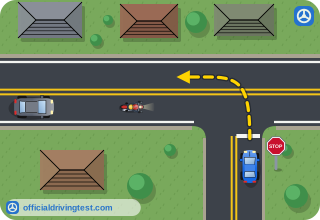
Why can it be difficult for a driver to judge how far away or how fast a motorcycle is traveling?
- Motorcycles always travel slower than other vehicles
- Its smaller size makes it seem much farther away than it is
- Motorcycles are not allowed on most roads
- Motorcycles do not have headlights
Show answer
Correct answer: Its smaller size makes it seem much farther away than it is
Motorcycles may appear to move faster than other vehicles. A motorcycle's smaller size makes it seem much farther away, and makes it difficult to judge how far away they are or how fast they are going.
Source: New York State Driver's Manual (Form MV-21), page 71 · Open this page in the manual (Manual page 71)
-
How many motorcyclists are allowed to ride side-by-side in a single lane, and what is a motorcyclist NOT allowed to do?
- Three may ride side-by-side, and they may pass any vehicle in the lane
- Any number may ride side-by-side, as long as they signal before passing a car
- Only one may ride in a lane, but it may pass or share the lane with a car
- Two may ride side-by-side, but may not pass or share a lane with a non-motorcycle vehicle
Show answer
Correct answer: Two may ride side-by-side, but may not pass or share a lane with a non-motorcycle vehicle
Two motorcyclists are allowed to ride side-by-side in a single lane, but a motorcyclist cannot pass or share a lane with another motor vehicle that is not a motorcycle.
Source: New York State Driver's Manual (Form MV-21), page 71 · Open this page in the manual (Manual page 71)
-
Why can motorcycle headlights fail to stand out to other drivers?
- Motorcycle headlights are not required to be on while driving
- So many vehicles have daytime running lights that are always on
- Motorcycles are required to use only yellow headlights
- Motorcycle headlights are dimmer than a bicycle's
Show answer
Correct answer: So many vehicles have daytime running lights that are always on
Headlights and taillights on motorcycles must be illuminated when driving, but with so many vehicles equipped with daytime running lights that are always on even in daylight, motorcycle headlights don't stand out.
Source: New York State Driver's Manual (Form MV-21), page 71 · Open this page in the manual (Manual page 71)
-
Why are motorcycle brake lights often harder to notice than those on a car or truck?
- Most motorcycle brake lights sit below eye level
- Motorcycle brake lights are always turned off
- Motorcycle brake lights are illegal in New York
- Motorcycle brake lights only work in reverse
Show answer
Correct answer: Most motorcycle brake lights sit below eye level
Most cars and trucks are equipped with a Center High Mount Stop Light (CHMSL) designed to be at, or close to, eye level. Most motorcycle brake lights are mounted lower than eye level, which makes them less obvious to many motorists.
Source: New York State Driver's Manual (Form MV-21), page 71 · Open this page in the manual (Manual page 71)
-
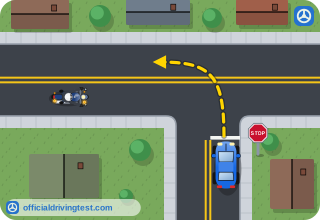
Why might a motorcycle's turn signal be on even when the rider has no intention of turning?
- On most motorcycles, the signal does not turn off automatically after a turn
- Motorcycle turn signals are always on regardless of use
- Turn signals on motorcycles are purely decorative
- New York law requires motorcycle turn signals to stay on at all times
Show answer
Correct answer: On most motorcycles, the signal does not turn off automatically after a turn
On most motorcycles, the directional signal does not turn off automatically after a turn, so their turn signal may be on inadvertently when the motorcyclist has no intention of turning.
Source: New York State Driver's Manual (Form MV-21), page 71 · Open this page in the manual (Manual page 71)
-
According to a 2015 National Highway Traffic Safety Administration report cited in the manual, what was a common circumstance in fatal motorcycle crashes?
- 41 percent involved the other vehicle turning left as the motorcycle went straight or passed
- Most occurred because motorcycles were exceeding the speed limit on expressways
- Most occurred at railroad crossings
- Most occurred because motorcycles lacked headlights
Show answer
Correct answer: 41 percent involved the other vehicle turning left as the motorcycle went straight or passed
The National Highway Traffic Safety Administration reports that, in 2015, 41 percent of fatal motorcycle crashes in the US occurred with the other vehicle turning left while the motorcycle was going straight, passing, or overtaking other vehicles.
Source: New York State Driver's Manual (Form MV-21), page 72 · Open this page in the manual (Manual page 72)
-
In 2014, what percentage of reported motorcycle crashes in New York State involved another vehicle?
- 15.2%
- 53.6%
- 78.9%
- 99%
Show answer
Correct answer: 53.6%
In 2014, there were 4,750 reported motorcycle crashes in New York State. Of these, 2,546 involved another vehicle -- that's 53.6% of the reported crashes.
Source: New York State Driver's Manual (Form MV-21), page 72 · Open this page in the manual (Manual page 72)
-
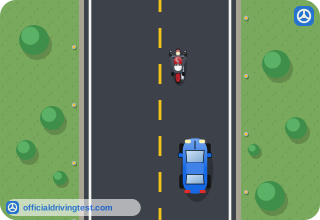
Why shouldn't you tailgate a motorcycle?
- It has no effect on safety either way
- Motorcycles always take longer to stop than cars, even on dry, clear pavement
- Tailgating a motorcycle is required to keep it visible
- They can stop shorter than cars under the right conditions; slowing may be hard to notice
Show answer
Correct answer: They can stop shorter than cars under the right conditions; slowing may be hard to notice
Don't tailgate. Motorcycles can stop in a shorter distance than cars under the right conditions, and it may be more difficult to notice they are slowing or stopping.
Source: New York State Driver's Manual (Form MV-21), page 73 · Open this page in the manual (Manual page 73)
-
What are mopeds, as described in the manual?
- Low speed, two- or three-wheeled limited use motorcycles
- Full-size motorcycles requiring a class M license only
- Non-motorized bicycles with an added basket
- Four-wheeled vehicles limited to farm use
Show answer
Correct answer: Low speed, two- or three-wheeled limited use motorcycles
Limited use motorcycles, often called mopeds, are low speed, two- or three-wheeled vehicles for limited use on public highways. There are three different classes based on maximum performance speed.
Source: New York State Driver's Manual (Form MV-21), page 73 · Open this page in the manual (Manual page 73)
-
According to the moped operation chart, what is the top speed range for a Class A limited use motorcycle, and what license is required?
- 20 mph or less, no license required
- 21 to 30 mph, any Class 4 license
- 31 to 40 mph, a Class M license or permit
- Over 55 mph, a commercial license
Show answer
Correct answer: 31 to 40 mph, a Class M license or permit
A Class A limited use motorcycle (moped) has a top speed range of 31 to 40 mph and requires a Class M license or learner permit.
Source: New York State Driver's Manual (Form MV-21), page 73 · Open this page in the manual (Manual page 73)
-
What is the top speed range for a Class C limited use motorcycle (moped)?
- 31 to 40 mph
- 21 to 30 mph
- 20 mph or less
- 45 mph or more
Show answer
Correct answer: 20 mph or less
A Class C limited use motorcycle (moped) has a top speed range of 20 mph or less.
Source: New York State Driver's Manual (Form MV-21), page 73 · Open this page in the manual (Manual page 73)
-
According to the moped operation chart, when must the headlight be on?
- Only at night
- Only in Class C mopeds
- Whenever operating, in all three classes
- Only when requested by a passenger
Show answer
Correct answer: Whenever operating, in all three classes
The moped operation chart shows that the headlight must be on when operating for all three classes -- A, B, and C.
Source: New York State Driver's Manual (Form MV-21), page 73 · Open this page in the manual (Manual page 73)
-
For which classes of limited use motorcycles (mopeds) is helmet and eye protection required, according to the chart?
- It is required for A and B, recommended for C
- It is required for none of the classes
- It is required only for Class C
- It is optional for all classes
Show answer
Correct answer: It is required for A and B, recommended for C
According to the chart, helmet and eye protection are required when operating a Class A or Class B moped, while it is only recommended for Class C.
Source: New York State Driver's Manual (Form MV-21), page 73 · Open this page in the manual (Manual page 73)
-
Where can Class B and C mopeds be driven?
- In any lane of traffic
- Only on sidewalks
- Only in the right lane, as far to the right as possible
- Only in the left lane, as far to the left as possible
Show answer
Correct answer: Only in the right lane, as far to the right as possible
Class B and C mopeds can be driven only in the right lane of traffic, as far to the right as possible. Class A mopeds are allowed to drive in any lane and any section of a lane.
Source: New York State Driver's Manual (Form MV-21), page 74 · Open this page in the manual (Manual page 74)