New York: Sharing the road — Part 4 Practice Test
Questions in this part include: “Are mopeds permitted on expressways or other controlled access highways?” · “Why do large vehicles like tractor-trailers take longer to stop than smaller vehicles traveling at the same speed?”
Independent educational site · not affiliated with any government agency or DMV
Ready? Test yourself
- Instant feedback with an explanation
- Every answer cites its source in the manual
- Your best score is saved on this device
Questions are original and based on the official manual "New York State Driver's Manual" (Form MV-21), New York State Department of Motor Vehicles (DMV).
All 18 questions in this practice test
Take the test above first, then use this list to study. Tap “Show answer” to see the correct answer and explanation.
Show the questions and answersHide the questions
-
Are mopeds permitted on expressways or other controlled access highways?
- Yes, always, without exception
- Yes, but only at night
- Yes, but only Class C mopeds
- No, unless posted signs permit it
Show answer
Correct answer: No, unless posted signs permit it
Mopeds are not permitted on expressways or other controlled access highways unless posted signs permit it.
Source: New York State Driver's Manual (Form MV-21), page 74 · Open this page in the manual (Manual page 74)
-
What precautions should you use when you approach a moped?
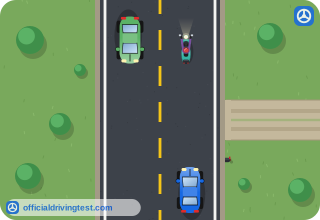
- None; mopeds do not require special caution
- The same precautions you would use with a bicyclist
- Only slow down if the moped is a Class A
- Sound your horn continuously
Show answer
Correct answer: The same precautions you would use with a bicyclist
When you approach a moped, use the same precautions you would when you approach a bicyclist.
Source: New York State Driver's Manual (Form MV-21), page 74 · Open this page in the manual (Manual page 74)
-
In more than 60 percent of fatal crashes involving cars and big trucks, who contributes to the cause of the crash?
- The truck driver
- The car driver
- Weather conditions only
- Road construction crews
Show answer
Correct answer: The car driver
In more than 60 percent of all fatal crashes that involve cars and big trucks, the car driver, not the truck driver, contributes to the cause of the traffic crash, and four out of five times it is the car driver who is killed.
Source: New York State Driver's Manual (Form MV-21), page 74 · Open this page in the manual (Manual page 74)
-
The bigger a large vehicle is, the more of which of the following is true?
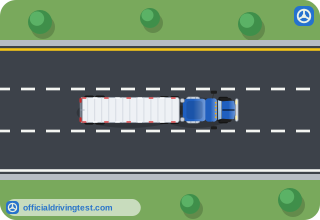
- The smaller their blind spots and the shorter it takes them to stop
- Bigger blind spots, longer to stop, and more room needed to maneuver
- They need less room to turn
- It takes automobiles less time to pass them
Show answer
Correct answer: Bigger blind spots, longer to stop, and more room needed to maneuver
Large trucks, recreational vehicles and buses are not big cars. The bigger they are, the bigger their blind spots, the longer it takes them to stop, the more room they need to maneuver, and the longer it takes for an automobile to pass them.
Source: New York State Driver's Manual (Form MV-21), page 74 · Open this page in the manual (Manual page 74)
-
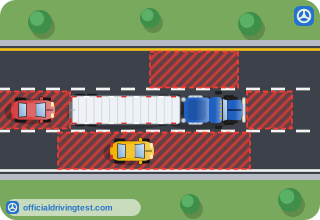
How large can the blind spot be in front of a tractor with a long hood?
- 5 feet
- 10 feet
- 20 feet
- 50 feet
Show answer
Correct answer: 20 feet
Tractors with long hoods can have a blind spot of 20 feet in front of the vehicle. You should avoid these "no zones."
Source: New York State Driver's Manual (Form MV-21), page 74 · Open this page in the manual (Manual page 74)
-
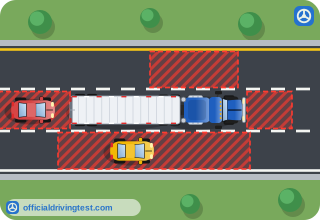
What happens if you remain in the back blind spot of a large vehicle?
- Nothing changes; the other driver can still see you in the mirrors
- Your headlights automatically turn on
- The other driver cannot see your car, and your view of traffic is blocked
- The large vehicle is legally required to stop
Show answer
Correct answer: The other driver cannot see your car, and your view of traffic is blocked
If you remain in the back blind spot of a large vehicle, you increase the chance of a crash. The other driver cannot see your car and your view of other traffic will be blocked.
Source: New York State Driver's Manual (Form MV-21), page 74 · Open this page in the manual (Manual page 74)
-
Why do large vehicles like tractor-trailers take longer to stop than smaller vehicles traveling at the same speed?
- Because their tires are smaller
- Because they are required by law to stop slowly
- Because they have no brakes on the trailer, only on the tractor
- Because of brake delay as air brakes send power from tractor to trailer
Show answer
Correct answer: Because of brake delay as air brakes send power from tractor to trailer
For tractor trailers, the difference in stopping distance comes from brake delay. Air brakes transmit brake power from the tractor to the trailer, and this can add many feet to the distance it takes to stop.
Source: New York State Driver's Manual (Form MV-21), page 74 · Open this page in the manual (Manual page 74)
-
When passing a large vehicle, what should you make sure of before you return to your lane?
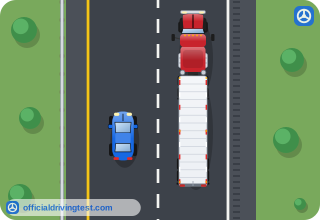
- That you have used your horn
- That you can see the whole front of the vehicle in your mirror
- That the large vehicle has turned on its hazard lights
- That you are on a downhill grade
Show answer
Correct answer: That you can see the whole front of the vehicle in your mirror
When you pass a large vehicle, make sure you can see the whole front of the vehicle in your mirror before you return to your lane.
Source: New York State Driver's Manual (Form MV-21), page 74 · Open this page in the manual (Manual page 74)
-
What should you do if a truck ahead of you is backing up to load or unload goods?
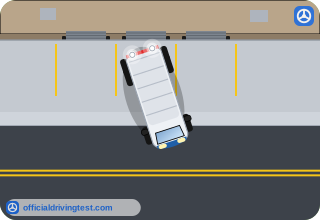
- Pass close behind it quickly
- Be patient and never pass close behind it
- Honk repeatedly until it stops
- Drive around it on the shoulder immediately
Show answer
Correct answer: Be patient and never pass close behind it
Never pass close behind a large vehicle that is backing up. Often a truck driver has to block a road to back into an area to load or unload goods -- be patient.
Source: New York State Driver's Manual (Form MV-21), page 75 · Open this page in the manual (Manual page 75)
-
Why should you always leave space when you stop behind a truck or bus at a traffic light or stop sign, especially facing uphill?
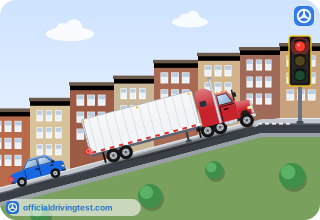
- It could move backward slightly when it starts
- It is required only to be polite
- It helps you see the traffic light better
- It is only necessary in the rain
Show answer
Correct answer: It could move backward slightly when it starts
Always leave space when you stop behind a truck or bus at a traffic light or stop sign, especially when you face up a hill. The truck or bus could move backward slightly when it starts.
Source: New York State Driver's Manual (Form MV-21), page 75 · Open this page in the manual (Manual page 75)
-
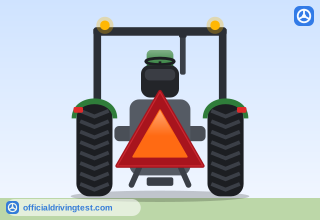
What does the "slow-moving vehicle" symbol look like, and what does it indicate?
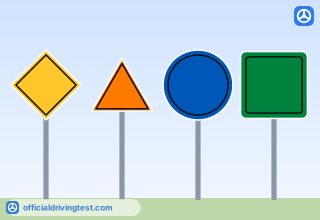
- A blue circle, indicating a vehicle powered by electricity
- A green square, indicating a hybrid vehicle
- A yellow diamond, required on all buses
- A reflective orange triangle, required on most farm vehicles
Show answer
Correct answer: A reflective orange triangle, required on most farm vehicles
The "slow-moving vehicle" symbol, a reflective orange triangle, must be displayed on the back of vehicles drawn by animals, most farm vehicles, and construction equipment.
Source: New York State Driver's Manual (Form MV-21), page 76 · Open this page in the manual (Manual page 76)
-
Besides farm vehicles and construction equipment, what other vehicles are required to display the orange slow-moving vehicle triangle?
- School buses
- Rural mail vehicles
- Taxicabs
- Police vehicles
Show answer
Correct answer: Rural mail vehicles
The United States Postal Service also requires these orange safety triangles to be displayed on all rural mail delivery vehicles.
Source: New York State Driver's Manual (Form MV-21), page 76 · Open this page in the manual (Manual page 76)
-
What does New York State law allow all-terrain vehicles (ATVs) and snowmobiles to do?
- To cross many state highways and local roadways
- To drive on expressways at full highway speed
- To park in any handicapped space
- To ignore all traffic control devices
Show answer
Correct answer: To cross many state highways and local roadways
State law allows all-terrain vehicles (ATVs) and snowmobiles to legally go across many state highways and local roadways.
Source: New York State Driver's Manual (Form MV-21), page 76 · Open this page in the manual (Manual page 76)
-
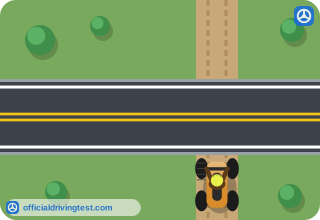
What must ATVs and snowmobiles do before crossing a state highway or local roadway?
- Come to a stop and yield to traffic
- Sound a horn continuously
- Turn on hazard lights and proceed without stopping
- Radio ahead to the local police department
Show answer
Correct answer: Come to a stop and yield to traffic
Before ATVs and snowmobiles cross a state highway or local roadway, they must come to a stop and yield to traffic.
Source: New York State Driver's Manual (Form MV-21), page 76 · Open this page in the manual (Manual page 76)
-
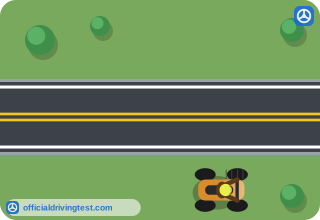
At what angle must ATVs and snowmobiles cross a road surface?
- A 45-degree angle
- A 90-degree angle
- Any angle they choose
- A 180-degree angle
Show answer
Correct answer: A 90-degree angle
ATVs and snowmobiles must go across the road surface at a 90-degree angle.
Source: New York State Driver's Manual (Form MV-21), page 76 · Open this page in the manual (Manual page 76)
-
Are horse riders subject to and protected by the rules of the road?
- No, horse riders are completely exempt from them
- Yes, they are subject to and protected by them
- Only if they are on a sidewalk
- Only during daylight hours
Show answer
Correct answer: Yes, they are subject to and protected by them
Horse riders are subject to, and protected by, the rules of the road.
Source: New York State Driver's Manual (Form MV-21), page 76 · Open this page in the manual (Manual page 76)
-
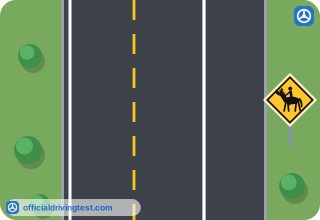
Where must horse riders ride along the road?
- Single file near the right curb or road edge, or on a right shoulder
- In the center of the road, two abreast
- Only on sidewalks
- Single file near the left curb or road edge, facing traffic
Show answer
Correct answer: Single file near the right curb or road edge, or on a right shoulder
Horse riders must ride single file near the right curb or road edge or on a right shoulder, lane or path that can be used.
Source: New York State Driver's Manual (Form MV-21), page 76 · Open this page in the manual (Manual page 76)
-
What is illegal to do when you approach or pass a horse being ridden or walked along a road?
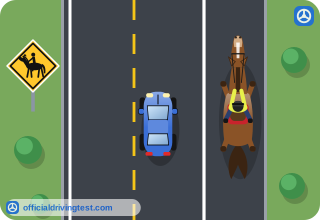
- Reducing your speed
- Sounding your horn
- Leaving extra distance
- Stopping completely
Show answer
Correct answer: Sounding your horn
You must drive at an acceptable speed and at an acceptable distance away from the horse. It is illegal to sound your horn when you approach or pass a horse.
Source: New York State Driver's Manual (Form MV-21), page 76 · Open this page in the manual (Manual page 76)