New York: Sharing the road — Part 1 Practice Test
Questions in this part include: “Under most conditions, on which side should you pass another vehicle traveling in the same direction as you?” · “You cannot pass another vehicle on the left if your lane has what?”
Independent educational site · not affiliated with any government agency or DMV
Ready? Test yourself
Answer to start, or tap Start below:
Under most conditions, on which side should you pass another vehicle traveling in the same direction as you?
- Instant feedback with an explanation
- Every answer cites its source in the manual
- Your best score is saved on this device
- Keyboard: press 1 to 4 to answer and Enter for the next question
Questions are original and based on the official manual "New York State Driver's Manual" (Form MV-21), New York State Department of Motor Vehicles (DMV).
All 18 questions in this practice test
Take the test above first, then use this list to study. Tap “Show answer” to see the correct answer and explanation.
Show the questions and answersHide the questions
-
Under most conditions, on which side should you pass another vehicle traveling in the same direction as you?
- On the left side
- On the right side
- On either side, whichever is quicker
- You should never pass another vehicle
Show answer
Correct answer: On the left side
The manual states that when passing is allowed, you usually pass on the left side.
Source: New York State Driver's Manual (Form MV-21), page 39 · Open this page in the manual (Manual page 39)
-
According to the manual, what must you never do when passing another vehicle?
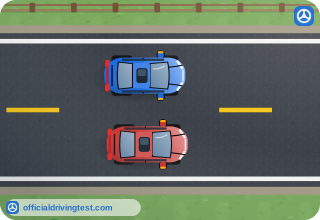
- Check your mirrors
- Exceed the speed limit
- Signal your intention
- Move into the left lane
Show answer
Correct answer: Exceed the speed limit
You must not exceed the speed limit to pass another vehicle.
Source: New York State Driver's Manual (Form MV-21), page 39 · Open this page in the manual (Manual page 39)
-
When you pass a motorcycle, what should you do?
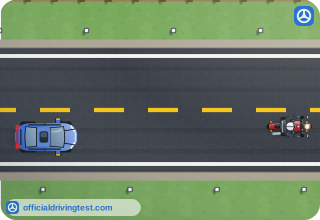
- Move partly into the motorcycle's lane if it is wide
- Pass as closely as possible to save time
- Give the motorcycle the same full-lane width as other vehicles
- Only pass motorcycles on the right
Show answer
Correct answer: Give the motorcycle the same full-lane width as other vehicles
Never move into the same lane space as a motorcycle, even if the lane is wide and the motorcycle is to one side.
Source: New York State Driver's Manual (Form MV-21), page 39 · Open this page in the manual (Manual page 39)
-
When overtaking a bicyclist from behind, what does the law require?
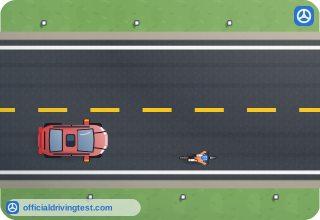
- Sound your horn continuously
- Pass on the right at any distance
- Wait until the bicyclist stops
- Pass on the left at a safe distance
Show answer
Correct answer: Pass on the left at a safe distance
The law requires you to pass a bicyclist on the left at a safe distance until the bicycle has been cleared.
Source: New York State Driver's Manual (Form MV-21), page 39 · Open this page in the manual (Manual page 39)
-
How far before making a lane change must you signal your intention, according to the manual?
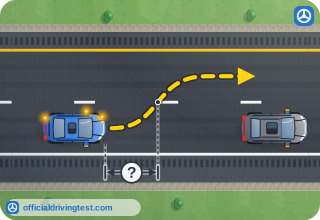
- At least 100 feet (30 m)
- At least 50 feet (15 m)
- At least 150 feet (45 m)
- At least 200 feet (60 m)
Show answer
Correct answer: At least 100 feet (30 m)
The law requires you to signal at least 100 feet (30 m) before you make a lane change.
Source: New York State Driver's Manual (Form MV-21), page 39 · Open this page in the manual (Manual page 39)
-
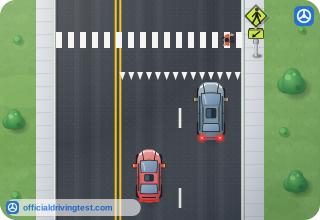
You must never pass a vehicle that has stopped at a crosswalk when it is doing what?
- Waiting for a traffic light
- Allowing a pedestrian to cross
- Turning left
- Checking for oncoming traffic
Show answer
Correct answer: Allowing a pedestrian to cross
You must never pass a vehicle that has stopped at a crosswalk to allow a pedestrian to go across.
Source: New York State Driver's Manual (Form MV-21), page 39 · Open this page in the manual (Manual page 39)
-
You cannot pass another vehicle on the left if your lane has what?
- A dashed white line
- A broken yellow center line
- A solid yellow center line
- No markings at all
Show answer
Correct answer: A solid yellow center line
One condition that prohibits passing on the left is a solid yellow center line in your lane.
Source: New York State Driver's Manual (Form MV-21), page 39 · Open this page in the manual (Manual page 39)
-
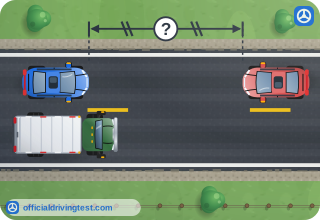
You cannot pass on the left if you cannot safely return to the right lane before an oncoming vehicle comes within how many feet of you?
- 100 feet (30 m)
- 150 feet (45 m)
- 300 feet (90 m)
- 200 feet (60 m)
Show answer
Correct answer: 200 feet (60 m)
You cannot pass on the left if you cannot safely return before any oncoming vehicle comes within 200 feet (60 m) of you.
Source: New York State Driver's Manual (Form MV-21), page 39 · Open this page in the manual (Manual page 39)
-
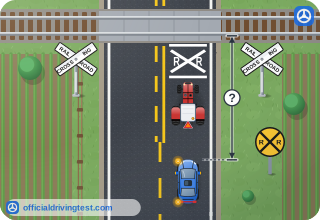
You cannot pass a vehicle on the left if you are within how many feet of a railroad crossing on a two-way roadway?
- 100 feet (30 m)
- 50 feet (15 m)
- 75 feet (23 m)
- 200 feet (60 m)
Show answer
Correct answer: 100 feet (30 m)
You cannot pass on the left within 100 feet (30 m) of a railroad crossing on a two-way roadway.
Source: New York State Driver's Manual (Form MV-21), page 39 · Open this page in the manual (Manual page 39)
-
You cannot pass on the left if you are within 100 feet of a bridge, tunnel or viaduct on a two-way road and what is true?
- There is a speed limit sign
- Your view is obstructed
- The road is wet
- There is a passing lane
Show answer
Correct answer: Your view is obstructed
You cannot pass on the left within 100 feet (30 m) of a bridge, tunnel or viaduct on a two-way road if your view is obstructed.
Source: New York State Driver's Manual (Form MV-21), page 39 · Open this page in the manual (Manual page 39)
-
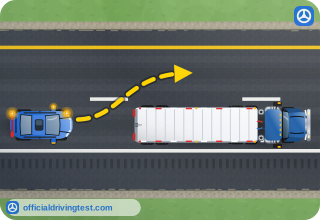
Before you pull into the left lane to pass, in addition to checking your mirrors, what should you also do?
- Flash your high beams
- Honk your horn twice
- Look quickly over your left shoulder
- Reduce to half the speed limit
Show answer
Correct answer: Look quickly over your left shoulder
Never depend only on your mirrors, since they leave blind spots; always look over your shoulder before you change lanes or pass.
Source: New York State Driver's Manual (Form MV-21), page 39 · Open this page in the manual (Manual page 39)
-
Before you return to the right lane after passing a vehicle, what should you be able to see in your interior rear-view mirror?
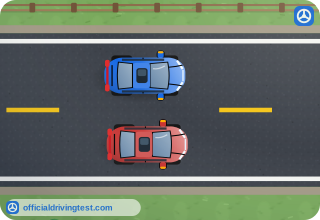
- The rear bumper of your own vehicle
- Only the vehicle behind you
- No mirror check is necessary
- The front bumper of the vehicle you passed
Show answer
Correct answer: The front bumper of the vehicle you passed
Make sure you can see the front bumper of the vehicle you passed before returning to the right lane.
Source: New York State Driver's Manual (Form MV-21), page 39 · Open this page in the manual (Manual page 39)
-
In which situation can you pass another vehicle on the right?
- When the vehicle ahead is making a left turn
- Whenever traffic is heavy
- When your lane has a solid yellow line
- Whenever you are late
Show answer
Correct answer: When the vehicle ahead is making a left turn
You can pass on the right when a vehicle ahead of you makes a left turn.
Source: New York State Driver's Manual (Form MV-21), page 39 · Open this page in the manual (Manual page 39)
-
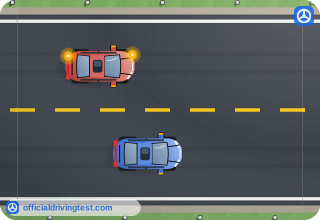
If another vehicle passes you on the left, what should you do?
- Speed up to stay ahead
- Slow slightly and stay centered in your lane
- Move to the left lane
- Flash your lights at the passing vehicle
Show answer
Correct answer: Slow slightly and stay centered in your lane
Decrease your speed slightly and stay centered in your lane; resume normal speed once the vehicle has safely passed.
Source: New York State Driver's Manual (Form MV-21), page 40 · Open this page in the manual (Manual page 40)
-
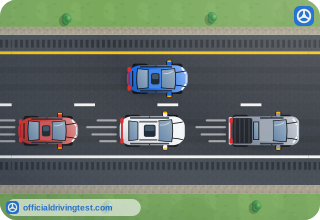
If you find that you are being passed on the right by many vehicles, what should you do?
- Speed up to prevent them from passing
- Stop your vehicle immediately
- Move into the right lane and let them pass
- Honk continuously
Show answer
Correct answer: Move into the right lane and let them pass
You should move into the right lane and allow those vehicles to pass you on the left.
Source: New York State Driver's Manual (Form MV-21), page 40 · Open this page in the manual (Manual page 40)
-
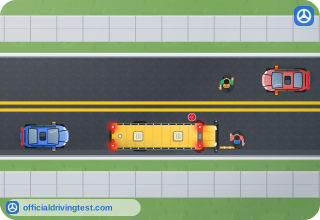
How far away must you stop when a school bus ahead of you flashes its red lights?
- At least 10 feet (3 m)
- At least 30 feet (9 m)
- At least 50 feet (15 m)
- At least 20 feet (6 m)
Show answer
Correct answer: At least 20 feet (6 m)
You should stop at least 20 feet (6 m) away from a school bus that is flashing its red lights.
Source: New York State Driver's Manual (Form MV-21), page 40 · Open this page in the manual (Manual page 40)
-
Before a school bus stops to load or discharge passengers, what does the driver usually do?
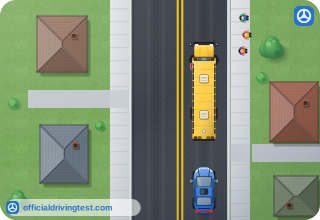
- Flash yellow warning lights
- Sound the horn
- Turn on hazard lights only
- Pull off the roadway entirely
Show answer
Correct answer: Flash yellow warning lights
The bus driver usually flashes yellow warning lights located near the roof, front and back, before stopping; you should decrease speed and be prepared to stop.
Source: New York State Driver's Manual (Form MV-21), page 40 · Open this page in the manual (Manual page 40)
-
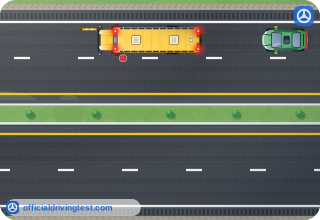
Must you stop for a school bus with flashing red lights if it is on the opposite side of a divided highway?
- No, only vehicles on the same side must stop
- Yes, you must stop even on a divided highway
- Only if there are no children visible
- Only during school hours
Show answer
Correct answer: Yes, you must stop even on a divided highway
The manual states that you must stop for a school bus even if it is on the opposite side of a divided highway.
Source: New York State Driver's Manual (Form MV-21), page 40 · Open this page in the manual (Manual page 40)