New York: Exam Simulator
20 random questions from every topic, like a mini exam.
Independent educational site · not affiliated with any government agency or DMV
Ready? Test yourself
Like the real test: 20 questions; pass with 14 correct, including 2 of the 4 road-sign questions.
- Instant feedback with an explanation
- Every answer cites its source in the manual
- Your best score is saved on this device
- Keyboard: press 1 to 4 to answer and Enter for the next question
Questions are original and based on the official manual "New York State Driver's Manual" (Form MV-21), New York State Department of Motor Vehicles (DMV).
Sample questions
The exam simulator picks 20 random questions from every topic each time you start. Here are a few examples.
Show the questions and answersHide the questions
-
According to the New York State Driver's Manual, can a person under age 16 who holds a valid driver license from another state legally drive in New York?
- No, not even with a valid out-of-state license
- Yes, as long as the out-of-state license is current
- Yes, but only when accompanied by a parent
- Yes, if they have completed a driver education course
Show answer
Correct answer: No, not even with a valid out-of-state license
The manual states that even if you are licensed somewhere else, people under age 16 cannot drive in New York State.
Source: New York State Driver's Manual (Form MV-21), page 6 · Open this page in the manual (Manual page 6)
-
If you buy a vehicle from someone who is not a New York State dealer, which form should you request for extra time to get the required vehicle inspection after you register it?
- Change of Address Form (MV-232)
- Schedule of Registration Fees (MV-204A)
- Statement of Transaction/Sale or Gift of Motor Vehicle (DTF-802)
- Ten-Day Time Extension for Motor Vehicle Inspection (VS-1077)
Show answer
Correct answer: Ten-Day Time Extension for Motor Vehicle Inspection (VS-1077)
If you purchase a vehicle from someone who is not a NYS dealer, you must have the vehicle inspected within 10 days after you register it. Make sure to request a 'Ten-Day Time Extension for Motor Vehicle Inspection' (VS-1077).
Source: New York State Driver's Manual (Form MV-21), page 27 · Open this page in the manual (Manual page 27)
-
What is the purpose of the lines and symbols painted on the roadway (pavement markings)?
- They divide lanes and guide passing, turns and stops
- They are purely decorative
- They only indicate posted speed limits
- They only mark construction zones and detours
Show answer
Correct answer: They divide lanes and guide passing, turns and stops
Pavement markings divide lanes and tell you when you can pass or change lanes, which lanes to use for turns, and where you must stop for signs or signals.
Source: New York State Driver's Manual (Form MV-21), page 31 · Open this page in the manual (Manual page 31)
-
What does "expressway" mean, and how do you normally enter or exit one?
- Any divided highway with one-way traffic on two or more lanes; you normally use ramps
- Any road with a single lane in each direction; you enter through intersections
- A road only for local traffic with stop signs
- A road where pedestrians and cars share the same lane
Show answer
Correct answer: Any divided highway with one-way traffic on two or more lanes; you normally use ramps
"Expressway" means any divided highway where traffic moves in one direction on two or more lanes. You normally enter or exit the expressway on ramps (controlled-access).
Source: New York State Driver's Manual (Form MV-21), page 62 · Open this page in the manual (Manual page 62)
-
According to the manual, parallel parking is part of what?
- Every road test
- Only the written knowledge test
- Highway driving only
- Defensive driving courses only
Show answer
Correct answer: Every road test
Parallel parking takes skill and is part of every road test.
Source: New York State Driver's Manual (Form MV-21), page 42 · Open this page in the manual (Manual page 42)
-
What shape and color are most regulation signs?
- White rectangles with black letters or symbols
- Yellow diamonds with black letters or symbols
- Red octagons with white letters
- Green rectangles with white letters
Show answer
Correct answer: White rectangles with black letters or symbols
Regulation signs are normally white rectangles with black letters or symbols, although some have different shapes or use red letters or symbols.
Source: New York State Driver's Manual (Form MV-21), page 29 · Open this page in the manual (Manual page 29)
-
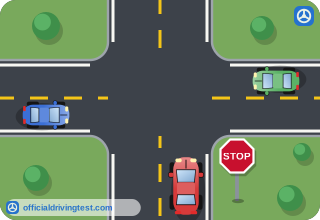
What must you do at a STOP sign, according to the manual?
- Slow down and proceed if no traffic is coming
- Come to a full stop, yield the right-of-way, and go when it is safe
- Stop only if there is a marked stop line
- Come to a full stop and wait five seconds before proceeding
Show answer
Correct answer: Come to a full stop, yield the right-of-way, and go when it is safe
A STOP sign means come to a full stop, yield the right-of-way to vehicles and pedestrians in or heading toward the intersection, and go only when it is safe.
Source: New York State Driver's Manual (Form MV-21), page 29 · Open this page in the manual (Manual page 29)
-
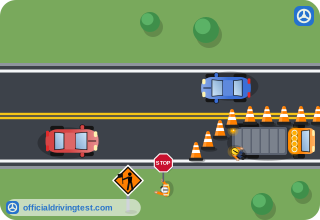
What three signals does the manual describe a highway work area flag person using?
- Go, Wait, Stop
- STOP, PROCEED, and SLOW
- Red, Yellow, and Green
- Stop, Yield, and Merge
Show answer
Correct answer: STOP, PROCEED, and SLOW
The manual shows a flag person using STOP, PROCEED, and SLOW signals.
Source: New York State Driver's Manual (Form MV-21), page 30 · Open this page in the manual (Manual page 30)
-
According to the New York State Driver's Manual, a driver who approaches an intersection must yield the right-of-way to:
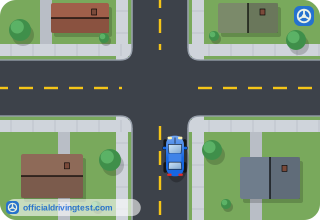
- Traffic that is already in the intersection
- Any vehicle waiting behind them
- Only vehicles making a right turn
- Traffic that has not yet reached the intersection
Show answer
Correct answer: Traffic that is already in the intersection
The manual states a driver who approaches an intersection must yield the right-of-way to traffic that is already in the intersection.
Source: New York State Driver's Manual (Form MV-21), page 34 · Open this page in the manual (Manual page 34)
-
A grade crossing is the point where train tracks intersect a roadway. What is it considered, and what should you always expect as you approach one?
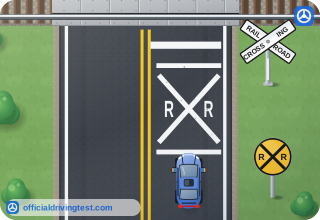
- An intersection; you should always expect a train
- A parking area; you should always expect pedestrians
- A toll plaza; you should always expect to stop and pay
- A rest stop; you should always expect construction
Show answer
Correct answer: An intersection; you should always expect a train
A grade crossing is the point at which train tracks intersect with a roadway and is considered an intersection. As you approach a crossing, always expect a train, because trains can run on any track, at any time, from either direction.
Source: New York State Driver's Manual (Form MV-21), page 60 · Open this page in the manual (Manual page 60)