New York: Sharing the road — Part 2 Practice Test
Questions in this part include: “What is the maximum fine for passing a stopped school bus if it is your third violation within three years?” · “What does the manual say about carrying an infant under a year old as a bicycle passenger?”
Independent educational site · not affiliated with any government agency or DMV
Ready? Test yourself
Answer to start, or tap Start below:
What is the maximum fine for passing a stopped school bus if it is your third violation within three years?
- Instant feedback with an explanation
- Every answer cites its source in the manual
- Your best score is saved on this device
- Keyboard: press 1 to 4 to answer and Enter for the next question
Questions are original and based on the official manual "New York State Driver's Manual" (Form MV-21), New York State Department of Motor Vehicles (DMV).
All 18 questions in this practice test
Take the test above first, then use this list to study. Tap “Show answer” to see the correct answer and explanation.
Show the questions and answersHide the questions
-
What is the maximum fine for passing a stopped school bus if it is your third violation within three years?
- $250
- $500
- $1,000
- $750
Show answer
Correct answer: $1,000
The fine ranges from a minimum of $250 for a first violation to a maximum of $1,000 for three violations in three years.
Source: New York State Driver's Manual (Form MV-21), page 40 · Open this page in the manual (Manual page 40)
-
Under the 2019 law authorizing stop-arm cameras on school buses, what is the penalty for a first violation?
- $275
- $300
- $500
- $250
Show answer
Correct answer: $250
Under the stop-arm camera law, a first violation carries a penalty of $250; a second within 18 months is $275, and a third or more is $300.
Source: New York State Driver's Manual (Form MV-21), page 40 · Open this page in the manual (Manual page 40)
-
What right do bicyclists have on the road, according to the manual?
- The right to travel against the flow of traffic at all times
- The right to ride only on sidewalks everywhere
- The right to ignore all traffic signals
- The right to share the road in the same direction as motor vehicles
Show answer
Correct answer: The right to share the road in the same direction as motor vehicles
Bicyclists have the right to share the road and travel in the same direction as motor vehicles.
Source: New York State Driver's Manual (Form MV-21), page 68 · Open this page in the manual (Manual page 68)
-
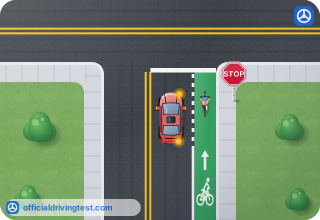
Before you make a turn, parallel park, open a door or leave a curb, what should you do to check for bicyclists?
- Depend only on your side and rearview mirrors
- Assume no bicyclist is nearby unless you hear one
- Turn your head to check blind spots, not only your mirrors
- Honk your horn once and then proceed without looking
Show answer
Correct answer: Turn your head to check blind spots, not only your mirrors
Check your blind spots before you make a turn, parallel park, open a door or leave a curb. Do not depend only on your mirrors -- turn your head to look for bicyclists that may be next to you or approaching.
Source: New York State Driver's Manual (Form MV-21), page 68 · Open this page in the manual (Manual page 68)
-
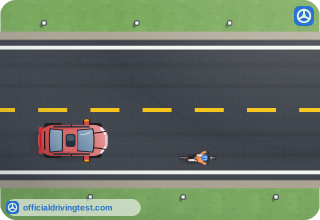
What should you do when you pass a bicyclist, and why?
- Speed up so you spend less time beside them in the lane
- Stay as close as possible so you do not block other traffic
- Sound your horn so they know you are about to pass
- Reduce speed and give room, as air pressure can send them off balance
Show answer
Correct answer: Reduce speed and give room, as air pressure can send them off balance
Give bicyclists room when you drive and reduce speed as you pass them. Air pressure from a vehicle that passes them quickly can send them off balance.
Source: New York State Driver's Manual (Form MV-21), page 68 · Open this page in the manual (Manual page 68)
-
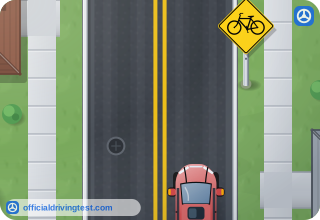
Where must bicyclists ride when there is no bicycle lane?
- In the center of the lane at all times, like a car
- Near the right curb or edge of the road, or on a right shoulder
- In the left lane or on the left shoulder, facing traffic
- On the sidewalk in all cases, never on the road
Show answer
Correct answer: Near the right curb or edge of the road, or on a right shoulder
Where there is no bicycle lane, bicyclists must remain near the right curb or edge of the road or on a right shoulder of the road, to prevent interference with other traffic.
Source: New York State Driver's Manual (Form MV-21), page 69 · Open this page in the manual (Manual page 69)
-
Do bicyclists have to remain to the right when preparing for a left turn or avoiding a hazard?
- Yes, they must always remain to the right in every situation
- Only at night
- No, they do not have to remain to the right in that situation
- Only on expressways
Show answer
Correct answer: No, they do not have to remain to the right in that situation
When bicyclists prepare for a left turn or must move left to avoid hazards, they do not have to remain to the right.
Source: New York State Driver's Manual (Form MV-21), page 69 · Open this page in the manual (Manual page 69)
-
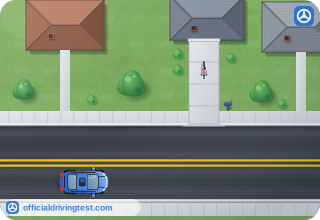
What must bicyclists do before entering a roadway from a driveway, an alley or over a curb?
- Ring their bell continuously
- Dismount and walk their bicycle across
- Speed up to merge quickly
- Come to a full stop
Show answer
Correct answer: Come to a full stop
Bicyclists must come to a full stop before they enter a roadway from a driveway, an alley or over a curb.
Source: New York State Driver's Manual (Form MV-21), page 69 · Open this page in the manual (Manual page 69)
-
How many bicyclists may travel side-by-side in a single lane at most?
- One
- Two
- Three
- Four
Show answer
Correct answer: Two
Bicyclists must never travel with more than two side-by-side in a single lane.
Source: New York State Driver's Manual (Form MV-21), page 69 · Open this page in the manual (Manual page 69)
-
Which bicyclists and passengers must wear an approved helmet?
- Only riders over age 18
- Bicyclists and their passengers ages 1 through 13
- Only passengers, never the bicyclist
- No one; helmets are never required in New York
Show answer
Correct answer: Bicyclists and their passengers ages 1 through 13
Bicyclists and their passengers ages 1 - 13 must wear an approved helmet. Adults must obey any local laws or regulations about helmet use.
Source: New York State Driver's Manual (Form MV-21), page 69 · Open this page in the manual (Manual page 69)
-
How does a bicyclist signal a right turn using a hand signal?
- By extending the right arm straight out to the right
- By extending the left arm straight out to the left
- By waving both arms overhead
- By pointing downward with the right hand
Show answer
Correct answer: By extending the right arm straight out to the right
A bicyclist can signal a right turn when they extend the right arm straight out to the right.
Source: New York State Driver's Manual (Form MV-21), page 69 · Open this page in the manual (Manual page 69)
-
What does the manual say about carrying an infant under a year old as a bicycle passenger?
- It is allowed if the infant wears a helmet
- It is allowed only in a bicycle safety seat during the day
- It is against the law
- It is allowed if an adult holds the infant
Show answer
Correct answer: It is against the law
Bicyclists must never carry an infant under a year old as a passenger. It is against the law.
Source: New York State Driver's Manual (Form MV-21), page 69 · Open this page in the manual (Manual page 69)
-
How must child passengers ages 1 through 4 be carried on a bicycle?
- In attached bicycle safety seats
- On the handlebars
- Seated on the rider's lap
- Standing on the rear wheel pegs
Show answer
Correct answer: In attached bicycle safety seats
Child passengers ages 1 - 4 must ride in attached bicycle safety seats.
Source: New York State Driver's Manual (Form MV-21), page 69 · Open this page in the manual (Manual page 69)
-
What lighting must a bicycle used at night have, according to the manual?
- A headlight visible from at least 300 feet ahead and a red taillight from at least 500 feet behind
- Only a red taillight visible from at least 300 feet behind
- No lighting is required if reflectors are present
- A headlight visible from at least 500 feet ahead and a red taillight from at least 300 feet behind
Show answer
Correct answer: A headlight visible from at least 500 feet ahead and a red taillight from at least 300 feet behind
A bicycle used at night must have a headlight visible from at least 500 feet ahead and a red taillight visible from at least 300 feet behind.
Source: New York State Driver's Manual (Form MV-21), page 69 · Open this page in the manual (Manual page 69)
-
What must be done if a bicycle crash causes death or serious injury?
- It must be reported to the DMV within 10 days of the incident
- Nothing needs to be reported
- It must be reported within 30 days to the local library
- It must be reported only if a motor vehicle was involved
Show answer
Correct answer: It must be reported to the DMV within 10 days of the incident
Any bicycle crash that causes death or serious injury must be reported to DMV within 10 days of the incident. Bicycle Crash Report forms (MV-104C) are available at any motor vehicle office, and you can also submit your report online.
Source: New York State Driver's Manual (Form MV-21), page 69 · Open this page in the manual (Manual page 69)
-
What is a "bike box," as described in the manual?
- A locked storage box for bicycles at a train or bus station
- A rack or trailer used to carry bicycles behind a car
- A marked bicycle lane that allows travel in both directions
- A marked area for bicyclists ahead of where traffic must stop
Show answer
Correct answer: A marked area for bicyclists ahead of where traffic must stop
A bike box is a marked area at an intersection, ahead of where traffic is required to stop. This area provides extra space for bicyclists, and some bike boxes extend across the entire intersection, functioning similar to a crosswalk for pedestrians.
Source: New York State Driver's Manual (Form MV-21), page 70 · Open this page in the manual (Manual page 70)
-
Besides pedestrians and bicyclists, which other road users does the manual specifically mention as vulnerable to careless drivers?
- In-line skaters, skateboarders and non-motorized scooters
- Taxi drivers, bus drivers and tow truck operators
- Delivery truck drivers, mail carriers and couriers
- Traffic officers, toll collectors and crossing guards
Show answer
Correct answer: In-line skaters, skateboarders and non-motorized scooters
As with pedestrians and bicyclists, other road users such as in-line skaters, skateboarders and non-motorized scooters are vulnerable to the careless actions of motor vehicle drivers.
Source: New York State Driver's Manual (Form MV-21), page 70 · Open this page in the manual (Manual page 70)
-
Who is responsible for safe and lawful operation around in-line skaters, skateboarders and non-motorized scooters?
- Only the local police who patrol the area
- Motor vehicle operators, who must exercise due care
- Only the skaters and scooter riders themselves
- No one; there is no such requirement
Show answer
Correct answer: Motor vehicle operators, who must exercise due care
Motor vehicle operators are responsible for safe and lawful operation of the vehicles they drive. As a driver, you are responsible to exercise due care by being aware, alert, and driving defensively.
Source: New York State Driver's Manual (Form MV-21), page 70 · Open this page in the manual (Manual page 70)