New York: Speed & following distance Practice Test
The basic speed law and how to judge a safe following distance.
Independent educational site · not affiliated with any government agency or DMV
Ready? Test yourself
Answer to start, or tap Start below:
If no speed limit is posted, what is the maximum speed you may legally drive, according to the manual?
- Instant feedback with an explanation
- Every answer cites its source in the manual
- Your best score is saved on this device
- Keyboard: press 1 to 4 to answer and Enter for the next question
Questions are original and based on the official manual "New York State Driver's Manual" (Form MV-21), New York State Department of Motor Vehicles (DMV).
All 9 questions in this practice test
Take the test above first, then use this list to study. Tap “Show answer” to see the correct answer and explanation.
Show the questions and answersHide the questions
-
If no speed limit is posted, what is the maximum speed you may legally drive, according to the manual?
- 45 mph
- 55 mph
- 65 mph
- 75 mph
Show answer
Correct answer: 55 mph
The manual states that if no speed limit is posted, you must drive no more than 55 mph (88 km/h).
Source: New York State Driver's Manual (Form MV-21), page 47 · Open this page in the manual (Manual page 47)
-
According to the manual, driving slower than a posted minimum speed limit can:
- Never cause any problem
- Interfere with traffic flow and create a danger
- Always be safer than driving at the limit
- Only matter on rural roads
Show answer
Correct answer: Interfere with traffic flow and create a danger
The manual explains that driving slower than the minimum speed can interfere with traffic flow and create a dangerous condition.
Source: New York State Driver's Manual (Form MV-21), page 47 · Open this page in the manual (Manual page 47)
-
Unless another limit is posted, what is the speed limit in New York City, according to the manual?
- 15 mph
- 20 mph
- 30 mph
- 25 mph
Show answer
Correct answer: 25 mph
The manual gives the example that the speed limit is 25 mph (48 km/h) in New York City unless another limit is posted.
Source: New York State Driver's Manual (Form MV-21), page 47 · Open this page in the manual (Manual page 47)
-
According to the manual, can a police officer ticket you for speed even if you are at or below the posted limit?
- No, never, as long as you are at or below the posted limit
- Only if you are on an expressway
- Yes, if your speed is not reasonable for the existing conditions
- Only if it is nighttime
Show answer
Correct answer: Yes, if your speed is not reasonable for the existing conditions
The manual explains that even driving below a posted limit, a police officer could ticket you for a speed 'not reasonable' for the conditions.
Source: New York State Driver's Manual (Form MV-21), page 47 · Open this page in the manual (Manual page 47)
-
According to the manual, about how many of every 10 crashes involve rear-end collisions, normally caused by following too closely?
- 1 of every 10
- 7 of every 10
- 4 of every 10
- 9 of every 10
Show answer
Correct answer: 4 of every 10
The manual states that four of every 10 crashes involve rear-end collisions, normally because a person is following too closely.
Source: New York State Driver's Manual (Form MV-21), page 47 · Open this page in the manual (Manual page 47)
-
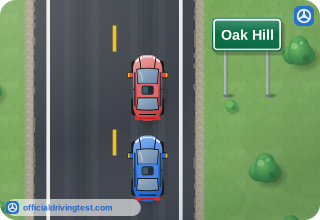
What is the recommended minimum following interval under the manual's 'two-second rule'?
- One second
- Five seconds
- Ten seconds
- Two seconds
Show answer
Correct answer: Two seconds
The manual describes the two-second rule: count 'one thousand one, one thousand two' after the vehicle ahead passes a fixed point; if you reach it sooner, you are following too closely.
Source: New York State Driver's Manual (Form MV-21), page 47 · Open this page in the manual (Manual page 47)
-
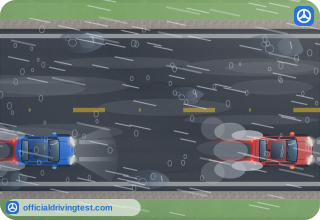
In bad weather or when following large trucks, the manual recommends increasing your following count to at least:
- One second
- Two seconds
- Three or four seconds
- Five or six seconds
Show answer
Correct answer: Three or four seconds
The manual says that in bad weather and when following large trucks, you should increase the two-second count to at least three or four seconds.
Source: New York State Driver's Manual (Form MV-21), page 47 · Open this page in the manual (Manual page 47)
-
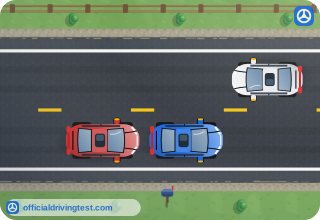
If a driver is tailgating you, what does the manual recommend?
- Slam on your brakes to warn the driver behind
- Change lanes or pull off the road to let them pass
- Speed up to lose them
- Flash your brake lights repeatedly
Show answer
Correct answer: Change lanes or pull off the road to let them pass
The manual advises that if a driver tailgates you, move to another lane if possible or reduce speed and pull off the road to let the driver go by.
Source: New York State Driver's Manual (Form MV-21), page 47 · Open this page in the manual (Manual page 47)
-
Why does the manual say you should avoid pressing your brakes suddenly or unnecessarily when someone is tailgating you?
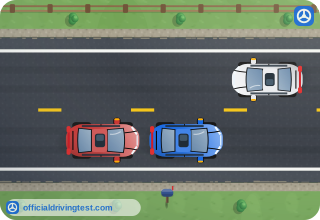
- It could startle them and escalate into road rage
- It could damage your brake pads permanently
- It has no real effect on the situation
- It is required by law to accelerate instead
Show answer
Correct answer: It could startle them and escalate into road rage
The manual warns that pressing your brakes suddenly could startle the motorist behind you and could escalate into road rage.
Source: New York State Driver's Manual (Form MV-21), page 47 · Open this page in the manual (Manual page 47)