New York: Emergencies and special situations
Breakdowns, hazardous conditions, and other special driving situations. Split into 4 shorter tests so you're not stuck in one long quiz.
Independent educational site · not affiliated with any government agency or DMV
Choose a part
Emergencies and special situations — Part 1
Questions in this part include: “Which of the following behaviors does the manual associate with aggressive driving?”
Emergencies and special situations — Part 2
Questions in this part include: “According to the manual, how often should you schedule regular stops on a long trip to help prevent fatigue?”
Emergencies and special situations — Part 3
Questions in this part include: “When sleet, freezing rain, or snow begins to fall, which road surfaces freeze first?”
Emergencies and special situations — Part 4
Questions in this part include: “About how many traffic crashes occur in New York State each year, according to the manual?”
Questions are original and based on the official manual "New York State Driver's Manual" (Form MV-21), New York State Department of Motor Vehicles (DMV).
All 75 Emergencies and special situations questions with answers
Choose a part above to take a practice test, or study every question and answer here.
Show the questions and answersHide the questions
1Part 119 questions
-
According to the manual, if a driver on a side road approaches a STOP or YIELD sign, what should you assume for safety?
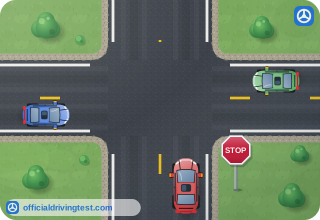
- That the driver may not actually stop or yield
- That the driver will definitely stop
- That the driver has the right-of-way over you
- That you do not need to watch that vehicle
Show answer
Correct answer: That the driver may not actually stop or yield
The manual advises: do not assume a driver approaching a STOP or YIELD sign will actually stop or yield; it is better to assume they will not.
Source: New York State Driver's Manual (Form MV-21), page 45 · Open this page in the manual (Manual page 45)
-
Which of the following behaviors does the manual associate with aggressive driving?
- Signaling every lane change well in advance
- Driving below the posted speed limit
- Yielding the right-of-way frequently
- Following too closely and unsignaled lane changes
Show answer
Correct answer: Following too closely and unsignaled lane changes
The manual lists aggressive driving as including speeding, following too closely, and frequent or quick lane changes without a signal.
Source: New York State Driver's Manual (Form MV-21), page 45 · Open this page in the manual (Manual page 45)
-
According to the manual, aggressive driving becomes 'road rage' when:
- Aggressive drivers try to cause harm to another driver
- A driver merely exceeds the speed limit occasionally
- A driver signals a turn too late
- A driver operates an older vehicle
Show answer
Correct answer: Aggressive drivers try to cause harm to another driver
The manual explains that some aggressive drivers try to cause harm to another driver, and that is how aggressive driving becomes road rage.
Source: New York State Driver's Manual (Form MV-21), page 46 · Open this page in the manual (Manual page 46)
-
To help prevent road rage, the manual suggests that you should sometimes:
- Make strong, prolonged eye contact with the other driver
- Honk your horn repeatedly to warn them
- Avoid making eye contact with another driver
- Flash your high beams at them
Show answer
Correct answer: Avoid making eye contact with another driver
The manual says it is sometimes better not to make eye contact with another driver, since the other driver can take this as being challenged.
Source: New York State Driver's Manual (Form MV-21), page 46 · Open this page in the manual (Manual page 46)
-
If an aggressive driver confronts you, what does the manual recommend?
- Increase your speed to hold your position in the lane
- Remain calm and try to move away safely
- Return their gestures and shouts
- Stop your vehicle and get out to talk it over
Show answer
Correct answer: Remain calm and try to move away safely
The manual advises that when an aggressive driver confronts you, you should remain calm and relaxed and try to move away safely.
Source: New York State Driver's Manual (Form MV-21), page 46 · Open this page in the manual (Manual page 46)
-
If an aggressive driver is following you, what does the manual say you should do?
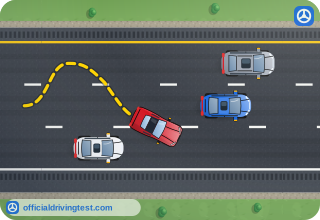
- Drive to the nearest police station
- Pull over and get out of your vehicle
- Stop immediately on the shoulder
- Speed up to try to lose them
Show answer
Correct answer: Drive to the nearest police station
The manual says if an aggressive driver is following you, do not stop or get out of your vehicle; drive to the nearest police station.
Source: New York State Driver's Manual (Form MV-21), page 46 · Open this page in the manual (Manual page 46)
-
If you report an aggressive driver to law enforcement, the manual says you should give:
- Only the approximate time of day it happened
- Your own insurance policy number
- Vehicle description, location, plate and direction
- Just the color of the vehicle
Show answer
Correct answer: Vehicle description, location, plate and direction
The manual says to report aggressive drivers to law enforcement and give a vehicle description, location, vehicle plate number and direction of travel.
Source: New York State Driver's Manual (Form MV-21), page 46 · Open this page in the manual (Manual page 46)
-
Which of these is listed as a way to avoid becoming an aggressive driver yourself?
- Allow enough travel time to arrive on schedule
- Schedule your trips during rush hour on purpose
- Drive without a seat belt to feel more alert
- Avoid listening to any music while driving
Show answer
Correct answer: Allow enough travel time to arrive on schedule
The manual lists allowing enough travel time to reach your destination on schedule as a way to avoid becoming an aggressive driver.
Source: New York State Driver's Manual (Form MV-21), page 46 · Open this page in the manual (Manual page 46)
-
According to the manual, if you have the right-of-way, you should:
- Be prepared to yield it to other highway users
- Treat it as an absolute right you never give up
- Force other drivers to wait no matter the risk
- Speed up to assert your right-of-way
Show answer
Correct answer: Be prepared to yield it to other highway users
The manual says not to think of the right-of-way as a complete right; be prepared to yield it to other highway users.
Source: New York State Driver's Manual (Form MV-21), page 46 · Open this page in the manual (Manual page 46)
-
How does the manual define 'road rage'?
- Any instance of exceeding the posted speed limit
- A minor paperwork violation
- An angry, hostile state that can lead to violent crime
- A required topic only in defensive driving courses
Show answer
Correct answer: An angry, hostile state that can lead to violent crime
The manual defines road rage as an angry, hostile state which can increase into violent criminal actions or attempts of violent action resulting from operating a motor vehicle.
Source: New York State Driver's Manual (Form MV-21), page 46 · Open this page in the manual (Manual page 46)
-
According to the manual, what is the key difference between aggressive driving and road rage?
- There is no real difference between the two
- Road rage is always legal while aggressive driving is not
- Aggressive driving only happens on highways, never on local streets
- Aggressive driving generally breaks a traffic law; road rage, a criminal law
Show answer
Correct answer: Aggressive driving generally breaks a traffic law; road rage, a criminal law
The manual explains that aggressive driving generally involves the violation of a traffic safety law, while road rage involves the breaking of a criminal law.
Source: New York State Driver's Manual (Form MV-21), page 46 · Open this page in the manual (Manual page 46)
-
Which of the following behaviors does the manual list as an example of road rage?
- Deliberately slamming into another vehicle
- Signaling early before making a turn
- Maintaining a two-second following distance
- Parking within a marked space
Show answer
Correct answer: Deliberately slamming into another vehicle
The manual lists deliberately slamming into a vehicle as an example of a road rage driving action.
Source: New York State Driver's Manual (Form MV-21), page 47 · Open this page in the manual (Manual page 47)
-
According to research cited in the manual, being in a state of rage can affect:
- Only your ability to see traffic signs
- Your blood pressure and ability to reason and decide
- Only your fuel efficiency
- Nothing related to your driving ability at all
Show answer
Correct answer: Your blood pressure and ability to reason and decide
The manual states that research indicates being in a state of rage can affect your blood pressure and your ability to reason and make decisions.
Source: New York State Driver's Manual (Form MV-21), page 47 · Open this page in the manual (Manual page 47)
-
According to the manual, aggressive driving and road rage can lead to:
- An improved driving record
- A revoked or suspended license
- Lower auto insurance premiums
- Automatic license renewal
Show answer
Correct answer: A revoked or suspended license
The manual states that aggressive driving and road rage can lead to revoked or suspended driver licenses, problems between family and friends, loss of employment, and legal problems.
Source: New York State Driver's Manual (Form MV-21), page 47 · Open this page in the manual (Manual page 47)
-
What does New York State law require of DMV-approved crash prevention courses?
- They must address the dangers of road rage
- They must ignore road rage entirely
- They must only cover parking regulations
- They must be limited to repeat offenders
Show answer
Correct answer: They must address the dangers of road rage
The manual states that state law requires every DMV-approved crash prevention course to address the hazards and dangers of road rage.
Source: New York State Driver's Manual (Form MV-21), page 47 · Open this page in the manual (Manual page 47)
-
Which of the following is listed in the manual as a symptom of drowsy driving?
- Improved reaction time
- Increased attentiveness to traffic signs
- Your eyes close or go out of focus by themselves
- Better memory of the last few miles driven
Show answer
Correct answer: Your eyes close or go out of focus by themselves
The manual lists 'your eyes close or go out of focus by themselves' as a symptom associated with drowsy driving.
Source: New York State Driver's Manual (Form MV-21), page 51 · Open this page in the manual (Manual page 51)
-
According to the manual, which of these driving behaviors is a listed symptom of fatigue?
- Drifting between lanes or missing traffic signs
- Staying perfectly centered in your lane
- Signaling every lane change well in advance
- Checking your mirrors every few seconds
Show answer
Correct answer: Drifting between lanes or missing traffic signs
The manual lists drifting between lanes, tailgating, or missing traffic signs as symptoms associated with drowsy driving.
Source: New York State Driver's Manual (Form MV-21), page 51 · Open this page in the manual (Manual page 51)
-
According to the manual, which group is identified as being at greater risk for drowsy driving crashes because they tend to stay up late and drive at night?
- Senior citizens
- Young people
- Only long-haul truck drivers
- Only new drivers
Show answer
Correct answer: Young people
The manual states drowsy driving crashes are most common for young people, who tend to stay up late, sleep too little, and drive at night.
Source: New York State Driver's Manual (Form MV-21), page 52 · Open this page in the manual (Manual page 52)
-
According to the manual, what type of work schedule increases the risk of a fatigue-related crash?
- Standard 9-to-5 schedules
- Part-time schedules
- Remote work schedules
- Shift work schedules
Show answer
Correct answer: Shift work schedules
The manual states drivers who have non-traditional work schedules (shift workers) have a greater risk of being involved in a fatigue-related traffic crash.
Source: New York State Driver's Manual (Form MV-21), page 52 · Open this page in the manual (Manual page 52)
2Part 219 questions
-
According to the manual, how often should you schedule regular stops on a long trip to help prevent fatigue?
- Every 500 miles or 5 hours
- Every 100 miles or two hours
- Every 50 miles or 30 minutes
- Only once per trip
Show answer
Correct answer: Every 100 miles or two hours
The manual recommends scheduling regular stops every 100 miles or two hours to help prevent fatigue on long trips.
Source: New York State Driver's Manual (Form MV-21), page 52 · Open this page in the manual (Manual page 52)
-
According to the manual, how long should you wait before driving after waking from sleep?
- At least 15 minutes
- At least 5 minutes
- At least one hour
- No waiting is necessary
Show answer
Correct answer: At least 15 minutes
The manual advises not to drive for at least 15 minutes after waking from sleep.
Source: New York State Driver's Manual (Form MV-21), page 52 · Open this page in the manual (Manual page 52)
-
If you suspect you are drowsy while driving, the manual recommends pulling off into a safe area and taking a brief nap of how long?
- 5 to 10 minutes
- 1 to 2 hours
- 15 to 45 minutes
- 3 to 4 hours
Show answer
Correct answer: 15 to 45 minutes
The manual recommends pulling off into a safe area away from traffic and taking a brief nap of 15 to 45 minutes if you are drowsy.
Source: New York State Driver's Manual (Form MV-21), page 52 · Open this page in the manual (Manual page 52)
-
According to the manual, about how long does it take for caffeine to enter the bloodstream and promote alertness?
- About 5 minutes
- About 2 hours
- About 4 hours
- About 30 minutes
Show answer
Correct answer: About 30 minutes
The manual notes it takes about 30 minutes for caffeine to enter the bloodstream.
Source: New York State Driver's Manual (Form MV-21), page 52 · Open this page in the manual (Manual page 52)
-
About what percentage of your driving decisions are based on what you see, and what happens to your night vision as you age?
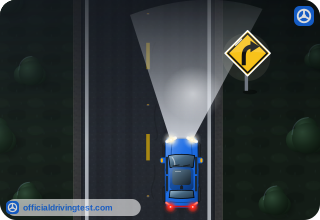
- About 50%; night vision stays the same with age
- About 25%; night vision improves with age
- About 75%; night vision is unrelated to age
- About 90%; night vision decreases with age
Show answer
Correct answer: About 90%; night vision decreases with age
About 90% of your decisions are based on what you see. At night, you must use extra caution to make up for reduced visibility, and the ability to see well at night decreases with age.
Source: New York State Driver's Manual (Form MV-21), page 62 · Open this page in the manual (Manual page 62)
-
About how far ahead do your headlights let you see, and what does "driving within the range" of your headlights mean?
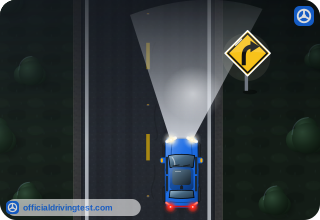
- About 100 feet; driving fast enough to reach your destination quickly
- About 1,000 feet; driving with your high beams on at all times
- About 350 feet; driving at a speed that lets you stop safely within that distance
- About 50 feet; driving with your eyes fixed on the road edge
Show answer
Correct answer: About 350 feet; driving at a speed that lets you stop safely within that distance
Your headlights cover about 350 feet ahead. It is important that you drive at a speed that allows you to stop safely within that distance. This is called "driving within the range" of your headlights.
Source: New York State Driver's Manual (Form MV-21), page 62 · Open this page in the manual (Manual page 62)
-
New York law requires you to use your headlights during which of these conditions?
- When visibility is less than 1,000 feet
- Only between midnight and 4 a.m.
- Only on expressways
- Only when another driver requests it
Show answer
Correct answer: When visibility is less than 1,000 feet
The law requires you to use your headlights from one-half hour after the sun sets to one-half hour before the sun rises, when visibility is less than 1,000 feet (300 m), and when you use your windshield wipers to clear rain, snow, or sleet.
Source: New York State Driver's Manual (Form MV-21), page 63 · Open this page in the manual (Manual page 63)
-
Within what distances must you switch your headlights to low beam?
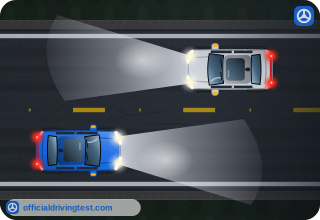
- 500 feet of an oncoming vehicle or 200 feet of one ahead
- 1,000 feet of any vehicle in any direction
- 50 feet of an oncoming vehicle only
- There is no set distance; it is left to driver judgment
Show answer
Correct answer: 500 feet of an oncoming vehicle or 200 feet of one ahead
Your headlights must be on low beam when you are within 500 feet (150 m) of an oncoming vehicle or within 200 feet (60 m) of a vehicle ahead of you, even if the vehicle ahead is in a different lane.
Source: New York State Driver's Manual (Form MV-21), page 63 · Open this page in the manual (Manual page 63)
-
Can you use parking lights or daytime running lights as a replacement for headlights in low-light conditions?
- Yes, they work exactly the same as headlights
- Yes, but only during fog
- Yes, but only in the city
- No, headlights do a better job
Show answer
Correct answer: No, headlights do a better job
Even when headlights do not help you see in low-light periods, they make it easier for other drivers and pedestrians to see your vehicle. Do not use parking lights or daytime running lights as a replacement; headlights do a better job.
Source: New York State Driver's Manual (Form MV-21), page 63 · Open this page in the manual (Manual page 63)
-
If an oncoming driver flashes their headlights at you during a period of low visibility, what does this usually mean?
- They are greeting you
- They want you to speed up
- There is a police checkpoint ahead
- You should turn on your headlights
Show answer
Correct answer: You should turn on your headlights
If an oncoming driver flashes headlights at you during a period of low visibility, it means your vehicle was difficult to see and you should turn on your headlights.
Source: New York State Driver's Manual (Form MV-21), page 63 · Open this page in the manual (Manual page 63)
-
If an approaching driver does not dim their high beams, what should you do?
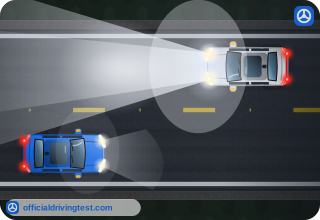
- Flash high beams for a second, then dim
- Stare directly at their headlights
- Turn off all your lights
- Speed up to pass them quickly
Show answer
Correct answer: Flash high beams for a second, then dim
If an approaching driver does not dim the headlights, flash your headlights to high beam for a second, then return to low beam. To help avoid the glare of approaching high beams, move your eyes to the right and use the road edge as a guide until the approaching vehicle passes by.
Source: New York State Driver's Manual (Form MV-21), page 63 · Open this page in the manual (Manual page 63)
-
How can you reduce glare from the headlights of vehicles following you at night?
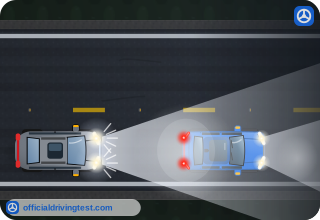
- Switch your rear view mirror to "night"
- Remove your rear view mirror completely
- Turn on your hazard lights
- Speed up to get away from them
Show answer
Correct answer: Switch your rear view mirror to "night"
To reduce glare from the lights of following vehicles, switch your inside rear view mirror to the "night" position.
Source: New York State Driver's Manual (Form MV-21), page 63 · Open this page in the manual (Manual page 63)
-
What is "hydroplaning"?
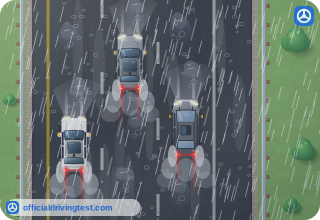
- When your engine overheats in the rain
- When your windshield wipers stop working
- When your headlights flicker in fog
- When your tires ride on water and lose traction
Show answer
Correct answer: When your tires ride on water and lose traction
In heavy rain, your tires can begin to ride on the water on top of the road pavement. This is called "hydroplaning" and can cause complete loss of traction and control of steering. It normally occurs at higher speeds, but can also occur if tires are tread worn or not inflated properly.
Source: New York State Driver's Manual (Form MV-21), page 63 · Open this page in the manual (Manual page 63)
-
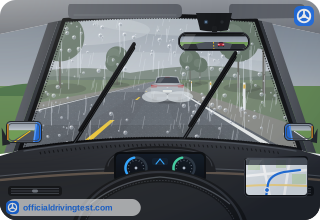
New York law requires you to turn on your headlights whenever weather conditions require the use of windshield wipers. Do "daytime running lights" satisfy this requirement?
- Yes, daytime running lights always qualify as headlights
- Only in fog, not in rain or snow
- Only on expressways
- No, "daytime running lights" do not qualify as headlights
Show answer
Correct answer: No, "daytime running lights" do not qualify as headlights
New York State law requires you to turn on your headlights when weather conditions require the use of windshield wipers to clear rain, snow, sleet or fog. "Daytime running lights" do not qualify as headlights.
Source: New York State Driver's Manual (Form MV-21), page 63 · Open this page in the manual (Manual page 63)
-
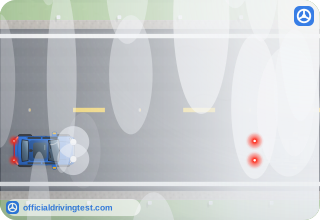
Should you use high beams or low beams when driving in rain, fog, or snow?
- High beams, because they light up more of the road
- It does not matter which you use
- Low beams, as high beams reflect off rain, fog, and snow
- Neither; turn off your headlights entirely
Show answer
Correct answer: Low beams, as high beams reflect off rain, fog, and snow
Headlights on high beams reflect rain, fog, and snow as it falls, making it even harder for you to see. For better visibility during these weather conditions, keep your headlights on low beam.
Source: New York State Driver's Manual (Form MV-21), page 63 · Open this page in the manual (Manual page 63)
-
In New York State, what colors are required for front and back fog lights?
- Front lights must be blue; back lights must be green
- Both front and back lights must be purple
- Front and back lights can be any color the owner chooses
- Front lights can be amber or white; back lights must be red
Show answer
Correct answer: Front lights can be amber or white; back lights must be red
In New York State, all fog lights must be correctly installed and of a type approved by the Commissioner of DMV. Front fog lights can be amber or white in color. Back fog lights must be red and can be larger than the normal back lights.
Source: New York State Driver's Manual (Form MV-21), page 63 · Open this page in the manual (Manual page 63)
-
During which dates can tires with metal studs be used in New York State?
- January 1 through March 31
- Year-round, with no restriction
- November 1 through February 28
- October 16 through April 30
Show answer
Correct answer: October 16 through April 30
Tires with metal studs can be used in New York State only from October 16 through April 30.
Source: New York State Driver's Manual (Form MV-21), page 64 · Open this page in the manual (Manual page 64)
-
Should you ever combine radial and non-radial tires on the same vehicle?
- Yes, it is recommended in winter
- Only on the rear axle
- Only if the tires are the same brand
- No, never combine them on one vehicle
Show answer
Correct answer: No, never combine them on one vehicle
Make sure your vehicle has good snow tires and put them on before the first storm. Never combine radial and non-radial tires on the same vehicle.
Source: New York State Driver's Manual (Form MV-21), page 64 · Open this page in the manual (Manual page 64)
-
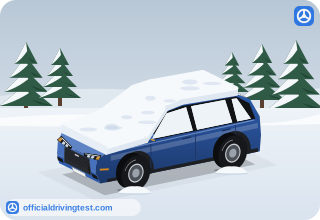
Before driving in an ice or snow storm, what must you clear from your vehicle?
- Only the front windshield and the driver's side window
- Only the license plate and the side mirrors
- Only the side mirrors and the front headlights
- Headlights, back lights, wipers, hood, roof and all windows
Show answer
Correct answer: Headlights, back lights, wipers, hood, roof and all windows
If you must drive during an ice or snow storm, first clear the ice and snow from your vehicle. This includes the headlights and back lights, the windshield wipers, the hood and roof of your vehicle, and all of the windows.
Source: New York State Driver's Manual (Form MV-21), page 64 · Open this page in the manual (Manual page 64)
3Part 319 questions
-
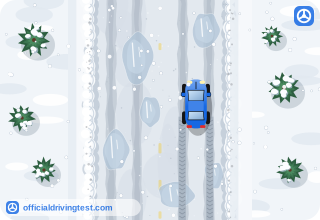
How should you brake if your vehicle has anti-lock brakes (ABS) versus if it does not?
- With ABS: brake as hard as possible; without ABS: never brake at all
- Brake technique makes no difference either way
- With ABS: pump the pedal rapidly; without ABS: apply even pressure
- With ABS: keep even pressure on the pedal; without ABS: pump the pedal carefully
Show answer
Correct answer: With ABS: keep even pressure on the pedal; without ABS: pump the pedal carefully
If your vehicle has anti-lock brakes (ABS), keep your foot with even pressure on the brake pedal. If your vehicle does not have ABS, pump the pedal carefully, more rapidly only as your car slows down. Braking hard with regular brakes will make the situation worse.
Source: New York State Driver's Manual (Form MV-21), page 64 · Open this page in the manual (Manual page 64)
-
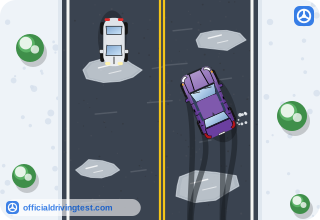
If your rear wheels start to skid, which way should you turn the steering wheel?
- Always turn it to the right, regardless of the skid direction
- Turn it in the direction the vehicle is trying to go
- Turn it opposite to the direction the rear is sliding
- Keep the steering wheel completely straight and do nothing
Show answer
Correct answer: Turn it in the direction the vehicle is trying to go
If your rear wheels start to skid, turn the steering wheel in the direction the vehicle is trying to go. If your rear wheels slide left, steer left; if they slide right, steer right.
Source: New York State Driver's Manual (Form MV-21), page 64 · Open this page in the manual (Manual page 64)
-
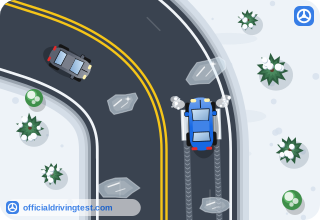
If your front wheels skid, what should you do first?
- Immediately steer hard in the opposite direction of the skid
- Take your foot off the gas, shift to neutral, and do not steer yet
- Brake as hard as you can and keep the wheels locked
- Accelerate firmly to regain traction and control
Show answer
Correct answer: Take your foot off the gas, shift to neutral, and do not steer yet
If your front wheels skid, take your foot off the gas and shift to neutral or push in the clutch, but do not try to immediately steer. As the wheels skid sideways, they will slow the vehicle and traction will return; then turn the wheel in the direction you want to go.
Source: New York State Driver's Manual (Form MV-21), page 64 · Open this page in the manual (Manual page 64)
-
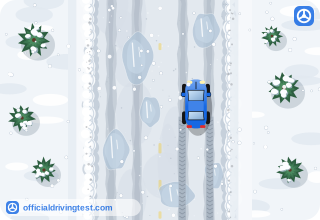
What is the best way to prevent skids on snow and ice?
- Brake early, carefully and gently, in slow, steady strokes
- Brake as hard and as late as possible to lock the wheels
- Avoid braking entirely on snow and ice
- Speed up to get through slippery areas quickly
Show answer
Correct answer: Brake early, carefully and gently, in slow, steady strokes
To prevent skids on snow and ice, brake early, carefully, and gently. "Press" your brakes in slow, steady strokes, and allow the wheels to keep turning. If they begin to lock, decrease pressure on the brake pedal.
Source: New York State Driver's Manual (Form MV-21), page 64 · Open this page in the manual (Manual page 64)
-
When sleet, freezing rain, or snow begins to fall, which road surfaces freeze first?
- Bridges, ramps, and overpasses
- Only tunnels
- Only parking lots
- Only the center of wide roads
Show answer
Correct answer: Bridges, ramps, and overpasses
When sleet, freezing rain, or snow begin to fall, remember that bridges, ramps, and overpasses will freeze first. Also know that slippery spots may remain after road workers have removed the snow.
Source: New York State Driver's Manual (Form MV-21), page 64 · Open this page in the manual (Manual page 64)
-
During which months do two-thirds of all deer-vehicle collisions occur, and when is daily deer activity highest?
- June, July, and August; activity highest at midday
- October, November, and December; activity highest at dawn and dusk
- January, February, and March; activity highest at night
- April, May, and June; activity highest in early morning only
Show answer
Correct answer: October, November, and December; activity highest at dawn and dusk
Two-thirds of all deer-vehicle collisions occur during October, November, and December — this is also when deer breed and travel the most. Daily deer activity is highest at dawn and dusk, often the highest travel time for motor-vehicle commuters.
Source: New York State Driver's Manual (Form MV-21), page 64 · Open this page in the manual (Manual page 64)
-
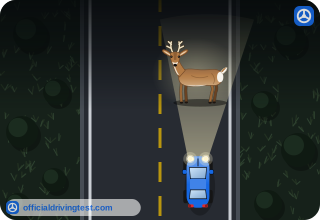
According to the manual's deer-collision precautions, what should you do to warn other drivers when you see deer on or near the road?
- Use your emergency lights or flash your headlights
- Sound your horn continuously
- Turn off your headlights so the deer are not startled
- Drive faster to pass the area quickly
Show answer
Correct answer: Use your emergency lights or flash your headlights
Use emergency lights or flash your headlights to warn other drivers when deer are seen on or near the road.
Source: New York State Driver's Manual (Form MV-21), page 65 · Open this page in the manual (Manual page 65)
-
What is the most important rule in any driving emergency?
- Call for help before doing anything else
- Do not panic
- Accelerate away from the situation
- Turn off the engine immediately in every case
Show answer
Correct answer: Do not panic
The most important rule in any emergency is do not panic. You have a better chance in an emergency if you do not let fear take over; in most emergencies, you will have a second or two to think before you act.
Source: New York State Driver's Manual (Form MV-21), page 65 · Open this page in the manual (Manual page 65)
-
If you experience a tire blowout, what should you do?
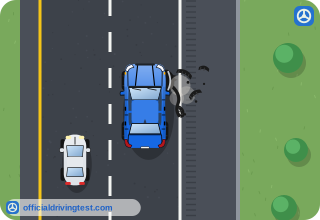
- Brake hard immediately to stop as fast as possible
- Hold the wheel tightly and slowly take your foot off the gas
- Turn off the engine while the vehicle is still moving
- Accelerate firmly to keep the vehicle stable
Show answer
Correct answer: Hold the wheel tightly and slowly take your foot off the gas
A thumping sound can warn that a blowout is about to occur. If a tire blows out, hold the steering wheel tightly and slowly take your foot off the gas pedal. If your vehicle skids, handle it as you would on ice or snow. Do not brake until your vehicle is controlled, and leave the road when it is safe to do so.
Source: New York State Driver's Manual (Form MV-21), page 65 · Open this page in the manual (Manual page 65)
-
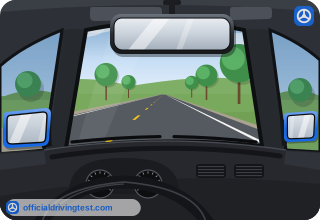
If your brake pedal suddenly goes to the floor, what should you try first?
- Shift into a higher gear immediately
- Turn off the ignition right away
- Pump the brake pedal to increase pressure
- Open the door and jump out
Show answer
Correct answer: Pump the brake pedal to increase pressure
If your brake pedal suddenly goes to the floor, try pumping it to increase pressure. If that does not help, use your emergency brake if you can apply it gradually, but use it gently. Shifting to a lower gear will also help your vehicle decrease speed.
Source: New York State Driver's Manual (Form MV-21), page 65 · Open this page in the manual (Manual page 65)
-
If your steering suddenly fails and your vehicle will not respond when you steer, what should you do?
- Slam on the brakes immediately to stop the vehicle as fast as possible
- Slowly ease off the gas, turn on emergency lights, keep off the brake while safe
- Shift into reverse to slow the vehicle down quickly
- Turn off the engine and all the lights, then coast to a stop
Show answer
Correct answer: Slowly ease off the gas, turn on emergency lights, keep off the brake while safe
If your vehicle suddenly will not respond when you steer, slowly take your foot off the gas pedal, turn on your emergency lights, and keep your foot off the brake pedal while it is safe to do so. The vehicle's balance will let it continue going straight, but a sudden change in speed could send it out of control. As the vehicle decreases speed, you can brake very carefully to bring it to a stop.
Source: New York State Driver's Manual (Form MV-21), page 65 · Open this page in the manual (Manual page 65)
-
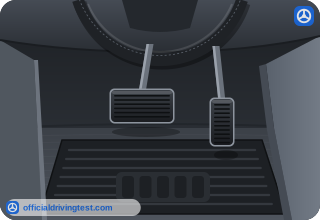
If your gas pedal becomes stuck, why should you NOT turn off the ignition?
- It would damage the engine and drain the battery
- You could lose steering control or lock the steering wheel
- It would set off the airbags in front of you
- It would make the gas pedal stick down even further
Show answer
Correct answer: You could lose steering control or lock the steering wheel
If your gas pedal is stuck, hook your shoe under it and try to free it. If that fails, shift into neutral and use the brake to slow your vehicle and get off the road. Do not turn off the ignition, as you could lose your steering control or lock your steering wheel.
Source: New York State Driver's Manual (Form MV-21), page 65 · Open this page in the manual (Manual page 65)
-
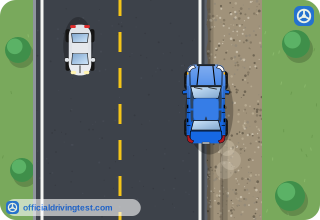
If your wheels move off the pavement onto the shoulder, what should you do?
- Suddenly steer or swerve back onto the pavement without slowing
- Ease off the gas, brake gently, check traffic, then turn back carefully
- Accelerate, then steer sharply back onto the pavement
- Brake hard and stop the vehicle on the shoulder at once
Show answer
Correct answer: Ease off the gas, brake gently, check traffic, then turn back carefully
If your wheels move off the pavement, do not suddenly steer or swerve back onto the pavement. Ease your foot off the gas pedal and brake gently. When your vehicle has decreased speed, check for traffic behind you, then turn carefully back onto the pavement.
Source: New York State Driver's Manual (Form MV-21), page 65 · Open this page in the manual (Manual page 65)
-
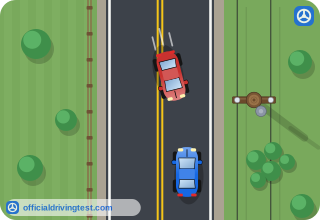
If a vehicle is approaching head-on in your lane, what should you do?
- Turn into the left lane to get out of its way
- Decrease speed, pull over to the right, and sound your horn
- Speed up and flash your headlights to warn the driver
- Stop immediately in your lane and wait for it to move
Show answer
Correct answer: Decrease speed, pull over to the right, and sound your horn
If a vehicle is approaching head-on in your lane, decrease speed, pull over to the right, and sound your horn to warn the other driver. Do not turn into the left lane — the other driver may suddenly recover and pull back into that lane, causing a head-on collision.
Source: New York State Driver's Manual (Form MV-21), page 65 · Open this page in the manual (Manual page 65)
-
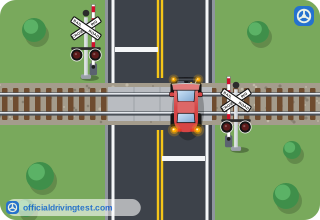
If your vehicle stalls on railroad tracks and you are completely sure no trains are coming, what does the manual say to try?
- Wait for a train to arrive before doing anything
- Try to restart the engine; if that fails, push it off in neutral
- Leave the vehicle where it is permanently and walk home
- Sit inside the vehicle with the doors locked
Show answer
Correct answer: Try to restart the engine; if that fails, push it off in neutral
When you are completely sure no trains are coming, open your window to listen for a train and try to start the engine. If that fails, shift your vehicle into neutral and push it from the tracks.
Source: New York State Driver's Manual (Form MV-21), page 66 · Open this page in the manual (Manual page 66)
-
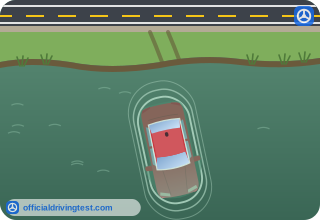
If your vehicle goes into the water, how should you escape, and why should you avoid opening a door?
- Stay seated and wait for rescue; opening anything would be unsafe
- Escape through a window: an open door lets water rush in and the car could turn over
- Open the door immediately, since a door is the fastest and safest way out
- Honk the horn continuously until the car sinks
Show answer
Correct answer: Escape through a window: an open door lets water rush in and the car could turn over
A vehicle will normally float for a while, giving you time to escape before it sinks. Release your seat belt and escape through a window. An open door would cause water to rush in and the car could turn over on top of you.
Source: New York State Driver's Manual (Form MV-21), page 66 · Open this page in the manual (Manual page 66)
-
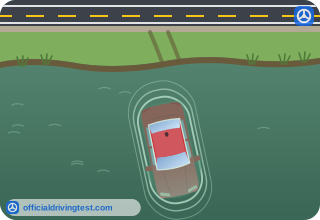
If your vehicle sinks before you can escape, where should you go, and how should you breathe as you surface?
- Go to the trunk and hold your breath tightly the whole way up
- Go to the back seat; let air out in small breaths through your nose or lips as you rise
- Go to the front passenger seat and hold your breath until you reach the surface
- Stay in the driver's seat with your eyes closed
Show answer
Correct answer: Go to the back seat; let air out in small breaths through your nose or lips as you rise
If the vehicle sinks before you can escape, get into the back seat — an air pocket can form there as the weight of the engine pulls the vehicle down front first. When the vehicle settles, take a breath and escape through a window. As you rise, let air escape in small breaths through your nose or lips as you surface; do not hold your breath tight or try to blow air out.
Source: New York State Driver's Manual (Form MV-21), page 66 · Open this page in the manual (Manual page 66)
-
If you see smoke coming from under the hood of your vehicle, what should you do?
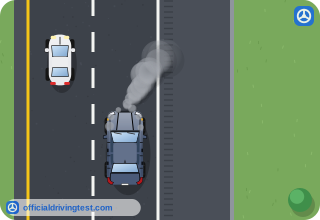
- Stop, open the hood right away and try to put out the fire yourself
- Park off the road, turn off the ignition, get away and call the fire department
- Keep driving until you reach a gas station or a repair shop
- Pour water from your water bottle onto the hood while driving
Show answer
Correct answer: Park off the road, turn off the ignition, get away and call the fire department
If you see smoke come from under the hood, pull off the road and park your vehicle. Turn off the ignition, get away from the car, and call the fire department. It is dangerous to try to fight the fire yourself.
Source: New York State Driver's Manual (Form MV-21), page 66 · Open this page in the manual (Manual page 66)
-
If your hood opens suddenly or your vision through the windshield becomes blocked, what should you do?
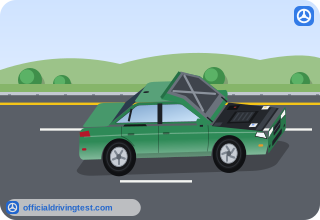
- Close your eyes and brake hard immediately
- Open the side window, turn on emergency lights, and carefully pull off the road
- Speed up so the wind blows the hood back down into place
- Steer into the oncoming lane, where your visibility might be better
Show answer
Correct answer: Open the side window, turn on emergency lights, and carefully pull off the road
If your hood opens suddenly or your vision through the windshield becomes blocked by some other object or wipers that have failed, you can open the side window so you can see. Turn on your emergency lights and carefully pull your vehicle off the road and park it.
Source: New York State Driver's Manual (Form MV-21), page 66 · Open this page in the manual (Manual page 66)
4Part 418 questions
-
About how many traffic crashes occur in New York State each year, according to the manual?
- About 30,000
- Fewer than 10,000
- More than 300,000
- About 1 million
Show answer
Correct answer: More than 300,000
The manual states there are more than 300,000 traffic crashes in New York State each year.
Source: New York State Driver's Manual (Form MV-21), page 77 · Open this page in the manual (Manual page 77)
-
What can you carry in your vehicle to help in an emergency, according to the manual?
- Flares and first aid supplies
- A spare tire and jack only
- Extra fuel
- A tow rope
Show answer
Correct answer: Flares and first aid supplies
The manual recommends carrying an emergency kit with flares and first aid supplies.
Source: New York State Driver's Manual (Form MV-21), page 77 · Open this page in the manual (Manual page 77)
-
If you are in a traffic crash, when must you stop?
- Only if someone is injured
- Regardless of the level of damage
- Only if the damage is severe
- Only if requested by another driver
Show answer
Correct answer: Regardless of the level of damage
The manual states that if you are in a crash you must stop, and the level of damage does not matter.
Source: New York State Driver's Manual (Form MV-21), page 77 · Open this page in the manual (Manual page 77)
-
Leaving the scene of a crash that involves only property damage is what kind of violation?
- No violation if damage is minor
- A civil lawsuit only
- A parking violation
- A traffic violation
Show answer
Correct answer: A traffic violation
The manual states it is a traffic violation to leave the scene of an incident involving property damage.
Source: New York State Driver's Manual (Form MV-21), page 77 · Open this page in the manual (Manual page 77)
-
Leaving the scene of a crash that involves a fatality or personal injury is what kind of violation?
- A criminal violation
- A traffic violation only
- A minor infraction
- Not a violation if you call police later
Show answer
Correct answer: A criminal violation
The manual states it is a criminal violation to leave the scene of an incident involving a fatality or personal injury.
Source: New York State Driver's Manual (Form MV-21), page 77 · Open this page in the manual (Manual page 77)
-
Even if a crash involves only property damage, what must you do?
- Wait for police only if damage exceeds $5,000
- Nothing, as long as no one is hurt and the cars can still be driven
- Exchange name, address, license number, registration and insurance information
- Only exchange phone numbers
Show answer
Correct answer: Exchange name, address, license number, registration and insurance information
The manual requires drivers to exchange name, address, driver license number, and vehicle registration and insurance information (including policy number and effective date), even for property-damage-only crashes.
Source: New York State Driver's Manual (Form MV-21), page 77 · Open this page in the manual (Manual page 77)
-
What must you show at the scene of a crash if a police officer or other driver requests it?
- Your vehicle title
- Your insurance ID card
- Your birth certificate
- Your Social Security card
Show answer
Correct answer: Your insurance ID card
The manual states you must show your insurance identification card if requested.
Source: New York State Driver's Manual (Form MV-21), page 77 · Open this page in the manual (Manual page 77)
-
If your crash damages a parked vehicle, other property, or injures a domestic animal, and the owner is not present, what must you do?
- Leave a note only if it is convenient
- Nothing is required
- Wait at the scene for 24 hours
- Try to find the owner or notify the police
Show answer
Correct answer: Try to find the owner or notify the police
The manual states you must try to find the owner or notify the police in these situations.
Source: New York State Driver's Manual (Form MV-21), page 77 · Open this page in the manual (Manual page 77)
-
If any person is injured or killed in a crash, what must you do?
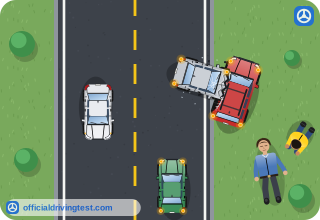
- Make sure the police are notified at once and an ambulance is called
- Move the vehicles first, then decide whether to call for help
- Wait for a passerby to call for help
- Only notify your insurance company
Show answer
Correct answer: Make sure the police are notified at once and an ambulance is called
The manual states police must be notified immediately and you should make sure ambulance or rescue personnel have been called.
Source: New York State Driver's Manual (Form MV-21), page 77 · Open this page in the manual (Manual page 77)
-
After a crash, if possible, what should you do with your vehicle and the scene?
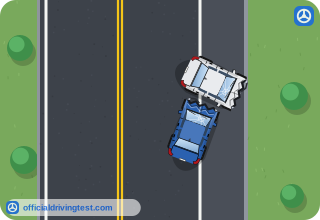
- Leave everything exactly in place and walk away from the scene
- Push other vehicles out of the way
- Move it off the road and protect the scene with reflectors or flares
- Turn off all vehicle lights immediately
Show answer
Correct answer: Move it off the road and protect the scene with reflectors or flares
The manual advises moving your vehicle off the road if possible and protecting the scene with reflectors or flares while watching for leaking fuel.
Source: New York State Driver's Manual (Form MV-21), page 77 · Open this page in the manual (Manual page 77)
-
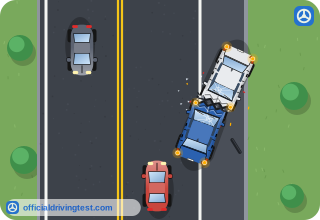
According to the manual, what should you do if you come across a crash scene that you were not involved in?
- Always stop, so you can help direct traffic
- Stop only if emergency help has not arrived
- Stop only to take photos
- Stop only during daylight hours
Show answer
Correct answer: Stop only if emergency help has not arrived
The manual says not to stop at a crash scene unless you are involved or emergency help has not arrived, and to focus on driving and follow directions from traffic officers.
Source: New York State Driver's Manual (Form MV-21), page 77 · Open this page in the manual (Manual page 77)
-
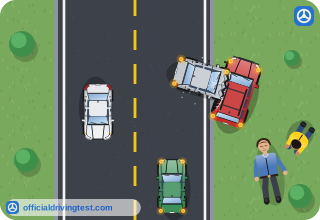
According to the manual's first-aid tips, when should you move an injured person at a crash scene?
- Immediately, to make them more comfortable while waiting for help
- Only if you are a trained paramedic
- Never, under any circumstances
- Only if fire or another life-threatening danger makes it necessary
Show answer
Correct answer: Only if fire or another life-threatening danger makes it necessary
The manual advises not moving an injured person unless necessary due to fire or another life-threatening danger, and to keep the back and neck as straight as possible if you must move them.
Source: New York State Driver's Manual (Form MV-21), page 77 · Open this page in the manual (Manual page 77)
-
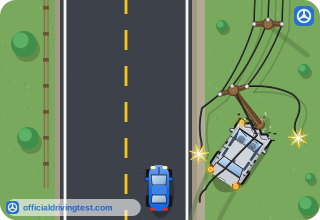
What should you do if you see downed wires at a crash scene?
- Do not go near them; if they touch the vehicle, warn occupants to stay inside
- Move them off the road with a stick, then help the occupants get out
- Cut them with insulated tools
- Drive over them quickly
Show answer
Correct answer: Do not go near them; if they touch the vehicle, warn occupants to stay inside
The manual instructs not to go near downed wires and to warn vehicle occupants to remain inside until help arrives if wires touch or lie near the vehicle.
Source: New York State Driver's Manual (Form MV-21), page 77 · Open this page in the manual (Manual page 77)
-
You must report a crash to the DMV if it involves which of the following?
- Only crashes on highways
- Any crash, no matter how minor
- A fatality or personal injury
- Only crashes involving out-of-state drivers
Show answer
Correct answer: A fatality or personal injury
The manual requires reporting to DMV any traffic crash that involves a fatality or personal injury.
Source: New York State Driver's Manual (Form MV-21), page 77 · Open this page in the manual (Manual page 77)
-
Besides crashes involving injury or death, what other type of crash must be reported to the DMV?
- Any crash involving a rental car
- One involving $1,000 or more in damage to one person's property
- Any crash occurring at night
- One involving a government vehicle, whatever the damage
Show answer
Correct answer: One involving $1,000 or more in damage to one person's property
The manual states you must report any traffic incident or crash involving $1,000 or more in damage to the property of any one person.
Source: New York State Driver's Manual (Form MV-21), page 77 · Open this page in the manual (Manual page 77)
-
What is the name of the form used to report a crash to the DMV, and where can it be found?
- Form DTF-17, available only by mail
- Form SR-22, available only from your insurance company after the crash is settled
- There is no official form; a phone call is sufficient
- Report of Motor Vehicle Crash (MV-104), at DMV offices, most insurance agents, or online
Show answer
Correct answer: Report of Motor Vehicle Crash (MV-104), at DMV offices, most insurance agents, or online
The manual names the Report of Motor Vehicle Crash (MV-104), available at any motor vehicle office, from most insurance agents, and from the DMV website.
Source: New York State Driver's Manual (Form MV-21), page 77 · Open this page in the manual (Manual page 77)
-
Within how many days of a reportable crash must you file a report with the DMV?
- 10 days
- 30 days
- 60 days
- 90 days
Show answer
Correct answer: 10 days
The manual states you must file a report with DMV within 10 days of the event.
Source: New York State Driver's Manual (Form MV-21), page 77 · Open this page in the manual (Manual page 77)
-
What can happen if you fail to report a required crash to the DMV?
- A small late fee only
- Nothing, if you already reported it to your insurance company
- It is a misdemeanor and can lead to license suspension or revocation
- Your insurance premium automatically increases
Show answer
Correct answer: It is a misdemeanor and can lead to license suspension or revocation
The manual states failure to report an accident is a criminal offense (misdemeanor) and can mean suspension or revocation of your driver license and/or registrations.
Source: New York State Driver's Manual (Form MV-21), page 77 · Open this page in the manual (Manual page 77)