New York: Emergencies and special situations — Part 2 Practice Test
Questions in this part include: “According to the manual, how often should you schedule regular stops on a long trip to help prevent fatigue?” · “Can you use parking lights or daytime running lights as a replacement for headlights in low-light conditions?”
Independent educational site · not affiliated with any government agency or DMV
Ready? Test yourself
Answer to start, or tap Start below:
According to the manual, how often should you schedule regular stops on a long trip to help prevent fatigue?
- Instant feedback with an explanation
- Every answer cites its source in the manual
- Your best score is saved on this device
- Keyboard: press 1 to 4 to answer and Enter for the next question
Questions are original and based on the official manual "New York State Driver's Manual" (Form MV-21), New York State Department of Motor Vehicles (DMV).
All 19 questions in this practice test
Take the test above first, then use this list to study. Tap “Show answer” to see the correct answer and explanation.
Show the questions and answersHide the questions
-
According to the manual, how often should you schedule regular stops on a long trip to help prevent fatigue?
- Every 500 miles or 5 hours
- Every 100 miles or two hours
- Every 50 miles or 30 minutes
- Only once per trip
Show answer
Correct answer: Every 100 miles or two hours
The manual recommends scheduling regular stops every 100 miles or two hours to help prevent fatigue on long trips.
Source: New York State Driver's Manual (Form MV-21), page 52 · Open this page in the manual (Manual page 52)
-
According to the manual, how long should you wait before driving after waking from sleep?
- At least 15 minutes
- At least 5 minutes
- At least one hour
- No waiting is necessary
Show answer
Correct answer: At least 15 minutes
The manual advises not to drive for at least 15 minutes after waking from sleep.
Source: New York State Driver's Manual (Form MV-21), page 52 · Open this page in the manual (Manual page 52)
-
If you suspect you are drowsy while driving, the manual recommends pulling off into a safe area and taking a brief nap of how long?
- 5 to 10 minutes
- 1 to 2 hours
- 15 to 45 minutes
- 3 to 4 hours
Show answer
Correct answer: 15 to 45 minutes
The manual recommends pulling off into a safe area away from traffic and taking a brief nap of 15 to 45 minutes if you are drowsy.
Source: New York State Driver's Manual (Form MV-21), page 52 · Open this page in the manual (Manual page 52)
-
According to the manual, about how long does it take for caffeine to enter the bloodstream and promote alertness?
- About 5 minutes
- About 2 hours
- About 4 hours
- About 30 minutes
Show answer
Correct answer: About 30 minutes
The manual notes it takes about 30 minutes for caffeine to enter the bloodstream.
Source: New York State Driver's Manual (Form MV-21), page 52 · Open this page in the manual (Manual page 52)
-
About what percentage of your driving decisions are based on what you see, and what happens to your night vision as you age?
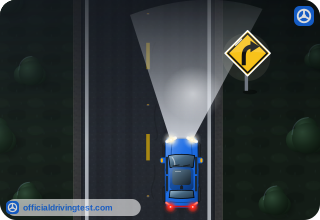
- About 50%; night vision stays the same with age
- About 25%; night vision improves with age
- About 75%; night vision is unrelated to age
- About 90%; night vision decreases with age
Show answer
Correct answer: About 90%; night vision decreases with age
About 90% of your decisions are based on what you see. At night, you must use extra caution to make up for reduced visibility, and the ability to see well at night decreases with age.
Source: New York State Driver's Manual (Form MV-21), page 62 · Open this page in the manual (Manual page 62)
-
About how far ahead do your headlights let you see, and what does "driving within the range" of your headlights mean?
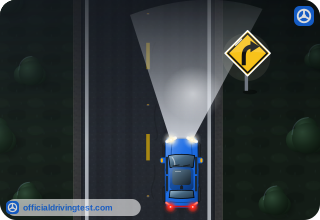
- About 100 feet; driving fast enough to reach your destination quickly
- About 1,000 feet; driving with your high beams on at all times
- About 350 feet; driving at a speed that lets you stop safely within that distance
- About 50 feet; driving with your eyes fixed on the road edge
Show answer
Correct answer: About 350 feet; driving at a speed that lets you stop safely within that distance
Your headlights cover about 350 feet ahead. It is important that you drive at a speed that allows you to stop safely within that distance. This is called "driving within the range" of your headlights.
Source: New York State Driver's Manual (Form MV-21), page 62 · Open this page in the manual (Manual page 62)
-
New York law requires you to use your headlights during which of these conditions?
- When visibility is less than 1,000 feet
- Only between midnight and 4 a.m.
- Only on expressways
- Only when another driver requests it
Show answer
Correct answer: When visibility is less than 1,000 feet
The law requires you to use your headlights from one-half hour after the sun sets to one-half hour before the sun rises, when visibility is less than 1,000 feet (300 m), and when you use your windshield wipers to clear rain, snow, or sleet.
Source: New York State Driver's Manual (Form MV-21), page 63 · Open this page in the manual (Manual page 63)
-
Within what distances must you switch your headlights to low beam?
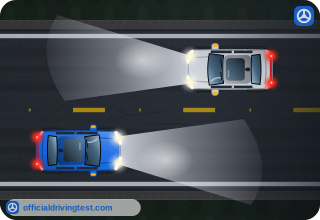
- 500 feet of an oncoming vehicle or 200 feet of one ahead
- 1,000 feet of any vehicle in any direction
- 50 feet of an oncoming vehicle only
- There is no set distance; it is left to driver judgment
Show answer
Correct answer: 500 feet of an oncoming vehicle or 200 feet of one ahead
Your headlights must be on low beam when you are within 500 feet (150 m) of an oncoming vehicle or within 200 feet (60 m) of a vehicle ahead of you, even if the vehicle ahead is in a different lane.
Source: New York State Driver's Manual (Form MV-21), page 63 · Open this page in the manual (Manual page 63)
-
Can you use parking lights or daytime running lights as a replacement for headlights in low-light conditions?
- Yes, they work exactly the same as headlights
- Yes, but only during fog
- Yes, but only in the city
- No, headlights do a better job
Show answer
Correct answer: No, headlights do a better job
Even when headlights do not help you see in low-light periods, they make it easier for other drivers and pedestrians to see your vehicle. Do not use parking lights or daytime running lights as a replacement; headlights do a better job.
Source: New York State Driver's Manual (Form MV-21), page 63 · Open this page in the manual (Manual page 63)
-
If an oncoming driver flashes their headlights at you during a period of low visibility, what does this usually mean?
- They are greeting you
- They want you to speed up
- There is a police checkpoint ahead
- You should turn on your headlights
Show answer
Correct answer: You should turn on your headlights
If an oncoming driver flashes headlights at you during a period of low visibility, it means your vehicle was difficult to see and you should turn on your headlights.
Source: New York State Driver's Manual (Form MV-21), page 63 · Open this page in the manual (Manual page 63)
-
If an approaching driver does not dim their high beams, what should you do?
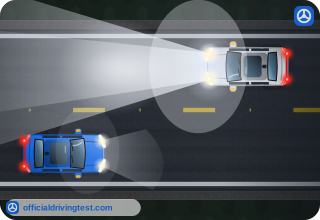
- Flash high beams for a second, then dim
- Stare directly at their headlights
- Turn off all your lights
- Speed up to pass them quickly
Show answer
Correct answer: Flash high beams for a second, then dim
If an approaching driver does not dim the headlights, flash your headlights to high beam for a second, then return to low beam. To help avoid the glare of approaching high beams, move your eyes to the right and use the road edge as a guide until the approaching vehicle passes by.
Source: New York State Driver's Manual (Form MV-21), page 63 · Open this page in the manual (Manual page 63)
-
How can you reduce glare from the headlights of vehicles following you at night?
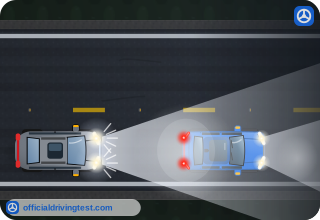
- Switch your rear view mirror to "night"
- Remove your rear view mirror completely
- Turn on your hazard lights
- Speed up to get away from them
Show answer
Correct answer: Switch your rear view mirror to "night"
To reduce glare from the lights of following vehicles, switch your inside rear view mirror to the "night" position.
Source: New York State Driver's Manual (Form MV-21), page 63 · Open this page in the manual (Manual page 63)
-
What is "hydroplaning"?
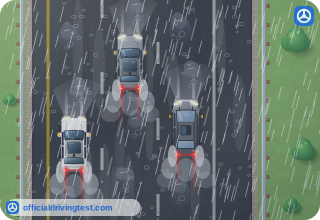
- When your engine overheats in the rain
- When your windshield wipers stop working
- When your headlights flicker in fog
- When your tires ride on water and lose traction
Show answer
Correct answer: When your tires ride on water and lose traction
In heavy rain, your tires can begin to ride on the water on top of the road pavement. This is called "hydroplaning" and can cause complete loss of traction and control of steering. It normally occurs at higher speeds, but can also occur if tires are tread worn or not inflated properly.
Source: New York State Driver's Manual (Form MV-21), page 63 · Open this page in the manual (Manual page 63)
-
New York law requires you to turn on your headlights whenever weather conditions require the use of windshield wipers. Do "daytime running lights" satisfy this requirement?
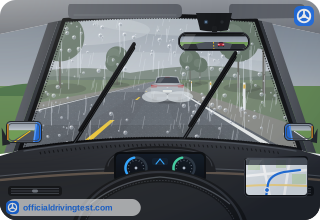
- Yes, daytime running lights always qualify as headlights
- Only in fog, not in rain or snow
- Only on expressways
- No, "daytime running lights" do not qualify as headlights
Show answer
Correct answer: No, "daytime running lights" do not qualify as headlights
New York State law requires you to turn on your headlights when weather conditions require the use of windshield wipers to clear rain, snow, sleet or fog. "Daytime running lights" do not qualify as headlights.
Source: New York State Driver's Manual (Form MV-21), page 63 · Open this page in the manual (Manual page 63)
-
Should you use high beams or low beams when driving in rain, fog, or snow?
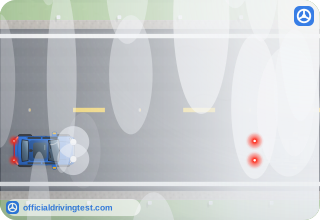
- High beams, because they light up more of the road
- It does not matter which you use
- Low beams, as high beams reflect off rain, fog, and snow
- Neither; turn off your headlights entirely
Show answer
Correct answer: Low beams, as high beams reflect off rain, fog, and snow
Headlights on high beams reflect rain, fog, and snow as it falls, making it even harder for you to see. For better visibility during these weather conditions, keep your headlights on low beam.
Source: New York State Driver's Manual (Form MV-21), page 63 · Open this page in the manual (Manual page 63)
-
In New York State, what colors are required for front and back fog lights?
- Front lights must be blue; back lights must be green
- Both front and back lights must be purple
- Front and back lights can be any color the owner chooses
- Front lights can be amber or white; back lights must be red
Show answer
Correct answer: Front lights can be amber or white; back lights must be red
In New York State, all fog lights must be correctly installed and of a type approved by the Commissioner of DMV. Front fog lights can be amber or white in color. Back fog lights must be red and can be larger than the normal back lights.
Source: New York State Driver's Manual (Form MV-21), page 63 · Open this page in the manual (Manual page 63)
-
During which dates can tires with metal studs be used in New York State?
- January 1 through March 31
- Year-round, with no restriction
- November 1 through February 28
- October 16 through April 30
Show answer
Correct answer: October 16 through April 30
Tires with metal studs can be used in New York State only from October 16 through April 30.
Source: New York State Driver's Manual (Form MV-21), page 64 · Open this page in the manual (Manual page 64)
-
Should you ever combine radial and non-radial tires on the same vehicle?
- Yes, it is recommended in winter
- Only on the rear axle
- Only if the tires are the same brand
- No, never combine them on one vehicle
Show answer
Correct answer: No, never combine them on one vehicle
Make sure your vehicle has good snow tires and put them on before the first storm. Never combine radial and non-radial tires on the same vehicle.
Source: New York State Driver's Manual (Form MV-21), page 64 · Open this page in the manual (Manual page 64)
-
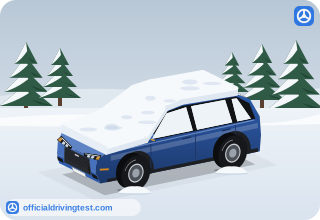
Before driving in an ice or snow storm, what must you clear from your vehicle?
- Only the front windshield and the driver's side window
- Only the license plate and the side mirrors
- Only the side mirrors and the front headlights
- Headlights, back lights, wipers, hood, roof and all windows
Show answer
Correct answer: Headlights, back lights, wipers, hood, roof and all windows
If you must drive during an ice or snow storm, first clear the ice and snow from your vehicle. This includes the headlights and back lights, the windshield wipers, the hood and roof of your vehicle, and all of the windows.
Source: New York State Driver's Manual (Form MV-21), page 64 · Open this page in the manual (Manual page 64)