New York: Emergency vehicles & work zones Practice Test
Yielding to emergency vehicles and slowing down in work zones.
Independent educational site · not affiliated with any government agency or DMV
Ready? Test yourself
Answer to start, or tap Start below:
According to the manual, you must yield the right-of-way to which of the following when they respond to emergencies?
- Instant feedback with an explanation
- Every answer cites its source in the manual
- Your best score is saved on this device
- Keyboard: press 1 to 4 to answer and Enter for the next question
Questions are original and based on the official manual "New York State Driver's Manual" (Form MV-21), New York State Department of Motor Vehicles (DMV).
All 25 questions in this practice test
Take the test above first, then use this list to study. Tap “Show answer” to see the correct answer and explanation.
Show the questions and answersHide the questions
-
According to the manual, you must yield the right-of-way to which of the following when they respond to emergencies?
- Tow trucks and snow plows showing amber lights
- School buses only
- Fire, ambulance, police and other emergency vehicles
- Rural mail delivery vehicles with amber lights
Show answer
Correct answer: Fire, ambulance, police and other emergency vehicles
The manual states you must yield the right-of-way to fire, ambulance, police and other authorized emergency vehicles when they respond to emergencies.
Source: New York State Driver's Manual (Form MV-21), page 35 · Open this page in the manual (Manual page 35)
-
What light combinations does the manual say emergency vehicles display?
- Flashing red, red and blue, or red and white
- Only flashing amber, or amber and white
- Only steady white headlights, not flashing
- Only flashing green, or green and yellow
Show answer
Correct answer: Flashing red, red and blue, or red and white
The manual states emergency vehicles display lights that are flashing red, red and blue, or red and white, and may sound a siren or air-horn.
Source: New York State Driver's Manual (Form MV-21), page 35 · Open this page in the manual (Manual page 35)
-
Vehicles responding to emergencies for a Police Department, Sheriff Department, or the New York State Troopers:
- Must always flash their headlights instead of using a siren
- Are not always required to use an audible siren or horn
- Must always use a siren when responding
- Are prohibited from using sirens in cities
Show answer
Correct answer: Are not always required to use an audible siren or horn
The manual notes that vehicles responding to emergencies for a Police Department, Sheriff Department, or the New York State Troopers are not always required to use an audible siren or horn.
Source: New York State Driver's Manual (Form MV-21), page 35 · Open this page in the manual (Manual page 35)
-
When you hear or see an emergency vehicle heading toward your vehicle from any direction, you must:
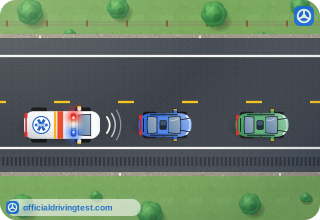
- Speed up to clear the intersection first
- Safely pull over to the right edge and stop, leaving any intersection first
- Stop immediately wherever you are, even in the middle of an intersection
- Pull to the left edge of the road and stop
Show answer
Correct answer: Safely pull over to the right edge and stop, leaving any intersection first
The manual instructs you to safely pull over immediately to the right edge of the road and stop, and if you are in an intersection, to drive out of it before you pull over.
Source: New York State Driver's Manual (Form MV-21), page 35 · Open this page in the manual (Manual page 35)
-
You must pull over and stop for an emergency vehicle:
- Only if it is in your own lane
- Only during daytime hours
- Even if it is headed toward you in the opposite lane
- Only if it is using its siren, not just its lights
Show answer
Correct answer: Even if it is headed toward you in the opposite lane
The manual states you must pull over and stop for an emergency vehicle even if it is headed toward you in the opposite lane of a two-way roadway.
Source: New York State Driver's Manual (Form MV-21), page 35 · Open this page in the manual (Manual page 35)
-
If you hear a siren or air-horn close by but do not know exactly where the emergency vehicle is, you must:
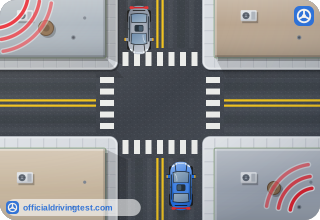
- Continue driving normally until you can see exactly where it is
- Pull over to the left shoulder and wait for it to pass
- Increase your speed to get away from the area quickly
- Pull over to the right and stop until sure it is not headed your way
Show answer
Correct answer: Pull over to the right and stop until sure it is not headed your way
The manual states that if you hear a siren or air-horn close by but do not know where the emergency vehicle is, you must safely pull over to the right-side edge of the road and stop until you are sure it is not headed toward you.
Source: New York State Driver's Manual (Form MV-21), page 35 · Open this page in the manual (Manual page 35)
-
According to the manual, an emergency vehicle using lights and a siren or air-horn can legally:
- Only exceed the speed limit, nothing else
- Exceed the speed limit and pass red lights and STOP signs
- Ignore pedestrians in crosswalks without any caution
- Never exceed the speed limit under any circumstance
Show answer
Correct answer: Exceed the speed limit and pass red lights and STOP signs
The manual states an emergency vehicle using lights and a siren or air-horn can legally exceed the speed limit, pass red lights and STOP or YIELD signs, go the wrong way on one-way streets, and turn in directions not normally allowed, though drivers must still be cautious.
Source: New York State Driver's Manual (Form MV-21), page 35 · Open this page in the manual (Manual page 35)
-
The Move Over Law applies to an authorized emergency or hazard vehicle parked, stopped, or standing on the shoulder or highway with which lights activated?
- Only red lights, not amber or blue lights
- Only headlights, with no flashing lights
- Emergency lights, amber hazard lights, or amber and blue lights
- Hazard lights are never relevant to the Move Over Law
Show answer
Correct answer: Emergency lights, amber hazard lights, or amber and blue lights
The manual states the Move Over Law requires drivers to avoid colliding with an authorized emergency or hazard vehicle on the shoulder or highway with its emergency lights, one or more amber hazard lights, or a combination of amber and blue lights activated.
Source: New York State Driver's Manual (Form MV-21), page 35 · Open this page in the manual (Manual page 35)
-
Under the Move Over Law, drivers must reduce speed when encountering a parked emergency or hazard vehicle:
- Only if the vehicle is in your lane
- Only on highways with speed limits over 55 mph
- Only at night
- On all roads
Show answer
Correct answer: On all roads
The manual states drivers must reduce speed on all roads when encountering such vehicles.
Source: New York State Driver's Manual (Form MV-21), page 35 · Open this page in the manual (Manual page 35)
-
On parkways, interstates, and other controlled access roads with multiple lanes, the Move Over Law further requires drivers to:
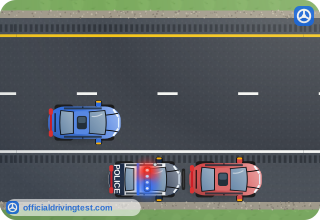
- Move out of the lane next to the vehicle unless unsafe to do so
- Stop completely on the shoulder behind the vehicle
- Honk the horn continuously as they pass the vehicle
- Increase speed to pass the vehicle as quickly as possible
Show answer
Correct answer: Move out of the lane next to the vehicle unless unsafe to do so
The manual states that on parkways, interstates, and other controlled access roads with multiple lanes, drivers are further required to move from the lane adjacent to the emergency or hazard vehicle unless traffic or other hazards prevent doing so safely.
Source: New York State Driver's Manual (Form MV-21), page 35 · Open this page in the manual (Manual page 35)
-
The Move Over Law also requires drivers to move over for vehicles displaying which lights, and violations of the law are punishable as:
- Red and white lights; a parking ticket
- Blue and green lights; a moving violation
- Yellow lights only; a verbal warning
- No lights matter; a felony charge
Show answer
Correct answer: Blue and green lights; a moving violation
The manual states drivers are also required to move over for vehicles with blue and green lights, and violations of this law are punishable as a moving violation.
Source: New York State Driver's Manual (Form MV-21), page 35 · Open this page in the manual (Manual page 35)
-
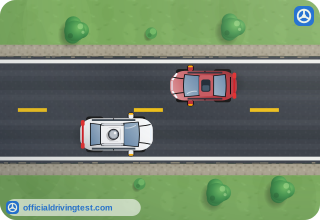
Personal vehicles driven by volunteer firefighters responding to alarms are allowed to display:
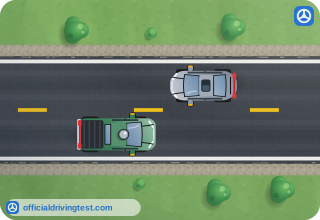
- Green lights
- Red lights
- Blue lights
- White strobe lights
Show answer
Correct answer: Blue lights
The manual states personal vehicles driven by volunteer firefighters responding to alarms are allowed to display blue lights.
Source: New York State Driver's Manual (Form MV-21), page 35 · Open this page in the manual (Manual page 35)
-
Personal vehicles driven by volunteer ambulance or rescue squad members can display:
- Blue lights
- Green lights
- Red lights
- Amber lights
Show answer
Correct answer: Green lights
The manual states personal vehicles driven by volunteer ambulance or rescue squad members can display green lights.
Source: New York State Driver's Manual (Form MV-21), page 35 · Open this page in the manual (Manual page 35)
-
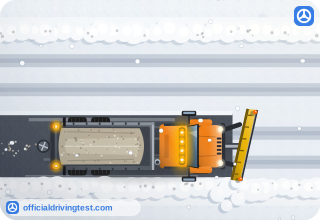
Amber lights on hazard vehicles such as snow plows and tow trucks are used to:
- Signal that the vehicle is an emergency vehicle with full right-of-way
- Warn other drivers of possible dangers
- Indicate the vehicle is stopped for a meal break
- Replace the need for turn signals
Show answer
Correct answer: Warn other drivers of possible dangers
The manual states amber lights on hazard vehicles such as snow plows and tow trucks warn other drivers of possible dangers.
Source: New York State Driver's Manual (Form MV-21), page 35 · Open this page in the manual (Manual page 35)
-
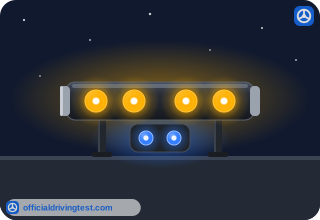
A combination of amber lights and rear-projected blue lights is used on:
- Hazard vehicles that tow or push disabled vehicles
- Unmarked police cars answering emergency calls
- Personal cars of volunteer firefighters only
- School buses only
Show answer
Correct answer: Hazard vehicles that tow or push disabled vehicles
The manual states the combination of amber lights and rear-projected blue lights is used on hazard vehicles designed for towing or pushing disabled vehicles.
Source: New York State Driver's Manual (Form MV-21), page 35 · Open this page in the manual (Manual page 35)
-
Flashing amber lights are also used on which vehicles to warn traffic of their presence?
- Taxis and limousines
- Rural mail delivery vehicles and school buses
- Personal cars of off-duty police officers
- City delivery vans only
Show answer
Correct answer: Rural mail delivery vehicles and school buses
The manual states flashing amber lights are also used on rural mail delivery vehicles and school buses to warn traffic of their presence.
Source: New York State Driver's Manual (Form MV-21), page 35 · Open this page in the manual (Manual page 35)
-
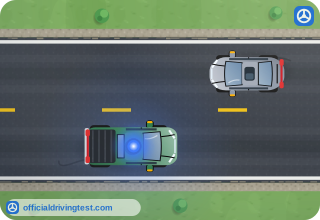
Vehicles that display blue, green, or amber lights are:
- Authorized emergency vehicles with full emergency privileges
- Exempt from all traffic laws
- Not authorized emergency vehicles; drivers must obey all traffic laws
- Required to always have a police escort
Show answer
Correct answer: Not authorized emergency vehicles; drivers must obey all traffic laws
The manual states the vehicles that display blue, green, or amber lights are not authorized emergency vehicles; their drivers must obey all traffic laws.
Source: New York State Driver's Manual (Form MV-21), page 35 · Open this page in the manual (Manual page 35)
-
Regarding vehicles that display blue, green, or amber lights, other drivers:
- Are required by law to yield the right-of-way to them
- Are not required to yield, but should as a courtesy if safe
- Must always come to a complete stop
- Should ignore them completely
Show answer
Correct answer: Are not required to yield, but should as a courtesy if safe
The manual states that while drivers are not required to yield the right-of-way to vehicles displaying blue, green, or amber lights, they should yield as a courtesy if they can safely do so.
Source: New York State Driver's Manual (Form MV-21), page 35 · Open this page in the manual (Manual page 35)
-
What shape and color are 'work zone' warning signs typically, according to the manual?
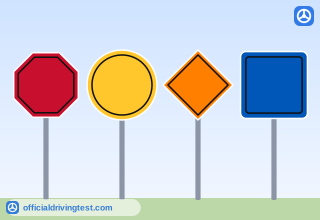
- Yellow circles
- Red octagons
- Blue squares
- Orange diamonds
Show answer
Correct answer: Orange diamonds
The manual states that orange signs in the shape of diamonds are work zone warning signs often placed before road construction projects.
Source: New York State Driver's Manual (Form MV-21), page 49 · Open this page in the manual (Manual page 49)
-
According to the manual, what authority does a flagger have in a work zone?
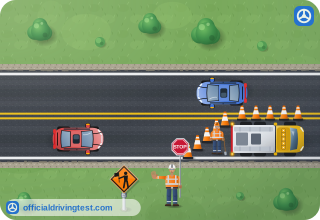
- No authority; drivers may ignore a flagger
- The same authority as a sign; you can be ticketed
- Only advisory authority, never enforceable
- Authority only over commercial trucks
Show answer
Correct answer: The same authority as a sign; you can be ticketed
The manual states a flagger has the same authority as a sign, and disobeying their directions can result in a ticket.
Source: New York State Driver's Manual (Form MV-21), page 49 · Open this page in the manual (Manual page 49)
-
According to the manual, what happens to speeding ticket fines in a work zone?
- They are reduced by half when no workers are there
- They double, but only while workers are present
- They double, even when workers are not present
- They are waived if no workers are present
Show answer
Correct answer: They double, even when workers are not present
The manual states that when you speed in work zones, ticket fines double, even when the workers or work vehicles are not there.
Source: New York State Driver's Manual (Form MV-21), page 49 · Open this page in the manual (Manual page 49)
-
If a work zone sign reads 'Road Work 1,500 feet,' how long will it take a car traveling 60 mph to reach that point, according to the manual's example?
- 17 seconds
- 7 seconds
- 27 seconds
- 47 seconds
Show answer
Correct answer: 17 seconds
The manual's example states that at 60 mph, a car will reach a point 1,500 feet ahead in about 17 seconds.
Source: New York State Driver's Manual (Form MV-21), page 49 · Open this page in the manual (Manual page 49)
-
According to the manual, what is the most common type of crash in a work zone?
- Head-on collision
- Rollover crash
- Side-swipe crash
- Rear-end collision
Show answer
Correct answer: Rear-end collision
The manual states that the rear-end collision is the most common crash in a work zone.
Source: New York State Driver's Manual (Form MV-21), page 49 · Open this page in the manual (Manual page 49)
-
To help avoid a rear-end collision in a work zone, the manual recommends keeping a braking distance of at least:
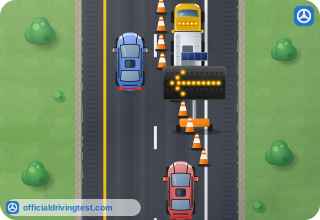
- Half a second
- Two seconds
- Ten seconds
- Thirty seconds
Show answer
Correct answer: Two seconds
The manual recommends keeping a braking distance of two seconds or more between you and the vehicle in front of you in a work zone.
Source: New York State Driver's Manual (Form MV-21), page 49 · Open this page in the manual (Manual page 49)
-
When a work zone sign warns 'lane closed ahead,' what does the manual advise?
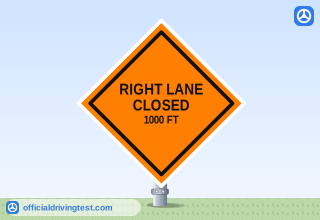
- Merge into the correct lane when it is safe, as soon as you notice the sign
- Speed up to reach the open lane before it closes
- Stop immediately in the closing lane
- Drive on the shoulder to bypass traffic
Show answer
Correct answer: Merge into the correct lane when it is safe, as soon as you notice the sign
The manual advises merging into the correct lane when it is safe as soon as you notice the warning sign, rather than speeding to the end of the closed lane.
Source: New York State Driver's Manual (Form MV-21), page 49 · Open this page in the manual (Manual page 49)