New York: Emergencies and special situations — Part 4 Practice Test
Questions in this part include: “About how many traffic crashes occur in New York State each year, according to the manual?” · “What must you show at the scene of a crash if a police officer or other driver requests it?”
Independent educational site · not affiliated with any government agency or DMV
Ready? Test yourself
- Instant feedback with an explanation
- Every answer cites its source in the manual
- Your best score is saved on this device
Questions are original and based on the official manual "New York State Driver's Manual" (Form MV-21), New York State Department of Motor Vehicles (DMV).
All 18 questions in this practice test
Take the test above first, then use this list to study. Tap “Show answer” to see the correct answer and explanation.
Show the questions and answersHide the questions
-
About how many traffic crashes occur in New York State each year, according to the manual?
- About 30,000
- Fewer than 10,000
- More than 300,000
- About 1 million
Show answer
Correct answer: More than 300,000
The manual states there are more than 300,000 traffic crashes in New York State each year.
Source: New York State Driver's Manual (Form MV-21), page 77 · Open this page in the manual (Manual page 77)
-
What can you carry in your vehicle to help in an emergency, according to the manual?
- Flares and first aid supplies
- A spare tire and jack only
- Extra fuel
- A tow rope
Show answer
Correct answer: Flares and first aid supplies
The manual recommends carrying an emergency kit with flares and first aid supplies.
Source: New York State Driver's Manual (Form MV-21), page 77 · Open this page in the manual (Manual page 77)
-
If you are in a traffic crash, when must you stop?
- Only if someone is injured
- Regardless of the level of damage
- Only if the damage is severe
- Only if requested by another driver
Show answer
Correct answer: Regardless of the level of damage
The manual states that if you are in a crash you must stop, and the level of damage does not matter.
Source: New York State Driver's Manual (Form MV-21), page 77 · Open this page in the manual (Manual page 77)
-
Leaving the scene of a crash that involves only property damage is what kind of violation?
- No violation if damage is minor
- A civil lawsuit only
- A parking violation
- A traffic violation
Show answer
Correct answer: A traffic violation
The manual states it is a traffic violation to leave the scene of an incident involving property damage.
Source: New York State Driver's Manual (Form MV-21), page 77 · Open this page in the manual (Manual page 77)
-
Leaving the scene of a crash that involves a fatality or personal injury is what kind of violation?
- A criminal violation
- A traffic violation only
- A minor infraction
- Not a violation if you call police later
Show answer
Correct answer: A criminal violation
The manual states it is a criminal violation to leave the scene of an incident involving a fatality or personal injury.
Source: New York State Driver's Manual (Form MV-21), page 77 · Open this page in the manual (Manual page 77)
-
Even if a crash involves only property damage, what must you do?
- Wait for police only if damage exceeds $5,000
- Nothing, as long as no one is hurt and the cars can still be driven
- Exchange name, address, license number, registration and insurance information
- Only exchange phone numbers
Show answer
Correct answer: Exchange name, address, license number, registration and insurance information
The manual requires drivers to exchange name, address, driver license number, and vehicle registration and insurance information (including policy number and effective date), even for property-damage-only crashes.
Source: New York State Driver's Manual (Form MV-21), page 77 · Open this page in the manual (Manual page 77)
-
What must you show at the scene of a crash if a police officer or other driver requests it?
- Your vehicle title
- Your insurance ID card
- Your birth certificate
- Your Social Security card
Show answer
Correct answer: Your insurance ID card
The manual states you must show your insurance identification card if requested.
Source: New York State Driver's Manual (Form MV-21), page 77 · Open this page in the manual (Manual page 77)
-
If your crash damages a parked vehicle, other property, or injures a domestic animal, and the owner is not present, what must you do?
- Leave a note only if it is convenient
- Nothing is required
- Wait at the scene for 24 hours
- Try to find the owner or notify the police
Show answer
Correct answer: Try to find the owner or notify the police
The manual states you must try to find the owner or notify the police in these situations.
Source: New York State Driver's Manual (Form MV-21), page 77 · Open this page in the manual (Manual page 77)
-
If any person is injured or killed in a crash, what must you do?
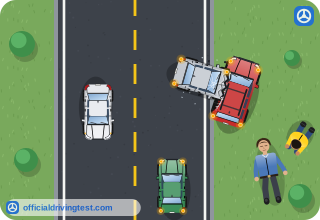
- Make sure the police are notified at once and an ambulance is called
- Move the vehicles first, then decide whether to call for help
- Wait for a passerby to call for help
- Only notify your insurance company
Show answer
Correct answer: Make sure the police are notified at once and an ambulance is called
The manual states police must be notified immediately and you should make sure ambulance or rescue personnel have been called.
Source: New York State Driver's Manual (Form MV-21), page 77 · Open this page in the manual (Manual page 77)
-
After a crash, if possible, what should you do with your vehicle and the scene?
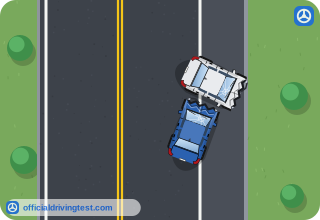
- Leave everything exactly in place and walk away from the scene
- Push other vehicles out of the way
- Move it off the road and protect the scene with reflectors or flares
- Turn off all vehicle lights immediately
Show answer
Correct answer: Move it off the road and protect the scene with reflectors or flares
The manual advises moving your vehicle off the road if possible and protecting the scene with reflectors or flares while watching for leaking fuel.
Source: New York State Driver's Manual (Form MV-21), page 77 · Open this page in the manual (Manual page 77)
-
According to the manual, what should you do if you come across a crash scene that you were not involved in?
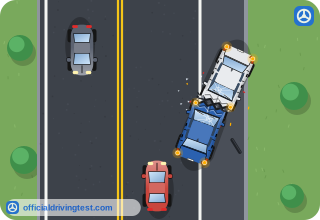
- Always stop, so you can help direct traffic
- Stop only if emergency help has not arrived
- Stop only to take photos
- Stop only during daylight hours
Show answer
Correct answer: Stop only if emergency help has not arrived
The manual says not to stop at a crash scene unless you are involved or emergency help has not arrived, and to focus on driving and follow directions from traffic officers.
Source: New York State Driver's Manual (Form MV-21), page 77 · Open this page in the manual (Manual page 77)
-
According to the manual's first-aid tips, when should you move an injured person at a crash scene?
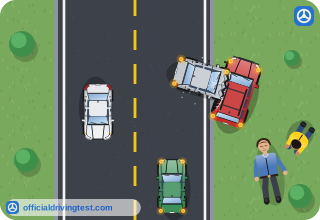
- Immediately, to make them more comfortable while waiting for help
- Only if you are a trained paramedic
- Never, under any circumstances
- Only if fire or another life-threatening danger makes it necessary
Show answer
Correct answer: Only if fire or another life-threatening danger makes it necessary
The manual advises not moving an injured person unless necessary due to fire or another life-threatening danger, and to keep the back and neck as straight as possible if you must move them.
Source: New York State Driver's Manual (Form MV-21), page 77 · Open this page in the manual (Manual page 77)
-
What should you do if you see downed wires at a crash scene?
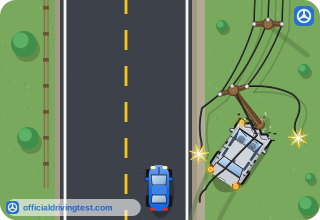
- Do not go near them; if they touch the vehicle, warn occupants to stay inside
- Move them off the road with a stick, then help the occupants get out
- Cut them with insulated tools
- Drive over them quickly
Show answer
Correct answer: Do not go near them; if they touch the vehicle, warn occupants to stay inside
The manual instructs not to go near downed wires and to warn vehicle occupants to remain inside until help arrives if wires touch or lie near the vehicle.
Source: New York State Driver's Manual (Form MV-21), page 77 · Open this page in the manual (Manual page 77)
-
You must report a crash to the DMV if it involves which of the following?
- Only crashes on highways
- Any crash, no matter how minor
- A fatality or personal injury
- Only crashes involving out-of-state drivers
Show answer
Correct answer: A fatality or personal injury
The manual requires reporting to DMV any traffic crash that involves a fatality or personal injury.
Source: New York State Driver's Manual (Form MV-21), page 77 · Open this page in the manual (Manual page 77)
-
Besides crashes involving injury or death, what other type of crash must be reported to the DMV?
- Any crash involving a rental car
- One involving $1,000 or more in damage to one person's property
- Any crash occurring at night
- One involving a government vehicle, whatever the damage
Show answer
Correct answer: One involving $1,000 or more in damage to one person's property
The manual states you must report any traffic incident or crash involving $1,000 or more in damage to the property of any one person.
Source: New York State Driver's Manual (Form MV-21), page 77 · Open this page in the manual (Manual page 77)
-
What is the name of the form used to report a crash to the DMV, and where can it be found?
- Form DTF-17, available only by mail
- Form SR-22, available only from your insurance company after the crash is settled
- There is no official form; a phone call is sufficient
- Report of Motor Vehicle Crash (MV-104), at DMV offices, most insurance agents, or online
Show answer
Correct answer: Report of Motor Vehicle Crash (MV-104), at DMV offices, most insurance agents, or online
The manual names the Report of Motor Vehicle Crash (MV-104), available at any motor vehicle office, from most insurance agents, and from the DMV website.
Source: New York State Driver's Manual (Form MV-21), page 77 · Open this page in the manual (Manual page 77)
-
Within how many days of a reportable crash must you file a report with the DMV?
- 10 days
- 30 days
- 60 days
- 90 days
Show answer
Correct answer: 10 days
The manual states you must file a report with DMV within 10 days of the event.
Source: New York State Driver's Manual (Form MV-21), page 77 · Open this page in the manual (Manual page 77)
-
What can happen if you fail to report a required crash to the DMV?
- A small late fee only
- Nothing, if you already reported it to your insurance company
- It is a misdemeanor and can lead to license suspension or revocation
- Your insurance premium automatically increases
Show answer
Correct answer: It is a misdemeanor and can lead to license suspension or revocation
The manual states failure to report an accident is a criminal offense (misdemeanor) and can mean suspension or revocation of your driver license and/or registrations.
Source: New York State Driver's Manual (Form MV-21), page 77 · Open this page in the manual (Manual page 77)