New York: Emergencies and special situations — Part 1 Practice Test
Questions in this part include: “Which of the following behaviors does the manual associate with aggressive driving?” · “Which of the following behaviors does the manual list as an example of road rage?”
Independent educational site · not affiliated with any government agency or DMV
Ready? Test yourself
Answer to start, or tap Start below:
Which of the following behaviors does the manual associate with aggressive driving?
- Instant feedback with an explanation
- Every answer cites its source in the manual
- Your best score is saved on this device
- Keyboard: press 1 to 4 to answer and Enter for the next question
Questions are original and based on the official manual "New York State Driver's Manual" (Form MV-21), New York State Department of Motor Vehicles (DMV).
All 19 questions in this practice test
Take the test above first, then use this list to study. Tap “Show answer” to see the correct answer and explanation.
Show the questions and answersHide the questions
-
According to the manual, if a driver on a side road approaches a STOP or YIELD sign, what should you assume for safety?
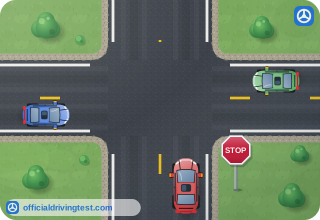
- That the driver may not actually stop or yield
- That the driver will definitely stop
- That the driver has the right-of-way over you
- That you do not need to watch that vehicle
Show answer
Correct answer: That the driver may not actually stop or yield
The manual advises: do not assume a driver approaching a STOP or YIELD sign will actually stop or yield; it is better to assume they will not.
Source: New York State Driver's Manual (Form MV-21), page 45 · Open this page in the manual (Manual page 45)
-
Which of the following behaviors does the manual associate with aggressive driving?
- Signaling every lane change well in advance
- Driving below the posted speed limit
- Yielding the right-of-way frequently
- Following too closely and unsignaled lane changes
Show answer
Correct answer: Following too closely and unsignaled lane changes
The manual lists aggressive driving as including speeding, following too closely, and frequent or quick lane changes without a signal.
Source: New York State Driver's Manual (Form MV-21), page 45 · Open this page in the manual (Manual page 45)
-
According to the manual, aggressive driving becomes 'road rage' when:
- Aggressive drivers try to cause harm to another driver
- A driver merely exceeds the speed limit occasionally
- A driver signals a turn too late
- A driver operates an older vehicle
Show answer
Correct answer: Aggressive drivers try to cause harm to another driver
The manual explains that some aggressive drivers try to cause harm to another driver, and that is how aggressive driving becomes road rage.
Source: New York State Driver's Manual (Form MV-21), page 46 · Open this page in the manual (Manual page 46)
-
To help prevent road rage, the manual suggests that you should sometimes:
- Make strong, prolonged eye contact with the other driver
- Honk your horn repeatedly to warn them
- Avoid making eye contact with another driver
- Flash your high beams at them
Show answer
Correct answer: Avoid making eye contact with another driver
The manual says it is sometimes better not to make eye contact with another driver, since the other driver can take this as being challenged.
Source: New York State Driver's Manual (Form MV-21), page 46 · Open this page in the manual (Manual page 46)
-
If an aggressive driver confronts you, what does the manual recommend?
- Increase your speed to hold your position in the lane
- Remain calm and try to move away safely
- Return their gestures and shouts
- Stop your vehicle and get out to talk it over
Show answer
Correct answer: Remain calm and try to move away safely
The manual advises that when an aggressive driver confronts you, you should remain calm and relaxed and try to move away safely.
Source: New York State Driver's Manual (Form MV-21), page 46 · Open this page in the manual (Manual page 46)
-
If an aggressive driver is following you, what does the manual say you should do?
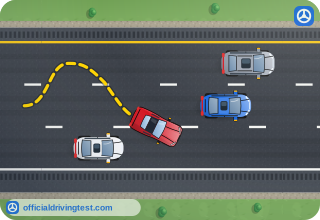
- Drive to the nearest police station
- Pull over and get out of your vehicle
- Stop immediately on the shoulder
- Speed up to try to lose them
Show answer
Correct answer: Drive to the nearest police station
The manual says if an aggressive driver is following you, do not stop or get out of your vehicle; drive to the nearest police station.
Source: New York State Driver's Manual (Form MV-21), page 46 · Open this page in the manual (Manual page 46)
-
If you report an aggressive driver to law enforcement, the manual says you should give:
- Only the approximate time of day it happened
- Your own insurance policy number
- Vehicle description, location, plate and direction
- Just the color of the vehicle
Show answer
Correct answer: Vehicle description, location, plate and direction
The manual says to report aggressive drivers to law enforcement and give a vehicle description, location, vehicle plate number and direction of travel.
Source: New York State Driver's Manual (Form MV-21), page 46 · Open this page in the manual (Manual page 46)
-
Which of these is listed as a way to avoid becoming an aggressive driver yourself?
- Allow enough travel time to arrive on schedule
- Schedule your trips during rush hour on purpose
- Drive without a seat belt to feel more alert
- Avoid listening to any music while driving
Show answer
Correct answer: Allow enough travel time to arrive on schedule
The manual lists allowing enough travel time to reach your destination on schedule as a way to avoid becoming an aggressive driver.
Source: New York State Driver's Manual (Form MV-21), page 46 · Open this page in the manual (Manual page 46)
-
According to the manual, if you have the right-of-way, you should:
- Be prepared to yield it to other highway users
- Treat it as an absolute right you never give up
- Force other drivers to wait no matter the risk
- Speed up to assert your right-of-way
Show answer
Correct answer: Be prepared to yield it to other highway users
The manual says not to think of the right-of-way as a complete right; be prepared to yield it to other highway users.
Source: New York State Driver's Manual (Form MV-21), page 46 · Open this page in the manual (Manual page 46)
-
How does the manual define 'road rage'?
- Any instance of exceeding the posted speed limit
- A minor paperwork violation
- An angry, hostile state that can lead to violent crime
- A required topic only in defensive driving courses
Show answer
Correct answer: An angry, hostile state that can lead to violent crime
The manual defines road rage as an angry, hostile state which can increase into violent criminal actions or attempts of violent action resulting from operating a motor vehicle.
Source: New York State Driver's Manual (Form MV-21), page 46 · Open this page in the manual (Manual page 46)
-
According to the manual, what is the key difference between aggressive driving and road rage?
- There is no real difference between the two
- Road rage is always legal while aggressive driving is not
- Aggressive driving only happens on highways, never on local streets
- Aggressive driving generally breaks a traffic law; road rage, a criminal law
Show answer
Correct answer: Aggressive driving generally breaks a traffic law; road rage, a criminal law
The manual explains that aggressive driving generally involves the violation of a traffic safety law, while road rage involves the breaking of a criminal law.
Source: New York State Driver's Manual (Form MV-21), page 46 · Open this page in the manual (Manual page 46)
-
Which of the following behaviors does the manual list as an example of road rage?
- Deliberately slamming into another vehicle
- Signaling early before making a turn
- Maintaining a two-second following distance
- Parking within a marked space
Show answer
Correct answer: Deliberately slamming into another vehicle
The manual lists deliberately slamming into a vehicle as an example of a road rage driving action.
Source: New York State Driver's Manual (Form MV-21), page 47 · Open this page in the manual (Manual page 47)
-
According to research cited in the manual, being in a state of rage can affect:
- Only your ability to see traffic signs
- Your blood pressure and ability to reason and decide
- Only your fuel efficiency
- Nothing related to your driving ability at all
Show answer
Correct answer: Your blood pressure and ability to reason and decide
The manual states that research indicates being in a state of rage can affect your blood pressure and your ability to reason and make decisions.
Source: New York State Driver's Manual (Form MV-21), page 47 · Open this page in the manual (Manual page 47)
-
According to the manual, aggressive driving and road rage can lead to:
- An improved driving record
- A revoked or suspended license
- Lower auto insurance premiums
- Automatic license renewal
Show answer
Correct answer: A revoked or suspended license
The manual states that aggressive driving and road rage can lead to revoked or suspended driver licenses, problems between family and friends, loss of employment, and legal problems.
Source: New York State Driver's Manual (Form MV-21), page 47 · Open this page in the manual (Manual page 47)
-
What does New York State law require of DMV-approved crash prevention courses?
- They must address the dangers of road rage
- They must ignore road rage entirely
- They must only cover parking regulations
- They must be limited to repeat offenders
Show answer
Correct answer: They must address the dangers of road rage
The manual states that state law requires every DMV-approved crash prevention course to address the hazards and dangers of road rage.
Source: New York State Driver's Manual (Form MV-21), page 47 · Open this page in the manual (Manual page 47)
-
Which of the following is listed in the manual as a symptom of drowsy driving?
- Improved reaction time
- Increased attentiveness to traffic signs
- Your eyes close or go out of focus by themselves
- Better memory of the last few miles driven
Show answer
Correct answer: Your eyes close or go out of focus by themselves
The manual lists 'your eyes close or go out of focus by themselves' as a symptom associated with drowsy driving.
Source: New York State Driver's Manual (Form MV-21), page 51 · Open this page in the manual (Manual page 51)
-
According to the manual, which of these driving behaviors is a listed symptom of fatigue?
- Drifting between lanes or missing traffic signs
- Staying perfectly centered in your lane
- Signaling every lane change well in advance
- Checking your mirrors every few seconds
Show answer
Correct answer: Drifting between lanes or missing traffic signs
The manual lists drifting between lanes, tailgating, or missing traffic signs as symptoms associated with drowsy driving.
Source: New York State Driver's Manual (Form MV-21), page 51 · Open this page in the manual (Manual page 51)
-
According to the manual, which group is identified as being at greater risk for drowsy driving crashes because they tend to stay up late and drive at night?
- Senior citizens
- Young people
- Only long-haul truck drivers
- Only new drivers
Show answer
Correct answer: Young people
The manual states drowsy driving crashes are most common for young people, who tend to stay up late, sleep too little, and drive at night.
Source: New York State Driver's Manual (Form MV-21), page 52 · Open this page in the manual (Manual page 52)
-
According to the manual, what type of work schedule increases the risk of a fatigue-related crash?
- Standard 9-to-5 schedules
- Part-time schedules
- Remote work schedules
- Shift work schedules
Show answer
Correct answer: Shift work schedules
The manual states drivers who have non-traditional work schedules (shift workers) have a greater risk of being involved in a fatigue-related traffic crash.
Source: New York State Driver's Manual (Form MV-21), page 52 · Open this page in the manual (Manual page 52)