New York: Emergencies and special situations — Part 3 Practice Test
Questions in this part include: “When sleet, freezing rain, or snow begins to fall, which road surfaces freeze first?” · “What is the most important rule in any driving emergency?”
Independent educational site · not affiliated with any government agency or DMV
Ready? Test yourself
- Instant feedback with an explanation
- Every answer cites its source in the manual
- Your best score is saved on this device
Questions are original and based on the official manual "New York State Driver's Manual" (Form MV-21), New York State Department of Motor Vehicles (DMV).
All 19 questions in this practice test
Take the test above first, then use this list to study. Tap “Show answer” to see the correct answer and explanation.
Show the questions and answersHide the questions
-
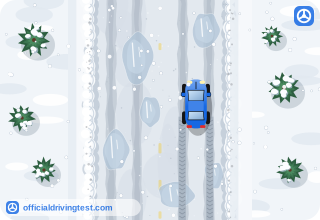
How should you brake if your vehicle has anti-lock brakes (ABS) versus if it does not?
- With ABS: brake as hard as possible; without ABS: never brake at all
- Brake technique makes no difference either way
- With ABS: pump the pedal rapidly; without ABS: apply even pressure
- With ABS: keep even pressure on the pedal; without ABS: pump the pedal carefully
Show answer
Correct answer: With ABS: keep even pressure on the pedal; without ABS: pump the pedal carefully
If your vehicle has anti-lock brakes (ABS), keep your foot with even pressure on the brake pedal. If your vehicle does not have ABS, pump the pedal carefully, more rapidly only as your car slows down. Braking hard with regular brakes will make the situation worse.
Source: New York State Driver's Manual (Form MV-21), page 64 · Open this page in the manual (Manual page 64)
-
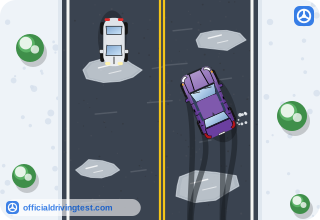
If your rear wheels start to skid, which way should you turn the steering wheel?
- Always turn it to the right, regardless of the skid direction
- Turn it in the direction the vehicle is trying to go
- Turn it opposite to the direction the rear is sliding
- Keep the steering wheel completely straight and do nothing
Show answer
Correct answer: Turn it in the direction the vehicle is trying to go
If your rear wheels start to skid, turn the steering wheel in the direction the vehicle is trying to go. If your rear wheels slide left, steer left; if they slide right, steer right.
Source: New York State Driver's Manual (Form MV-21), page 64 · Open this page in the manual (Manual page 64)
-
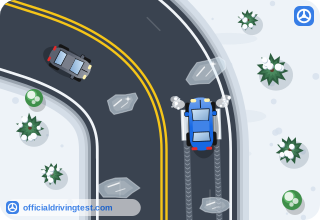
If your front wheels skid, what should you do first?
- Immediately steer hard in the opposite direction of the skid
- Take your foot off the gas, shift to neutral, and do not steer yet
- Brake as hard as you can and keep the wheels locked
- Accelerate firmly to regain traction and control
Show answer
Correct answer: Take your foot off the gas, shift to neutral, and do not steer yet
If your front wheels skid, take your foot off the gas and shift to neutral or push in the clutch, but do not try to immediately steer. As the wheels skid sideways, they will slow the vehicle and traction will return; then turn the wheel in the direction you want to go.
Source: New York State Driver's Manual (Form MV-21), page 64 · Open this page in the manual (Manual page 64)
-
What is the best way to prevent skids on snow and ice?
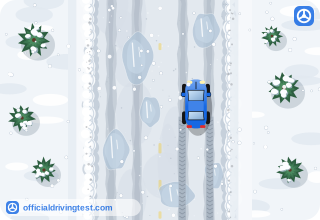
- Brake early, carefully and gently, in slow, steady strokes
- Brake as hard and as late as possible to lock the wheels
- Avoid braking entirely on snow and ice
- Speed up to get through slippery areas quickly
Show answer
Correct answer: Brake early, carefully and gently, in slow, steady strokes
To prevent skids on snow and ice, brake early, carefully, and gently. "Press" your brakes in slow, steady strokes, and allow the wheels to keep turning. If they begin to lock, decrease pressure on the brake pedal.
Source: New York State Driver's Manual (Form MV-21), page 64 · Open this page in the manual (Manual page 64)
-
When sleet, freezing rain, or snow begins to fall, which road surfaces freeze first?
- Bridges, ramps, and overpasses
- Only tunnels
- Only parking lots
- Only the center of wide roads
Show answer
Correct answer: Bridges, ramps, and overpasses
When sleet, freezing rain, or snow begin to fall, remember that bridges, ramps, and overpasses will freeze first. Also know that slippery spots may remain after road workers have removed the snow.
Source: New York State Driver's Manual (Form MV-21), page 64 · Open this page in the manual (Manual page 64)
-
During which months do two-thirds of all deer-vehicle collisions occur, and when is daily deer activity highest?
- June, July, and August; activity highest at midday
- October, November, and December; activity highest at dawn and dusk
- January, February, and March; activity highest at night
- April, May, and June; activity highest in early morning only
Show answer
Correct answer: October, November, and December; activity highest at dawn and dusk
Two-thirds of all deer-vehicle collisions occur during October, November, and December — this is also when deer breed and travel the most. Daily deer activity is highest at dawn and dusk, often the highest travel time for motor-vehicle commuters.
Source: New York State Driver's Manual (Form MV-21), page 64 · Open this page in the manual (Manual page 64)
-
According to the manual's deer-collision precautions, what should you do to warn other drivers when you see deer on or near the road?
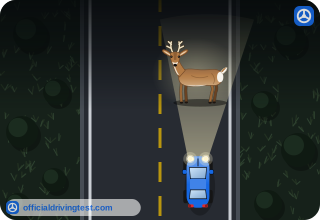
- Use your emergency lights or flash your headlights
- Sound your horn continuously
- Turn off your headlights so the deer are not startled
- Drive faster to pass the area quickly
Show answer
Correct answer: Use your emergency lights or flash your headlights
Use emergency lights or flash your headlights to warn other drivers when deer are seen on or near the road.
Source: New York State Driver's Manual (Form MV-21), page 65 · Open this page in the manual (Manual page 65)
-
What is the most important rule in any driving emergency?
- Call for help before doing anything else
- Do not panic
- Accelerate away from the situation
- Turn off the engine immediately in every case
Show answer
Correct answer: Do not panic
The most important rule in any emergency is do not panic. You have a better chance in an emergency if you do not let fear take over; in most emergencies, you will have a second or two to think before you act.
Source: New York State Driver's Manual (Form MV-21), page 65 · Open this page in the manual (Manual page 65)
-
If you experience a tire blowout, what should you do?
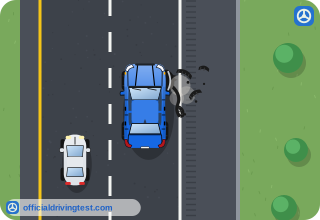
- Brake hard immediately to stop as fast as possible
- Hold the wheel tightly and slowly take your foot off the gas
- Turn off the engine while the vehicle is still moving
- Accelerate firmly to keep the vehicle stable
Show answer
Correct answer: Hold the wheel tightly and slowly take your foot off the gas
A thumping sound can warn that a blowout is about to occur. If a tire blows out, hold the steering wheel tightly and slowly take your foot off the gas pedal. If your vehicle skids, handle it as you would on ice or snow. Do not brake until your vehicle is controlled, and leave the road when it is safe to do so.
Source: New York State Driver's Manual (Form MV-21), page 65 · Open this page in the manual (Manual page 65)
-
If your brake pedal suddenly goes to the floor, what should you try first?
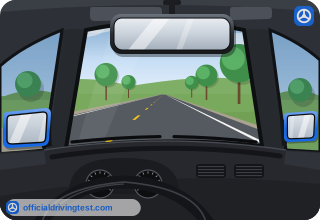
- Shift into a higher gear immediately
- Turn off the ignition right away
- Pump the brake pedal to increase pressure
- Open the door and jump out
Show answer
Correct answer: Pump the brake pedal to increase pressure
If your brake pedal suddenly goes to the floor, try pumping it to increase pressure. If that does not help, use your emergency brake if you can apply it gradually, but use it gently. Shifting to a lower gear will also help your vehicle decrease speed.
Source: New York State Driver's Manual (Form MV-21), page 65 · Open this page in the manual (Manual page 65)
-
If your steering suddenly fails and your vehicle will not respond when you steer, what should you do?
- Slam on the brakes immediately to stop the vehicle as fast as possible
- Slowly ease off the gas, turn on emergency lights, keep off the brake while safe
- Shift into reverse to slow the vehicle down quickly
- Turn off the engine and all the lights, then coast to a stop
Show answer
Correct answer: Slowly ease off the gas, turn on emergency lights, keep off the brake while safe
If your vehicle suddenly will not respond when you steer, slowly take your foot off the gas pedal, turn on your emergency lights, and keep your foot off the brake pedal while it is safe to do so. The vehicle's balance will let it continue going straight, but a sudden change in speed could send it out of control. As the vehicle decreases speed, you can brake very carefully to bring it to a stop.
Source: New York State Driver's Manual (Form MV-21), page 65 · Open this page in the manual (Manual page 65)
-
If your gas pedal becomes stuck, why should you NOT turn off the ignition?
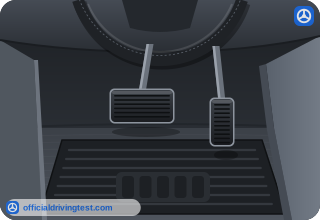
- It would damage the engine and drain the battery
- You could lose steering control or lock the steering wheel
- It would set off the airbags in front of you
- It would make the gas pedal stick down even further
Show answer
Correct answer: You could lose steering control or lock the steering wheel
If your gas pedal is stuck, hook your shoe under it and try to free it. If that fails, shift into neutral and use the brake to slow your vehicle and get off the road. Do not turn off the ignition, as you could lose your steering control or lock your steering wheel.
Source: New York State Driver's Manual (Form MV-21), page 65 · Open this page in the manual (Manual page 65)
-
If your wheels move off the pavement onto the shoulder, what should you do?
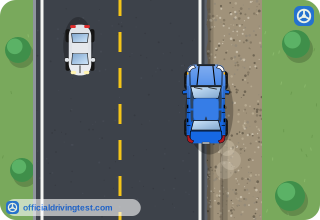
- Suddenly steer or swerve back onto the pavement without slowing
- Ease off the gas, brake gently, check traffic, then turn back carefully
- Accelerate, then steer sharply back onto the pavement
- Brake hard and stop the vehicle on the shoulder at once
Show answer
Correct answer: Ease off the gas, brake gently, check traffic, then turn back carefully
If your wheels move off the pavement, do not suddenly steer or swerve back onto the pavement. Ease your foot off the gas pedal and brake gently. When your vehicle has decreased speed, check for traffic behind you, then turn carefully back onto the pavement.
Source: New York State Driver's Manual (Form MV-21), page 65 · Open this page in the manual (Manual page 65)
-
If a vehicle is approaching head-on in your lane, what should you do?
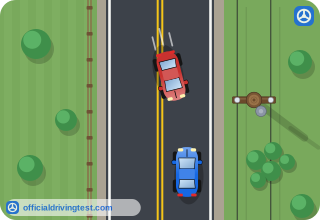
- Turn into the left lane to get out of its way
- Decrease speed, pull over to the right, and sound your horn
- Speed up and flash your headlights to warn the driver
- Stop immediately in your lane and wait for it to move
Show answer
Correct answer: Decrease speed, pull over to the right, and sound your horn
If a vehicle is approaching head-on in your lane, decrease speed, pull over to the right, and sound your horn to warn the other driver. Do not turn into the left lane — the other driver may suddenly recover and pull back into that lane, causing a head-on collision.
Source: New York State Driver's Manual (Form MV-21), page 65 · Open this page in the manual (Manual page 65)
-
If your vehicle stalls on railroad tracks and you are completely sure no trains are coming, what does the manual say to try?
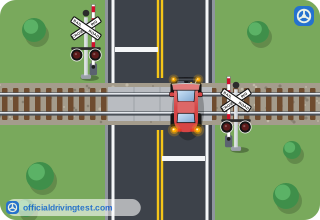
- Wait for a train to arrive before doing anything
- Try to restart the engine; if that fails, push it off in neutral
- Leave the vehicle where it is permanently and walk home
- Sit inside the vehicle with the doors locked
Show answer
Correct answer: Try to restart the engine; if that fails, push it off in neutral
When you are completely sure no trains are coming, open your window to listen for a train and try to start the engine. If that fails, shift your vehicle into neutral and push it from the tracks.
Source: New York State Driver's Manual (Form MV-21), page 66 · Open this page in the manual (Manual page 66)
-
If your vehicle goes into the water, how should you escape, and why should you avoid opening a door?
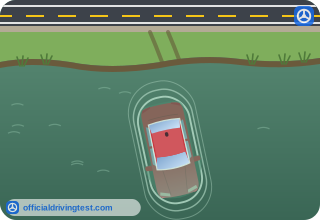
- Stay seated and wait for rescue; opening anything would be unsafe
- Escape through a window: an open door lets water rush in and the car could turn over
- Open the door immediately, since a door is the fastest and safest way out
- Honk the horn continuously until the car sinks
Show answer
Correct answer: Escape through a window: an open door lets water rush in and the car could turn over
A vehicle will normally float for a while, giving you time to escape before it sinks. Release your seat belt and escape through a window. An open door would cause water to rush in and the car could turn over on top of you.
Source: New York State Driver's Manual (Form MV-21), page 66 · Open this page in the manual (Manual page 66)
-
If your vehicle sinks before you can escape, where should you go, and how should you breathe as you surface?
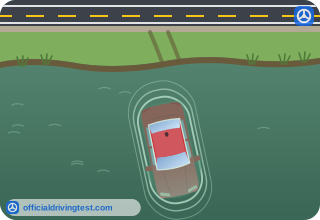
- Go to the trunk and hold your breath tightly the whole way up
- Go to the back seat; let air out in small breaths through your nose or lips as you rise
- Go to the front passenger seat and hold your breath until you reach the surface
- Stay in the driver's seat with your eyes closed
Show answer
Correct answer: Go to the back seat; let air out in small breaths through your nose or lips as you rise
If the vehicle sinks before you can escape, get into the back seat — an air pocket can form there as the weight of the engine pulls the vehicle down front first. When the vehicle settles, take a breath and escape through a window. As you rise, let air escape in small breaths through your nose or lips as you surface; do not hold your breath tight or try to blow air out.
Source: New York State Driver's Manual (Form MV-21), page 66 · Open this page in the manual (Manual page 66)
-
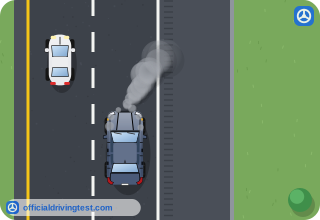
If you see smoke coming from under the hood of your vehicle, what should you do?
- Stop, open the hood right away and try to put out the fire yourself
- Park off the road, turn off the ignition, get away and call the fire department
- Keep driving until you reach a gas station or a repair shop
- Pour water from your water bottle onto the hood while driving
Show answer
Correct answer: Park off the road, turn off the ignition, get away and call the fire department
If you see smoke come from under the hood, pull off the road and park your vehicle. Turn off the ignition, get away from the car, and call the fire department. It is dangerous to try to fight the fire yourself.
Source: New York State Driver's Manual (Form MV-21), page 66 · Open this page in the manual (Manual page 66)
-
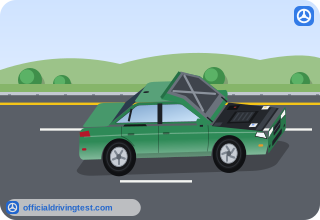
If your hood opens suddenly or your vision through the windshield becomes blocked, what should you do?
- Close your eyes and brake hard immediately
- Open the side window, turn on emergency lights, and carefully pull off the road
- Speed up so the wind blows the hood back down into place
- Steer into the oncoming lane, where your visibility might be better
Show answer
Correct answer: Open the side window, turn on emergency lights, and carefully pull off the road
If your hood opens suddenly or your vision through the windshield becomes blocked by some other object or wipers that have failed, you can open the side window so you can see. Turn on your emergency lights and carefully pull your vehicle off the road and park it.
Source: New York State Driver's Manual (Form MV-21), page 66 · Open this page in the manual (Manual page 66)