Nevada: Vehicle controls and equipment — Hitching a Fifth-Wheel, Inspection, Backing Practice Test
Questions in this part include: “What should you make sure of before backing your vehicle under a fifth-wheel trailer?” · “After the 50-mile check on an extended trip, when should you inspect the trailer again?”
Independent educational site · not affiliated with any government agency or DMV
Ready? Test yourself
- Instant feedback with an explanation
- Every answer cites its source in the manual
- Your best score is saved on this device
- Keyboard: press 1 to 4 to answer and Enter for the next question
Questions are original and based on the official manual "Nevada Driver's Handbook" (March 2024 (DMV 700)), Nevada Department of Motor Vehicles.
All 23 questions in this practice test
Take the test above first, then use this list to study. Tap “Show answer” to see the correct answer and explanation.
Show the questions and answersHide the questions
-
What should you make sure of before backing your vehicle under a fifth-wheel trailer?
- That the trailer brakes are released
- That the safety chains are crossed
- That the release arm is open
- That the trailer brakes are locked
Show answer
Correct answer: That the trailer brakes are locked
Before backing under the trailer, make sure the trailer brakes are locked.
Source: Nevada Driver's Handbook (March 2024 (DMV 700)), page 69 · Open this page in the manual (Manual page 69)
-
On a fifth-wheel hitch, what does it mean if the locking lever is not locked after the jaws close around the kingpin?
- The coupling is not seated properly and should be fixed before driving
- The coupling is seated correctly and the unit is ready to drive
- The trailer brakes are now locked, so the coupling is just fine
- The kingpin has been greased and the platform is not cracked
Show answer
Correct answer: The coupling is not seated properly and should be fixed before driving
If the locking lever is not locked, the coupling is not seated properly and should be fixed before driving the coupled unit.
Source: Nevada Driver's Handbook (March 2024 (DMV 700)), page 69 · Open this page in the manual (Manual page 69)
-
When hitching a fifth-wheel trailer, how much space should there be between the upper and lower fifth-wheel coupling?
- A gap of a few inches
- A thin layer of sand
- None
- A small amount of slack
Show answer
Correct answer: None
There should be no space between the upper and lower fifth-wheel coupling.
Source: Nevada Driver's Handbook (March 2024 (DMV 700)), page 70 · Open this page in the manual (Manual page 70)
-
When hitching a fifth-wheel trailer, how should the trailer sit on the fifth-wheel skid plate?
- Tilted toward the rear
- Lying flat
- Raised on one side
- Hanging from the kingpin
Show answer
Correct answer: Lying flat
The trailer should be lying flat on the fifth-wheel skid plate.
Source: Nevada Driver's Handbook (March 2024 (DMV 700)), page 70 · Open this page in the manual (Manual page 70)
-
Why should the fifth-wheel plate be greased as required?
- To keep the electric lines tight
- To lock the trailer brakes
- To raise the trailer height
- To prevent steering problems
Show answer
Correct answer: To prevent steering problems
The fifth-wheel plate is greased as required to prevent steering problems.
Source: Nevada Driver's Handbook (March 2024 (DMV 700)), page 70 · Open this page in the manual (Manual page 70)
-
How do you unlock a fifth-wheel?
- Pull the release handle to the open position
- Push the release handle to the closed position
- Lock the trailer brakes and back up quickly
- Tighten the safety chains and pull forward
Show answer
Correct answer: Pull the release handle to the open position
To unlock the fifth-wheel, pull the release handle to the open position.
Source: Nevada Driver's Handbook (March 2024 (DMV 700)), page 70 · Open this page in the manual (Manual page 70)
-
What should be true of the electric lines when hitching a fifth-wheel trailer?
- They are spliced where they are too long
- They are wrapped tightly around the kingpin
- They are not chafed, spliced or worn
- They are left unconnected until the trip starts
Show answer
Correct answer: They are not chafed, spliced or worn
When hitching a fifth-wheel trailer, the electric lines should not be chafed, spliced, or worn.
Source: Nevada Driver's Handbook (March 2024 (DMV 700)), page 70 · Open this page in the manual (Manual page 70)
-
How can you test the truck and trailer connection for security during the pre-trip inspection?
- Back up quickly with the trailer brakes released and then check all the lights on the trailer
- Gently pull forward in low gear against the locked trailer brakes and then look at the connection
- Drive at highway speed for a mile and then listen for any noise coming from the hitch
- Lift the trailer tongue by hand and then look at the safety chains and the electric lines
Show answer
Correct answer: Gently pull forward in low gear against the locked trailer brakes and then look at the connection
The connection is tested by gently pulling forward in low gear against the locked trailer brakes and then looking at the connection.
Source: Nevada Driver's Handbook (March 2024 (DMV 700)), page 70 · Open this page in the manual (Manual page 70)
-
How should the electric lines and chains from the towing vehicle to the trailer be?
- Pulled as tight as possible
- Loose enough to drag on the road
- Removed during turns
- Secure but with enough slack for turns
Show answer
Correct answer: Secure but with enough slack for turns
The electric lines and chains should be secure but allow enough slack for turns.
Source: Nevada Driver's Handbook (March 2024 (DMV 700)), page 70 · Open this page in the manual (Manual page 70)
-
As part of the pre-trip inspection, what should you ensure about outside storage compartment doors?
- They are latched securely or locked
- They are removed before the trip
- They are left unlatched for quick access
- They are taped shut with the trailer lights on
Show answer
Correct answer: They are latched securely or locked
Part of the pre-trip inspection is to ensure all outside storage compartment doors are latched securely or locked.
Source: Nevada Driver's Handbook (March 2024 (DMV 700)), page 70 · Open this page in the manual (Manual page 70)
-
When should you inspect the trailer and load-securing devices again after beginning an extended trip?
- Within 5 miles
- Within 100 miles
- Within 50 miles
- Within 200 miles
Show answer
Correct answer: Within 50 miles
The trailer and load-securing devices should be inspected again within 50 miles after beginning an extended trip.
Source: Nevada Driver's Handbook (March 2024 (DMV 700)), page 70 · Open this page in the manual (Manual page 70)
-
After the 50-mile check on an extended trip, when should you inspect the trailer again?
- After you have driven for 1 hour or 25 miles
- After you have driven for 3 hours or 150 miles
- After you have driven for 6 hours or 400 miles
- Only when you reach your destination
Show answer
Correct answer: After you have driven for 3 hours or 150 miles
After making adjustments, inspect again after driving for 3 hours or 150 miles.
Source: Nevada Driver's Handbook (March 2024 (DMV 700)), page 70 · Open this page in the manual (Manual page 70)
-
Why should you signal your intentions when towing?
- It is a courtesy but it is not a legal requirement
- It is required only on freeways
- It is needed only when the trailer is empty
- It is important for safety and it is also the law
Show answer
Correct answer: It is important for safety and it is also the law
Other drivers cannot know what you will do until you tell them, and signaling is the law.
Source: Nevada Driver's Handbook (March 2024 (DMV 700)), page 70 · Open this page in the manual (Manual page 70)
-
When backing with a trailer, which way should you turn the steering wheel compared with backing a single vehicle?
- In the same direction
- Straight ahead only
- Half a turn toward the curb
- In the opposite direction
Show answer
Correct answer: In the opposite direction
When backing with a trailer you turn the steering wheel in the opposite direction from the way you turn it when backing a single vehicle.
Source: Nevada Driver's Handbook (March 2024 (DMV 700)), page 71 · Open this page in the manual (Manual page 71)
-
When backing with a trailer, how should you correct the trailer drifting off course?
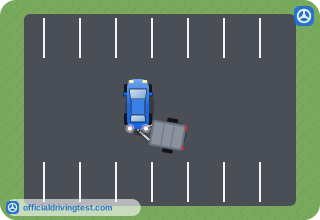
- Turn the top of the steering wheel in the direction of the drift
- Turn the top of the steering wheel away from the drift
- Brake hard and stop at once
- Speed up to straighten the trailer
Show answer
Correct answer: Turn the top of the steering wheel in the direction of the drift
As soon as you see the trailer getting off course, you correct it by turning the top of the steering wheel in the direction of the drift.
Source: Nevada Driver's Handbook (March 2024 (DMV 700)), page 71 · Open this page in the manual (Manual page 71)
-
When backing with a trailer, toward which side should you back and turn whenever possible?
- The passenger's side
- The side with more space
- The driver's side
- The side with the curb
Show answer
Correct answer: The driver's side
Back and turn toward the driver's side whenever possible, because backing toward the right side is very dangerous since you can't see as well.
Source: Nevada Driver's Handbook (March 2024 (DMV 700)), page 71 · Open this page in the manual (Manual page 71)
-
How fast should you back when backing with a trailer?
- At about the speed of traffic behind you
- As slowly as possible
- At a moderate speed to keep control
- Quickly, to clear the area sooner
Show answer
Correct answer: As slowly as possible
Always back as slowly as possible so you can easily correct any steering errors and stop quickly if necessary.
Source: Nevada Driver's Handbook (March 2024 (DMV 700)), page 71 · Open this page in the manual (Manual page 71)
-
When backing with a trailer, what do the mirrors help you see?
- Whether the trailer brakes are locked
- Whether the safety chains are crossed
- Whether the tires are properly inflated
- Whether the trailer is drifting to one side
Show answer
Correct answer: Whether the trailer is drifting to one side
The mirrors will help you see whether the trailer is drifting to one side.
Source: Nevada Driver's Handbook (March 2024 (DMV 700)), page 71 · Open this page in the manual (Manual page 71)
-
Before backing with a trailer, what should you do to check your path?
- Get out and walk around the vehicle, checking clearance to the sides and overhead
- Look only in the rear-view mirror from the driver's seat before moving
- Sound the horn, turn on your hazard lights, and start backing right away
- Ask the traffic behind you to move far away while you start to back up
Show answer
Correct answer: Get out and walk around the vehicle, checking clearance to the sides and overhead
Before you begin, look at your line of travel, get out and walk around the vehicle, and check clearance to the sides and overhead.
Source: Nevada Driver's Handbook (March 2024 (DMV 700)), page 71 · Open this page in the manual (Manual page 71)
-
When backing a trailer, what should you do to reposition your vehicle as needed?
- Back up farther
- Turn the wheel sharply and keep backing
- Pull forward
- Raise the trailer jacks
Show answer
Correct answer: Pull forward
When backing a trailer, pull forward to reposition your vehicle as needed.
Source: Nevada Driver's Handbook (March 2024 (DMV 700)), page 71 · Open this page in the manual (Manual page 71)
-
How should a helper who is guiding you while backing a trailer stand?
- Directly behind the trailer, out of your view
- Near the back of your vehicle where you can see them
- Beside the driver's door
- Far to the side of the trailer
Show answer
Correct answer: Near the back of your vehicle where you can see them
The helper should stand near the back of your vehicle where you can see them, and you should agree on hand signals, including one for STOP, before backing.
Source: Nevada Driver's Handbook (March 2024 (DMV 700)), page 71 · Open this page in the manual (Manual page 71)
-
What should you do with your helper before you begin backing a trailer?
- Agree to use only the horn as the signal for every message
- Agree that the helper will not give any signals while you back up
- Agree that the helper will drive the vehicle while you walk around
- Work out hand signals you both understand, including one for STOP
Show answer
Correct answer: Work out hand signals you both understand, including one for STOP
Before you begin backing, work out a set of hand signals that you both understand and agree on a signal for STOP.
Source: Nevada Driver's Handbook (March 2024 (DMV 700)), page 71 · Open this page in the manual (Manual page 71)
-
When parking with a trailer, how should you try to park?
- So you will be able to pull forward when you leave
- So you will have to back out when you leave
- So the trailer blocks the lane behind you
- So you can back into the traffic lane
Show answer
Correct answer: So you will be able to pull forward when you leave
When you park, try to park so you will be able to pull forward when you leave, because backing up is always dangerous.
Source: Nevada Driver's Handbook (March 2024 (DMV 700)), page 71 · Open this page in the manual (Manual page 71)