Nevada: Vehicle controls and equipment — Collision Warning, Driver Assistance, Automation Practice Test
Questions in this part include: “Will a forward collision warning system alone automatically brake for the driver?” · “How is lane keeping assist easily cancelled?”
Independent educational site · not affiliated with any government agency or DMV
Ready? Test yourself
- Instant feedback with an explanation
- Every answer cites its source in the manual
- Your best score is saved on this device
- Keyboard: press 1 to 4 to answer and Enter for the next question
Questions are original and based on the official manual "Nevada Driver's Handbook" (March 2024 (DMV 700)), Nevada Department of Motor Vehicles.
All 24 questions in this practice test
Take the test above first, then use this list to study. Tap “Show answer” to see the correct answer and explanation.
Show the questions and answersHide the questions
-
Will a forward collision warning system alone automatically brake for the driver?
- Yes, it always brakes at any speed
- Yes, but only below 25 mph
- No, it only warns the driver
- Yes, but only on freeways
Show answer
Correct answer: No, it only warns the driver
The warning system alone will not automatically brake for the driver; it warns so the driver can brake or swerve in time.
Source: Nevada Driver's Handbook (March 2024 (DMV 700)), page 53 · Open this page in the manual (Manual page 53)
-
Forward collision warning systems warn drivers of impending collisions with what?
- Vehicles approaching quickly from behind in the adjacent lane
- Slower-moving or stationary vehicles or other objects ahead
- Pedestrians crossing at intersections on either side of the car
- Animals crossing the road at night on rural roads
Show answer
Correct answer: Slower-moving or stationary vehicles or other objects ahead
These systems warn drivers of impending collisions with slower-moving or stationary vehicles or other objects ahead so the driver can brake or swerve in time.
Source: Nevada Driver's Handbook (March 2024 (DMV 700)), page 53 · Open this page in the manual (Manual page 53)
-
What does a high speed alert do?
- Slows the vehicle when it is speeding
- Displays the posted speed limit only
- Flashes the brake lights when the driver speeds
- Sounds if the driver is speeding
Show answer
Correct answer: Sounds if the driver is speeding
High speed alerts will sound if the driver is speeding, helping drivers maintain a safe driving speed.
Source: Nevada Driver's Handbook (March 2024 (DMV 700)), page 53 · Open this page in the manual (Manual page 53)
-
How do lane departure warning devices warn a driver who is drifting out of their lane?
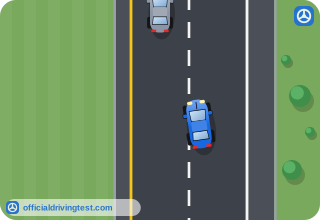
- By steering the vehicle back automatically
- By applying the brakes on one side
- Using visual, vibratory, or sound warnings
- By switching on the hazard lights
Show answer
Correct answer: Using visual, vibratory, or sound warnings
Lane departure warning devices warn a driver drifting out of their lane using visual, vibratory, or sound warnings.
Source: Nevada Driver's Handbook (March 2024 (DMV 700)), page 53 · Open this page in the manual (Manual page 53)
-
What do rear cross-traffic alert systems do?
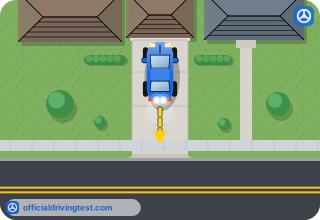
- Alert the driver to vehicles following too closely behind
- Alert the driver to pedestrians crossing in front of the car
- Alert the driver to vehicles about to enter the backing path
- Warn the driver when the trunk is not fully closed
Show answer
Correct answer: Alert the driver to vehicles about to enter the backing path
Rear cross-traffic alert systems alert the driver if one or more vehicles are about to enter the vehicle’s backing path.
Source: Nevada Driver's Handbook (March 2024 (DMV 700)), page 53 · Open this page in the manual (Manual page 53)
-
What is the primary purpose of vehicle driver assistance systems technologies?
- To perform part of the driving function in certain circumstances
- To warn the driver only, without ever adjusting the vehicle
- To remove the driver's responsibility for operating the vehicle
- To drive the vehicle in every circumstance without a driver
Show answer
Correct answer: To perform part of the driving function in certain circumstances
The primary purpose is to perform a component of the driving function in specific circumstances.
Source: Nevada Driver's Handbook (March 2024 (DMV 700)), page 53 · Open this page in the manual (Manual page 53)
-
What are safety critical technologies?
- Technologies that only provide conveniences for the driver
- Technologies that may prevent or reduce the severity of a crash
- Technologies that drive the vehicle in every situation
- Technologies that only warn the driver by sound
Show answer
Correct answer: Technologies that may prevent or reduce the severity of a crash
Safety critical technologies are technologies that may prevent or reduce the severity of a crash.
Source: Nevada Driver's Handbook (March 2024 (DMV 700)), page 53 · Open this page in the manual (Manual page 53)
-
What do automatic emergency braking systems do if the driver fails to respond to slow or stopped traffic or objects ahead?
- Urgently apply the brakes
- Sound the horn and flash the lights
- Steer into the next lane
- Turn off the cruise control only
Show answer
Correct answer: Urgently apply the brakes
These systems sense slow or stopped traffic or objects ahead and will urgently apply the brakes if the driver fails to respond.
Source: Nevada Driver's Handbook (March 2024 (DMV 700)), page 53 · Open this page in the manual (Manual page 53)
-
With automatic emergency braking, what should drivers continue to do?
- Rely on the system to keep a safe following distance
- Look only at the dashboard display for warnings
- Scan the road for hazards and maintain a safe following distance
- Stop watching the road ahead once the system has been switched on
Show answer
Correct answer: Scan the road for hazards and maintain a safe following distance
Drivers should continue to scan the road for hazards and maintain a safe following distance.
Source: Nevada Driver's Handbook (March 2024 (DMV 700)), page 53 · Open this page in the manual (Manual page 53)
-
What do automatic reverse braking systems do if an obstacle is detected while reversing and the driver does not react?
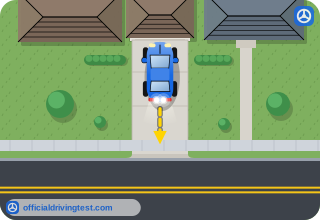
- Shift the vehicle into park
- Immediately apply the brakes
- Turn off the engine
- Turn the steering wheel away
Show answer
Correct answer: Immediately apply the brakes
If the driver does not react, the brakes are immediately applied to help avoid a potential crash.
Source: Nevada Driver's Handbook (March 2024 (DMV 700)), page 53 · Open this page in the manual (Manual page 53)
-
If a driver does not act when the vehicle drifts out of its lane, what may lane keeping assist do?
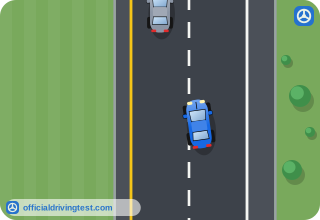
- Apply the brakes until the vehicle stops
- Shift the vehicle into neutral
- Turn on the hazard flashers
- Gently steer the vehicle into its lane
Show answer
Correct answer: Gently steer the vehicle into its lane
The driver should return to their lane, and if they do not act, lane keeping assist may gently steer the driver into their lane.
Source: Nevada Driver's Handbook (March 2024 (DMV 700)), page 54 · Open this page in the manual (Manual page 54)
-
How is lane keeping assist easily cancelled?
- By pressing the horn
- By applying the parking brake
- By turning on the wipers
- By nudging the wheel
Show answer
Correct answer: By nudging the wheel
Lane keeping assist is easily cancelled by nudging the wheel.
Source: Nevada Driver's Handbook (March 2024 (DMV 700)), page 54 · Open this page in the manual (Manual page 54)
-
When will a lane keeping assist feature not work?
- When the vehicle is traveling in the left lane on a freeway
- When lane lines are faint or covered with snow or dirt
- When the vehicle is carrying more than one passenger
- When the headlights are turned on during the day
Show answer
Correct answer: When lane lines are faint or covered with snow or dirt
The feature will not work when lane lines are faint or covered with snow or dirt.
Source: Nevada Driver's Handbook (March 2024 (DMV 700)), page 54 · Open this page in the manual (Manual page 54)
-
If the gap in traffic is too small to permit a left turn, what does the left turn assist system do?
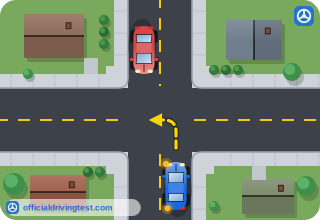
- Prevents the vehicle from moving forward
- Turns on the right turn signal
- Sounds the horn for oncoming traffic
- Shifts the vehicle into reverse
Show answer
Correct answer: Prevents the vehicle from moving forward
If the gap in traffic is too small to permit a turn, the system prevents the vehicle from moving forward.
Source: Nevada Driver's Handbook (March 2024 (DMV 700)), page 54 · Open this page in the manual (Manual page 54)
-
What should the driver do rather than depend on left turn crash avoidance?
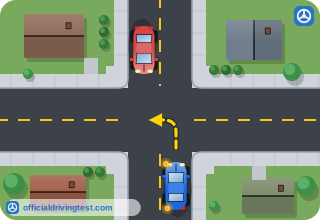
- Wait for the system to confirm it is safe before turning left
- Turn quickly so the system has less traffic to monitor
- Safely scan the environment and decide when it is safe to turn
- Look only at the dash lights for warning signs
Show answer
Correct answer: Safely scan the environment and decide when it is safe to turn
The driver should not depend on left turn crash avoidance and should safely scan and monitor the driving environment ahead for hazards and determine when it is safe to turn in front of other traffic.
Source: Nevada Driver's Handbook (March 2024 (DMV 700)), page 54 · Open this page in the manual (Manual page 54)
-
What does adaptive cruise control (ACC) do?
- Keeps the vehicle centered in its lane with the steering
- Stops the vehicle automatically at every red light
- Warns the driver when another vehicle is in the blind spot
- Adjusts speed to keep a following distance the driver sets
Show answer
Correct answer: Adjusts speed to keep a following distance the driver sets
Adaptive cruise control increases or decreases speed to maintain a following distance set by the driver.
Source: Nevada Driver's Handbook (March 2024 (DMV 700)), page 54 · Open this page in the manual (Manual page 54)
-
While adaptive cruise control is working, what is the driver required to do?
- Keep both feet off the pedals
- Keep the vehicle in the right lane
- Remain aware of their surroundings
- Watch only the car ahead
Show answer
Correct answer: Remain aware of their surroundings
Sensors read the road ahead for traffic, but the driver is required to remain aware of their surroundings.
Source: Nevada Driver's Handbook (March 2024 (DMV 700)), page 54 · Open this page in the manual (Manual page 54)
-
What does the handbook advise about using adaptive cruise control in bad weather and other unsafe driving conditions?
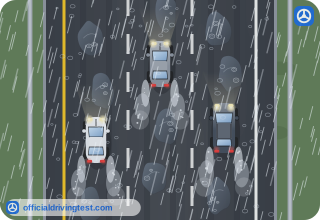
- It is advised not to use it
- Use it with a longer following distance
- Use it only on freeways
- Use it at the highest following-distance setting
Show answer
Correct answer: It is advised not to use it
In bad weather and other unsafe driving conditions, it is advised not to use ACC.
Source: Nevada Driver's Handbook (March 2024 (DMV 700)), page 54 · Open this page in the manual (Manual page 54)
-
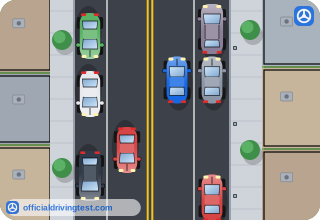
Who is responsible for braking when using automatic parallel parking?
- The vehicle's system
- The examiner
- The driver
- The parking sensor
Show answer
Correct answer: The driver
With automatic parallel parking, the driver is responsible for braking.
Source: Nevada Driver's Handbook (March 2024 (DMV 700)), page 54 · Open this page in the manual (Manual page 54)
-
Which of these may be among the prompts from a vehicle's automatic parallel parking feature?
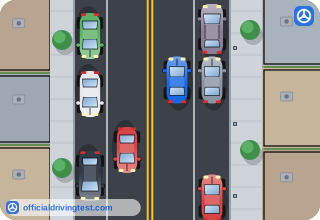
- Taking hands off the steering wheel
- Taking your foot off the brake
- Turning off the engine
- Opening the driver's door
Show answer
Correct answer: Taking hands off the steering wheel
The prompts may include pulling in front of the space, shifting into reverse, and taking hands off the steering wheel.
Source: Nevada Driver's Handbook (March 2024 (DMV 700)), page 54 · Open this page in the manual (Manual page 54)
-
At what levels of driving automation under the SAE J3016 standard does an autonomous vehicle function, according to the handbook's definition?
- Level 0, 1, or 2
- Level 1 only
- Level 2 only
- Level 3, 4, or 5
Show answer
Correct answer: Level 3, 4, or 5
An autonomous vehicle is equipped with an automated driving system designed to function at a level of driving automation of level 3, 4, or 5.
Source: Nevada Driver's Handbook (March 2024 (DMV 700)), page 55 · Open this page in the manual (Manual page 55)
-
What range of levels does the SAE classification system use for driving automation?
- One to three
- Zero to five
- One to ten
- Zero to ten
Show answer
Correct answer: Zero to five
The SAE levels range from zero to five (0-5).
Source: Nevada Driver's Handbook (March 2024 (DMV 700)), page 55 · Open this page in the manual (Manual page 55)
-
The SAE levels start with vehicles without this technology and end with what?
- Self-driving vehicles
- Vehicles with only warning systems
- Vehicles with adaptive cruise control
- Vehicles with automatic parking
Show answer
Correct answer: Self-driving vehicles
The levels start with vehicles without this technology and end with self-driving vehicles.
Source: Nevada Driver's Handbook (March 2024 (DMV 700)), page 55 · Open this page in the manual (Manual page 55)
-
Who developed the classification system that defines the degree of driving automation a car and its equipment may have to offer?
- The Nevada Department of Motor Vehicles
- The Nevada Highway Patrol training unit
- The Society of Automotive Engineers (SAE)
- The Nevada Legislature and the DMV
Show answer
Correct answer: The Society of Automotive Engineers (SAE)
The Society of Automotive Engineers (SAE) developed the classification system for the degree of driving automation.
Source: Nevada Driver's Handbook (March 2024 (DMV 700)), page 55 · Open this page in the manual (Manual page 55)