Nevada: Vehicle controls and equipment — Signals, Lane Changes and Headlights Practice Test
Questions in this part include: “If the turn signals or brake lights on your car are temporarily out of order, which hand signal shows a left turn?” · “Headlights are legally required from when until when?”
Independent educational site · not affiliated with any government agency or DMV
Ready? Test yourself
- Instant feedback with an explanation
- Every answer cites its source in the manual
- Your best score is saved on this device
- Keyboard: press 1 to 4 to answer and Enter for the next question
Questions are original and based on the official manual "Nevada Driver's Handbook" (March 2024 (DMV 700)), Nevada Department of Motor Vehicles.
All 24 questions in this practice test
Take the test above first, then use this list to study. Tap “Show answer” to see the correct answer and explanation.
Show the questions and answersHide the questions
-
Which turn signal should you use when exiting a roundabout?
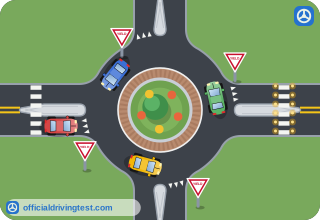
- Your left turn signal
- Your right turn signal
- Your hazard lights
- No signal, because you are already turning
Show answer
Correct answer: Your right turn signal
The handbook says to use your right turn signal when exiting a roundabout.
Source: Nevada Driver's Handbook (March 2024 (DMV 700)), page 44 · Open this page in the manual (Manual page 44)
-
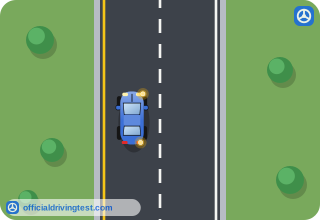
Why must you use signals to show you are changing lanes, turning, slowing down, stopping or parking?
- It is only a courtesy and is never required
- It is not just common courtesy; it is also the law
- It is required only at night
- It is required only on highways
Show answer
Correct answer: It is not just common courtesy; it is also the law
Using signals to tell others what you are going to do is not just common courtesy, it is also the law.
Source: Nevada Driver's Handbook (March 2024 (DMV 700)), page 45 · Open this page in the manual (Manual page 45)
-
If the turn signals or brake lights on your car are temporarily out of order, which hand signal shows a left turn?
- Extend your left arm downward, with the palm to the rear
- Extend your left arm with the elbow bent upward at about 90 degrees
- Extend your right arm out of the open window
- Extend your left arm horizontally out of the open window
Show answer
Correct answer: Extend your left arm horizontally out of the open window
A left turn is signaled by extending the left arm horizontally out of the open window.
Source: Nevada Driver's Handbook (March 2024 (DMV 700)), page 45 · Open this page in the manual (Manual page 45)
-
If the turn signals or brake lights on your car are temporarily out of order, which hand signal shows a right turn?
- Extend your left arm, elbow bent upward at about 90 degrees
- Extend your left arm horizontally out of the open window
- Extend your left arm downward, with the palm to the rear
- Extend your left arm straight up with the palm forward
Show answer
Correct answer: Extend your left arm, elbow bent upward at about 90 degrees
A right turn is signaled by extending the left arm with the elbow bent upward at about 90 degrees.
Source: Nevada Driver's Handbook (March 2024 (DMV 700)), page 45 · Open this page in the manual (Manual page 45)
-
If the brake lights on your car are temporarily out of order, which hand signal shows that you are slowing or stopping?
- Extend your left arm horizontally out of the open window
- Extend your left arm with the elbow bent upward at about 90 degrees
- Extend your left arm downward, with the palm of the hand to the rear
- Extend your left arm upward with the palm forward
Show answer
Correct answer: Extend your left arm downward, with the palm of the hand to the rear
Slowing or stopping is signaled by extending the left arm downward with the palm to the rear.
Source: Nevada Driver's Handbook (March 2024 (DMV 700)), page 45 · Open this page in the manual (Manual page 45)
-
When must you use hand and arm signals instead of the vehicle's lights?
- Whenever you are driving on a city street at slow speed
- When your turn signals or brake lights are out of order
- Whenever it is raining or the road is wet
- Only when you are turning left at an intersection
Show answer
Correct answer: When your turn signals or brake lights are out of order
Hand signals are required when the turn signals or brake lights are temporarily out of order.
Source: Nevada Driver's Handbook (March 2024 (DMV 700)), page 45 · Open this page in the manual (Manual page 45)
-
After you enter the flow of traffic when making a turn, what should you be sure of about your turn signal?
- That it is still flashing for a few more seconds
- That it is on until you reach the next intersection
- That it is off
- That it has been switched to the hazard lights
Show answer
Correct answer: That it is off
One of the requirements for safe and legal turns is to be sure the turn signal is off after you enter the flow of traffic.
Source: Nevada Driver's Handbook (March 2024 (DMV 700)), page 45 · Open this page in the manual (Manual page 45)
-
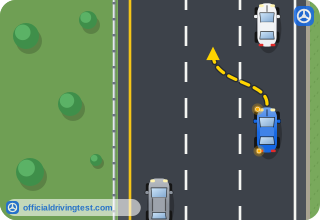
How far ahead should you signal before changing lanes on highways or freeways?
- 100 feet (10 car lengths)
- 150 feet (15 car lengths)
- 500 feet (50 car lengths)
- 300 feet (30 car lengths)
Show answer
Correct answer: 300 feet (30 car lengths)
Signal ahead 300 feet (30 car lengths) on highways or freeways before changing lanes.
Source: Nevada Driver's Handbook (March 2024 (DMV 700)), page 46 · Open this page in the manual (Manual page 46)
-
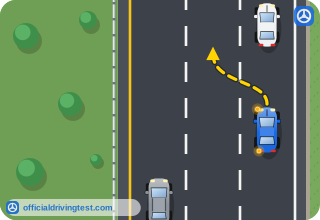
How far ahead should you signal before changing lanes on city streets?
- 100 feet (10 car lengths)
- 300 feet (30 car lengths)
- 50 feet (5 car lengths)
- 200 feet (20 car lengths)
Show answer
Correct answer: 100 feet (10 car lengths)
Signal ahead 100 feet (10 car lengths) on city streets before changing lanes.
Source: Nevada Driver's Handbook (March 2024 (DMV 700)), page 46 · Open this page in the manual (Manual page 46)
-
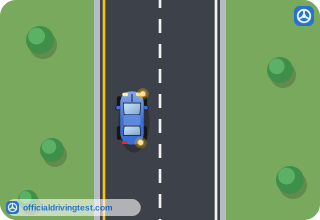
Before changing lanes, how should you check your blind spots?
- Rely on your side-view mirrors and rear-view mirror alone
- Sound your horn and then move over at once
- Look over your shoulder and move when clear
- Glance at the rear-view mirror only, then move over
Show answer
Correct answer: Look over your shoulder and move when clear
Check blind spots by looking over your shoulder and change lanes when traffic is clear.
Source: Nevada Driver's Handbook (March 2024 (DMV 700)), page 46 · Open this page in the manual (Manual page 46)
-
Where should you avoid changing lanes?
- On a freeway
- In an intersection
- On a city street
- On a two-lane road in daylight
Show answer
Correct answer: In an intersection
The handbook says not to change lanes in an intersection.
Source: Nevada Driver's Handbook (March 2024 (DMV 700)), page 46 · Open this page in the manual (Manual page 46)
-
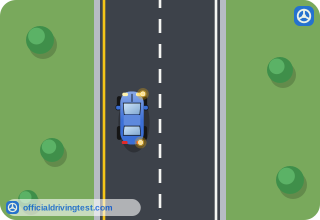
Which mirrors should you use to check traffic when you want to change lanes?
- Only the rear-view mirror
- Only the left side mirror
- Only the mirror on the side you are moving toward
- Your rear and side-view mirrors
Show answer
Correct answer: Your rear and side-view mirrors
Use your rear and side-view mirrors to check traffic when changing lanes.
Source: Nevada Driver's Handbook (March 2024 (DMV 700)), page 46 · Open this page in the manual (Manual page 46)
-
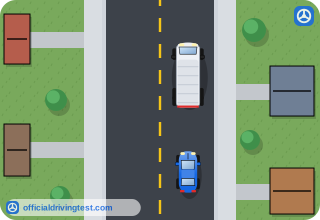
When passing on a two-lane road in business or residential areas, how far ahead should you turn on your left signal?
- 100 feet
- 50 feet
- 200 feet
- 300 feet
Show answer
Correct answer: 100 feet
Turn your left signal light on 100 feet ahead in business or residential areas.
Source: Nevada Driver's Handbook (March 2024 (DMV 700)), page 47 · Open this page in the manual (Manual page 47)
-
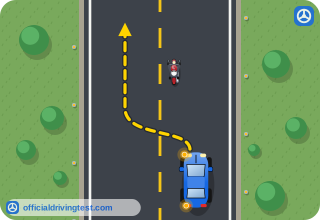
When passing on a two-lane road in areas other than business or residential areas, how far ahead should you turn on your left signal?
- 100 feet
- 200 feet
- 300 feet
- 500 feet
Show answer
Correct answer: 300 feet
Turn your left signal light on 300 feet ahead in other areas.
Source: Nevada Driver's Handbook (March 2024 (DMV 700)), page 47 · Open this page in the manual (Manual page 47)
-
Headlights are legally required from when until when?
- From sunset until sunrise
- From one hour after sunset until one hour before sunrise
- From a half hour after sunset until a half hour before sunrise
- From 6:00 PM until 6:00 AM every day
Show answer
Correct answer: From a half hour after sunset until a half hour before sunrise
Nevada requires headlights from a half hour after sunset until a half hour before sunrise.
Source: Nevada Driver's Handbook (March 2024 (DMV 700)), page 56 · Open this page in the manual (Manual page 56)
-
Headlights are legally required whenever persons or vehicles cannot be clearly seen at what distance?
- 500 feet
- 1,000 feet
- 300 feet
- 100 feet
Show answer
Correct answer: 1,000 feet
Headlights are required whenever persons or vehicles cannot be clearly seen at a distance of 1,000 feet.
Source: Nevada Driver's Handbook (March 2024 (DMV 700)), page 56 · Open this page in the manual (Manual page 56)
-
Which of these is a time when headlights are legally required?
- Only when driving on a freeway
- Only when driving faster than 45 mph
- Only when another vehicle is following you
- When there is insufficient light
Show answer
Correct answer: When there is insufficient light
Headlights are legally required when there is insufficient light, among other times.
Source: Nevada Driver's Handbook (March 2024 (DMV 700)), page 56 · Open this page in the manual (Manual page 56)
-
Which of these situations requires you to use your headlights by law?
- When directed by a traffic control device
- When a vehicle is following you closely
- When you are driving below 25 mph
- When you are parked on a city street
Show answer
Correct answer: When directed by a traffic control device
Headlights are legally required when directed by an official traffic control device.
Source: Nevada Driver's Handbook (March 2024 (DMV 700)), page 56 · Open this page in the manual (Manual page 56)
-
It is advisable to use your headlights when driving in which conditions?
- Dry, sunny weather
- Light wind only
- Rain, snow or fog
- Heavy traffic only
Show answer
Correct answer: Rain, snow or fog
The handbook says it is advisable to use headlights in rain, snow or fog.
Source: Nevada Driver's Handbook (March 2024 (DMV 700)), page 56 · Open this page in the manual (Manual page 56)
-
Where does the handbook say to use high beams at night?
- In heavy city traffic
- In open country
- Behind another vehicle
- Near oncoming vehicles
Show answer
Correct answer: In open country
High beams are for open country at night; change to low beams near other vehicles.
Source: Nevada Driver's Handbook (March 2024 (DMV 700)), page 56 · Open this page in the manual (Manual page 56)
-
You are using high beams at night. How far before oncoming vehicles should you change to low beams?
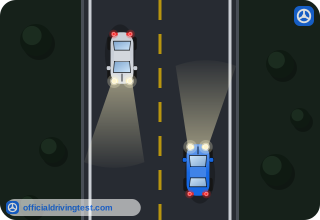
- At least 250 feet
- At least 100 feet
- At least 1,000 feet
- At least 500 feet
Show answer
Correct answer: At least 500 feet
Change to low beams when you are at least 500 feet before any oncoming vehicles.
Source: Nevada Driver's Handbook (March 2024 (DMV 700)), page 56 · Open this page in the manual (Manual page 56)
-
You are using high beams at night behind another vehicle. How far before that vehicle should you change to low beams?
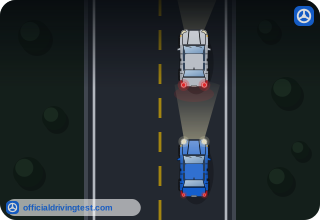
- At least 300 feet
- At least 100 feet
- At least 200 feet
- At least 800 feet
Show answer
Correct answer: At least 300 feet
Change to low beams 300 feet before any vehicle you are following.
Source: Nevada Driver's Handbook (March 2024 (DMV 700)), page 56 · Open this page in the manual (Manual page 56)
-
Why may drivers flash their headlights?
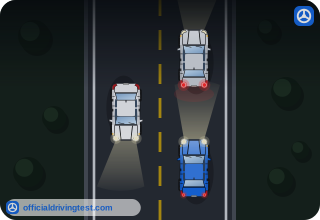
- To tell oncoming drivers to switch to low beams
- To signal that you are about to slow down
- To warn a driver ahead that you intend to pass
- To thank a driver who has let you merge ahead
Show answer
Correct answer: To warn a driver ahead that you intend to pass
The handbook says drivers may flash the headlights to warn a driver ahead that they intend to pass.
Source: Nevada Driver's Handbook (March 2024 (DMV 700)), page 56 · Open this page in the manual (Manual page 56)
-
A driver should not drive with just which lights on?
- The low-beam headlights
- The parking lights
- The high-beam headlights
- The headlights and tail lights
Show answer
Correct answer: The parking lights
The handbook says drivers should not drive with just the parking lights on.
Source: Nevada Driver's Handbook (March 2024 (DMV 700)), page 56 · Open this page in the manual (Manual page 56)