Nevada: Pavement markings Practice Test
Yellow and white lines, center turn lanes, crosswalks, stop lines and lane markings.
Independent educational site · not affiliated with any government agency or DMV
Ready? Test yourself
- Instant feedback with an explanation
- Every answer cites its source in the manual
- Your best score is saved on this device
- Keyboard: press 1 to 4 to answer and Enter for the next question
Questions are original and based on the official manual "Nevada Driver's Handbook" (March 2024 (DMV 700)), Nevada Department of Motor Vehicles.
All 17 questions in this practice test
Take the test above first, then use this list to study. Tap “Show answer” to see the correct answer and explanation.
Show the questions and answersHide the questions
-
What do broken or dashed white lines mark?
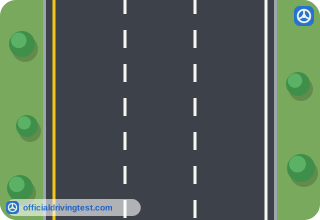
- The edge of the highway and the boundary with the shoulder
- Traffic lanes where several lanes move in the same direction
- Lanes of traffic moving in opposite directions on a roadway
- The place where vehicles must stop before an intersection
Show answer
Correct answer: Traffic lanes where several lanes move in the same direction
Broken or dashed white lines mark traffic lanes on roads that have more than one lane moving in the same direction.
Source: Nevada Driver's Handbook (March 2024 (DMV 700)), page 32 · Open this page in the manual (Manual page 32)
-
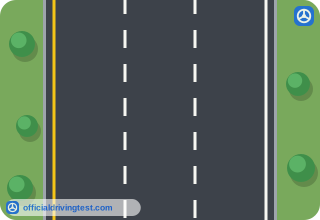
How should you drive in lanes marked by broken white lines?
- Straddling the line to leave room for passing cars
- Along the left line so you can pass quickly
- Over the line whenever the next lane is empty
- Within the lane, without straddling the lines
Show answer
Correct answer: Within the lane, without straddling the lines
Drivers should drive within lanes marked by broken white lines and not straddle the lines.
Source: Nevada Driver's Handbook (March 2024 (DMV 700)), page 32 · Open this page in the manual (Manual page 32)
-
When solid white lines separate lanes of traffic moving in the same direction, what must you not do?
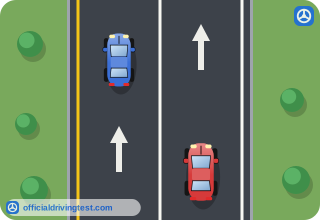
- Change lanes or pass
- Slow down
- Use your turn signal
- Drive within the lane
Show answer
Correct answer: Change lanes or pass
Where solid white lines separate lanes of traffic moving in the same direction, drivers must not change lanes or pass.
Source: Nevada Driver's Handbook (March 2024 (DMV 700)), page 32 · Open this page in the manual (Manual page 32)
-
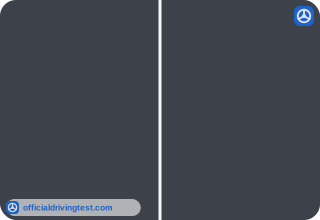
A solid white line is also used to mark what?
- The beginning of a no-passing zone on a two-lane road
- The separation between lanes of opposing traffic
- The edge of the highway and the shoulder boundary
- The left edge of a multi-lane divided highway
Show answer
Correct answer: The edge of the highway and the shoulder boundary
A solid white line marks the edge of the highway and the boundary between a travel lane and a highway shoulder.
Source: Nevada Driver's Handbook (March 2024 (DMV 700)), page 32 · Open this page in the manual (Manual page 32)
-
What do yellow lines separate?
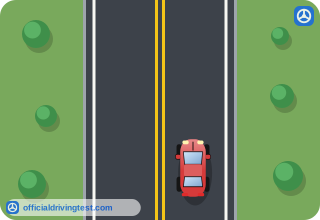
- Lanes of traffic moving in the same direction
- Lanes of traffic moving in opposite directions
- A travel lane from the highway shoulder
- Parking spaces from the nearest travel lane
Show answer
Correct answer: Lanes of traffic moving in opposite directions
Yellow lines separate lanes of traffic moving in opposite directions.
Source: Nevada Driver's Handbook (March 2024 (DMV 700)), page 32 · Open this page in the manual (Manual page 32)
-
What does a broken or dashed yellow line mean?
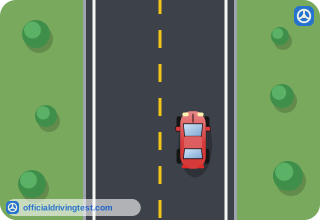
- You must not cross or pass
- You may cross it only to park
- Traffic on both sides moves in the same direction
- You may pass when it is safe to do so
Show answer
Correct answer: You may pass when it is safe to do so
Broken or dashed yellow lines mean you may pass when it is safe to do so.
Source: Nevada Driver's Handbook (March 2024 (DMV 700)), page 32 · Open this page in the manual (Manual page 32)
-
What does a solid yellow line indicate?
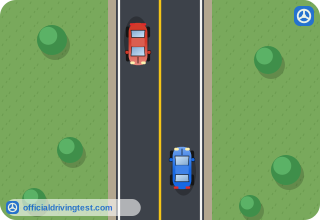
- You are not to cross over or pass
- You may pass if the road ahead is clear
- The lane is reserved for turning vehicles
- Traffic on both sides moves in the same direction
Show answer
Correct answer: You are not to cross over or pass
A solid yellow line indicates that you are not to cross over or pass.
Source: Nevada Driver's Handbook (March 2024 (DMV 700)), page 32 · Open this page in the manual (Manual page 32)
-
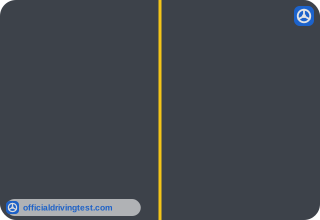
A solid yellow line is also used to mark what?
- The right edge of a two-lane road
- The boundary between a travel lane and the shoulder
- The left edge on multi-lane divided highways
- The start of an exit-only lane on a freeway
Show answer
Correct answer: The left edge on multi-lane divided highways
A solid yellow line is also used to mark the left edge on multi-lane divided highways.
Source: Nevada Driver's Handbook (March 2024 (DMV 700)), page 32 · Open this page in the manual (Manual page 32)
-
At double yellow lines, when are you not allowed to pass?
- Only when oncoming traffic is visible
- When the lines on your side are solid
- Only at night or in poor weather
- Only when a vehicle is directly ahead
Show answer
Correct answer: When the lines on your side are solid
Double yellow lines mean you cannot pass if the lines on your side are solid.
Source: Nevada Driver's Handbook (March 2024 (DMV 700)), page 32 · Open this page in the manual (Manual page 32)
-
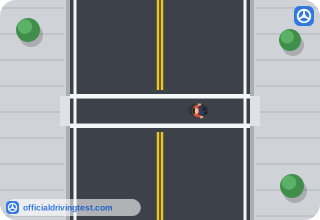
Where should vehicles always be stopped in relation to a crosswalk?
- Partly on the crosswalk
- Beyond the crosswalk
- Anywhere in the intersection
- Before the crosswalk
Show answer
Correct answer: Before the crosswalk
Vehicles should always be stopped before the crosswalk.
Source: Nevada Driver's Handbook (March 2024 (DMV 700)), page 32 · Open this page in the manual (Manual page 32)
-
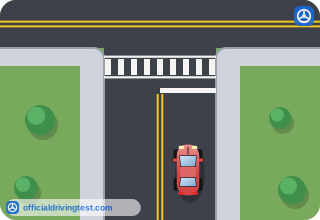
A wide white line is painted across your traffic lane at an intersection. What does it show?
- The point where the crosswalk ends and the sidewalk begins
- Where you must stop only when a train is approaching
- Where you must stop before entering the intersection
- Where the next lane begins and merging is required
Show answer
Correct answer: Where you must stop before entering the intersection
Stop lines are wide white lines painted across a traffic lane where you must stop before you enter the intersection.
Source: Nevada Driver's Handbook (March 2024 (DMV 700)), page 32 · Open this page in the manual (Manual page 32)
-
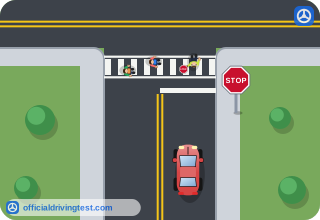
When you stop at a stop line, what should you be able to see?
- Only the traffic signal
- Traffic coming from all directions
- Only oncoming traffic on the cross street
- Only traffic on your left side
Show answer
Correct answer: Traffic coming from all directions
A stop line is placed so that drivers stopped at it should be able to see traffic coming from all directions.
Source: Nevada Driver's Handbook (March 2024 (DMV 700)), page 32 · Open this page in the manual (Manual page 32)
-
What may dotted white lines indicate?
- A lane reserved for vehicles that are turning left
- The boundary between a travel lane and the shoulder
- The place where vehicles must stop before a crosswalk
- An extension of a lane line through an intersection
Show answer
Correct answer: An extension of a lane line through an intersection
Dotted white lines may indicate an extension of a lane line through an intersection or exit-only lanes on a freeway.
Source: Nevada Driver's Handbook (March 2024 (DMV 700)), page 32 · Open this page in the manual (Manual page 32)
-
When may drivers cross the lines that mark a center turn lane?
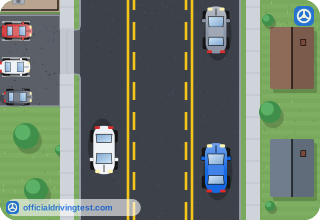
- To make a left turn onto or from the highway
- To pass slower traffic when the road ahead is clear
- To drive past a stopped vehicle in the travel lane
- To make a right turn onto a side street
Show answer
Correct answer: To make a left turn onto or from the highway
Drivers may cross the lines of a center turn lane only to make a left turn onto or from the highway.
Source: Nevada Driver's Handbook (March 2024 (DMV 700)), page 32 · Open this page in the manual (Manual page 32)
-
Center turn lanes are not travel lanes. What may they not be used for?
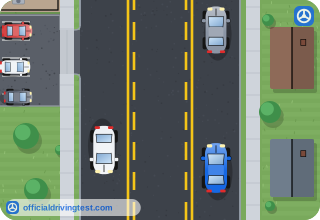
- Making a left turn from the highway
- Turning left onto the highway
- Passing
- Merging with traffic after a left turn
Show answer
Correct answer: Passing
Center turn lanes are not travel lanes and may not be used for passing.
Source: Nevada Driver's Handbook (March 2024 (DMV 700)), page 32 · Open this page in the manual (Manual page 32)
-
How far may drivers travel in a center turn lane before making a left-hand turn?
- No more than 100 feet
- No more than 200 feet
- No more than 300 feet
- No more than 500 feet
Show answer
Correct answer: No more than 200 feet
Drivers may not travel more than 200 feet in a center turn lane before making a left-hand turn.
Source: Nevada Driver's Handbook (March 2024 (DMV 700)), page 32 · Open this page in the manual (Manual page 32)
-
After a left-hand turn onto the highway, how far may drivers travel in the center lane before merging with traffic?
- No more than 25 feet
- No more than 100 feet
- No more than 150 feet
- No more than 50 feet
Show answer
Correct answer: No more than 50 feet
Drivers may not travel more than 50 feet in a center lane after turning left onto the highway before merging with traffic.
Source: Nevada Driver's Handbook (March 2024 (DMV 700)), page 32 · Open this page in the manual (Manual page 32)