Nevada: 30 Hardest Driving Test Questions
Questions that need a second thought, picked for close numbers, exceptions and easy-to-confuse rules. Take your time.
Independent educational site · not affiliated with any government agency or DMV
Ready? Test yourself
- Instant feedback with an explanation
- Every answer cites its source in the manual
- Your best score is saved on this device
- Keyboard: press 1 to 4 to answer and Enter for the next question
Questions are original and based on the official manual "Nevada Driver's Handbook" (March 2024 (DMV 700)), Nevada Department of Motor Vehicles.
All 30 questions in this practice test
Take the test above first, then use this list to study. Tap “Show answer” to see the correct answer and explanation.
Show the questions and answersHide the questions
-
When is it allowed to use a handheld wireless device to report an emergency while driving?
- Only after the vehicle has been stopped and parked
- Only when the emergency involves another vehicle
- When stopping the vehicle would be dangerous or impractical
- Never; handheld devices are always prohibited
Show answer
Correct answer: When stopping the vehicle would be dangerous or impractical
You may use the device to report an emergency if stopping the vehicle would be inadvisable, impractical or dangerous.
Source: Nevada Driver's Handbook (March 2024 (DMV 700)), page 43 · Open this page in the manual (Manual page 43)
-
At a crossing with a stop sign and a train coming, how far from the tracks must drivers stop?
- At least 5 feet
- At least 15 feet
- At least 10 feet
- At least 25 feet
Show answer
Correct answer: At least 15 feet
If there is a stop sign at the crossing and a train is coming, drivers must stop at least 15 feet from the tracks.
Source: Nevada Driver's Handbook (March 2024 (DMV 700)), page 33 · Open this page in the manual (Manual page 33)
-
Under the young-driver curfew, between which hours may a minor not operate a motor vehicle?
- Between 10 p.m. and 5 a.m.
- Between 8 p.m. and 4 a.m.
- Between midnight and 6 a.m.
- Between 11 p.m. and 6 a.m.
Show answer
Correct answer: Between 10 p.m. and 5 a.m.
A minor shall not operate a motor vehicle between 10 p.m. and 5 a.m., except as the curfew rule allows.
Source: Nevada Driver's Handbook (March 2024 (DMV 700)), page 15 · Open this page in the manual (Manual page 15)
-
In which situation may a motorist stop or drive on a designated bicycle lane?
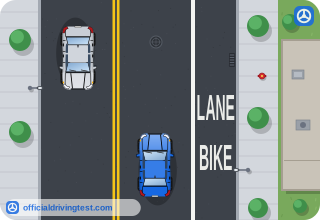
- When no bicyclists are in sight
- When turning right at the next intersection
- When passing a slower vehicle
- When directed by a police officer
Show answer
Correct answer: When directed by a police officer
Motorists may not stop, park or drive on a designated bicycle path or lane unless entering or leaving an alley or driveway, directed by a police officer, or in an emergency.
Source: Nevada Driver's Handbook (March 2024 (DMV 700)), page 65 · Open this page in the manual (Manual page 65)
-
You must not make a U-turn where you cannot see clearly in each direction for how far, because of a curve, hill, rain, fog or other reason?
- 100 feet
- 200 feet
- 300 feet
- 400 feet
Show answer
Correct answer: 200 feet
Never make a U-turn where you cannot see clearly 200 feet in each direction.
Source: Nevada Driver's Handbook (March 2024 (DMV 700)), page 46 · Open this page in the manual (Manual page 46)
-
How long is a good rule of thumb to wait to give a blind pedestrian time to decide?
- 1 second
- 10 seconds
- 3-4 seconds
- 30 seconds
Show answer
Correct answer: 3-4 seconds
Waiting 3-4 seconds is a good rule of thumb.
Source: Nevada Driver's Handbook (March 2024 (DMV 700)), page 67 · Open this page in the manual (Manual page 67)
-
A child aged 7 or younger left in a vehicle where conditions present a significant risk must be supervised by, and within sight of, a person at least how old?
- 10 years old
- 14 years old
- 16 years old
- 12 years old
Show answer
Correct answer: 12 years old
The child may be left only if supervised by and within sight of a person at least 12 years old.
Source: Nevada Driver's Handbook (March 2024 (DMV 700)), page 25 · Open this page in the manual (Manual page 25)
-
Anyone under what age may not ride in the bed of a pickup truck driven on a paved highway in Nevada?
- Under 16
- Under 18
- Under 14
- Under 21
Show answer
Correct answer: Under 18
Anyone under the age of 18 may not ride within the bed of a pickup truck driven on a paved highway.
Source: Nevada Driver's Handbook (March 2024 (DMV 700)), page 66 · Open this page in the manual (Manual page 66)
-
How often may you attend traffic school to remove points from your record?
- Once in every 36-month period
- Twice in any 12-month period
- Only once in a 12-month period
- As many times as you need
Show answer
Correct answer: Only once in a 12-month period
You may attend traffic school only once in a 12-month period to remove points from your record.
Source: Nevada Driver's Handbook (March 2024 (DMV 700)), page 77 · Open this page in the manual (Manual page 77)
-
For how long may a driver who is 16 or 17 when licensed not carry passengers under age 18, except immediate family members?
- The first 30 days they drive
- The first 6 months they drive
- The first year they drive
- Until they turn 18
Show answer
Correct answer: The first 6 months they drive
Drivers who are 16 or 17 when licensed cannot carry passengers under 18 (except immediate family members) for the first 6 months they drive.
Source: Nevada Driver's Handbook (March 2024 (DMV 700)), page 15 · Open this page in the manual (Manual page 15)
-
How far ahead should a driver look down the road on a freeway?
- About 5 to 10 seconds
- At least 1 minute
- At least 20 to 30 seconds
- Only as far as the next vehicle
Show answer
Correct answer: At least 20 to 30 seconds
On a freeway, drivers should look ahead much farther down the road, at least 20 to 30 seconds.
Source: Nevada Driver's Handbook (March 2024 (DMV 700)), page 36 · Open this page in the manual (Manual page 36)
-
On what dates may studded snow tires be used?
- November 1 through March 31
- October 1 through April 30
- September 1 through May 31
- Any time of year
Show answer
Correct answer: October 1 through April 30
Studded snow tires may only be used from October 1 through April 30.
Source: Nevada Driver's Handbook (March 2024 (DMV 700)), page 57 · Open this page in the manual (Manual page 57)
-
You are using high beams at night behind another vehicle. How far before that vehicle should you change to low beams?
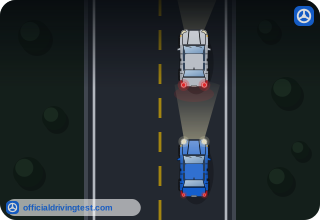
- At least 300 feet
- At least 100 feet
- At least 200 feet
- At least 800 feet
Show answer
Correct answer: At least 300 feet
Change to low beams 300 feet before any vehicle you are following.
Source: Nevada Driver's Handbook (March 2024 (DMV 700)), page 56 · Open this page in the manual (Manual page 56)
-
When passing on a two-lane road in areas other than business or residential areas, how far ahead should you turn on your left signal?
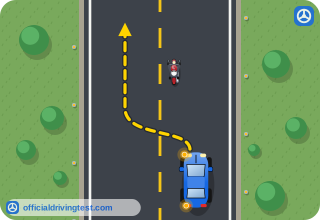
- 100 feet
- 200 feet
- 300 feet
- 500 feet
Show answer
Correct answer: 300 feet
Turn your left signal light on 300 feet ahead in other areas.
Source: Nevada Driver's Handbook (March 2024 (DMV 700)), page 47 · Open this page in the manual (Manual page 47)
-
Children who measure less than how many inches tall must be in an approved child restraint system?
- 48 inches
- 52 inches
- 60 inches
- 57 inches
Show answer
Correct answer: 57 inches
Children who measure less than 57 inches tall must be in an approved child restraint system.
Source: Nevada Driver's Handbook (March 2024 (DMV 700)), page 25 · Open this page in the manual (Manual page 25)
-
While drying wet brakes, how often should you test them?
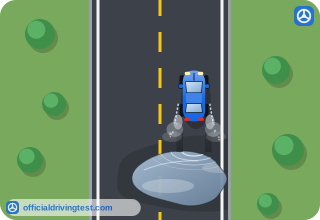
- About every 50 feet
- About every 1,000 feet
- About every mile
- About every 200 feet
Show answer
Correct answer: About every 200 feet
Test the brakes about every 200 feet, continuing until braking action returns to normal.
Source: Nevada Driver's Handbook (March 2024 (DMV 700)), page 58 · Open this page in the manual (Manual page 58)
-
Near a grade, you must not make a U-turn if there is less than how much visibility in both directions?
- 100 feet
- 50 feet
- 300 feet
- 500 feet
Show answer
Correct answer: 500 feet
Never make a U-turn near a grade where there is less than 500 feet of visibility in both directions.
Source: Nevada Driver's Handbook (March 2024 (DMV 700)), page 46 · Open this page in the manual (Manual page 46)
-
How far may drivers travel in a center turn lane before making a left-hand turn?
- No more than 100 feet
- No more than 200 feet
- No more than 300 feet
- No more than 500 feet
Show answer
Correct answer: No more than 200 feet
Drivers may not travel more than 200 feet in a center turn lane before making a left-hand turn.
Source: Nevada Driver's Handbook (March 2024 (DMV 700)), page 32 · Open this page in the manual (Manual page 32)
-
Which of these is an exception to the rule against parking in a bicycle lane?
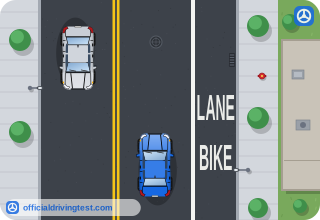
- When your vehicle is disabled
- For a few minutes to load passengers
- When no cyclist is in sight
- When your four-way flashers are on
Show answer
Correct answer: When your vehicle is disabled
Parking within a bicycle lane is not allowed unless your vehicle is disabled.
Source: Nevada Driver's Handbook (March 2024 (DMV 700)), page 50 · Open this page in the manual (Manual page 50)
-
How close to a fire hydrant may you not park in a place where angle parking is permitted?
- Within 5 feet
- Within 10 feet
- Within 15 feet
- Within 20 feet
Show answer
Correct answer: Within 20 feet
Where angle parking is permitted, you may not park within 20 feet of a fire hydrant.
Source: Nevada Driver's Handbook (March 2024 (DMV 700)), page 50 · Open this page in the manual (Manual page 50)
-
On the side of a highway opposite the entrance to any fire station, how close to that entrance may you not park?
- Within 20 feet
- Within 50 feet
- Within 100 feet
- Within 75 feet
Show answer
Correct answer: Within 75 feet
On the side of a highway opposite the entrance to any fire station, you may not park within 75 feet of that entrance.
Source: Nevada Driver's Handbook (March 2024 (DMV 700)), page 50 · Open this page in the manual (Manual page 50)
-
What is the minimum liability coverage Nevada requires for injury to or destruction of property of others in any one crash?
- $20,000
- $5,000
- $10,000
- $30,000
Show answer
Correct answer: $20,000
The minimum coverage for injury to or destruction of property of others in any one crash is $20,000.
Source: Nevada Driver's Handbook (March 2024 (DMV 700)), page 75 · Open this page in the manual (Manual page 75)
-
For how many days does a young driver lose the license if a blood, breath or urine test shows at least 0.02% but less than 0.08% alcohol by weight?
- 30 days
- 185 days
- 90 days
- One year
Show answer
Correct answer: 185 days
A test showing at least 0.02% but less than 0.08% alcohol costs a young driver the license for 185 days.
Source: Nevada Driver's Handbook (March 2024 (DMV 700)), page 13 · Open this page in the manual (Manual page 13)
-
Besides .08% or more, what lower alcohol concentration subjects a commercial driver license holder to the Illegal Per Se action?
- .04% or more but less than .08%
- .02% or more but less than .04%
- .05% or more but less than .10%
- Only .08% or more; no lower level
Show answer
Correct answer: .04% or more but less than .08%
For a commercial driver license holder, an alcohol concentration of .04% or more but less than .08% is subject to the action.
Source: Nevada Driver's Handbook (March 2024 (DMV 700)), page 80 · Open this page in the manual (Manual page 80)
-
What is the fine for a second DUI offense within seven years?
- $750 to $1,000
- $400 to $1,000
- $1,000 to $2,000
- $2,000 to $5,000
Show answer
Correct answer: $750 to $1,000
The fine for a second DUI offense within seven years is $750 to $1,000.
Source: Nevada Driver's Handbook (March 2024 (DMV 700)), page 80 · Open this page in the manual (Manual page 80)
-
What rearward amplification do triples have?
- 3.5
- 1.0
- 2.0
- 4.5
Show answer
Correct answer: 3.5
Triples have a rearward amplification of 3.5, which means the last trailer of a triple can roll 3.5 times as easily.
Source: Nevada Driver's Handbook (March 2024 (DMV 700)), page 73 · Open this page in the manual (Manual page 73)
-
In heavy rainfall, most cars begin to lose traction and hydroplane at what speeds?
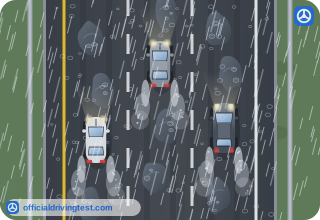
- Between 10 and 25 mph
- Between 35 and 55 mph
- Between 60 and 80 mph
- Between 20 and 30 mph
Show answer
Correct answer: Between 35 and 55 mph
Most cars begin to lose traction and hydroplane between speeds of 35 and 55 mph in heavy rainfall.
Source: Nevada Driver's Handbook (March 2024 (DMV 700)), page 41 · Open this page in the manual (Manual page 41)
-
Cars traveling at a high rate of speed can be pushed off the road by only how much water?
- 18 inches
- 3 feet
- 4 feet
- 6 inches
Show answer
Correct answer: 6 inches
Cars traveling at a high rate of speed can be pushed off the road by only 6 inches of water.
Source: Nevada Driver's Handbook (March 2024 (DMV 700)), page 59 · Open this page in the manual (Manual page 59)
-
For a typical passenger car with perfect brakes on dry, level pavement and a 2.5-second reaction time, what is the braking distance at 45 mph?
- 113 feet
- 68 feet
- 168 feet
- 256 feet
Show answer
Correct answer: 113 feet
At 45 mph the braking distance is 113 feet, after 165 feet of perception and reaction distance, for a total of 278 feet.
Source: Nevada Driver's Handbook (March 2024 (DMV 700)), page 41 · Open this page in the manual (Manual page 41)
-
If you are going 30 mph, how long is your stopping distance on ice?
- 173 feet
- 273 feet
- 373 feet
- 473 feet
Show answer
Correct answer: 373 feet
At 30 mph, the stopping distance on ice would be 373 feet, well over the length of a football field.
Source: Nevada Driver's Handbook (March 2024 (DMV 700)), page 41 · Open this page in the manual (Manual page 41)