Montana: Signals and vehicle controls — Horn, Turn Signals, and Hand Signals Practice Test
Questions in this part include: “If there is no immediate danger, what should be all you need to do with your horn?” · “What do other drivers generally expect you to do?”
Independent educational site · not affiliated with any government agency or DMV
Ready? Test yourself
- Instant feedback with an explanation
- Every answer cites its source in the manual
- Your best score is saved on this device
- Keyboard: press 1 to 4 to answer and Enter for the next question
Questions are original and based on the official manual "Montana Driver Manual" (Revised April 2024), Montana Department of Justice, Motor Vehicle Division.
All 22 questions in this practice test
Take the test above first, then use this list to study. Tap “Show answer” to see the correct answer and explanation.
Show the questions and answersHide the questions
-
If there is no immediate danger, what should be all you need to do with your horn?
- Hold it down with a long steady blast
- Sound two sharp blasts
- Give it three short blasts
- Give it a light tap
Show answer
Correct answer: Give it a light tap
If there is no immediate danger, a light tap on the horn should be all you need.
Source: Montana Driver Manual (Revised April 2024), page 56
-
In which situation does the manual say to give your horn a light tap?
- When you are passing a driver who starts to turn into your lane
- When the driver ahead is slow to move at a green light
- When you want to greet a friend
- When you want another driver to hurry
Show answer
Correct answer: When you are passing a driver who starts to turn into your lane
A light tap is advised when you are passing a driver who starts to turn into your lane.
Source: Montana Driver Manual (Revised April 2024), page 56
-
At which of these places does the manual say to give your horn a light tap?
- Stopping at a red traffic signal in a busy downtown area
- Driving on a straight, open highway with a clear view ahead
- Coming to a steep hill or a sharp curve where you cannot see ahead
- Parking in a parking lot that has no other vehicles in it
Show answer
Correct answer: Coming to a steep hill or a sharp curve where you cannot see ahead
A light tap is advised when coming to a place where you cannot see what is ahead, like a steep hill, a sharp curve, or exiting a narrow alley.
Source: Montana Driver Manual (Revised April 2024), page 56
-
Which driver does the manual say to give a light tap on the horn?
- A driver who is driving slightly below the speed limit ahead
- A driver who is not paying attention or who may have trouble seeing you
- A driver who has made an error while driving in front of you
- A driver who is waiting at a stop sign at a clear intersection
Show answer
Correct answer: A driver who is not paying attention or who may have trouble seeing you
A light tap on the horn is advised when a driver is not paying attention or may have trouble seeing you.
Source: Montana Driver Manual (Revised April 2024), page 56
-
In which situation does the manual say to sound a SHARP BLAST on your horn?
- A friend you know is waiting at the curb and you want to greet them
- The vehicle ahead of you is slow to start at a green light
- Another driver ahead of you has made an error in traffic
- Another car is in danger of hitting you
Show answer
Correct answer: Another car is in danger of hitting you
If there is danger, such as another car in danger of hitting you, do not be afraid to sound a sharp blast on your horn.
Source: Montana Driver Manual (Revised April 2024), page 56
-
If you have lost control of your vehicle and are moving toward someone, what should you do with your horn?
- Sound a sharp blast
- Give a light tap
- Do not use it
- Honk only after you stop
Show answer
Correct answer: Sound a sharp blast
The manual says to sound a sharp blast when you have lost control of your vehicle and are moving toward someone.
Source: Montana Driver Manual (Revised April 2024), page 56
-
Which of these is an occasion when you should NOT use your horn?
- When a driver is not paying attention
- When passing a driver who starts to turn into your lane
- To encourage someone to drive faster or get out of the way
- When exiting a narrow alley
Show answer
Correct answer: To encourage someone to drive faster or get out of the way
The manual lists encouraging someone to drive faster or get out of the way as an occasion when you should not use your horn.
Source: Montana Driver Manual (Revised April 2024), page 56
-
Which of these is an occasion when you should NOT use your horn?
- When you cannot see what is ahead
- To greet a friend
- When another car is in danger of hitting you
- When you are coming to a sharp curve
Show answer
Correct answer: To greet a friend
The manual lists greeting a friend as an occasion when you should not use your horn.
Source: Montana Driver Manual (Revised April 2024), page 56
-
Around which pedestrians does the manual say you should not use your horn?
- Pedestrians in a crosswalk
- Pedestrians wearing dark clothing
- Pedestrians carrying packages
- Visually impaired pedestrians
Show answer
Correct answer: Visually impaired pedestrians
The manual lists around visually impaired pedestrians as an occasion when you should not use your horn.
Source: Montana Driver Manual (Revised April 2024), page 56
-
What do other drivers generally expect you to do?
- Slow down when approaching intersections
- Keep doing what you are doing
- Move to the right lane whenever possible
- Stay in the left lane when passing
Show answer
Correct answer: Keep doing what you are doing
Other drivers generally expect you to keep doing what you are doing, so you must warn them when you are going to change direction or slow down.
Source: Montana Driver Manual (Revised April 2024), page 57
-
Which of these is a time when the manual says you should use your turn signal?
- While driving straight in your own lane
- When you start the engine
- When you drive through a green light going straight
- Before you merge into traffic
Show answer
Correct answer: Before you merge into traffic
The manual says to use turn signals before you change lanes, turn right or left, merge into traffic, pass on a highway or interstate, or park.
Source: Montana Driver Manual (Revised April 2024), page 58
-
Should you signal a lane change or turn when you do not see anyone else around?
- Yes, it is easy to miss someone who needs to know
- No, signals are needed only when other vehicles are visible
- No, signals are needed only when traffic is heavy
- No, only turns at intersections need a signal
Show answer
Correct answer: Yes, it is easy to miss someone who needs to know
The manual says to signal even when you do not see anyone else around, because it is easy to miss someone who needs to know what you are doing.
Source: Montana Driver Manual (Revised April 2024), page 58
-
There are streets or driveways between you and the street where you want to turn. When should you signal?
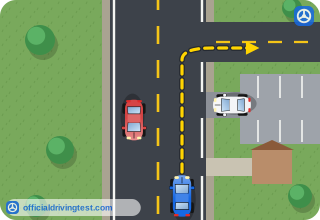
- As soon as you see the street you want
- Before the first driveway, to warn everyone
- Only when you reach the street
- After you have passed them
Show answer
Correct answer: After you have passed them
The manual warns not to signal too early: wait until you have passed streets, driveways, or entrances between you and your turn.
Source: Montana Driver Manual (Revised April 2024), page 58
-
Another vehicle is about to enter the street between you and where you plan to turn. Why should you wait until you have passed it to signal?
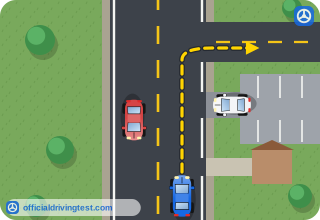
- Drivers behind the other vehicle would not be able to see your signal
- The other driver may think you plan to turn where they are
- Signaling that close to another vehicle is not allowed by law
- The other driver would have to stop and let you turn first
Show answer
Correct answer: The other driver may think you plan to turn where they are
If you signal earlier, the other driver may think you plan to turn where they are and might pull into your path.
Source: Montana Driver Manual (Revised April 2024), page 58
-
Why should you make sure your turn signal is off after a turn or lane change?
- Other drivers will not see your brake lights
- A signal left on can damage the turn lever
- Other drivers might think you plan to turn again
- The signal keeps your vehicle from slowing down
Show answer
Correct answer: Other drivers might think you plan to turn again
After small turns the signal may not turn off by itself, and if it stays on other drivers might think you plan to turn again.
Source: Montana Driver Manual (Revised April 2024), page 58
-
You are going to stop or slow down where another driver does not expect it. What does the manual say to do?
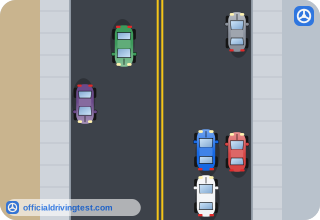
- Tap your brake pedal three or four times quickly
- Hold the brake pedal down firmly and stay on it
- Flash your high beams and keep your speed
- Sound your horn twice before you slow down
Show answer
Correct answer: Tap your brake pedal three or four times quickly
Tapping the brake pedal three or four times quickly lets those behind you know you are about to slow down.
Source: Montana Driver Manual (Revised April 2024), page 58
-
When should you begin to slow down for a turn or a stop?
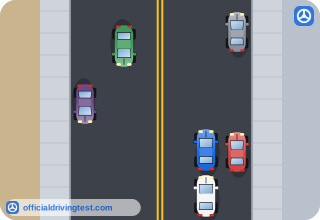
- As late as possible to keep traffic moving
- As early as it is safe to do so
- Only when you see the brake lights ahead
- Just before you reach the intersection
Show answer
Correct answer: As early as it is safe to do so
The manual says to always slow down as early as it is safe to do so.
Source: Montana Driver Manual (Revised April 2024), page 58
-
Why should you signal when you slow down to park or turn just before an intersection?
- Oncoming traffic expects you to stop before the intersection
- Pedestrians at the intersection expect you to turn first
- Turning drivers must always signal at least 300 feet ahead
- Following traffic expects you to continue through the intersection
Show answer
Correct answer: Following traffic expects you to continue through the intersection
Following traffic expects you to continue through the intersection, so a signal tells them you are slowing to park or turn.
Source: Montana Driver Manual (Revised April 2024), page 58
-
Even though vehicles are equipped with turn and brake lights, what else must you know?
- The basic hand signals
- How to replace a burned-out signal bulb
- The meaning of every horn pattern
- The locations of all rest areas
Show answer
Correct answer: The basic hand signals
The manual says that even with turn and brake lights you must know the basic hand signals as well.
Source: Montana Driver Manual (Revised April 2024), page 58
-
Which hand signal tells other drivers you are about to turn left?
- The driver’s arm bent upward at the elbow
- The driver’s arm held out and angled downward
- The driver’s arm held straight out to the side
- The driver’s arm raised straight up
Show answer
Correct answer: The driver’s arm held straight out to the side
The basic hand signal for a left turn is the arm held straight out to the side.
Source: Montana Driver Manual (Revised April 2024), page 58
-
Which hand signal tells other drivers you are about to turn right?
- The driver’s arm held straight out to the side
- The driver’s arm held out and angled downward
- The driver’s forearm bent upward at the elbow
- The driver’s arm waved back and forth
Show answer
Correct answer: The driver’s forearm bent upward at the elbow
The basic hand signal for a right turn is the arm bent upward at the elbow.
Source: Montana Driver Manual (Revised April 2024), page 58
-
Which hand signal tells other drivers you are stopping or slowing?
- The driver’s arm held out and angled downward
- The driver’s arm held straight out to the side
- The driver’s forearm bent upward at the elbow
- The driver’s arm raised straight up
Show answer
Correct answer: The driver’s arm held out and angled downward
The basic hand signal for stopping or slowing is the arm held out and angled downward.
Source: Montana Driver Manual (Revised April 2024), page 58