Montana: Signals and vehicle controls — Starting, Steering, and Looking Behind Practice Test
Questions in this part include: “How far before turning in town should you use a proper turn signal?” · “Where does the manual say both hands should be placed on the steering wheel?”
Independent educational site · not affiliated with any government agency or DMV
Ready? Test yourself
- Instant feedback with an explanation
- Every answer cites its source in the manual
- Your best score is saved on this device
- Keyboard: press 1 to 4 to answer and Enter for the next question
Questions are original and based on the official manual "Montana Driver Manual" (Revised April 2024), Montana Department of Justice, Motor Vehicle Division.
All 16 questions in this practice test
Take the test above first, then use this list to study. Tap “Show answer” to see the correct answer and explanation.
Show the questions and answersHide the questions
-
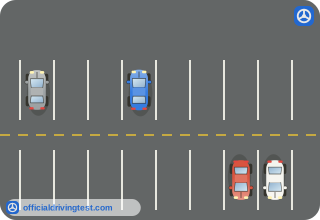
What does the manual tell you to do before backing up from where your car is parked?
- Rely on your side mirrors only
- Lower all of the windows
- Walk around your parked car
- Turn off the radio and heater
Show answer
Correct answer: Walk around your parked car
The manual says to walk around your parked car before backing up, so you know nothing is in your path.
Source: Montana Driver Manual (Revised April 2024), page 37
-
How far before turning in town should you use a proper turn signal?
- 50 feet
- 200 feet
- 100 feet
- 500 feet
Show answer
Correct answer: 100 feet
Use a proper turn signal 100 feet before turning in town.
Source: Montana Driver Manual (Revised April 2024), page 37
-
How far before turning on a rural road should you use a proper turn signal?
- 300 feet
- 150 feet
- 200 feet
- 500 feet
Show answer
Correct answer: 300 feet
On rural roads, use a proper turn signal 300 feet before turning.
Source: Montana Driver Manual (Revised April 2024), page 37
-
Before you start the vehicle, what does the manual say you should make sure is on?
- The headlights
- The turn signal
- The parking brake
- The emergency flashers
Show answer
Correct answer: The parking brake
The manual says to make sure the parking brake is on before you start the vehicle.
Source: Montana Driver Manual (Revised April 2024), page 50
-
If a vehicle has a manual transmission, what does the manual say about its gear when you start it?
- It must be in first gear
- It must not be in gear
- It must be in reverse
- It must be in the highest gear
Show answer
Correct answer: It must not be in gear
For a manual transmission, the vehicle must not be in gear when you start it, and in some vehicles you must also depress the clutch.
Source: Montana Driver Manual (Revised April 2024), page 50
-
Where must the shift selector be to start a vehicle that has an automatic transmission?
- In "drive"
- In "reverse"
- In "low"
- In "park"
Show answer
Correct answer: In "park"
For an automatic transmission, the shift selector must be in "park" or the vehicle will not start.
Source: Montana Driver Manual (Revised April 2024), page 50
-
What can happen if you try to start too fast, particularly on slippery surfaces?
- The drive wheels can spin and the vehicle can slide
- The engine can overheat and the vehicle can shut off
- The brakes can lock up and the vehicle can stop at once
- The steering can lock and the vehicle can roll backward
Show answer
Correct answer: The drive wheels can spin and the vehicle can slide
The manual says that starting too fast can make the drive wheels spin and the vehicle slide, particularly on slippery surfaces.
Source: Montana Driver Manual (Revised April 2024), page 50
-
Why should the driver of a manual-shift vehicle practice using the clutch and the accelerator?
- So the vehicle can start without the parking brake being set
- So the vehicle can be started while it is still in gear
- So the engine does not over-rev or stall when shifting between gears
- So the tires do not wear out unevenly when stopping
Show answer
Correct answer: So the engine does not over-rev or stall when shifting between gears
The manual says to practice so that the engine does not over-rev or stall when shifting between gears.
Source: Montana Driver Manual (Revised April 2024), page 50
-
Where does the manual say both hands should be placed on the steering wheel?
- Close together at the top of the wheel
- On opposite sides of the wheel
- One on the wheel and one on the gear shift
- One hand at the very top of the wheel
Show answer
Correct answer: On opposite sides of the wheel
Both hands should be on opposite sides of the steering wheel, which gives comfort and may give better control in critical situations.
Source: Montana Driver Manual (Revised April 2024), page 50
-
In newer vehicles with airbags mounted in the steering wheel, which hand positions does the manual give as an example?
- The 10 and 2 o'clock positions
- The 11 and 1 o'clock positions
- The 7 and 5 o'clock positions
- The 8 and 4 o'clock positions
Show answer
Correct answer: The 8 and 4 o'clock positions
The manual gives the 8 and 4 o'clock positions for newer vehicles equipped with airbags mounted in the steering wheel.
Source: Montana Driver Manual (Revised April 2024), page 50
-
Which technique does the manual say to use to turn the steering wheel when turning corners?
- Turning with just the palm of one hand
- Holding the wheel at the bottom with one hand
- The "hand-over-hand" technique
- Letting the wheel slip through your fingers
Show answer
Correct answer: The "hand-over-hand" technique
The manual says to use the hand-over-hand technique; turning with just the palm of one hand could cause you to lose control.
Source: Montana Driver Manual (Revised April 2024), page 50
-
What does the manual say about letting the steering wheel slip through your fingers after you complete a turn?
- It is the safest way to straighten the wheel
- It could be dangerous; straighten the wheel by hand
- It is acceptable when you are driving slowly
- It gives better control on high-speed roads
Show answer
Correct answer: It could be dangerous; straighten the wheel by hand
After a turn you should straighten out the steering wheel by hand, because letting it slip through your fingers could be dangerous.
Source: Montana Driver Manual (Revised April 2024), page 50
-
What does the steering lock warning label in the manual say not to do while driving?
- Shift into neutral
- Use hand-over-hand steering
- Release the parking brake
- Turn or remove the ignition key
Show answer
Correct answer: Turn or remove the ignition key
The warning label says not to turn or remove the ignition key while driving because the steering locks.
Source: Montana Driver Manual (Revised April 2024), page 50
-
According to the manual, when do you need to check the traffic behind you more often?
- When traffic is light
- When traffic is heavy
- When the road is straight and level
- When you are driving slowly on side streets
Show answer
Correct answer: When traffic is heavy
The manual says you need to check behind you more often when traffic is heavy.
Source: Montana Driver Manual (Revised April 2024), page 53
-
Which of these is a time when the manual says it is very important to look behind for vehicles?
- When you are driving on a flat, straight road with little traffic
- When you are parked with the engine off
- When you are stopped at a light with no one behind you
- When you are driving down a long or steep hill
Show answer
Correct answer: When you are driving down a long or steep hill
The manual says it is very important to look behind when you change lanes, slow down, back up, or drive down a long or steep hill.
Source: Montana Driver Manual (Revised April 2024), page 53
-
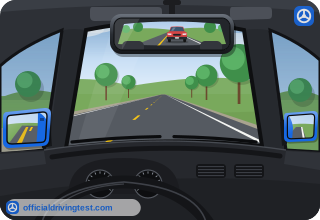
When must you check behind your vehicle?
- Whenever you slow down
- Only when you slow down quickly
- Only when you stop at a stop sign
- Only when you slow down for a curve
Show answer
Correct answer: Whenever you slow down
The manual says you must check behind your vehicle whenever you slow down, especially when you slow down quickly or where a following driver would not expect it.
Source: Montana Driver Manual (Revised April 2024), page 54