Montana: Signals and vehicle controls — Exhaust, Headlights & Tail Lights, Brake Lights Practice Test
Questions in this part include: “How quickly can fumes from a leaky exhaust cause death?” · “For what distance should headlights be capable of illuminating persons or vehicles on high beam?”
Independent educational site · not affiliated with any government agency or DMV
Ready? Test yourself
- Instant feedback with an explanation
- Every answer cites its source in the manual
- Your best score is saved on this device
- Keyboard: press 1 to 4 to answer and Enter for the next question
Questions are original and based on the official manual "Montana Driver Manual" (Revised April 2024), Montana Department of Justice, Motor Vehicle Division.
All 20 questions in this practice test
Take the test above first, then use this list to study. Tap “Show answer” to see the correct answer and explanation.
Show the questions and answersHide the questions
-
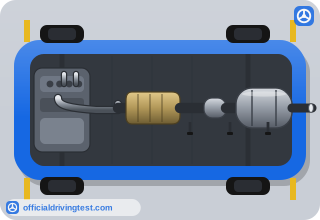
Which of these is a job of the exhaust system?
- Supplying fuel to the engine cylinders
- Charging the battery while driving
- Keeping the tires properly balanced
- Removing toxic gases from the engine
Show answer
Correct answer: Removing toxic gases from the engine
The manual says the exhaust system helps remove toxic gases from the engine, reduce engine noise, and cool the hot gases.
Source: Montana Driver Manual (Revised April 2024), page 13
-
How quickly can fumes from a leaky exhaust cause death?
- Only after several hours
- In a very short time
- Only after several days
- Never, they only smell bad
Show answer
Correct answer: In a very short time
The manual says fumes from a leaky exhaust can cause death in a very short time.
Source: Montana Driver Manual (Revised April 2024), page 13
-
Which of these does the manual say you should never do because of exhaust fumes?
- Park the car outdoors with the motor off
- Open a window while the motor runs
- Run the motor in your garage
- Have a leaky exhaust fixed
Show answer
Correct answer: Run the motor in your garage
The manual says to never run the motor in your garage, and never to sit in the car with the motor running without opening a window.
Source: Montana Driver Manual (Revised April 2024), page 13
-
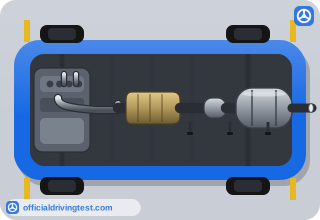
What does the manual say about most exhaust problems?
- They are leaks, which are easily heard
- They are blockages that cannot be heard
- They are caused by low tire pressure
- They appear only in cold weather
Show answer
Correct answer: They are leaks, which are easily heard
The manual says most exhaust problems are leaks, which are easily heard, and they should be fixed.
Source: Montana Driver Manual (Revised April 2024), page 13
-
Which of these may a poorly tuned engine do?
- Gain extra power needed for emergencies
- Lose power needed for driving and emergencies
- Improve your fuel economy on the highway
- Run quieter and start more easily
Show answer
Correct answer: Lose power needed for driving and emergencies
The manual says a poorly tuned engine may lose power needed for normal driving and emergencies, may not start, and gets poor fuel economy.
Source: Montana Driver Manual (Revised April 2024), page 13
-
Why should there be no objects on the floor of the vehicle?
- They could cover the speedometer dial
- They could make the horn sound off
- They could scratch the floor mats
- They could roll under the brake pedal
Show answer
Correct answer: They could roll under the brake pedal
The manual says objects on the floor could roll under the brake pedal so that you cannot slow or stop the vehicle.
Source: Montana Driver Manual (Revised April 2024), page 13
-
Why should there be no packages or other objects on the rear shelf or back seat?
- They could hit someone on the head
- They could block the heater vents
- They could drain the car battery
- They could change the tire pressure
Show answer
Correct answer: They could hit someone on the head
The manual says loose objects on the rear shelf or back seat could hit someone on the head in a sudden stop or crash.
Source: Montana Driver Manual (Revised April 2024), page 13
-
How should the horn be used?
- To greet other drivers
- To ask slower drivers to hurry
- Only as a warning to others
- To tell drivers they may go ahead
Show answer
Correct answer: Only as a warning to others
The manual says the horn is a warning device and should only be used as a warning to others.
Source: Montana Driver Manual (Revised April 2024), page 13
-
Vehicles manufactured after January 1, 1956, must emit what color of light to the front and to the rear, visible for 500 feet?
- Red or amber to the front, white or amber to the rear
- White to the front, green or amber to the rear
- White or amber to the front, red or amber to the rear
- Amber only to the front, white only to the rear
Show answer
Correct answer: White or amber to the front, red or amber to the rear
The manual says these vehicles must emit white or amber light to the front and red or amber light to the rear, visible for 500 feet.
Source: Montana Driver Manual (Revised April 2024), page 14
-
Headlights and tail lights may not be tinted or covered with colored material unless the tint is what?
- Original or optional equipment that meets federal regulations
- A tint no darker than the color of the vehicle’s body
- A tint approved in person by a law enforcement officer
- A tint used only when driving during the daytime
Show answer
Correct answer: Original or optional equipment that meets federal regulations
The manual allows tinting only if it is part of the original or optional equipment in compliance with federal manufacturers’ regulations.
Source: Montana Driver Manual (Revised April 2024), page 14
-
For what distance should headlights be capable of illuminating persons or vehicles on high beam?
- 100 feet
- 200 feet
- 1000 feet
- 350 feet
Show answer
Correct answer: 350 feet
The manual says headlights should illuminate persons or vehicles for 350 feet on high beam.
Source: Montana Driver Manual (Revised April 2024), page 14
-
For what distance should headlights be capable of illuminating persons or vehicles on low beam?
- 250 feet
- 100 feet
- 350 feet
- 500 feet
Show answer
Correct answer: 100 feet
The manual says headlights should illuminate persons or vehicles for 100 feet on low beam.
Source: Montana Driver Manual (Revised April 2024), page 14
-
At what distance must your high beam be dimmed when meeting other vehicles?
- 1000 feet
- 100 feet
- 350 feet
- 500 feet
Show answer
Correct answer: 1000 feet
The manual says the high beam must be dimmed when meeting other vehicles at 1000 feet.
Source: Montana Driver Manual (Revised April 2024), page 14
-
At what distance must your high beam be dimmed when overtaking other vehicles?
- 100 feet
- 1000 feet
- 500 feet
- 1500 feet
Show answer
Correct answer: 500 feet
The manual says the high beam must be dimmed when overtaking other vehicles at 500 feet.
Source: Montana Driver Manual (Revised April 2024), page 14
-
Between which times must headlamps be in use at all times?
- From one hour after sunset to one hour before sunrise
- From a half hour after sunset to a half hour before sunrise
- From sunset to sunrise
- From 6 p.m. to 6 a.m.
Show answer
Correct answer: From a half hour after sunset to a half hour before sunrise
The manual says headlamps are required at all times from a half hour after sunset to a half hour before sunrise.
Source: Montana Driver Manual (Revised April 2024), page 14
-
Besides the hours around night, when must headlamps be in use because of weather or blowing dust?
- When visibility is less than 1000 feet
- When visibility is less than 200 feet
- Whenever the road is wet or dusty
- When visibility is less than 500 feet
Show answer
Correct answer: When visibility is less than 500 feet
The manual says headlamps are required whenever, due to weather or blowing dust, visibility is less than 500 feet.
Source: Montana Driver Manual (Revised April 2024), page 14
-
A vehicle must be equipped with turn signals when the distance from the center of the steering post to the vehicle’s left outside limit is more than how many inches?
- 12 inches
- 36 inches
- 48 inches
- 24 inches
Show answer
Correct answer: 24 inches
The manual says turn signals are required when that distance is more than 24 inches.
Source: Montana Driver Manual (Revised April 2024), page 15
-
A vehicle must be equipped with turn signals when the distance from the steering post to the rear limit of the vehicle or load is more than how many feet?
- 8 feet
- 14 feet
- 10 feet
- 20 feet
Show answer
Correct answer: 14 feet
The manual says turn signals are required when the distance from the steering post to the rear limit of the vehicle or load is more than 14 feet.
Source: Montana Driver Manual (Revised April 2024), page 15
-
Brake lights on vehicles manufactured after January 1, 1956, must be visible for how far in normal sunlight?
- 100 feet
- 500 feet
- 300 feet
- 1000 feet
Show answer
Correct answer: 300 feet
The manual says brake lights must emit a red or amber light visible for 300 feet in normal sunlight.
Source: Montana Driver Manual (Revised April 2024), page 15
-
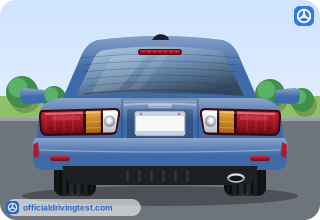
What do brake lights (stop lamps) indicate?
- That a vehicle is slowing or stopping
- That a vehicle is turning
- That a vehicle is parked
- That a vehicle is about to back up
Show answer
Correct answer: That a vehicle is slowing or stopping
The manual says brake lights (stop lamps) indicate a vehicle is slowing or stopping.
Source: Montana Driver Manual (Revised April 2024), page 15