Montana: Signals and vehicle controls — Required Equipment and Additional Lamps Practice Test
Questions in this part include: “What does the manual say about license plate lighting that is not the original manufacturer’s equipment?” · “How far must clearance lamps be visible when they are required?”
Independent educational site · not affiliated with any government agency or DMV
Ready? Test yourself
- Instant feedback with an explanation
- Every answer cites its source in the manual
- Your best score is saved on this device
- Keyboard: press 1 to 4 to answer and Enter for the next question
Questions are original and based on the official manual "Montana Driver Manual" (Revised April 2024), Montana Department of Justice, Motor Vehicle Division.
All 20 questions in this practice test
Take the test above first, then use this list to study. Tap “Show answer” to see the correct answer and explanation.
Show the questions and answersHide the questions
-
The license plate lamp on a vehicle manufactured after January 1, 1956, must illuminate the license plate for how far to the rear?
- 25 feet
- 50 feet
- 100 feet
- 200 feet
Show answer
Correct answer: 50 feet
The manual says the lamp must emit white light to illuminate the license plate for 50 feet to the rear.
Source: Montana Driver Manual (Revised April 2024), page 15
-
What does the manual say about license plate lighting that is not the original manufacturer’s equipment?
- It is required on trucks
- It is allowed in any color
- It is allowed if it flashes
- It is prohibited
Show answer
Correct answer: It is prohibited
The manual says license plate lighting that is not original manufacturer’s equipment is prohibited.
Source: Montana Driver Manual (Revised April 2024), page 15
-
What must a vehicle’s muffler do?
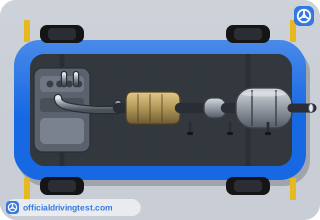
- Prevent excessive or unusual noise
- Increase the engine’s power
- Reduce the fuel the engine uses
- Warn other drivers of the vehicle
Show answer
Correct answer: Prevent excessive or unusual noise
The manual says a muffler must prevent excessive or unusual noise.
Source: Montana Driver Manual (Revised April 2024), page 15
-
Vehicles manufactured after January 1, 1956, must provide how much visibility to the rear of the vehicle through the mirror?
- 50 feet
- 100 feet
- 200 feet
- 500 feet
Show answer
Correct answer: 200 feet
The manual says vehicles made after January 1, 1956, must provide 200-foot visibility to the rear.
Source: Montana Driver Manual (Revised April 2024), page 15
-
What must the brakes and parking brakes of a vehicle be able to do?
- Stop the vehicle only when it is on level roads
- Hold the vehicle only when it is completely empty
- Control, stop, and hold the vehicle on any grade
- Stop the front wheels only, not the rear wheels
Show answer
Correct answer: Control, stop, and hold the vehicle on any grade
The manual says brakes and parking brakes must control the movement, stop, and hold of the vehicle under all conditions of loading and on any grade.
Source: Montana Driver Manual (Revised April 2024), page 15
-
A vehicle’s horn must provide a warning that can be heard for how far?
- 200 feet
- 50 feet
- 100 feet
- 500 feet
Show answer
Correct answer: 200 feet
The manual says the horn must provide warning audible for 200 feet.
Source: Montana Driver Manual (Revised April 2024), page 15
-
During the time headlamps are required, a vehicle parked or stopped on a roadway must display parking lights visible for how far?
- 100 feet
- 300 feet
- 1000 feet
- 500 feet
Show answer
Correct answer: 500 feet
The manual says parking lights must be visible for 500 feet when headlamps are required and the vehicle is parked or stopped on a roadway.
Source: Montana Driver Manual (Revised April 2024), page 15
-
Other than turn signals, which lights are prohibited on a vehicle except for emergency or authorized vehicles?
- Fog lamps and spot lamps mounted on the front
- Flashing, blinking, rotating, or pulsating lights
- Parking lights and brake lights of any color
- Headlights and tail lights on any vehicle
Show answer
Correct answer: Flashing, blinking, rotating, or pulsating lights
The manual prohibits flashing, blinking, sequential, rotating, or pulsating lights (other than turn signals) except on emergency or authorized vehicles.
Source: Montana Driver Manual (Revised April 2024), page 15
-
Which kind of glass is required in the front windshield of a motor vehicle manufactured after January 1, 1956?
- Safety glass
- Tinted glass
- Mirrored glass
- Plastic panels
Show answer
Correct answer: Safety glass
The manual says a front windshield with safety glass is required in motor vehicles manufactured after January 1, 1956.
Source: Montana Driver Manual (Revised April 2024), page 15
-
Which vehicle manufactured after January 1, 1956, is not required to have two tail lamps mounted on the rear?
- A passenger car
- A bus
- A trailer
- A motorcycle
Show answer
Correct answer: A motorcycle
The manual says vehicles made after 1956 need two tail lamps except motorcycles, motor-driven cycles, quadricycles, and truck tractors.
Source: Montana Driver Manual (Revised April 2024), page 16
-
What color light must clearance lamps on the front or side of a vehicle display?
- Red
- White
- Green
- Amber
Show answer
Correct answer: Amber
The manual says clearance lamps on the front or side of the vehicle display an amber light.
Source: Montana Driver Manual (Revised April 2024), page 16
-
How far must clearance lamps be visible when they are required?
- 100 feet
- 500 feet
- 300 feet
- 1000 feet
Show answer
Correct answer: 500 feet
The manual says all clearance lamps shall be visible for 500 feet when required.
Source: Montana Driver Manual (Revised April 2024), page 16
-
What must every vehicle, whatever its size, have on the rear in addition to the required clearance lamps?
- One reflector and two stop lights
- Two flags and a flare
- Two reflectors and a stop light
- A siren and a bell
Show answer
Correct answer: Two reflectors and a stop light
The manual says every vehicle must have two reflectors and a stop light on the rear in addition to the clearance lamps required.
Source: Montana Driver Manual (Revised April 2024), page 16
-
How far must a load extend beyond the body of a vehicle before a red light or red flag is required on it?
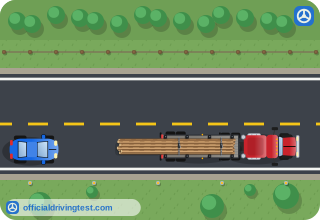
- Four feet or more
- One foot or more
- Two feet or more
- Six feet or more
Show answer
Correct answer: Four feet or more
The manual requires a red light or red flag when a load extends four feet or more beyond the body of the vehicle.
Source: Montana Driver Manual (Revised April 2024), page 16
-
A load extends four feet or more beyond the vehicle body at a time when headlamps are not required. What must be on the end of the load?
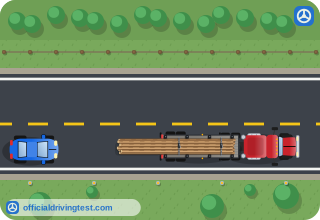
- A red light visible for 500 feet
- A red flag not less than 12 inches square
- A white flag not less than 6 inches square
- An amber light visible for 300 feet
Show answer
Correct answer: A red flag not less than 12 inches square
The manual says that at times other than when headlamps are required, a red flag not less than 12 inches square must be on the load.
Source: Montana Driver Manual (Revised April 2024), page 16
-
During the time headlamps are required, what must a farm tractor moved on the highway display?
- A red light to the front and a white light to the rear
- An amber light to the front and a green light to the rear
- A white light to the front only
- A white light to the front and a red light to the rear
Show answer
Correct answer: A white light to the front and a red light to the rear
The manual says a farm tractor must display a white light to the front and a red light to the rear, each visible for 500 feet.
Source: Montana Driver Manual (Revised April 2024), page 16
-
The lights on a farm tractor or implement of husbandry must be mounted to indicate which part of the vehicle?
- The extreme left projection
- The extreme right projection
- The center of the rear
- The highest point
Show answer
Correct answer: The extreme left projection
The manual says the lamps are mounted to indicate the extreme left projection of the vehicle.
Source: Montana Driver Manual (Revised April 2024), page 16
-
What is the greatest number of spot and/or auxiliary (fog) lamps any vehicle may be equipped with?
- One
- Three
- Two
- Four
Show answer
Correct answer: Two
The manual says any vehicle may be equipped with spot and/or auxiliary (fog) lamps, not to exceed two.
Source: Montana Driver Manual (Revised April 2024), page 16
-
What must you do with spot lamps when approaching another moving vehicle from either direction?
- Switch them to a lower beam
- Aim them at the road shoulder
- Turn them off
- Flash them twice
Show answer
Correct answer: Turn them off
The manual says spot lamps must be turned off when approaching another moving vehicle from either direction.
Source: Montana Driver Manual (Revised April 2024), page 16
-
Fog lamps may be used with lower head lamp beams if they do not project a beam stronger than what?
- The low beam head lamp
- The high beam head lamp
- The brake light
- The parking light
Show answer
Correct answer: The low beam head lamp
The manual says fog lamps may be used with lower head lamp beams if they do not project a beam stronger than the low beam head lamp.
Source: Montana Driver Manual (Revised April 2024), page 16