Montana: Pavement markings Practice Test
Yellow and white lines, edge and lane lines, shared center turn lanes, reversible lanes and shared-lane markings for bicycles.
Independent educational site · not affiliated with any government agency or DMV
Ready? Test yourself
- Instant feedback with an explanation
- Every answer cites its source in the manual
- Your best score is saved on this device
- Keyboard: press 1 to 4 to answer and Enter for the next question
Questions are original and based on the official manual "Montana Driver Manual" (Revised April 2024), Montana Department of Justice, Motor Vehicle Division.
All 23 questions in this practice test
Take the test above first, then use this list to study. Tap “Show answer” to see the correct answer and explanation.
Show the questions and answersHide the questions
-
What does a solid yellow line on your side of the centerline mean?
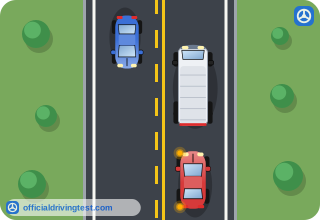
- You may pass if it is safe to do so
- You cannot pass over the centerline
- You may pass only on a hill or curve
- You must slow down before you pass
Show answer
Correct answer: You cannot pass over the centerline
A solid yellow line on your side means that you cannot pass over the centerline.
Source: Montana Driver Manual (Revised April 2024), page 34
-
For which purpose may you cross a solid yellow line, if it is safe to do so?
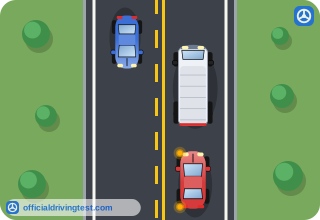
- To turn into a public or private parking lot
- To pass a slow-moving vehicle
- To get ahead of a line of traffic
- To pull around a vehicle waiting to turn
Show answer
Correct answer: To turn into a public or private parking lot
You may cross a solid yellow line to turn into a public or private parking lot, a private driveway, or a roadway if it is safe.
Source: Montana Driver Manual (Revised April 2024), page 34
-
What do solid lines along the side of the road show?
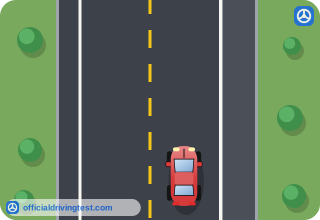
- Where you may park along the road
- Where passing is allowed on the road
- Where the edge of the road is located
- Where pedestrians are to cross the road
Show answer
Correct answer: Where the edge of the road is located
Solid lines along the side of the road show you where the edge of the road is located.
Source: Montana Driver Manual (Revised April 2024), page 34
-
What color are the lines that separate lanes of traffic moving in the same direction?
- Yellow
- White
- Red
- Green
Show answer
Correct answer: White
Lines separating lanes of traffic moving in the same direction are white.
Source: Montana Driver Manual (Revised April 2024), page 34
-
What color are the lines that separate traffic moving in opposite directions?
- White
- Red
- Blue
- Yellow
Show answer
Correct answer: Yellow
Lines separating traffic moving in opposite directions are yellow.
Source: Montana Driver Manual (Revised April 2024), page 34
-
What does a dashed white line between lanes of traffic mean?
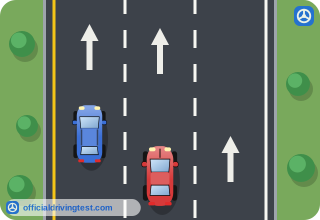
- You may cross it to change lanes if it is safe
- You may never change lanes here
- You may cross it only to pass a vehicle
- You must change lanes at the next break
Show answer
Correct answer: You may cross it to change lanes if it is safe
A dashed white line between lanes of traffic means that you may cross it to change lanes if it is safe to do so.
Source: Montana Driver Manual (Revised April 2024), page 34
-
What does a solid white line between lanes of traffic mean?
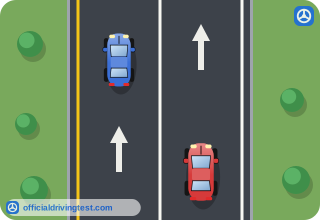
- You may change lanes at any time when it is safe to do so
- Lane changes are allowed only when you are passing a vehicle
- Stay in your lane unless a special situation requires you to change
- You must leave the lane and move over at the next exit ramp
Show answer
Correct answer: Stay in your lane unless a special situation requires you to change
A solid white line between lanes means you should stay in your lane unless a special situation requires you to change lanes.
Source: Montana Driver Manual (Revised April 2024), page 34
-
What does a dashed yellow line between opposing lanes of traffic mean?
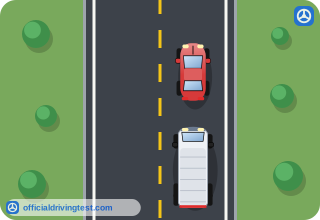
- You may cross it to pass if it is safe to do so
- Neither side may pass in either direction
- You may cross it only to make a left turn at a driveway
- You may never pass another vehicle on this kind of road
Show answer
Correct answer: You may cross it to pass if it is safe to do so
A dashed yellow line between opposing lanes means you may cross it to pass if it is safe to do so.
Source: Montana Driver Manual (Revised April 2024), page 34
-
Where there is both a solid and a dashed yellow line between opposing lanes, when may you pass?
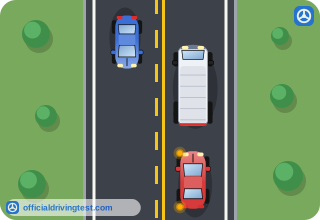
- Only if the solid line is on your side
- Never, because neither side may pass
- Only if the dashed line is on your side
- Whenever no vehicle is coming
Show answer
Correct answer: Only if the dashed line is on your side
You may not pass if the solid yellow line is on your side, and you may pass if it is safe and the dashed line is on your side.
Source: Montana Driver Manual (Revised April 2024), page 34
-
What do two solid yellow lines between opposing lanes of traffic mean?
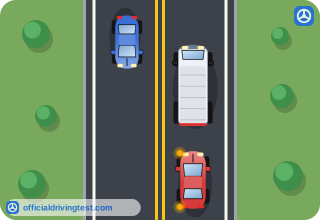
- Passing is allowed in both directions
- Neither side can pass
- Passing is allowed only if the road is clear
- Only the side with the wider lane can pass
Show answer
Correct answer: Neither side can pass
Two solid lines between opposing lanes of traffic mean that neither side can pass.
Source: Montana Driver Manual (Revised April 2024), page 34
-
What are reversible lanes?
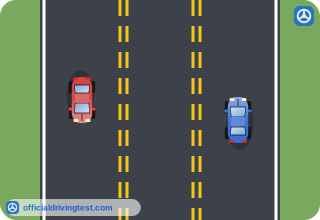
- Lanes that are reserved for vehicles with more than one person at certain times
- Center lanes that are used only for making left turns, by traffic from both directions
- Lanes that carry traffic in both directions at the same time with no dividing line
- Lanes that carry traffic one way at certain times and the opposite way at other times
Show answer
Correct answer: Lanes that carry traffic one way at certain times and the opposite way at other times
Reversible lanes are designed to carry traffic in one direction at certain times and in the opposite direction at other times.
Source: Montana Driver Manual (Revised April 2024), page 35
-
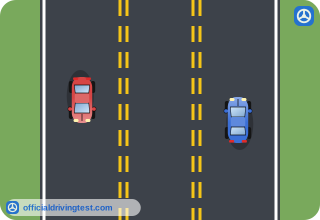
How are reversible lanes usually marked?
- With double-dashed yellow lines
- With double solid white lines
- With a single solid yellow line
- With dashed white lines
Show answer
Correct answer: With double-dashed yellow lines
Double-dashed yellow lines usually mark reversible lanes.
Source: Montana Driver Manual (Revised April 2024), page 35
-
What should you do before you start driving in a reversible lane?
- Slow down to a speed of 15 mph or less
- Move into the leftmost lane of the road
- Check which lanes you can use at that time
- Follow the vehicle ahead of you closely
Show answer
Correct answer: Check which lanes you can use at that time
Before you start driving in reversible lanes, check to see which lanes you can use at that time, using signs posted by the side of the road or overhead.
Source: Montana Driver Manual (Revised April 2024), page 35
-
What often marks a reserved lane, at the side of the road or on the road surface?
- A yellow diamond
- A white diamond
- A white circle
- A red square
Show answer
Correct answer: A white diamond
Reserved lanes are marked by signs and often have a white diamond posted at the side of the road or painted on the road surface.
Source: Montana Driver Manual (Revised April 2024), page 35
-
What does “Transit” or “Bus” mean on a reserved lane?
- The lane is for buses and trucks
- The lane is for buses and bicycles
- The lane is for buses during rush hour only
- The lane is for bus use only
Show answer
Correct answer: The lane is for bus use only
“Transit” or “Bus” means the lane is for bus use only.
Source: Montana Driver Manual (Revised April 2024), page 35
-
What does “Bicycle” mean on a reserved lane?
- The lane is reserved for bicycles
- The lane is shared by bicycles and buses
- The lane is for slow vehicles of any kind
- The lane is for bicycles only at night
Show answer
Correct answer: The lane is reserved for bicycles
“Bicycle” means the lane is reserved for bicycles.
Source: Montana Driver Manual (Revised April 2024), page 35
-
What does “HOV” stand for on a reserved lane?
- Heavy Operating Vehicles
- High Overload Vehicles
- High Occupancy Vehicles
- Highway Overtaking Vehicles
Show answer
Correct answer: High Occupancy Vehicles
“HOV” stands for High Occupancy Vehicles, lanes reserved for vehicles with more than one person in them.
Source: Montana Driver Manual (Revised April 2024), page 35
-
What does a sign reading “HOV 3” mean?
- There must be exactly three people in the vehicle
- There must be at least three people in the vehicle
- The lane is for vehicles with three or more axles
- The lane is open for three hours a day
Show answer
Correct answer: There must be at least three people in the vehicle
In an HOV lane, signs say how many people must be in the vehicle, so “HOV 3” means at least three people.
Source: Montana Driver Manual (Revised April 2024), page 35
-
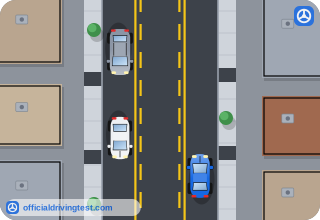
What is a shared center lane reserved for?
- Passing slower vehicles when traffic is light
- Traffic traveling in one direction at certain hours
- Use by emergency vehicles that are responding to a call
- Making left turns, or U-turns when they are permitted
Show answer
Correct answer: Making left turns, or U-turns when they are permitted
Shared center lanes are reserved for making left turns (or U-turns when permitted) but can be used by vehicles traveling in both directions.
Source: Montana Driver Manual (Revised April 2024), page 35
-
How is a shared center lane marked on each side?
- By a solid yellow line and a dashed yellow line
- By a pair of solid white lines on each side
- By a double solid yellow line on each side
- By a pair of dashed white lines on each side
Show answer
Correct answer: By a solid yellow line and a dashed yellow line
Shared center lanes are marked on each side by a solid yellow and dashed yellow line.
Source: Montana Driver Manual (Revised April 2024), page 35
-
Which markings alternate on the pavement of a shared center lane?
- Left-turn arrows and straight arrows for traffic going the same direction
- Solid white lines and dashed white lines on each side of the lane
- Left-turn arrows for one direction and left-hand arrows for the other direction
- Yellow X marks and green arrows painted along the whole center lane
Show answer
Correct answer: Left-turn arrows for one direction and left-hand arrows for the other direction
On the pavement of a shared center lane, left-turn arrows for traffic in one direction alternate with left-hand arrows for traffic coming from the other direction.
Source: Montana Driver Manual (Revised April 2024), page 35
-
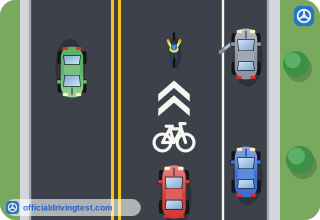
A lane shared by bicycles and motor vehicles has a pavement marking of two arrows over a bicycle. What is this marking meant to do?
- Reserve the lane for bicycles so motor vehicles may not use it
- Help bicyclists ride in the right location and direction in the lane
- Show where a bicycle path crosses the roadway just ahead
- Mark the place where bicyclists must stop at an intersection
Show answer
Correct answer: Help bicyclists ride in the right location and direction in the lane
Shared lane markings (sharrows) help bicyclists position themselves in the right location and in the right direction in a lane shared with motor vehicles.
Source: Montana Driver Manual (Revised April 2024), page 43
-
How do shared lane markings (sharrows) compare with the bicycle symbols used to mark bicycle lanes?
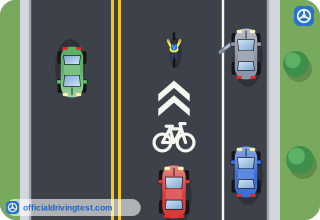
- They are not the same as bicycle-lane symbols
- They are the same, and both reserve the lane for bicycles
- They are used only on bike paths, away from motor vehicles
- They replace bicycle-lane symbols on all Montana roads
Show answer
Correct answer: They are not the same as bicycle-lane symbols
Shared lane markings are not the same as the bicycle symbols used to mark bicycle lanes; they mark a lane shared with motor vehicles.
Source: Montana Driver Manual (Revised April 2024), page 43