Montana: Signals and vehicle controls — Changing Lanes, Pulling Away, and Backing Up Practice Test
Questions in this part include: “When changing lanes, how long should you take your eyes off the road ahead?”
Independent educational site · not affiliated with any government agency or DMV
Ready? Test yourself
- Instant feedback with an explanation
- Every answer cites its source in the manual
- Your best score is saved on this device
- Keyboard: press 1 to 4 to answer and Enter for the next question
Questions are original and based on the official manual "Montana Driver Manual" (Revised April 2024), Montana Department of Justice, Motor Vehicle Division.
All 16 questions in this practice test
Take the test above first, then use this list to study. Tap “Show answer” to see the correct answer and explanation.
Show the questions and answersHide the questions
-
Which of these does the manual include in "changing lanes"?
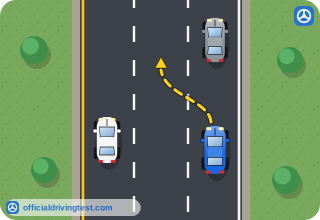
- Entering the roadway from the curb or shoulder
- Slowing down while staying in the same lane
- Stopping at a stop sign
- Following a vehicle in your own lane
Show answer
Correct answer: Entering the roadway from the curb or shoulder
Changing lanes includes changing from one lane to another, merging onto a roadway from an entrance ramp, and entering the roadway from the curb or shoulder.
Source: Montana Driver Manual (Revised April 2024), page 54
-
Before you change lanes, where must you check for traffic?
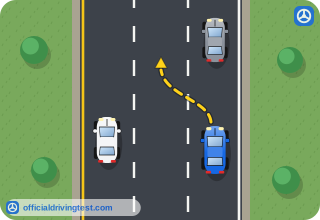
- Only ahead of your vehicle
- Only in your rearview mirror
- To the side and behind your vehicle
- Only in the lane you are leaving
Show answer
Correct answer: To the side and behind your vehicle
You must check that there are no vehicles in the lane you want to enter, which means checking to the side and behind your vehicle.
Source: Montana Driver Manual (Revised April 2024), page 54
-
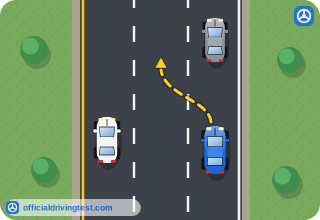
What does the manual say is the best way to alert other drivers that you will change or merge lanes?
- Flashing your headlights at drivers in the lane you will enter
- Using your turn signal to indicate which lane you will be entering
- Tapping your horn to warn the drivers in that other lane
- Moving partly over the lane line to show where you will go
Show answer
Correct answer: Using your turn signal to indicate which lane you will be entering
The manual says the best way to alert other drivers of a lane change or merge is to use your turn signal to indicate which lane you will be entering.
Source: Montana Driver Manual (Revised April 2024), page 54
-
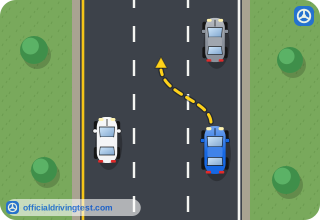
When you check your mirrors before a lane change, besides looking for vehicles in the lane, what should you make sure?
- That no vehicle is parked ahead
- That your headlights are on
- That your emergency flashers are off
- That nobody is about to pass you
Show answer
Correct answer: That nobody is about to pass you
The manual says to make sure there are no vehicles in the lane you want to enter and that nobody is about to pass you.
Source: Montana Driver Manual (Revised April 2024), page 54
-
Why are the areas near the rear corners of your vehicle called "blind spots"?
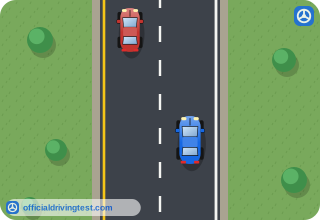
- You cannot see them through your mirrors
- They are hidden by the roof of the vehicle
- They are too dark to see at night
- They are blocked by the front pillars of the vehicle
Show answer
Correct answer: You cannot see them through your mirrors
These areas are called blind spots because you cannot see them through your mirrors, so you have to turn your head and look.
Source: Montana Driver Manual (Revised April 2024), page 54
-
How do you check a blind spot before changing lanes?
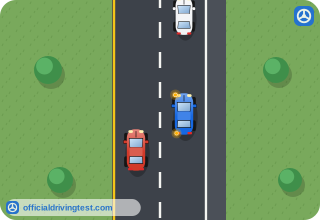
- Look into your rearview mirror only, without turning your head
- Look into your side mirror only, without turning your head
- Look over your shoulder in the direction you plan to move
- Lean forward and look through the windshield at the road
Show answer
Correct answer: Look over your shoulder in the direction you plan to move
You must turn your head and look over your shoulder in the direction you plan to move, because mirrors do not show the blind spots.
Source: Montana Driver Manual (Revised April 2024), page 54
-
When changing lanes, how long should you take your eyes off the road ahead?
- As long as it takes to be sure the lane is clear
- No more than an instant
- Up to 10 seconds when the traffic ahead is light
- Up to 15 seconds when the road is straight
Show answer
Correct answer: No more than an instant
The manual says not to take your eyes off the road ahead for more than an instant, because traffic ahead could stop suddenly.
Source: Montana Driver Manual (Revised April 2024), page 54
-
When should you check over your shoulder for traffic in your blind spot?
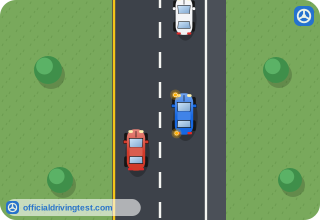
- As soon as you decide to change lanes, then not again
- Only after you have moved into the new lane
- Only if your mirrors show a vehicle
- Just before you change lanes
Show answer
Correct answer: Just before you change lanes
The manual says to check over your shoulder just before you change lanes for traffic in your blind spot.
Source: Montana Driver Manual (Revised April 2024), page 54
-
Why does the manual say to use your mirrors to check traffic while preparing to change lanes?
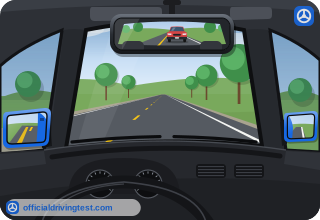
- So you can keep an eye on cars ahead of you at the same time
- So you do not have to use your turn signal when merging
- So you can drive faster while you are changing lanes
- So you do not have to look over your shoulder at all
Show answer
Correct answer: So you can keep an eye on cars ahead of you at the same time
Using your mirrors lets you check traffic while keeping an eye on the cars ahead of you at the same time.
Source: Montana Driver Manual (Revised April 2024), page 54
-
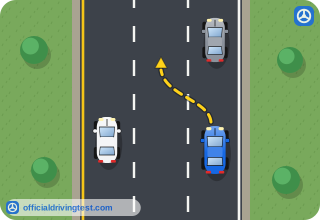
When changing lanes, what does the manual say about the far lane, if there is one?
- Ignore it, because only the lane directly next to you matters
- Sound your horn to warn the drivers who are in that lane
- Check it, because someone there may plan to move into the lane you want
- Move into it quickly before the other driver can do so
Show answer
Correct answer: Check it, because someone there may plan to move into the lane you want
Be sure to check the far lane, as someone in that lane may be planning to move into the same lane you want to enter.
Source: Montana Driver Manual (Revised April 2024), page 54
-
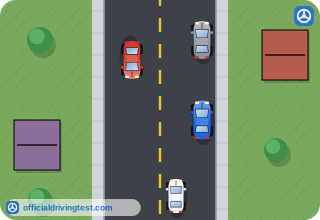
What does the manual say to do when pulling away from the curb?
- Signal, look over your right shoulder, and pull out at once
- Signal, look over your left shoulder, and pull out when it is safe
- Sound your horn and pull out when the road is clear
- Look only in the rearview mirror and pull out
Show answer
Correct answer: Signal, look over your left shoulder, and pull out when it is safe
When pulling away from the curb, signal, look over your left shoulder, and pull out when it is safe to do so.
Source: Montana Driver Manual (Revised April 2024), page 54
-
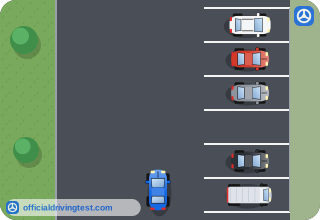
What does the manual suggest in a shopping center to avoid backing up?
- Park as far from the building entrance as you possibly can
- Always back into a parking space as soon as you arrive
- Park at the end of a row of spaces close to an exit
- Find a space you can drive through so you leave going forward
Show answer
Correct answer: Find a space you can drive through so you leave going forward
The manual says to do as little backing up as possible and to look for a drive-through space so you can drive forward when you leave.
Source: Montana Driver Manual (Revised April 2024), page 55
-
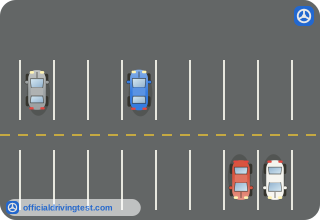
Why does the manual say to check behind your vehicle before you get in?
- Children or small objects cannot be seen from the driver's seat
- Mirrors do not work well while the engine is turned off
- The tires might be low on air from the previous trip
- You cannot see the license plate of the vehicle behind
Show answer
Correct answer: Children or small objects cannot be seen from the driver's seat
Children or small objects cannot be seen from the driver's seat, so check behind the vehicle before you get in.
Source: Montana Driver Manual (Revised April 2024), page 55
-
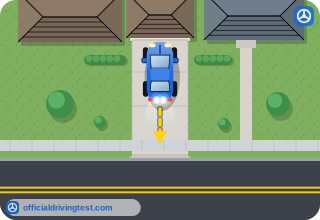
How does the manual say you should look when backing up?
- Rely on your rearview and side mirrors to see behind you
- Look only through the side windows, without turning around
- Turn around and look directly through the rear window
- Watch only the right-side mirror while backing
Show answer
Correct answer: Turn around and look directly through the rear window
You should turn around and look directly through the rear window, because you cannot see directly behind your vehicle in your mirrors.
Source: Montana Driver Manual (Revised April 2024), page 55
-
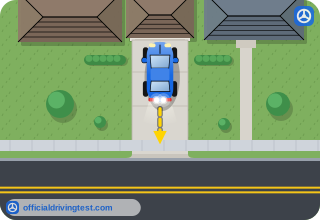
Why should you back up slowly?
- Your brakes work less well in reverse
- Your vehicle is much harder to steer while you are backing
- Your headlights do not light the road behind you at all
- Your engine can overheat in reverse
Show answer
Correct answer: Your vehicle is much harder to steer while you are backing
The manual says to back up slowly because the vehicle is much harder to steer while backing.
Source: Montana Driver Manual (Revised April 2024), page 55
-
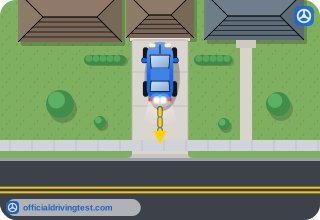
When backing up, what does the manual say to do whenever possible?
- Use only your rearview mirror to judge the distance
- Back up with the driver's door open to look behind
- Back up as quickly as you can to clear the space
- Use a person outside the vehicle to help you back up
Show answer
Correct answer: Use a person outside the vehicle to help you back up
The manual says to use a person outside the vehicle to help you back up whenever possible.
Source: Montana Driver Manual (Revised April 2024), page 55