Montana: Signals and vehicle controls — Night Driving and Using Headlights Practice Test
Questions in this part include: “During what hours does the manual say you shall turn on your headlights?” · “What does the manual say about wearing sunglasses at night?”
Independent educational site · not affiliated with any government agency or DMV
Ready? Test yourself
- Instant feedback with an explanation
- Every answer cites its source in the manual
- Your best score is saved on this device
- Keyboard: press 1 to 4 to answer and Enter for the next question
Questions are original and based on the official manual "Montana Driver Manual" (Revised April 2024), Montana Department of Justice, Motor Vehicle Division.
All 18 questions in this practice test
Take the test above first, then use this list to study. Tap “Show answer” to see the correct answer and explanation.
Show the questions and answersHide the questions
-
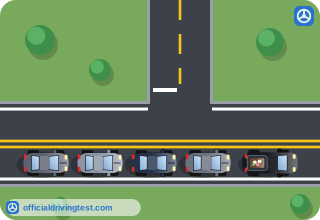
Which lights must be on for vehicles in a funeral procession?
- Only the parking lights
- Headlights and taillights
- Only the fog lights
- Only the high beams
Show answer
Correct answer: Headlights and taillights
In a funeral procession, all headlights and taillights must be illuminated.
Source: Montana Driver Manual (Revised April 2024), page 42
-
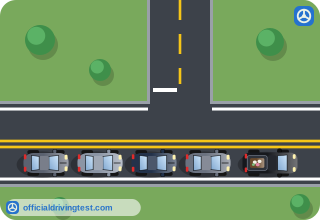
Which vehicles in a funeral procession must have their turn signals flashing at the same time as warning lights?
- Every vehicle in the procession
- Only the vehicle carrying the remains
- Only the funeral escort vehicle
- The first and the last vehicles
Show answer
Correct answer: The first and the last vehicles
Turn signals must flash simultaneously as warning lights on the first vehicle and on the vehicle believed to be the last in a funeral procession.
Source: Montana Driver Manual (Revised April 2024), page 42
-
During what hours does the manual say you shall turn on your headlights?
- From sunset to sunrise
- From one hour after sunset to one hour before sunrise
- From a half hour after sunset to a half hour before sunrise
- From two hours after sunset to two hours before sunrise
Show answer
Correct answer: From a half hour after sunset to a half hour before sunrise
The manual says that anytime from a half hour after sunset and a half hour before sunrise you shall turn on your headlights.
Source: Montana Driver Manual (Revised April 2024), page 55
-
You shall turn on your headlights any time persons or vehicles are not visible for how far?
- 100 feet
- 500 feet
- 250 feet
- 1000 feet
Show answer
Correct answer: 500 feet
The manual says to turn on your headlights anytime persons or vehicles are not visible for 500 feet because of insufficient light.
Source: Montana Driver Manual (Revised April 2024), page 55
-
In which light conditions does the manual say you should turn on your headlights even before dark?
- Only after the streetlights come on
- Only when it is fully dark
- At dusk or on overcast days
- Only when you leave the city
Show answer
Correct answer: At dusk or on overcast days
The manual says that at dusk or on overcast days you should turn on your headlights.
Source: Montana Driver Manual (Revised April 2024), page 55
-
Within what distance of meeting a vehicle should you dim your lights?
- 300 feet
- 1000 feet
- 500 feet
- 2000 feet
Show answer
Correct answer: 1000 feet
The manual says to dim your lights within 1000 feet of meeting a vehicle.
Source: Montana Driver Manual (Revised April 2024), page 55
-
Within what distance should you dim your lights when following another vehicle?
- 100 feet
- 200 feet
- 1000 feet
- 500 feet
Show answer
Correct answer: 500 feet
The manual says to dim your lights within 500 feet when following a vehicle.
Source: Montana Driver Manual (Revised April 2024), page 55
-
Why does the manual say you should NEVER drive with your parking lights?
- Oncoming traffic may think that you are stopped
- They do not light the road ahead of you
- They use too much battery power
- They are too bright for oncoming drivers
Show answer
Correct answer: Oncoming traffic may think that you are stopped
The manual says never to drive with parking lights because oncoming traffic may think that you are stopped.
Source: Montana Driver Manual (Revised April 2024), page 55
-
What does the manual say about using a spotlight?
- It may be used only on rural roads that have no oncoming traffic
- It may be used only when your high beams are turned off
- It may be used as long as you turn it off when approaching a motor vehicle
- It may not be used at all while you are driving a vehicle
Show answer
Correct answer: It may be used as long as you turn it off when approaching a motor vehicle
A spotlight may be used just as long as you turn it off when approaching a motor vehicle.
Source: Montana Driver Manual (Revised April 2024), page 55
-
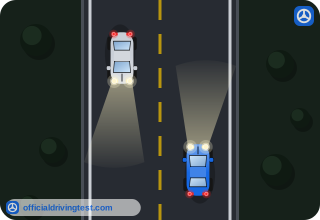
When meeting traffic at night, where does the manual say to look instead of directly at oncoming headlights?
- At the left edge of the roadway
- At the right edge of the roadway
- At the center of the road ahead
- At the dashboard lights
Show answer
Correct answer: At the right edge of the roadway
The manual says to avoid looking directly at oncoming headlights and instead watch the right edge of the roadway.
Source: Montana Driver Manual (Revised April 2024), page 55
-
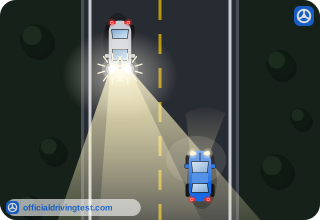
At night, what should you do if an oncoming driver flicks his lights at you?
- Turn off your headlights completely
- Flash your headlights back twice
- Switch to your parking lights
- Check to be sure you have dimmed yours
Show answer
Correct answer: Check to be sure you have dimmed yours
If an oncoming driver flicks his lights at you, check to be sure you have dimmed yours.
Source: Montana Driver Manual (Revised April 2024), page 55
-
What does the manual say about wearing sunglasses at night?
- They reduce your visibility dangerously
- They cut glare from oncoming headlights safely
- They help only if the lenses are not tinted
- They are fine if they are "photo gray" lenses
Show answer
Correct answer: They reduce your visibility dangerously
Sunglasses are a big help during the day but reduce visibility dangerously at night.
Source: Montana Driver Manual (Revised April 2024), page 55
-
Up to how much of your night vision can tinted and some "photo gray" lenses detract?
- Up to 10%
- Up to 50%
- Up to 30%
- Up to 75%
Show answer
Correct answer: Up to 30%
Even tinted and some "photo gray" lenses can detract up to 30% of your night vision.
Source: Montana Driver Manual (Revised April 2024), page 55
-
When does the manual say to turn on your headlights?
- Only when it is completely dark
- Only when a vehicle ahead has its lights on
- Only when oncoming drivers flash their lights
- Whenever you have trouble seeing others
Show answer
Correct answer: Whenever you have trouble seeing others
If you have trouble seeing others, they are having trouble seeing you, so turn on your headlights whenever you have trouble seeing others.
Source: Montana Driver Manual (Revised April 2024), page 56
-
What does the manual say to remember when you turn on your wipers?
- Turn on your headlights
- Turn on your emergency flashers
- Slow down to the minimum speed limit
- Turn off your high beams
Show answer
Correct answer: Turn on your headlights
The manual says that on rainy, snowy, or foggy days, if you turn on your wipers, turn on your headlights.
Source: Montana Driver Manual (Revised April 2024), page 56
-
For which vehicles does the manual say parking lights are meant?
- Cars driving in fog
- Cars driving at dusk
- Parked cars only
- Cars driving in light rain
Show answer
Correct answer: Parked cars only
The manual says that whenever driving and lights are necessary you should use your headlights, because parking lights are for parked cars only.
Source: Montana Driver Manual (Revised April 2024), page 56
-
When driving away from the rising or setting sun, what does the manual say to do?
- Use your parking lights
- Turn on your headlights
- Slow to the minimum speed limit
- Use your high beams
Show answer
Correct answer: Turn on your headlights
Drivers coming toward you may have trouble seeing your vehicle, so your headlights will help them see you.
Source: Montana Driver Manual (Revised April 2024), page 56
-
According to the manual, what often causes crashes?
- Drivers who follow the posted speed limit too closely in traffic
- Vehicles that have defective horns or worn-out tail lights
- One driver does not see another, or does what the other does not expect
- Drivers who use their turn signals too early before a turn
Show answer
Correct answer: One driver does not see another, or does what the other does not expect
Crashes often happen because one driver does not see another driver, or when one driver does something the other driver does not expect.
Source: Montana Driver Manual (Revised April 2024), page 56