West Virginia: Sharing the road — Part 4 Practice Test
Questions in this part include: “In which places should you also be aware of high jogging traffic?” · “What do holiday periods also produce on the roadway?”
Independent educational site · not affiliated with any government agency or DMV
Ready? Test yourself
Answer to start, or tap Start below:
In which places should you also be aware of high jogging traffic?
- Instant feedback with an explanation
- Every answer cites its source in the manual
- Your best score is saved on this device
- Keyboard: press 1 to 4 to answer and Enter for the next question
Questions are original and based on the official manual "West Virginia Driver's Licensing Handbook" (Revised July 2026), West Virginia Division of Motor Vehicles (DMV).
All 17 questions in this practice test
Take the test above first, then use this list to study. Tap “Show answer” to see the correct answer and explanation.
Show the questions and answersHide the questions
-
In which places should you also be aware of high jogging traffic?
- Freeway shoulders and ramps
- Parks or jogging paths
- Bridges
- Railroad crossings
Show answer
Correct answer: Parks or jogging paths
The handbook says to be aware of high jogging traffic in places such as parks or jogging paths.
Source: West Virginia Driver's Licensing Handbook (Revised July 2026), page 54 · Open this page in the manual (Manual page 54)
-
A public bus is loading passengers. Is traffic required to stop?
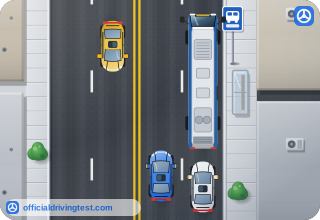
- Yes, traffic in both directions must stop
- Yes, but only traffic behind the bus
- No, but watch for passengers crossing
- Yes, if the bus is at a bus stop
Show answer
Correct answer: No, but watch for passengers crossing
Traffic does not have to stop for a public bus, but drivers should watch for passengers crossing the street as they get on and off.
Source: West Virginia Driver's Licensing Handbook (Revised July 2026), page 54 · Open this page in the manual (Manual page 54)
-
Rush-hour traffic is usually inbound to metropolitan areas between which times?
- 5 am and 7 am
- 8 am and 10 am
- 7 am and 9 am
- 9 am and 11 am
Show answer
Correct answer: 7 am and 9 am
Inbound rush-hour traffic is usually between 7 am and 9 am.
Source: West Virginia Driver's Licensing Handbook (Revised July 2026), page 65 · Open this page in the manual (Manual page 65)
-
Rush-hour traffic is usually outbound from metropolitan areas between which times?
- 3 pm and 5 pm
- 5 pm and 7 pm
- 6 pm and 8 pm
- 4 pm and 6 pm
Show answer
Correct answer: 4 pm and 6 pm
Outbound rush-hour traffic is usually between 4 pm and 6 pm.
Source: West Virginia Driver's Licensing Handbook (Revised July 2026), page 65 · Open this page in the manual (Manual page 65)
-
When do rush hours in industrial areas usually occur?
- During changes in work shifts
- During the middle of each work shift
- Only on weekends
- Between 7 am and 9 am only
Show answer
Correct answer: During changes in work shifts
Rush hours in industrial areas usually occur during changes in work shifts.
Source: West Virginia Driver's Licensing Handbook (Revised July 2026), page 65 · Open this page in the manual (Manual page 65)
-
When is rush-hour traffic heaviest?
- During weekends
- On holiday weekends only
- During weekdays
- In the summer months only
Show answer
Correct answer: During weekdays
Rush-hour traffic is heaviest during weekdays.
Source: West Virginia Driver's Licensing Handbook (Revised July 2026), page 65 · Open this page in the manual (Manual page 65)
-
What may you encounter on weekends, according to the handbook?
- Heavier rush-hour traffic than during the weekdays
- Drivers making longer trips and driving longer hours
- Fewer vehicles than at any other time of the week
- Mostly commuters who are in a hurry to reach work
Show answer
Correct answer: Drivers making longer trips and driving longer hours
On weekends you may meet drivers making longer trips and driving longer hours.
Source: West Virginia Driver's Licensing Handbook (Revised July 2026), page 65 · Open this page in the manual (Manual page 65)
-
Why are summer months associated with an increase in traffic?
- Vacation travel
- School bus schedules
- Road construction work
- Farm harvest traffic
Show answer
Correct answer: Vacation travel
Summer months bring an increase in traffic due to vacation travel.
Source: West Virginia Driver's Licensing Handbook (Revised July 2026), page 65 · Open this page in the manual (Manual page 65)
-
What do holiday periods also produce on the roadway?
- A decrease in the number of tired drivers
- A decrease in heavy trucks and buses
- An increase in the number of drunk drivers
- An increase in slow-moving farm machinery
Show answer
Correct answer: An increase in the number of drunk drivers
The handbook says holiday periods also produce an increase in the number of drunk drivers.
Source: West Virginia Driver's Licensing Handbook (Revised July 2026), page 65 · Open this page in the manual (Manual page 65)
-
Which may you encounter when driving in rural areas, according to the handbook?
- Stop-and-go traffic
- Hazards from game animals
- More intersections
- More pedestrians and bicycles
Show answer
Correct answer: Hazards from game animals
In rural areas you may meet slow-moving farm machinery, stray livestock, game animals, and faster motorists.
Source: West Virginia Driver's Licensing Handbook (Revised July 2026), page 65 · Open this page in the manual (Manual page 65)
-
Which may you encounter when driving in urban areas, according to the handbook?
- Slow-moving farm machinery
- Hazards from stray livestock
- Hazards from game animals
- Stop-and-go traffic
Show answer
Correct answer: Stop-and-go traffic
In urban areas you may meet more pedestrians, bicycles, intersections, and stop-and-go traffic.
Source: West Virginia Driver's Licensing Handbook (Revised July 2026), page 65 · Open this page in the manual (Manual page 65)
-
Why should a defensive driver be aware of the number of heavy trucks and buses in traffic?
- They always travel faster than passenger cars on hills
- They cannot be seen in the rear view mirror of a car
- They can cause problems in passing and slow traffic on hills
- They are not allowed to use the left lane at any time
Show answer
Correct answer: They can cause problems in passing and slow traffic on hills
Heavy trucks and buses can cause problems in passing and slow traffic on hills and grades.
Source: West Virginia Driver's Licensing Handbook (Revised July 2026), page 65 · Open this page in the manual (Manual page 65)
-
Which of these does the handbook give as a reason an oncoming driver may cross into your lane?
- Responding to a traffic signal turning green
- Recovering from a drop off the pavement
- Yielding to a vehicle approaching from behind
- Adjusting the air conditioning in the vehicle
Show answer
Correct answer: Recovering from a drop off the pavement
The handbook lists recovering from a drop off the pavement among the reasons an oncoming driver may come into your lane.
Source: West Virginia Driver's Licensing Handbook (Revised July 2026), page 66 · Open this page in the manual (Manual page 66)
-
To avoid a crash with a vehicle passing you, what does the handbook say to do?
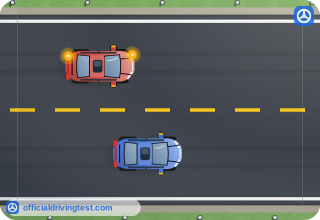
- Slow down and keep as close to the right side of the road as possible
- Speed up and move toward the center of the road to block the pass
- Stay in the center of your lane and hold your speed steady
- Move onto the shoulder and stop until the vehicle has passed
Show answer
Correct answer: Slow down and keep as close to the right side of the road as possible
Slowing down and staying as far to the right as possible makes it easier for the other vehicle to pass.
Source: West Virginia Driver's Licensing Handbook (Revised July 2026), page 66 · Open this page in the manual (Manual page 66)
-
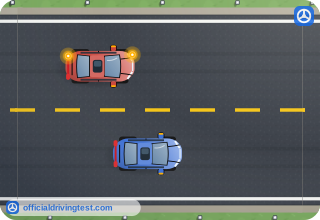
How does the handbook say you should view it when another driver passes you?
- As a challenge to stay ahead by speeding up
- As a reason to move into the left lane beside it
- As something not to be treated as a challenge
- As a chance to follow closely behind the passing vehicle
Show answer
Correct answer: As something not to be treated as a challenge
Being passed is not a challenge. Many sideswipe and run-off-the-road crashes result from being passed.
Source: West Virginia Driver's Licensing Handbook (Revised July 2026), page 66 · Open this page in the manual (Manual page 66)
-
According to the handbook, what does passing do to your vehicle?
- Lowers fuel consumption because speed stays steady
- Reduces wear on the engine and the tires
- Has no effect on the vehicle when done legally and smoothly
- Puts wear and tear on it and increases fuel consumption
Show answer
Correct answer: Puts wear and tear on it and increases fuel consumption
Even when done legally, passing puts wear and tear on your vehicle and increases fuel consumption.
Source: West Virginia Driver's Licensing Handbook (Revised July 2026), page 66 · Open this page in the manual (Manual page 66)
-
In the handbook's steps for passing another vehicle safely, what comes right after signaling before a lane change?
- Turn on your hazard lights
- Slow down to the speed of the vehicle ahead
- Move to the left lane
- Pull onto the right shoulder
Show answer
Correct answer: Move to the left lane
After signaling before the lane change, the next step is to move to the left lane.
Source: West Virginia Driver's Licensing Handbook (Revised July 2026), page 67 · Open this page in the manual (Manual page 67)