West Virginia: Sharing the road — Part 3 Practice Test
Questions in this part include: “Whether or not a bicyclist is operating lawfully, what should drivers always give the bicyclist?” · “In which direction must bicyclists ride?”
Independent educational site · not affiliated with any government agency or DMV
Ready? Test yourself
Answer to start, or tap Start below:
Whether or not a bicyclist is operating lawfully, what should drivers always give the bicyclist?
- Instant feedback with an explanation
- Every answer cites its source in the manual
- Your best score is saved on this device
- Keyboard: press 1 to 4 to answer and Enter for the next question
Questions are original and based on the official manual "West Virginia Driver's Licensing Handbook" (Revised July 2026), West Virginia Division of Motor Vehicles (DMV).
All 18 questions in this practice test
Take the test above first, then use this list to study. Tap “Show answer” to see the correct answer and explanation.
Show the questions and answersHide the questions
-
What rights and rules apply to persons riding animals on the road?
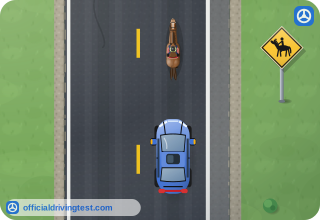
- They have the right-of-way over motor vehicles at all times
- They must keep off the roadway and use only the shoulder
- The same rights as motor vehicle users and the same rules
- They are exempt from most rules of the road
Show answer
Correct answer: The same rights as motor vehicle users and the same rules
Persons riding animals have the same rights as motor vehicle users and are subject to the same rules.
Source: West Virginia Driver's Licensing Handbook (Revised July 2026), page 53 · Open this page in the manual (Manual page 53)
-
Why should you never sound your horn when approaching or near a horse?
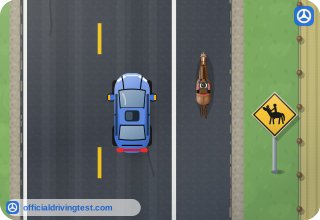
- It may frighten the horse and cause a crash
- Horses can only be warned with hand signals
- The rider may mistake it for a siren
- It may startle other drivers on the road
Show answer
Correct answer: It may frighten the horse and cause a crash
A horn may frighten the horse and cause a crash, so you must never sound it near a horse.
Source: West Virginia Driver's Licensing Handbook (Revised July 2026), page 53 · Open this page in the manual (Manual page 53)
-
What should you do when passing a bicyclist?
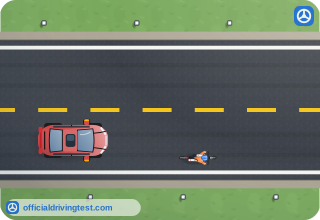
- Speed up and pass quickly so you spend less time near the cyclist
- Slow down, make sure the bicyclist is aware of you, and leave plenty of room
- Stay close to the bicyclist so oncoming drivers can see both of you
- Pass at your normal speed, staying in the center of the lane
Show answer
Correct answer: Slow down, make sure the bicyclist is aware of you, and leave plenty of room
When passing a bicyclist you slow down, make sure he or she is aware of you, and leave plenty of room.
Source: West Virginia Driver's Licensing Handbook (Revised July 2026), page 53 · Open this page in the manual (Manual page 53)
-
If there is no room to pass a bicyclist and traffic is approaching, what should you do?
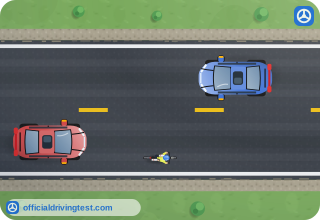
- Pass anyway, staying close to the bicyclist
- Sound your horn so oncoming traffic will slow
- Squeeze between the bicyclist and the oncoming traffic
- Wait until the traffic has gone by
Show answer
Correct answer: Wait until the traffic has gone by
If there is no room to pass and traffic is approaching, you should wait until the traffic has gone by before passing the bicyclist.
Source: West Virginia Driver's Licensing Handbook (Revised July 2026), page 53 · Open this page in the manual (Manual page 53)
-
When meeting an oncoming bicyclist at night, what should you do with your lights?
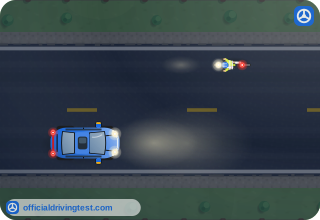
- Always dim them
- Keep your high beams on so the bicyclist sees you
- Turn them off briefly
- Flash them repeatedly
Show answer
Correct answer: Always dim them
When meeting an oncoming bicyclist at night you should always dim your lights.
Source: West Virginia Driver's Licensing Handbook (Revised July 2026), page 53 · Open this page in the manual (Manual page 53)
-
Whether or not a bicyclist is operating lawfully, what should drivers always give the bicyclist?
- A warning from the horn
- The lane on the left
- The benefit of the doubt
- Nothing more than any other driver would get
Show answer
Correct answer: The benefit of the doubt
The handbook says that whether or not a bicyclist is operating lawfully, you should always give the bicyclist the benefit of the doubt.
Source: West Virginia Driver's Licensing Handbook (Revised July 2026), page 53 · Open this page in the manual (Manual page 53)
-
A bicyclist does not have to signal a turn or stop when:
- The bicyclist is riding in the right-most lane
- There is no traffic within 100 feet of the bicyclist
- Both hands are required on the handlebars for balance
- The bicyclist is traveling at a slow speed
Show answer
Correct answer: Both hands are required on the handlebars for balance
Bicyclists must signal turns and stops unless both hands are required on the handlebars for balance.
Source: West Virginia Driver's Licensing Handbook (Revised July 2026), page 54 · Open this page in the manual (Manual page 54)
-
When bicyclists ride side by side, what must they do?
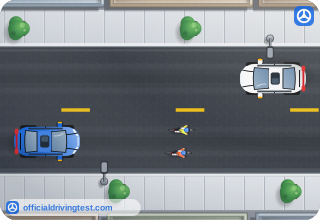
- Keep within a single lane and not hold up traffic
- Ride in the left lane so they can be seen
- Stay on the shoulder and let traffic pass
- Spread across the lane so cars cannot pass
Show answer
Correct answer: Keep within a single lane and not hold up traffic
Bicyclists riding side by side must keep within a single lane and not hold up traffic.
Source: West Virginia Driver's Licensing Handbook (Revised July 2026), page 54 · Open this page in the manual (Manual page 54)
-
What must a bicyclist never do with other vehicles?
- Ride in the same direction as them
- Signal a turn when near them
- Obey the same rules of the road as them
- Hang on to them in any manner
Show answer
Correct answer: Hang on to them in any manner
Bicyclists must never hang on to any other vehicles in any manner.
Source: West Virginia Driver's Licensing Handbook (Revised July 2026), page 54 · Open this page in the manual (Manual page 54)
-
What must bicyclists do about pedestrians?
- Expect them to yield in crosswalks
- Yield the right-of-way to them
- Sound a siren to clear their path
- Ride around them on the sidewalk
Show answer
Correct answer: Yield the right-of-way to them
Bicyclists must yield the right-of-way to pedestrians.
Source: West Virginia Driver's Licensing Handbook (Revised July 2026), page 54 · Open this page in the manual (Manual page 54)
-
A bicyclist may never carry a passenger unless:
- An attached seat is available
- The passenger is a child
- The passenger holds on to the rider
- It is during daylight hours
Show answer
Correct answer: An attached seat is available
Bicyclists must never carry a passenger unless an attached seat is available.
Source: West Virginia Driver's Licensing Handbook (Revised July 2026), page 54 · Open this page in the manual (Manual page 54)
-
What must a bicyclist never carry?
- Any article at all, even a very small and light one
- A bell or other signaling device
- Articles that interfere with control of the bicycle
- A rear reflector
Show answer
Correct answer: Articles that interfere with control of the bicycle
Bicyclists must never carry articles that interfere with control of the bicycle or prevent keeping at least one hand on the handlebars.
Source: West Virginia Driver's Licensing Handbook (Revised July 2026), page 54 · Open this page in the manual (Manual page 54)
-
In which direction must bicyclists ride?
- Against traffic so they can see it
- In the same direction as other vehicles
- Toward oncoming traffic on the shoulder
- In either direction on roads without a center line
Show answer
Correct answer: In the same direction as other vehicles
Bicyclists must ride in the same direction as other vehicles.
Source: West Virginia Driver's Licensing Handbook (Revised July 2026), page 54 · Open this page in the manual (Manual page 54)
-
What color reflector is required on the rear of all bicycles?
- White
- Yellow
- Amber
- Red
Show answer
Correct answer: Red
All bicycles are required to have a red reflector on the rear.
Source: West Virginia Driver's Licensing Handbook (Revised July 2026), page 54 · Open this page in the manual (Manual page 54)
-
Bicycle brakes must be strong enough to stop one wheel on what kind of pavement?
- Wet pavement on a slight hill
- Any pavement, wet or dry
- Gravel or dirt surfaces
- Dry, level, clean pavement
Show answer
Correct answer: Dry, level, clean pavement
Bicycles must have brakes strong enough to stop one wheel on dry, level, clean pavement.
Source: West Virginia Driver's Licensing Handbook (Revised July 2026), page 54 · Open this page in the manual (Manual page 54)
-
A bicycle must have a bell or other device that can be heard for what distance?
- At least 50 feet
- At least 100 feet
- At least 200 feet
- At least 500 feet
Show answer
Correct answer: At least 100 feet
A bicycle must have a bell or other device audible for at least 100 feet; a siren or whistle is not permitted.
Source: West Virginia Driver's Licensing Handbook (Revised July 2026), page 54 · Open this page in the manual (Manual page 54)
-
For riding after dark, a bicycle must have a white headlight visible for at least what distance to the front?
- 100 feet
- 200 feet
- 500 feet
- 1,000 feet
Show answer
Correct answer: 500 feet
For riding after dark, a bicycle needs a white headlight that is visible for at least 500 feet to the front.
Source: West Virginia Driver's Licensing Handbook (Revised July 2026), page 54 · Open this page in the manual (Manual page 54)
-
Where should you be especially alert for joggers?
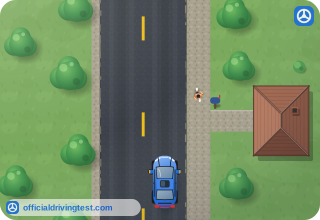
- In unexpected places such as curves, hilltops and around corners
- Only on straight roads where they can be seen far ahead
- Only on roads where signs warn of pedestrian traffic
- Only in school zones when children are walking to school
Show answer
Correct answer: In unexpected places such as curves, hilltops and around corners
Drivers should be alert for joggers in unexpected places such as curves, on the top of a hill or around a corner.
Source: West Virginia Driver's Licensing Handbook (Revised July 2026), page 54 · Open this page in the manual (Manual page 54)