West Virginia: Sharing the road — Part 2 Practice Test
Questions in this part include: “What must slow-moving vehicles such as farm vehicles display to warn approaching drivers?” · “Typically, how do blind spots change as a vehicle gets larger?”
Independent educational site · not affiliated with any government agency or DMV
Ready? Test yourself
Answer to start, or tap Start below:
What must slow-moving vehicles such as farm vehicles display to warn approaching drivers?
- Instant feedback with an explanation
- Every answer cites its source in the manual
- Your best score is saved on this device
- Keyboard: press 1 to 4 to answer and Enter for the next question
Questions are original and based on the official manual "West Virginia Driver's Licensing Handbook" (Revised July 2026), West Virginia Division of Motor Vehicles (DMV).
All 18 questions in this practice test
Take the test above first, then use this list to study. Tap “Show answer” to see the correct answer and explanation.
Show the questions and answersHide the questions
-
When passing a motorcycle, how far into the other lane should you go?
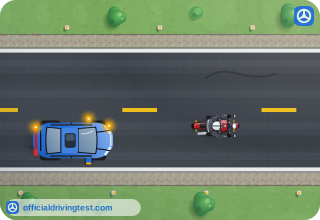
- All the way into the other lane
- Halfway, so the rider keeps part of the lane
- Only far enough to clear the rider's mirror
- Not at all; stay in your own lane beside the rider
Show answer
Correct answer: All the way into the other lane
The motorcyclist has the legal right to an entire lane and may need to swerve, so you go all the way into the other lane to pass.
Source: West Virginia Driver's Licensing Handbook (Revised July 2026), page 52 · Open this page in the manual (Manual page 52)
-
After passing a motorcycle, when should you move back into the other lane?
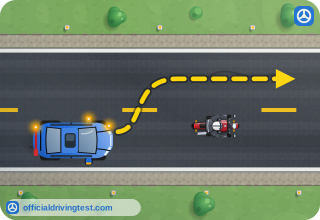
- As soon as the rider is in your mirror
- Right after your bumper is past the rider
- Not until you are well down the road
- Only after the rider signals you to merge
Show answer
Correct answer: Not until you are well down the road
Once you have passed a motorcycle, you should wait until you are well down the road before moving back into the lane.
Source: West Virginia Driver's Licensing Handbook (Revised July 2026), page 52 · Open this page in the manual (Manual page 52)
-
What must slow-moving vehicles such as farm vehicles display to warn approaching drivers?
- A flashing blue beacon
- A special triangular emblem
- A rectangular red banner
- A white octagonal sign
Show answer
Correct answer: A special triangular emblem
Slow-moving vehicles are required to display a special triangular emblem that means Slow-Moving Vehicle.
Source: West Virginia Driver's Licensing Handbook (Revised July 2026), page 52 · Open this page in the manual (Manual page 52)
-
Before you try to pass a slow-moving farm vehicle or construction equipment, what must you make sure of?
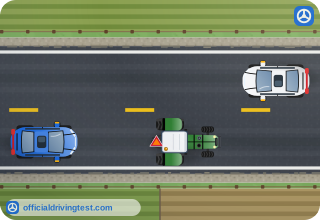
- That the vehicle has stopped completely
- That its driver has signaled you to go around
- That its emblem is clearly visible
- That you can pass it safely
Show answer
Correct answer: That you can pass it safely
Regular traffic must be aware of the slow speed of these vehicles and make sure it can pass safely before making the attempt.
Source: West Virginia Driver's Licensing Handbook (Revised July 2026), page 52 · Open this page in the manual (Manual page 52)
-
Compared with vehicles, how much room do trucks need to turn?
- About the same room
- Slightly less room
- Much more room
- Only a little more room
Show answer
Correct answer: Much more room
Trucks are more difficult to maneuver, are longer and heavier, and require much more room to turn.
Source: West Virginia Driver's Licensing Handbook (Revised July 2026), page 52 · Open this page in the manual (Manual page 52)
-
What is a heavy truck's "No-Zone"?
- Its blind spots, where the driver cannot see vehicles
- Roads where heavy trucks are not allowed to travel
- The space around it where vehicles may not park
- The distance at which its brakes can stop it
Show answer
Correct answer: Its blind spots, where the driver cannot see vehicles
A truck's blind spots are called the No-Zone, and they are dangerous because truck drivers cannot see vehicles in these areas.
Source: West Virginia Driver's Licensing Handbook (Revised July 2026), page 52 · Open this page in the manual (Manual page 52)
-
Typically, how do blind spots change as a vehicle gets larger?
- They get smaller
- They get larger
- They stay the same size
- They disappear once it has large mirrors
Show answer
Correct answer: They get larger
The handbook says that typically the larger the vehicle, the larger the blind spots.
Source: West Virginia Driver's Licensing Handbook (Revised July 2026), page 52 · Open this page in the manual (Manual page 52)
-
How can you tell whether you are in a truck driver's blind spot?
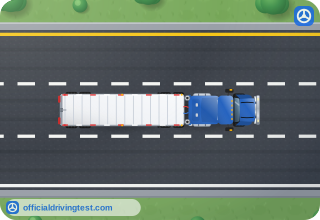
- You can see the truck's headlights in your own mirror
- The truck's turn signal is on and the driver slows down
- You are more than two car lengths from the truck
- You cannot see the driver's reflection in the side mirror
Show answer
Correct answer: You cannot see the driver's reflection in the side mirror
If you cannot see the truck driver's reflection in the side mirror, you are in the driver's blind spot.
Source: West Virginia Driver's Licensing Handbook (Revised July 2026), page 52 · Open this page in the manual (Manual page 52)
-
How long should you stay in a heavy truck's No-Zone when passing?
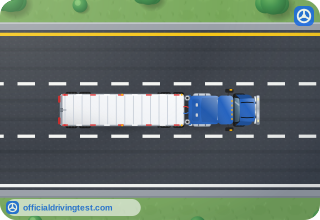
- No longer than needed to pass safely
- Until the truck driver waves you on
- Long enough to match the truck's speed
- As long as you keep a steady speed
Show answer
Correct answer: No longer than needed to pass safely
It is impossible to avoid blind spots completely, but drivers should not remain in the No-Zone any longer than needed to safely pass a heavy truck.
Source: West Virginia Driver's Licensing Handbook (Revised July 2026), page 52 · Open this page in the manual (Manual page 52)
-
The handbook says to give trucks extra room for which kind of turns?
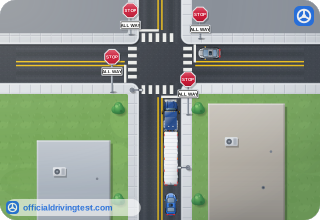
- Right turns
- Left turns
- U-turns
- Turns onto a one-way street
Show answer
Correct answer: Right turns
The truck safety list says to give trucks extra room for right turns.
Source: West Virginia Driver's Licensing Handbook (Revised July 2026), page 53 · Open this page in the manual (Manual page 53)
-
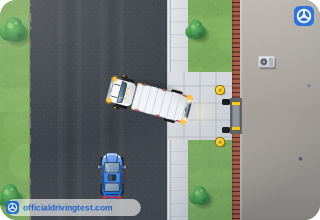
What should you give a truck that is backing up?
- A short blast of your horn
- The right-of-way only at night
- A clear view by moving close behind
- Extra space and time
Show answer
Correct answer: Extra space and time
The truck safety list says to give trucks extra space and time for backing up.
Source: West Virginia Driver's Licensing Handbook (Revised July 2026), page 53 · Open this page in the manual (Manual page 53)
-
What should you do if you see unsafe truck driving?
- Follow the truck to get its plate number
- Call authorities
- Flash your high beams at the driver
- Pass the truck and signal the driver to pull over
Show answer
Correct answer: Call authorities
The truck safety list says to call authorities if you see unsafe truck driving.
Source: West Virginia Driver's Licensing Handbook (Revised July 2026), page 53 · Open this page in the manual (Manual page 53)
-
Which action does the handbook say you should never do around a heavy truck?
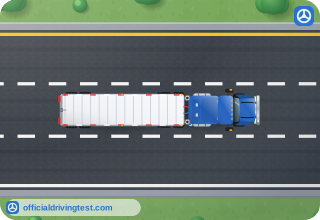
- Slam on your brakes in front of it
- Give it extra room for right turns
- Allow extra space and time when it backs up
- Call authorities about unsafe truck driving
Show answer
Correct answer: Slam on your brakes in front of it
The truck safety DON'Ts say never to slam on your brakes in front of a truck.
Source: West Virginia Driver's Licensing Handbook (Revised July 2026), page 53 · Open this page in the manual (Manual page 53)
-
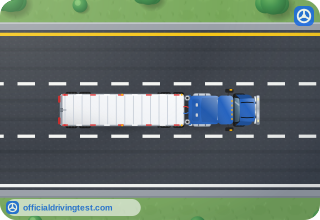
What does the handbook say about cutting off a truck to reach your exit or turn?
- It is fine if you signal first
- It is fine on an interstate
- Never do it
- It is fine if the truck is slow
Show answer
Correct answer: Never do it
Never cut off a truck in traffic or on the highway to reach your exit or turn.
Source: West Virginia Driver's Licensing Handbook (Revised July 2026), page 53 · Open this page in the manual (Manual page 53)
-
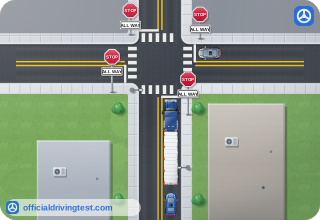
When may you pass a truck on the right while it is turning?
- When it signals a left turn
- Never
- When the shoulder is wide enough
- When it slows below 10 mph
Show answer
Correct answer: Never
Never pass a truck on the right during a turn.
Source: West Virginia Driver's Licensing Handbook (Revised July 2026), page 53 · Open this page in the manual (Manual page 53)
-
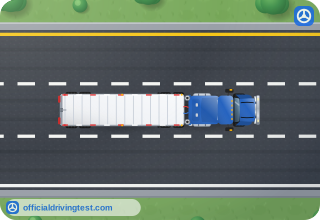
What does the handbook say about tailgating a truck?
- It is safe at low speeds
- It saves fuel on long trips
- It is fine on dry roads
- Never tailgate a truck
Show answer
Correct answer: Never tailgate a truck
The handbook’s truck safety rules say never tailgate a truck.
Source: West Virginia Driver's Licensing Handbook (Revised July 2026), page 53 · Open this page in the manual (Manual page 53)
-
What does the handbook say you should never underestimate about a truck?
- Its number of axles
- Its fuel economy
- Its cargo value
- Its size or speed
Show answer
Correct answer: Its size or speed
Never underestimate the size or speed of a truck.
Source: West Virginia Driver's Licensing Handbook (Revised July 2026), page 53 · Open this page in the manual (Manual page 53)
-
Where may animal riders not ride?
- On most public highways
- On interstate highways
- On rural two-lane roads
- On roads with a speed limit above 25 mph
Show answer
Correct answer: On interstate highways
Animal riders may use most public highways, but they may not use interstate highways.
Source: West Virginia Driver's Licensing Handbook (Revised July 2026), page 53 · Open this page in the manual (Manual page 53)