Washington: Speed and space — Part 4 Practice Test
Questions in this part include: “What does the guide say you should do to be prepared?” · “What does the guide say happens to the quality of your central, fringe, and peripheral vision at higher speeds?”
Independent educational site · not affiliated with any government agency or DMV
Ready? Test yourself
Answer to start, or tap Start below:
What does the guide say you should do to be prepared?
- Instant feedback with an explanation
- Every answer cites its source in the manual
- Your best score is saved on this device
- Keyboard: press 1 to 4 to answer and Enter for the next question
Questions are original and based on the official manual "Washington Driver Guide" (© 2025), Washington State Department of Licensing (DOL).
All 17 questions in this practice test
Take the test above first, then use this list to study. Tap “Show answer” to see the correct answer and explanation.
Show the questions and answersHide the questions
-
What does the guide say you should do to be prepared?
- Anticipate hazards by scanning the road ahead
- Turn off in-car entertainment systems
- Adjust your speed for road conditions and weather
- Check your phone before you start driving
Show answer
Correct answer: Anticipate hazards by scanning the road ahead
To be prepared, you anticipate hazards by scanning ahead and stay aware of your surroundings.
Source: Washington Driver Guide (© 2025), page 163 · Open this page in the manual (Manual page 163)
-
What does the guide say you should do to be proactive?
- Turn off your phone and in-car entertainment systems before you drive
- Scan the road ahead to anticipate hazards
- Keep the same speed on every road
- Adjust your speed and driving to road conditions, weather, and traffic
Show answer
Correct answer: Adjust your speed and driving to road conditions, weather, and traffic
Being proactive means changing your speed and driving to fit conditions, weather and traffic.
Source: Washington Driver Guide (© 2025), page 163 · Open this page in the manual (Manual page 163)
-
Which type of vision allows you to see detail straight in front of you?
- Fringe vision
- Peripheral vision
- Central vision
- Rear vision
Show answer
Correct answer: Central vision
Central vision is the focused vision straight ahead, like the vision you use to read.
Source: Washington Driver Guide (© 2025), page 164 · Open this page in the manual (Manual page 164)
-
Which type of vision is used to see what is to the side of you without losing focus on what is straight ahead?
- Central vision
- Peripheral vision
- Fringe vision
- Night vision
Show answer
Correct answer: Peripheral vision
Peripheral vision lets you see things to the side while keeping your focus ahead.
Source: Washington Driver Guide (© 2025), page 164 · Open this page in the manual (Manual page 164)
-
What does the guide say happens to the quality of your central, fringe, and peripheral vision at higher speeds?
- Only central vision is reduced in quality
- Only peripheral vision is reduced in quality
- Each type of vision is reduced in quality
- The quality of each stays the same
Show answer
Correct answer: Each type of vision is reduced in quality
The guide states that higher speeds reduce the quality of all three types of vision.
Source: Washington Driver Guide (© 2025), page 164 · Open this page in the manual (Manual page 164)
-
What does the guide say your path of travel is?
- The route or course you drive to get from one place to another
- The lane markings you drive between
- The distance between you and the vehicle in front of you
- The area you are scanning in your mirrors
Show answer
Correct answer: The route or course you drive to get from one place to another
Your path of travel is the course you take, and you may need to change it because of a hazard, weather or a new direction.
Source: Washington Driver Guide (© 2025), page 165 · Open this page in the manual (Manual page 165)
-
What does the guide say your line of sight is, once you pick the area where you want to be?
- The area directly beside your vehicle
- The area you see in your rearview mirror
- The route you drive to get there
- What is between you and that target
Show answer
Correct answer: What is between you and that target
Once you choose a target area, your line of sight is the space between you and that target.
Source: Washington Driver Guide (© 2025), page 165 · Open this page in the manual (Manual page 165)
-
What does the guide say a big part of driving is?
- Keeping your eyes fixed on the vehicle ahead and matching its speed
- Constantly shifting your focus between where you are and where you want to be
- Choosing a new path of travel every few seconds
- Matching your speed to the vehicle ahead
Show answer
Correct answer: Constantly shifting your focus between where you are and where you want to be
Driving requires you to keep shifting your visual focus and attention between your current position and your target.
Source: Washington Driver Guide (© 2025), page 165 · Open this page in the manual (Manual page 165)
-
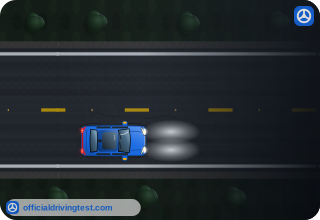
You should drive slowly enough to stop within the glow of your headlights at night. About how far do the headlights usually light the road?
- 100 feet
- 250 feet
- 400 feet
- 600 feet
Show answer
Correct answer: 400 feet
The guide gives 400 feet as the usual distance within which you should be able to stop at night.
Source: Washington Driver Guide (© 2025), page 166 · Open this page in the manual (Manual page 166)
-
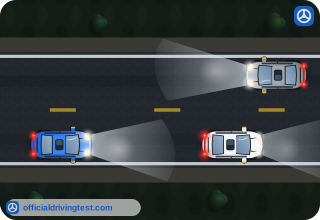
How should your following distance change for night driving and for unfamiliar roads at night?
- Decrease it
- Keep it the same as in daytime
- Follow closely so you can use the other vehicle's lights
- Increase it
Show answer
Correct answer: Increase it
The guide tells drivers to leave more following distance at night and on unfamiliar roads at night.
Source: Washington Driver Guide (© 2025), page 167 · Open this page in the manual (Manual page 167)
-
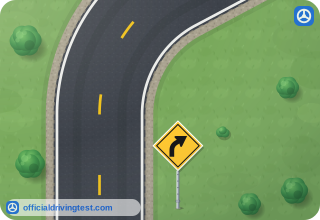
When should you reduce your speed for a curve?
- After you reach the middle of the curve
- Only after the vehicle begins to skid
- Before entering the curve
- Just as you leave the curve
Show answer
Correct answer: Before entering the curve
Slowing before the curve keeps traction and helps prevent skidding or leaving the road.
Source: Washington Driver Guide (© 2025), page 168 · Open this page in the manual (Manual page 168)
-
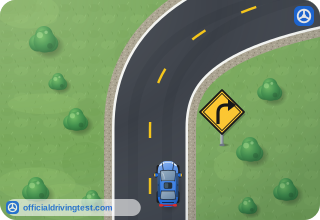
What might uphill and downhill curves require, according to the guide?
- Uphill curves could require more braking, while downhill curves might require more acceleration
- Both require the same steady speed with no changes
- Uphill curves could require more acceleration, while downhill curves might require more braking
- Both require shifting to neutral to keep speed steady
Show answer
Correct answer: Uphill curves could require more acceleration, while downhill curves might require more braking
Hills change how much power or braking a curve needs, so be ready to adjust.
Source: Washington Driver Guide (© 2025), page 168 · Open this page in the manual (Manual page 168)
-
What should you do with your speed while you are in a curve?
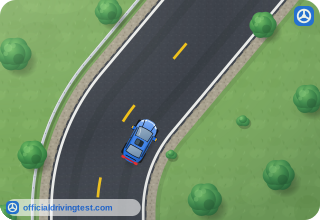
- Brake firmly so that the vehicle stays under control
- Accelerate firmly to keep your momentum up
- Shift to neutral and let the vehicle coast
- Keep a steady speed; avoid sudden braking or accelerating
Show answer
Correct answer: Keep a steady speed; avoid sudden braking or accelerating
Sudden braking or accelerating in a curve can upset the balance of the vehicle and cause a loss of control.
Source: Washington Driver Guide (© 2025), page 168 · Open this page in the manual (Manual page 168)
-
As you exit a curve, how should you return to your desired speed?
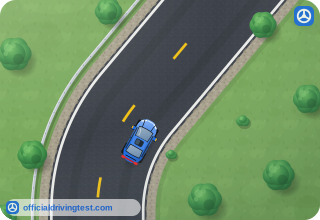
- Accelerate gradually
- Accelerate as hard as possible
- Brake lightly until the road is straight
- Stay at the curve speed for a few miles
Show answer
Correct answer: Accelerate gradually
Gentle acceleration keeps the vehicle stable as it returns to traveling straight.
Source: Washington Driver Guide (© 2025), page 168 · Open this page in the manual (Manual page 168)
-
What does the guide say about higher speeds?
- They lower kinetic energy, so the vehicle stops sooner
- They have no effect on the distance needed to turn
- They increase tire grip so turns are easier
- They create more energy, needing more time and space to stop
Show answer
Correct answer: They create more energy, needing more time and space to stop
Higher speeds create more energy, so you need more time and space to stop or change direction.
Source: Washington Driver Guide (© 2025), page 169 · Open this page in the manual (Manual page 169)
-
When the road is slippery, what might you need to do?
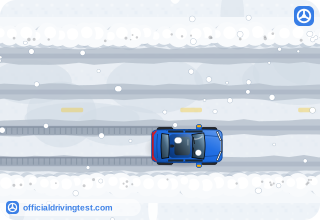
- Drive below the posted speed limit
- Drive at least at the posted speed limit
- Follow closer to share a path with other tires
- Switch to high beams
Show answer
Correct answer: Drive below the posted speed limit
The guide says you must adjust to the conditions, which might mean driving below the posted limit.
Source: Washington Driver Guide (© 2025), page 170 · Open this page in the manual (Manual page 170)
-
What do snowy roads require?
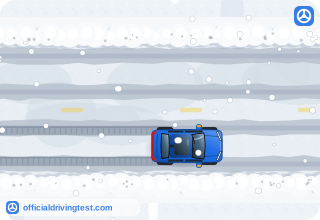
- A smaller following distance and the posted speed
- Only a slightly reduced speed on straight roads
- A shorter following distance to keep in sight of other cars
- A larger following distance and dramatically reduced speed
Show answer
Correct answer: A larger following distance and dramatically reduced speed
Snowy roads call for much more following distance and a far lower speed.
Source: Washington Driver Guide (© 2025), page 170 · Open this page in the manual (Manual page 170)